The Nationalist’s Delusion

Adam Serwer in The Atlantic:

1920Thirty years ago, nearly half of Louisiana voted for a Klansman, and the media struggled to explain why.

It was 1990 and David Duke, the former grand wizard of the Ku Klux Klan, astonished political observers when he came within striking distance of defeating incumbent Democratic U.S. Senator J. Bennett Johnston, earning 43 percent of the vote. If Johnston’s Republican rival hadn’t dropped out of the race and endorsed him at the last minute, the outcome might have been different.

Was it economic anxiety? The Washington Post reported that the state had “a large working class that has suffered through a long recession.” Was it a blow against the state’s hated political establishment? An editorial from United Press International explained, “Louisianans showed the nation by voting for Duke that they were mad as hell and not going to take it any more.” Was it anti-Washington rage? A Loyola University pollster argued, “There were the voters who liked Duke, those who hated J. Bennett Johnston, and those who just wanted to send a message to Washington.”

What message would those voters have been trying to send by putting a Klansman into office?

“There’s definitely a message bigger than Louisiana here,” Susan Howell, then the director of the Survey Research Center at the University of New Orleans, told the Los Angeles Times.

More here.

ARCHITECTURE: ECOCHARD IN KARACHI

Shabbir Kazmi and Mariam Karrar in Dawn:

ScreenHunter_2921 Dec. 06 20.43The past June in Karachi, temperatures soared to 47.2 degrees Celsius (117 degrees Fahrenheit) with 94 percent humidity, resulting in scores of deaths caused from heatstrokes alone. These catastrophic statistics are equal to any crisis the city of Karachi has witnessed.

As architects, a recurring question for us is why our buildings aren’t designed to withstand harsh temperatures. More importantly, why do we fail to capitalise on our natural resources, such as the sea breeze and subtropical conditions that nurture greenery and are favourable to our thermal comfort? In fact, due to the lack of ventilation and poor insulation, building interiors are comparable to a hot oven, baking its residents in the hot climate.Our built environment fails, both at the level of choice of material and design, which results in buildings that are not suited for the health and well-being of the end-users.

With this constant query in mind, while visiting a friend at the University of Karachi (KU) campus, we toured the Mahmud Hussain Library (See photograph 1) and the surrounding buildings for the first time. We were fortunate to see the architectural works and perhaps one of the best design solutions for the harsh climate, designed by a master of Modern Architecture, Michael Ecochard (March 11, 1905 — May 24, 1985). In line with the great Modernists of his time, Ecochard was the contemporary of the great architect Le Corbusier and followed very similar Modernist principles. Commissioned by the Government of Pakistan, Ecochard was the original architect for the Karachi University master plan and campus buildings from the 1950s.

More here.

Proxies: A Memoir in Twenty-four Attempts

Claire Lowdon in The White Review:

Pic‘Before we met,’ writes Maggie Nelson to her lover Harry Dodge, the addressee of The Argonauts, ‘I had spent a lifetime devoted to Wittgenstein’s idea that the inexpressible is contained – inexpressibly! – in the expressed.’ Nelson’s book, its intricate accretion of short philosophical observations, anecdote and commentary, belongs to a genre that we could call the piecemeal portrait. (Nelson herself might favour the word ‘prismatic’.) The apparent self-effacement of this indirect approach to autobiography is in line with modern sensibilities. As the smooth omniscience of the nineteenth century novelist gave way to the unreliable, fragmentary narratives of today, so the idea of straightforwardly ‘telling’ a life now feels at best staid, at worst existentially misguided. ‘The form is not “memoirs” but mémoires, fables from a time about a few people inside it,’ writes veteran-of-the-genre Adam Gopnik in The Stranger’s Gate. There’s a charming shrug here: oh, it’s not really about me, it’s just a bunch of stories I threw together. But of course part of the idea is that ‘me’ will emerge anyway. Join the dots. Or rather, intuit the inexpressible shape lurking in the interstices.

Other recent examples include Karl Ove Knausgaard’s Autumn, and now the poet Brian Blanchfield’s first book of prose, Proxies. We locate the author by a process of triangulation. ‘Is there a mythology of the mythologist? Doubtless there is, and the reader will soon see for himself where I stand,’ writes Barthes, a common ancestor, in his preface to the 1957 edition of Mythologies. ‘I’ve kept the essays in the order I wrote them, more or less’ – that shrug again, in Blanchfield’s preface to Proxies, modestly titled ‘[A Note]’. He goes on: ‘Whatever development can be tracked may correspond to what might be called a self.’ When Proxies was published in the US last year, its subtitle was ‘Essays Near Knowing [a reckoning]’. The UK edition calls itself ‘A Memoir in Twenty-Four Attempts’. Initially, at least, Blanchfield presses harder on the self-effacement pedal than Gopnik et al. But how does he measure up in other respects? Proxies is better than the Knausgaard (not difficult) but not as good as Gopnik or Nelson. (Nelson is a close friend of Blanchfield, referenced several times in the essays and also on the cover, where she claims to know of ‘no book like it, nor any recent book as thoroughly good, in art or in heart.’)

More here.

America’s Best Dance Party: 40 years since ‘Saturday Night Fever’

Alice George in Smithsonian:

JohnFor many Americans of a certain age, the film that provides the singular most refreshing dose of 1970s nostalgia is director John Badham’s Saturday Night Fever. In its most memorable scene, John Travolta, as the smooth-talking Tony Manero, swaggers down the street to the sounds of the Bee Gees’ incomparable hit “Stayin’ Alive;” and the audience travels back to when the four-year-old Twin Towers in the Manhattan skyline evoked only American success with no hint of tragedy. Powered by music, machismo and masterful footwork, the gritty low-budget film lured crowds to theatres, record stores and discos after it premiered 40 years ago this month. At a cost of just $6 million, this new incarnation of the traditional movie musical grossed more than $100 million domestically and $300 million worldwide. In fact, the film earned $31 million in its first 31 days. It was the third highest seller that year, surpassed only by George Lucas’s Star Wars and Steven Spielberg’s Close Encounters of the Third Kind. And the soundtrack, which sold 30 million copies, topped the album charts for six months and set a record as the biggest-selling album ever. (Michael Jackson’s Thriller subsequently broke that record.)

Saturday Night Fever’s long life in the American consciousness springs “primarily from a brilliant soundtrack that connected vast audiences with infectious, anthemic and imminently danceable hooks,” says the Smithsonian’s John Troutman, curator of American music at the National Museum of American History. “The inner tension that Travolta captured in Tony Manero’s underdog, working-class character—his stunted, bleak and occasionally dark emotional development weighing against his earnest aspirations and locally celebrated triumphs on the dance floor—came across to audiences throughout the country as not only relatable, but intensely believable,” says Troutman.

More here.

Tuesday, December 5, 2017

Stephen Yenser reviews Robert Pinsky’s new book of poems

Stephen Yenser in Poetry Daily:

Robert_Pinsky_Book_JacketAs the engaged reader discovers gradually and with increasing pleasure, Robert Pinsky’s new volume of poems, richly titled At the Foundling Hospital, delicately but persistently works in two ways at once. At the same time that it is a series of different kinds of what we casually call “lyric” poems, it is a constellation of musings on a number of subtly related motifs. Among these motifs are foundlings, slaves, ancestors, musical instruments, shells, threads and other filaments and filiations, names – all surprisingly reticulated terms, a little, ultimately uncontainable lexical tribe – and (almost inevitably) language itself, especially in its etymological dimension.

Pinsky is a master of his trade, one of the few living American poets who deserves that appellation. His individual compositions are prosodically firm and limber, whether in loose blank verse, longer six-to-seven-foot lines in distichs, tercets of four to five feet, or slant-rhymed couplets. He can craft a narrative, taut (“Radioman”) or vagarious (“The City”), invent a song (“The Orphan Quadrille,” “Genesis”), deftly translate a traditional sonnet (“Góngora: Life Is Brief,” after the Spanish poet’s “Menos solicitó veloz saeta”), make a mercurial dramatic monologue (“Mixed Chorus”), eulogize a kind of musician (“Horn”), relate local history (“The Foundling Tokens”), and noodle on locutions (“Improvisation on Yiddish”). His signature mode is meditation that incorporates thoughtful, often aphoristic, and sometimes humorous observation on matters of general interest, crisp description, and vivid anecdote – and conjures Horace in its perspicuity and geniality.

The result of the motifs binding this variety together is insistently a text, a term that stems from the Indo-European etymon teks-, which signified a fabrication, a thing made of fabric, specifically of wattle, comprising tree branches interlaced with boughs, tendrils, twigs, and the like (to be covered with clay and used as a shelter or domicile), fashioned in the first place by an ax.

More here.

Erwin Schrödinger: a misunderstood icon

Michael Brooks in the Times Literary Supplement:

Erwin-schrodingerDespite devising both the defining equation and the defining thought experiment of quantum physics, Erwin Schrödinger was never comfortable with what he helped to create. His “Schrödinger’s Cat” paradox, published in 1935, was an attempt to expose the flaws in the physics that flowed from his eponymous equation. And yet, that cat – both dead and alive – has become an icon of quantum physics rather than a warning against its shortcomings.

Schrödinger was born in Vienna in 1887. He was an exemplary schoolboy, displaying a startling ability in all his classes. He taught himself English and French in his spare time, and nurtured a love of classical literature. By the time he enrolled at the University of Vienna in 1906 he was focused on physics, but still took the time to learn a great deal of biology, which informed his later work – contributions that were cited as inspirational by the discoverers of DNA.

The work for which he is remembered requires some context. As with all science, an individual’s contributions to physics rarely occur in a vacuum, and a host of other figures set the stage for Schrödinger’s entrance. His seminal work began with his attempts to resolve a central mystery of the nascent quantum theory. Max Planck had discovered that the precise nature of the radiation emitted by hot objects could only be explained if the energy of the radiation came in discrete lumps that came to be known as quanta. Planck found this somewhat distasteful, as there was (and still is) no explanation for why this should be so. Einstein subsequently proved this energy quantization to be real with his discovery of the photoelectric effect, for which he won the 1921 Nobel Prize for Physics.

More here.

The Man Who Hated Relativism: Geoffrey Pullum on Jerry Fodor

Geoffrey Pullum in the Chronicle of Higher Education:

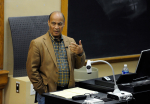
FodorIt was a spring evening in 1993 at Stanford; Fred Dretske (1932–2013) was introducing the man who would deliver that year’s Immanuel Kant Lectures, a distinguished philosopher of the cognitive and linguistic sciences from Rutgers: Jerry Fodor. Dretske spoke with warm approval about the intensity of Fodor’s philosophical views. He doesn’t just disagree with doctrines like empiricism, pragmatism, relativism, and holism, Dretske smilingly explained; he hates them.

To welcoming applause, Fodor stepped up to the podium, scowling. As he spread his papers on the lectern he muttered into the microphone: “I’d hate them a lot more if they were true.”

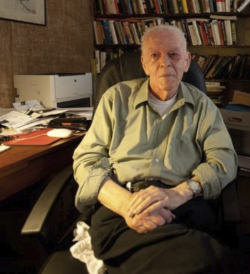
It was a classic deadpan ad lib, humorous yet thought-provoking, and indicative of the passion that animated all of Fodor’s philosophical writing. I remembered it clearly from two dozen years ago when his death was announced last week (he died on November 29). It was sad news. The philosophical world was a richer, more bracing, and more unpredictable place with Jerry Fodor in it.

“I hate relativism,” he once said, speaking of the then resurgent view that your truth may not be the same as my truth. “I hate relativism more than I hate anything else, excepting, maybe, fiberglass powerboats.” That’s Jerry. No other philosopher writes like that. I am so sorry that he’s gone.

More here.

pasternak the poet

BORIS_BESIDE_THE_BALTIC_AT_MEREKULE_1910_by_L.Pasternak-1-e1511556934665Lydia Shoup at Ploughshares:

It’s been 100 years since the Russian Revolution of 1917 toppled Tsarist rule, leading to the socialist system that would come to be known as the Soviet Union. Boris Pasternak is best known for writing Doctor Zhivago, a novel which documents these years of national upheaval through the eyes of a poet and physician. Like his eponymous character, Pasternak was famous in his native Russia for his verses.

The end of the novel sees the fictional Zhivago’s poems laid out for readers. Thematically, they cover love, death, and religion. The most moving are the ones that relate to Zhivago specifically, often written in first person. These poems communicate the disorienting effects of the revolution and its aftermath on the daily lives of Russian citizens through the experience of Zhivago and his beloved Lara.

On paper, these poems are neat, brief, four-line stanzas with simple titles like “White Night,” “Autumn,” “A Winter Night,” “Separation,” and “Dawn.” Many of them serve a practical purpose—to chart narrative events in the novel such as Lara’s leaving Zhivago and the town of Varykino and the doctor’s subsequent hours spent alone there, writing and longing for her return.

more here.

david hockney now

Bell_1-122117Julian Bell at the NYRB:

The sweet-tempered and hugely popular productions of Hockney’s later twenties and thirties, epitomized by that 1971 London interior with the cat and the carpet, tilt back toward descriptive decorum. In the later galleries of the retrospective, the mood continues to oscillate. Between the ages of sixty-eight and seventy-six Hockney devoted much of his energy to rural scenes from his native Yorkshire. On the one hand, the venture led to pounding melodramas such as the sixteen-foot-wide May Blossom on the Roman Road (2009), with its gigantiform shrubs and super-vibrant hues, a Carl Orff orchestration of a placid English backwater. On the other, a 2013 sequence of drawings of lanes through a woodland are virtuoso solos of steady, quiet lyricism—charcoal’s whole gamut of streaking, stippling, and stumping attuned to the interplay of ground, foliage, and sunlight.

There is an inspiring buoyancy to Hockney’s act. Here is an artist who reckons he can get marks to perform however he pleases. His force of attention seldom slackens, and there will always be more to do. Picturing is his element, stretching in all directions. Each picture, in his own words, is “an account of looking at something,” but each has “a limit to what it can see” and thus tantalizes with the prospect of further viewpoints. Hockney might here be talking about the works of which this retrospective is composed, but he might equally be talking about the units of which they themselves are composed, the variegated patches of attentiveness.

more here.

On Making Oneself Less Unreadable

Img_2118-1024x554Hernan Diaz at The Paris Review:

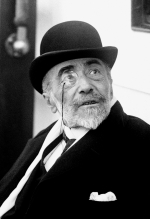
Born in Kent in 1858, H. W. Fowler was one of our greatest lexicographical geniuses. He led an ascetic life: he was a runner and a swimmer (lakes, rivers, ocean); he lived with his brother in relative seclusion on the island of Guernsey; and he held—and proved—that anyone should be able to subsist on a hundred pounds a year. He devoted his life to literature: he won the fifth prize in the immensely popular competition with which the Encyclopedia Britannica celebrated its tenth edition; he rediscovered and translated Lucian; he took on, almost single-handedly, the herculean project of boiling down the entire Oxford Dictionary to the Concise Oxford English Dictionary, which is, to this day, one of the most widely used reference books in the language. He was a politely outspoken atheist who lost his teaching position for being unwilling to prepare his students for confirmation. During World War I, he refused to collaborate on the recruiting campaign to send young men into harm’s way while he remained safe. Instead, he lied about his age (forty-four), got enlisted, and was sent to the front. After a rather hermitic life, he got happily married when he was in his seventies and died three years after his wife, in 1933. In the words of Ernest Gowers, “The simplicity of his habits has a counterpart in the simplicity of diction he preaches.”

more here.

Death: a lively visual history

Maggie Gray in More Intelligent Life:

Sleeping-deadOn a wet July day in Paris in 1793, during the period now known as “The Terror”, Charlotte Corday was among the first “enemies of the revolution” to be executed by guillotine. After her head was struck from her body, the executioner picked it up and slapped it in a theatrical gesture for the crowd. Some of those watching swore, aghast, that Corday blushed at the insult. The rumour spread, fuelling debate about France’s new killing machine. Its proponents had hailed it as a swift and therefore humane method of execution. But what if the victims did not lose consciousness with the cut of the blade? Was there an awful afterlife for the condemned, in which their severed heads were forced to contemplate their own demise?

This is just one of the fascinating and macabre stories to feature in “Death: A Graveside Companion”. The delightfully dark compendium draws together images of death (many from the collection of an American art dealer, Richard Harris) with essays considering different aspects of mankind’s relationship with death, raising profound and troubling questions. What does it mean to die? What should be done with a corpse? How do we picture death, and can we poke fun at it? Is death the end? The essays are printed on paper the colour of sodden earth; drawings of grinning reapers stalk the reader from the margins. It is a surprisingly lively book. We meet vivid characters who have put death at the centre of their lives, such as Frances Glessner Lee, a wealthy American who made miniature models of murder scenes as a police training resource, or Georgiana Houghton, a Victorian artist who claimed her kaleidoscopic drawings were the work of her spirit guide, and early anatomists who raided graves for fresh cadavers. Nowadays we try not to think too hard about death. Modern medicine keeps it at bay and hospitals, care homes and funeral parlours keep it out of sight. For many of us, death is an abstraction. But this sometimes disturbing yet unexpectedly affecting book reminds us that it is the most human thing of all.

More here.

Energy transitions

Michelle Grayson in Nature:

EnergyThe transition from fossil fuels is well under way. Each year sees an increase in the amount of electricity generated from renewable sources, including solar, wind and biomass. Changing where we get our energy from has numerous impacts on society, affecting job opportunities, infrastructure and the quality of our air and water resources. But this is not humanity’s first energy transition — society has experienced profound change time and again as new energy sources have risen to dominance.

The driving forces behind our present energy transition are diverse. Although many view low-carbon energy as a way to mitigate climate change, individuals and communities will often move for reasons of business and self-determination. Some people — such as those with no connection to the electrical grid — see little option but renewables. And there are economic benefits: it is likely that we have been grossly underestimating the real cost of fossil fuels. Will the latest energy transition be a success? It might depend on whether green electricity can make itself indispensable to the growing knowledge economy. Inequalities in energy use between the wealthiest and poorest members of society must also be addressed, and difficult decisions on power-plant placement taken. The current energy transition should not be viewed through just one lens. It is not merely an issue of technology, or resource availability. It is about history, democracy, economics and society.

More here.

Sunday, December 3, 2017

LONG TABLES, OPEN BOTTLES, AND SMOKE: HANGING OUT WITH DEREK WALCOTT

Sven Birkerts in Literary Hub:

ScreenHunter_2918 Dec. 03 19.12I learned a good deal about poets and poetry from Joseph Brodsky, whose classes I audited in the 1970s in Ann Arbor and whose opinion on most anything I took as holy writ in those days. Joseph was a great one for naming and ranking poets, and much of our conversation consisted of him delivering his various verdicts. “Miroslav Holub is terrific, ya?” Or “Yevtushenko, he’s just shit.” So-and-so was in fact a good poet, “too bad he had to get a Bly-job.” I was all ears, and tuned in closely whenever a new name appeared on his list. “Derek Walcott,” he said one day, “Caribbean poet—look him out [sic].” And I, ever dutiful, did just that, picking up Sea Grapes and Another Life. I remember liking both, and I also remember pushing myself to like them still more so I could be adequate to Brodsky’s esteem. I certainly felt Walcott’s power and freshness, and got that this was poetry with a unique rhythmic surge. But at that point I hadn’t fully connected with it. Some time later, after I moved to Cambridge, I thought I might try to get closer by writing about the man. I decided to set Walcott’s work and worldview against that of his fellow Caribbean writer V.S. Naipaul. The two had been friends in their youth but had since taken radically divergent paths, Naipaul dismissing his roots, Walcott putting his at the core of his poems and plays. I had heard there was friction.

When I finished, I showed the essay to Brodsky, who seemed to like it well enough. He made some noise about showing it to Walcott—the two had by this point become fast friends—but if he did, I never heard anything about it.

More here.

Scallops Have Eyes, and Each One Builds a Beautiful Living Mirror

Ed Yong in The Atlantic:

ScreenHunter_2917 Dec. 03 19.08In 2019, if everything goes according to plan, the much-delayed James Webb Space Telescope will finally launch into orbit. Once assembled, it will use an array of 18 hexagonal mirrors to collect and focus the light from distant galaxies. This segmented-mirror design was developed in the 1980s, and it has been so successful that it will feature in almost all the large telescopes to be built in the near future.

But as always, nature got there first. For millions of years, scallops have been gazing at the world using dozens of eyes, each of which has a segmented mirror that’s uncannily similar to those in our grandest telescopes. And scientists have just gotten a good look at one for the first time.

Yes, those scallops—the pan-seared pucks of white flesh that grace our dinner plates. Those pucks are just the muscles that the animals use to close their beautiful shells. Look at a full, living scallop, and you’ll see a very different animal. And that animal will be looking right back at you, using dozens of eyes that line the fleshy mantle on the inner edges of its shell. Some species have up to 200 eyes. Others have electric-blue ones.

Inside the eyes, the weirdness deepens. When light enters a human eye, it passes through a lens, which focuses it onto the retina—a layer of light-sensitive cells. When light enters a scallop eye, it passes through a lenslike structure, which … doesn’t seem to do anything. It then passes through two retinas, layered on top of each other. Finally, it hits a curved mirror at the back of the eye, which reflects it back onto the retinas. It’s this mirror, and not the lens, which focuses the incoming light, in much the same way that those in segmented telescopes do.

More here.

Why the UN is investigating extreme poverty … in America, the world’s richest nation

Ed Pilkington in The Guardian:

ScreenHunter_2916 Dec. 03 18.59The United Nations monitor on extreme poverty and human rights has embarked on a coast-to-coast tour of the US to hold the world’s richest nation – and its president – to account for the hardships endured by America’s most vulnerable citizens.

The tour, which kicked off on Friday morning, will make stops in four states as well as Washington DC and the US territory of Puerto Rico. It will focus on several of the social and economic barriers that render the American dream merely a pipe dream to millions – from homelessness in California to racial discrimination in the Deep South, cumulative neglect in Puerto Rico and the decline of industrial jobs in West Virginia.

With 41 million Americans officially in poverty according to the US Census Bureau (other estimates put that figure much higher), one aim of the UN mission will be to demonstrate that no country, however wealthy, is immune from human suffering induced by growing inequality. Nor is any nation, however powerful, beyond the reach of human rights law – a message that the US government and Donald Trump might find hard to stomach given their tendency to regard internal affairs as sacrosanct.

The UN special rapporteur on extreme poverty and human rights, Philip Alston, is a feisty Australian and New York University law professor who has a fearsome track record of holding power to account.

More here.

Robert Reich: How Clinton and Obama Failed to Defend the Middle Class

David Sirota in AlterNet:

Untitled_design_182You argue that capitalism needs to be saved, but what is your response to polls showing many Americans want an alternative to capitalism?

If we could come up with something that was much different, we might want to try that, but even the Chinese who call themselves a communist nation practice a form of capitalism in terms of private property and the free exchange of goods and services. I think the real question is what I meant by ‘saving capitalism’: saving capitalism from the moneyed interests that are now distorting our system of capitalism in ways that make it very difficult for most people to get ahead.

The issue is not capitalism versus some other ism, because there really isn't another ism around. The question is how to organize capitalism so that big money doesn't make the rules.

The idea that there is a free market out there some place in nature that can exist without rules, without rules that are generated by politics, by government, by federal agencies and departments and state agencies and departments and legislatures and courts is absurd on its face.

These rules are necessary. They are constantly being changed and adapted and altered. They are, right now, more than at any time since the 1880s and the 1890s, the Gilded Age of the robber barons, they are being made by and for very, very big companies, corporations, Wall Street and economic elite of very wealthy individuals who were politically active. This is a huge problem. This generates the distress and cynicism and anger about a rigged economy and a rigged system that contributed to Donald Trump becoming president.

More here.

jerry fodor (1935 – 2017)

Baldo-fodor-762x1024Jerry Fodor dismantles Pinker back in 1998 at the LRB:

A lot of the fun of Pinker’s book is his attempt to deduce human psychology from the assumption that our minds are adaptations for transmitting our genes. His last chapters are devoted to this and they range very broadly; including, so help me, one on the meaning of life. Pinker would like to convince us that the predictions that the selfish-gene theory makes about how our minds must be organised are independently plausible. But this project doesn’t fare well. Prima facie, the picture of the mind, indeed of human nature in general, that psychological Darwinism suggest is preposterous; a sort of jumped up, down-market version of Original Sin.

Psychological Darwinism is a kind of conspiracy theory; that is, it explains behaviour by imputing an interest (viz in the proliferation of the genome) that the agent of the behaviour does not acknowledge. When literal conspiracies are alleged, duplicity is generally part of the charge: ‘He wasn’t making confetti; he was shredding the evidence. He did X in aid of Y, and then he lied about his motive.’ But in the kind of conspiracy theories psychologists like best, the motive is supposed to be inaccessible even to the agent, who is thus perfectly sincere in denying the imputation. In the extreme case, it’s hardly even the agent to whom the motive is attributed. Freudian explanations provide a familiar example: What seemed to be merely Jones’s slip of the tongue was the unconscious expression of a libidinous impulse. But not Jones’s libidinous impulse, really; one that his Id had on his behalf. Likewise, for the psychological Darwinist: what seemed to be your, after all, unsurprising interest in your child’s well-being turns out to be your genes’ conspiracy to propagate themselves. Not your conspiracy, notice, but theirs.

more here.