
More here. (Note: Throughout February, at least one post will be dedicated to honor Black History Month)
Category: Recommended Reading
Love Poems for the Border Patrol
Amitava Kumar in The New Yorker:

Was it after three years? Five? Fifteen?
I have a narrative in my mind that is teleological—I think the word for this, from my graduate-student days, is “Hegelian”—and it culminates in my becoming a writer. A writer of immigritude. I cannot put a date to it, but I suspect that the rawness of always feeling out of place, of not belonging—that fighting sense I had of forever being on edge—diminished or even disappeared once I reached the understanding that I no longer had a home to which I could return. This went hand in hand (and this is part of the Hegelian schema I’m inhabiting here) with my finding a home in literature.
I arrived in the U.S., for graduate study, in literature, in the fall of 1986. I was twenty-three. After a year, I began to paint, even though I had come to the U.S. intending to become a writer. I painted small canvases, abstract forms that sometimes had words, often in Hindi, written on them. Why did this happen? Maybe because one day, in the college bookstore, I had seen a coffee-table book that had the word “India” printed on it in large letters.
More here.
20 years ago, research fraud catalyzed the anti-vaccination movement
Julia Belluz in Vox:

The study, led by the now discredited physician-researcher Andrew Wakefield, involved 12 children and suggested there’s a link between the measles, mumps, and rubella vaccine — which is administered to millions of children around the world each year — and autism.
The study was subsequently thoroughly debunked. The Lancet retracted the paper and Wakefield was stripped of his medical license. Autism researchers have shown decisively again and again that the developmental disorder is not caused by vaccines.
Still, public health experts say the false data and erroneous conclusions in that paper, while rejected in the scientific world, helped fuel a dangerous movement of vaccine skepticism and refusal around the world.
Since its publication, measles outbreaks have erupted in Europe, Australia, and the US in communities where people refuse or fear vaccines. Vaccine refusal has become such a problem that some countries in Europe are now cracking down, making vaccines mandatory for children and fining parents who reject them.
But there’s more to the story.
More here.
Documentary about Philip Larkin: Love and Death in Hull
The World Must Act Now on Syria: An Open Letter to the NYRB
From the New York Review of Books:
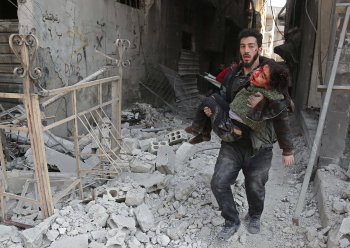
The world is a bystander to the carnage that has ravaged the lives of Syrians. All has happened in full view of a global audience that sees everything but refuses to act.
Through Russian obstruction and western irresolution, the UN Security Council has failed to protect Syrians. To the extent that it has been able to pass resolutions, they have proved ineffectual. All they have done is provide a fig leaf to an institution that appears moribund. Perhaps conscious of the stain this might leave on its legacy, the UN has even stopped counting Syria’s dead. After seven years, these nations appear united only in their apathy.
It will be redundant to list the nature and magnitude of all the crimes that the Assad regime has committed against Syrians, aided by local and foreign militias, by Iranian strategic and financial aid, by Russian airpower and mercenaries—and by international indifference. The world that watched and averted its eyes is its passive enabler.
More here.
Wednesday Poem
A Certain Slant of Sunlight
In Africa the wine is cheap, and it is
on St. Mark’s Place too, beneath a white moon.
I’ll go there tomorrow, dark bulk hooded
against what is hurled down at me in my no hat
which is weather: the tall pretty girl in the print dress
under the fur collar of her cloth coat will be standing
by the wire fence where the wild flowers grow not too tall
her eyes will be deep brown and her hair styled 1941 American
will be too; but
I’ll be shattered by then
But now I’m not and can also picture white clouds
impossibly high in blue sky over small boy heartbroken
to be dressed in black knickers, black coat, white shirt,
buster-brown collar, flowing black bow-tie
her hand lightly fallen on his shoulder, faded sunlight falling
across the picture, mother & son, 33 & 7, First Communion Day, 1941–
I’ll go out for a drink with one of my demons tonight
they are dry in Colorado 1980 spring snow.
by Ted Berrigan
from Selected Poems
Penguin Poets, publisher
Willa Cather, Pioneer

Willa Cather was not a flashy stylist, and though she was ambitious in her work, she did not attach it to a publicity-worthy life like some of her contemporaries, such as Ernest Hemingway and F. Scott Fitzgerald. Cather’s first book of poetry came out in 1903, when she was twenty-nine; her first book of stories followed a couple years later, when she was thirty-one. Her last novel appeared in 1940, and a volume of three more stories was published in 1948, shortly after she died. Forty-five years is a long career for a novelist, but she possessed an intensity of observation and a curiosity about human psychology, especially as it relates to nature, that never waned. My Ántonia is one of her best-loved books, and it displays all the characteristics that make Cather both elusive and fascinating even as it depicts a world that vanished almost as soon as the novel was published.
Willa Cather was born in an interesting spot in the mountains of Virginia, near Winchester, on the banks of a tributary of the Potomac, Back Creek. The family properties (one owned by her grandfather, another given to her father by her grandfather) were about ninety miles from Washington, D.C., and fifty miles from prosperous plantation regions like Loudon County.
more here.
the literature of grace paley
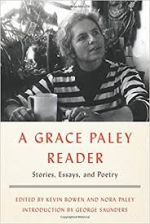
Born in 1922 to Russian Jewish parents who had left Ukraine 16 years earlier, Grace Goodside (originally Gutseit) grew up in the Bronx, hearing Russian and Yiddish and all the clamourings of New York City. Her parents were socialists and so was she, although she notes in the first essay collected here that, after her mother made nine-year-old Grace pull out of a play her youth group were doing on account of her awful singing voice, ‘in sheer spite I gave up my work for socialism for at least three years.’ She did all kinds of jobs and at 18 studied at the New School with W.H. Auden, who did her the great favour of encouraging her to write the way she talked. She married Jess Paley in 1942, in her late twenties had Nora and a son, Danny, and in her thirties began to write fiction and take part in the political activism that would continue to absorb much of her time and energy until her death in 2007. The Vietnam War, nuclear proliferation, US actions in Central America, the Israeli occupation of the West Bank and Gaza, and eventually the war in Iraq: she protested and organised against them all, and those fights marked her fiction. Her last collection has characters disagreeing about Golda Meir and discussing Mao. She taught writing at various universities from the mid-1960s onwards and, after separating from Jess Paley, married the writer Bob Nichols. She also published three books of fiction, though the novel her publishers hoped for never materialised. It seems fair to say that the short story was her form. The talent for nonchalance and compression that allows her to stretch out a brief chat to encompass several lives might be wasted if it extended much further. As it is, in her work possibilities proliferate rather than narrow. Paley often reuses the same narrator, but that person never needs to have learned from or remembered what seemed to define her last time round.
more here.
On Israel’s crackdown on migrants and refugees
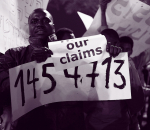
ON THE LAST DAY OF AUGUST, Benjamin Netanyahu, dressed in a wide navy suit and flanked by security guards, toured the muggy streets of south Tel Aviv. It had been several years since Netanyahu, whose net worth is an estimated $11 million, last visited the area, home to some of the city’s poorest neighborhoods and where tens of thousands of refugees and migrant workers have settled since the 1990s. The purpose of the tour, according to Netanyahu’s office, was “to identify with the residents and to hear their distress.” By residents, Netanyahu did not mean the migrant workers and refugees. “Our task,” he declared, “is to return the area to the citizens of Israel.”
An estimated 38,000 asylum seekers, mostly from Eritrea and Sudan, live in Israel today. Together with around 100,000 migrant workers, mainly from Eastern Europe and Southeast Asia, they make up Israel’s population of non-Jewish migrants. Indian, Nepalese, Filipino, and Sri Lankan migrants work as home health aides for elderly Israelis and as domestic workers in Israeli households.
more here.
Charlotte girl’s speech on race gets standing ovation
More here. (Note: Throughout February, at least one post will be dedicated to honor Black History Month)
Tuesday, February 27, 2018
African Americans in Medicine in the Civil War Era
From BlackPast.Org:
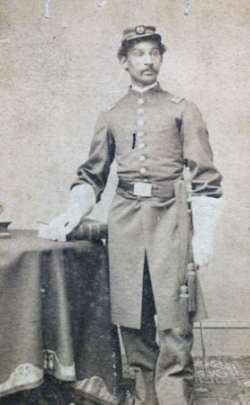
Three men were commissioned officers while the remaining nine served as acting assistant surgeons (contract physicians). Alexander Thomas Augusta from Norfolk, Virginia, was unable to obtain admittance to a United States medical school so he went to Ontario, Canada. There he was successful in gaining admittance to Trinity College, Ontario University. In 1860 he became the first person of African ancestry to receive a medical degree in Canada. He received his commission as a surgeon (with the rank of major) in April 1863 in the 7th United States Colored Infantry (known popularly by the initials, USCT, for U.S. Colored Troops). Augusta was the first African American to obtain this rank in the U. S. Army. At the end of the war he was brevetted to lieutenant colonel, a promotion for meritorious service. When Howard Medical College opened in 1868, he was the only African American on its original faculty. Nine years later he left the medical school for private medical practice in Washington, D.C. Augusta died in 1890 and was the first African American officer to be buried in Arlington National Cemetery.
More here. (Note: Throughout February, at least one post will be dedicated to honor Black History Month)
Roth Agonistes
Nathaniel Rich in the New York Review of Books:
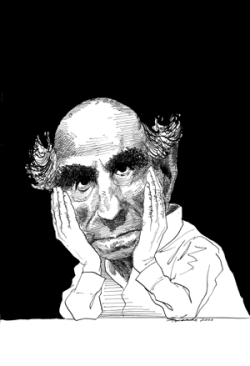
A more intriguing question: Why not write? For this is what Roth, since 2009, has chosen to do: not write. When asked to explain his decision, he has tended to summon a Bartlebyesque detachment: “I have no desire any longer to write fiction,” he told one disappointed interviewer in 2014. “I did what I did and it’s done.” He elaborated slightly a month later, in a conversation with Sweden’s Svenska Dagbladet, crediting his self-imposed silence to
a strong suspicion that I’d done my best work and anything more would be inferior. I was by this time no longer in possession of the mental vitality or the verbal energy or the physical fitness needed to mount and sustain a large creative attack of any duration on a complex structure as demanding as the novel.
“Attack” is the word that rises, three-dimensionally, from the text. It recurs often throughout Roth’s nonfiction, invoked to describe the various aggressions he has absorbed, his resentment toward his critics, and his assault on the blank page that faced him each morning. During his early writing years in Chicago, Roth began each morning by shouting at the young face peering out from the mirror at him: “Attack! Attack!”
More here.
Which problems make good research problems?
Sabine Hossenfelder in Back Reaction:
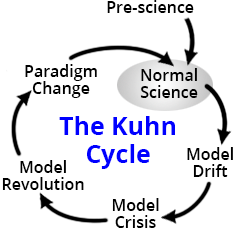
A first, rough, classification of research problems can be made using Thomas Kuhn’s cycle of scientific theories. Kuhn’s cycle consists of a phase of “normal science” followed by “crisis” leading to a paradigm change, after which a new phase of “normal science” begins. This grossly oversimplifies reality, but it will be good enough for what follows.
During the phase of normal science, research questions usually can be phrased as “How do we measure this?” (for the experimentalists) or “How do we calculate this?” (for the theorists).
In the foundations of physics, we have a lot of these “normal problems.” For the experimentalists it’s because the low-hanging fruits have been picked and measuring anything new becomes increasingly challenging. For the theorists it’s because in physics predictions don’t just fall out of hypotheses. We often need many steps of argumentation and lengthy calculations to derive quantitative consequences from a theory’s premises.
A good example for a normal problem in the foundations of physics is cold dark matter. The hypothesis is easy enough: There’s some cold, dark, stuff in the cosmos that behaves like a fluid and interacts weakly both with itself and other matter. But that by itself isn’t a useful prediction. A concrete research problem would instead be: “What is the effect of cold dark matter on the temperature fluctuations of the cosmic microwave background?” And then the experimental question “How can we measure this?”
Other problems of this type in the foundations of physics are “What is the gravitational contribution to the magnetic moment of the muon?,” or “What is the photon background for proton scattering at the Large Hadron Collider?”
Answering such normal problems expands our understanding of existing theories. These are calculations that can be done within the frameworks we have, but calculations can be be challenging.
The examples in the previous paragraphs are solved problems, or at least problems that we know how to solve, though you can always ask for higher precision. But we also have unsolved problems in this category.
More here.
How to resolve racially stressful situations
Yanis Varoufakis’s lessons for reasserting European social democracy
J. W. Mason in the Boston Review:
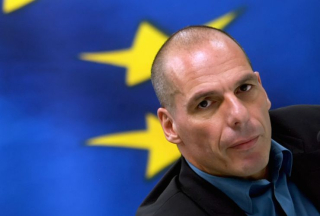
Syriza was represented in these negotiations by its finance minister, Yanis Varoufakis. With his shaved head, leather jacket, and motorcycle, he was not just a visual contrast to the gray-suited Eurocrats across the table. His radical but rigorous proposals for a different kind of Europe—one based on meeting human needs rather than rigid financial criteria—offered a daily rebuke to the old refrain “there is no alternative.”
The drama was clear, but the stakes were a little obscure. Why did it matter if Greece stayed in the euro? Orthodox economic theory, after all, gives little role for money or finance. What matters are real wants and real resources, for which money is just a convenient yardstick. University of Chicago economist John Cochrane probably spoke for much of the profession when he asked why it made any more sense to talk about Greece leaving the euro than about Greece leaving the metric system.
But money does indeed matter—especially in economic relations between countries, as Varoufakis himself has convincingly shown. In his three books—The Global Minotaur (2011), And the Weak Suffer What They Must (2016), and Adults in the Room (2017)—Varoufakis offers a fascinating lens on the euro system and its masters.
More here.
Tuesday Poem
Strange Fruit
Southern trees bear a strange fruit
Blood on the leaves and blood at the root
Black bodies swinging in the southern breeze
Strange fruit hanging from the poplar trees
Pastoral scene of the gallant south
The bulging eyes and the twisted mouth
Scent of magnolias, sweet and fresh
Then the sudden smell of burning flesh
Here is fruit for the crows to pluck
For the rain to gather, for the wind to suck
For the sun to rot, for the trees to drop
Here is a strange and bitter crop
by Abel Meeropol
.
Aimee Nezhukumatathil’s poems explore the mysteries of love

Nezhukumatathil’s villanelle is ultimately the song of a woeful narrator whose carefree prelude sours into longing. “I’ll finger the rim on the paper coffee cup / you leave in my car. When I hear your name I can’t forget // how your long torso pressed against my bare back, / bluish in this early light,” the narrator says, the turn from tenderness to eroticism capturing the pain of being separated from a lover. Soon, longing explodes into full-throated lament: “There is no lack // of how it haunts me still—what I bid—lost, sacked / and wrapped for other girls.” The narrator thinks to herself, “I should have looked up / to see who else was bidding” on her lover’s heart, but instead, she says, “I studied the folds in your jacket.”
Other poems in At the Drive-In Volcano connect the anxieties of love to broader cultural themes. In “First Anniversary, With Monkeys,” the narrator and her husband are lost in the Periyar Nature Preserve in southern India, where the narrator’s “tube / of sunblock is as warm as a baby’s bottle.” She’s thankful that her husband’s hands can cover the places she can’t reach and that he “never worried if our families would clash” and “never worried // about my relatives staring at [his] pale, muscled calves.”
more here.
The New Museum’s ‘I Am More Woke Than You’ Triennial

There are 26 artists and artist collectives between the ages of 26 and 36 in the New Museum triennial “Songs for Sabotage.” As is the case with most biennials these days, all are said to be making art that addresses “profound social and political upheaval.” Thus “Songs” is a pro forma biennial, name-checking the heady litany of issues shows like this always address: systemic oppression, Western hegemony, economic injustice, migration, homophobia, racism, sexism, colonialism, and postcolonialism. The bugaboo most maligned by the co-curators — the New Museum’s Gary Carrion-Murayari and Alex Gartenfeld, deputy director and chief curator of the Institute for Contemporary Art in Miami — is something called “late liberalism,” which is ID’d as the “illusion of the seamless flow of capital through global networks via mechanisms of surveillance and control.”
This is all really just curator code for “I’m more woke than you.” A better definition of “late liberalism” in the art world may be tenured and professional curators and academics ignoring the emergencies and needs of artists in their backyards (95 percent of whom could use a break) and instead traveling the world to troubled hot spots like concerned anchormen and anchorwomen to bring back “interventions” and art that supposedly “sabotages” things.
more here.
U.S. Girls’ Collection of Characters

I bought the first U.S. Girls seven-inch, “Kankakee Memories,” in 2009, for reasons that no music-discovery algorithm would likely predict. I didn’t know what U.S. Girls sounded like, or if it was indeed a band of American women. But the single’s title reminded me of my mother, who likes to reminisce about a summer in the early nineteen-seventies that she spent working at a diner in the small town of Kankakee, Illinois, just after she arrived in the United States. I eventually found out that U.S. Girls was one person, Meghan Remy, who grew up in Chicago but now lives in Toronto. Her songs were short and hazy, full of bright melodies washed out with abrasive noise. Listening to them was like listening to oldies while tilling gravel.
In the next few years, Remy released music on a number of labels, casting her vocals against different, comparatively cleaner backdrops, from guitars, distortion, and feedback to samples and dusty loops. She cycled through genres purposefully, one by one.
more here.
Monday, February 26, 2018
George Boole and the Calculus of Thought
by Richard Passov
* * *
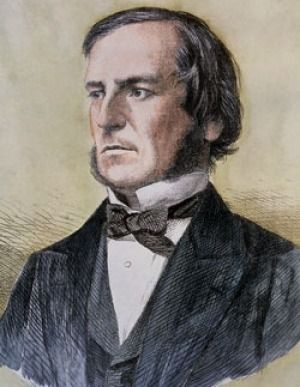
George was born in a small rail hub one hundred and fifty miles north of London, in the den of a cobbler who, said his wife, was ‘…good at everything except his own business of managing shop.’ Unable to afford an education, Boole’s father nevertheless encouraged his son to study. Dutiful, George taught himself six languages, read the classics, read philosophy and studied his figures.
By twelve he had a reputation owing to his father’s submission to the local newspaper of a poem translated from ancient Greek. Interested readers were surprised to discover that the translator was an unschooled boy. The Town Councilor, fancying himself an amateur mathematician, provided George access to a library filled with mathematics.
George calculated that math would be more remunerative than his first love, theology. Some things don’t change. After enough self-study, hoping for tips from grateful parents he secured a position as an usher tutoring students in theater-sized classrooms. By nineteen, he opened his own school to which he gave the very unoriginal name: “The Classical, Commercial and Mathematical Academy.”
Teaching during the day, studying at night, living with and the sole support for his extended family, George mastered the complete cannon of contemporary math. Mastered to such an extent that in 1837 he responded to an advertisement from a newly established mathematical journal with an astonishingly original piece of work.