
A Green Crab’s Shell
Not, exactly, green:
closer to bronze
preserved in kind brine,
something retrieved
from a Greco-Roman wreck,
patinated and oddly
muscular. We cannot
know what his fantastic
legs were like –
though evidence
suggests eight
complexly folded
scuttling works
of armament, crowned
by the foreclaws’
gesture of menace
and power. A gull’s
gobbled the center,
leaving this chamber
–size of a demitasse-
open to reveal
a shocking, Giotto blue,
Though it smells
of seaweed and ruin,
this little traveling case
comes with such lavish lining!
Imagine breathing
surrounded by
the brilliant rinse
of summer’s firmament.
What color is
the underside of skin?
Not so bad, to die,
if we could be opened
into this–
if the smallest chambers
of ourselves,
similarly,
revealed some sky.
by Mark Doty
from Atlantis
Harper Perennial, 1995

 In 2014, a graduate student at the University of Waterloo, Canada, named
 Carol Dweck, a psychology professor at Stanford University, remembers asking an undergraduate seminar recently, “How many of you are waiting to find your passion?”
 Bilal Abdul Kareem is an expert in staying alive.

 Amitava Kumar in The Baffler:
 Early on in Helen Jukes’s A Honeybee Heart Has Five Openings she ponders the increasing popularity of urban beekeeping, referring to the idea that “one possible psychological response to the apprehension of a threat is to begin producing idealised versions of the thing we perceive of as being at risk”. That’s also a good explanation for the current crop of bee books: not just A Honeybee Heart and Thor Hanson’s Buzz, but Kate Bradbury’s wonderful The Bumblebee Flies Anyway and Maja Lunde’s The History of Bees, among others. Books, like hives, are ways of capturing something and holding on to it: either helping to preserve it, or looking at it closely before it’s gone.
 If malignant cells from solid or blood cancers enter the central nervous system (CNS) and grow there, the treatment options and clinical outlook deteriorate rapidly. In a type of leukaemia called acute lymphoblastic leukaemia (ALL), invasion of the CNS commonly occurs. To try to limit this, people with the condition often receive radiation or chemotherapy that targets the CNS. If more-effective and less-toxic approaches became available to prevent disease spread to the CNS, this might benefit many people with ALL.
 Sheri Berman in The Guardian:
 In his book The Main Questions of Modern Culture from 1914, the German philosopher Emil Hammacher wrote about the questions of his time—among them the social, woman, and worker questions—their causes, and the longstanding desire to solve them and others, tracing their causes and solution-seeking back to
 CRISPR has been heralded as one of the
 Jamelle Bouie, the chief political correspondent for Slate, recently penned an essay suggesting that the Enlightenment was racist — though the real point seemed to be that liking the Enlightenment too much is kind of racist. Regardless, the essay set off quite a hullabaloo, mostly on Twitter. His main targets were two new books, Enlightenment Now, by Steven Pinker, and Suicide of the West, by yours truly. Jordan Peterson, the controversial Canadian psychologist bogeyman of the moment for many liberals, was namechecked for good measure.
 S
 Still, the application of the idea of the history of vision does not stop, and does not begin, with modernity. As Jonathan Crary argues at length, the general mode of perception may have undergone some important form of change already in the first half of the 19thcentury. And theorists of postmodernism rely on the principle of the history of vision as much as theorists of modernity do. Frederic Jameson, for example, argues that postmodernism offers “a whole new Utopian realm of the senses.” The premise all these arguments share is that history, and art history, can be understood, at least partially, as the history of perception. This assumption is so deeply ingrained in much of the discourse on 19th and 20th century art and culture and in (at least some branches of) art history and aesthetics that it has been taken for granted without further discussion. As Whitney Davis summarized, “according to visual-culture studies, it is true prima facie that vision has a cultural history.” And one of the guiding ideas of post-formalism has become the claim that vision (and imagination) has an (art) history.
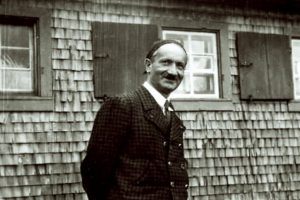 Martin Heidegger’s writings owe their fascination to their fusion of radical criticism of the Western philosophical tradition with a dark, trenchant diagnosis of the “homelessness” and “destitute” condition of human beings in modernity. Heidegger’s work has enjoyed unrivalled influence in a wide range of twentieth-century philosophical movements or fields – phenomenology and existentialism, pragmatism and postmodernism, hermeneutics and poetics, theology and environmental ethics. Phenomenologists and pragmatists could applaud his “destruction” of Cartesian rationalism, existentialists his call to “authenticity”, and environmentalists his reflections on “the devastation of the earth”. Heidegger’s influence might have been greater still if potential admirers had not been deterred by his challenging vocabulary or by his connection to Nazism.