
Category: Recommended Reading
In solitude what happiness?
Maggie Fergusson in More Intelligent Life:

Rebecca has joined the 7m other people in Britain who are trying to find love through the internet. She reckons she’s been on at least 100 dates so far. Every time, she makes an effort – gets “frocked up” as Australians say – but it’s never yet been successful, and she travels home from each assignation feeling “more lonely than if I’d never tried”. Her distaste for the whole business is palpable. Still, faute de mieux, she bashes on. “How does it feel?” I ask, as she opens her page on the Guardian Soulmates website (which shows that, to date, 1,305 people have viewed her and 356 people liked her). “It feels pragmatic, and sad. I’m admitting, ‘I’m lonely, and I want to have a family’, and there’s a kind of shame in that.”
She takes me through the profiles of men who have recently joined the site, most with cheeky-chappy nick-names: Curbychup, FoodieGeoff, LieutenantGrey. She shows me how she’s built her own profile, presenting herself as a happy-go-lucky woman who’s well read and widely travelled. “There’s a loneliness in having to present yourself in a certain way, definitely. The distance between the image I give and the reality is getting wider and wider. But if I were to write the truth – that I’m lonely and worried I might not have a family – it would be just the most off-putting thing.”
“So people think of loneliness almost as an infectious disease?”
“Yup. Something like that. Most people find it very, very unattractive.”
“Does anyone on the Guardian site ever admit to loneliness in their profile?”
“NEVER!”
More here.
Beyond the Slave Trade, the Cadaver Trade
Daina Ramey Berry in The New York Times:
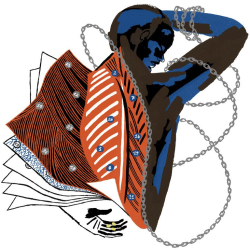
It is time to acknowledge this dark truth behind our understanding of human anatomy and modern medicine.
Over several years, I’ve studied what I call the domestic cadaver trade and its connection to 19th-century medical education. The body trade was as elaborate as the trans-Atlantic and domestic slave trade that transported Africans to the New World and resold African-Americans on our soil. But when enslaved people died, some were sold again and trafficked along the same roads and waterways they traveled while alive. The domestic cadaver trade was active, functional and profitable for much of the 19th century. Fueled by demand from medical schools’ need for specimens for anatomy classes, it was a booming business. Typically, the supply of bodies consisted of executed criminals and unclaimed corpses from almshouses and prisons. But when these sources fell short, physicians and students alike looked elsewhere. Some anatomy professors personally sent agents to work with professional body snatchers who stole bodies from pauper cemeteries. Body snatchers like Grandison Harris of Georgia and Chris Baker of Virginia collected specimens for dissection for the benefit of medical colleges. While they received room, board and modest wages for the bodies they collected, they were also enslaved African-American men themselves, listed as “janitors” or “porters” in the medical schools’ records.
More here. (Note: Throughout February, at least one post will be dedicated to honor Black History Month)
Sunday Poem
Storm Ending
Thunder blossoms gorgeously above our heads,
Great, hollow, bell-like flowers,
Rumbling in the wind,
Stretching clappers to strike our ears . . .
Full-lipped flowers
Bitten by the sun
Bleeding rain
Dripping rain like golden honey—
And the sweet earth flying from the thunder.
by Jean Toomer
Saturday, February 3, 2018
200 Years Later, We’re Still Learning from Frankenstein: The 1818 Text
Lorraine Berry in Signature:
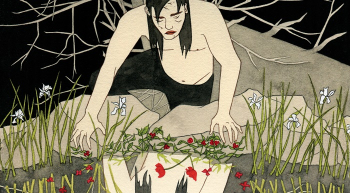
These are Victor Frankenstein’s words upon seeing his “child,” the Monster, who is never named by his father. The Monster is created early in the book’s narrative, in chapter four, and the rest of the novel’s action concerns itself with the consequences of Frankenstein’s ultimate sin as a parent: the abandonment of his newborn.
It’s the bicentennial of the publication of Mary Shelley’s first novel, a novel that has been translated to television and film more than any others – 177, as of October 2017. And yet, those who have not sat down with the original version, written by Mary Shelley when she was between sixteen and eighteen, and published when she was twenty, will have little idea of the real story of Frankenstein. The gothic novel was the product of a famous challenge among Lord Byron, Percy Bysshe Shelley, John William Polidori, and Mary Godwin, who was not yet married to Shelley. Byron challenged all of them over a weekend to write a scary tale. Out of that weekend, Polidori wrote The Vampyre, the original vampire novel, and Mary, unable to come up with anything over the weekend, worked on Frankenstein for a year.
More here.
You thought quantum mechanics was weird: check out entangled time
Elise Crull in Aeon:

Until his death, Einstein remained convinced that entanglement showed how quantum mechanics was incomplete. Schrödinger thought that entanglement was the defining feature of the new physics, but this didn’t mean that he accepted it lightly. ‘I know of course how the hocus pocus works mathematically,’ he wrote to Einstein on 13 July 1935. ‘But I do not like such a theory.’ Schrödinger’s famous cat, suspended between life and death, first appeared in these letters, a byproduct of the struggle to articulate what bothered the pair.
The problem is that entanglement violates how the world ought to work. Information can’t travel faster than the speed of light, for one. But in a 1935 paper, Einstein and his co-authors showed how entanglement leads to what’s now called quantum nonlocality, the eerie link that appears to exist between entangled particles. If two quantum systems meet and then separate, even across a distance of thousands of lightyears, it becomes impossible to measure the features of one system (such as its position, momentum and polarity) without instantly steering the other into a corresponding state.
More here.
Fragments Were What I Had Available to Me: Talking to Danielle Allen
Andy Fitch in the Los Angeles Review of Books blog:
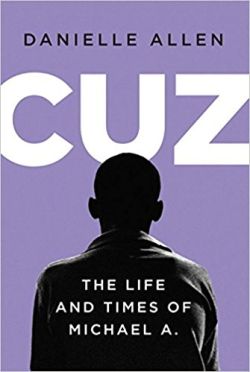
ANDY FITCH: Before we get to anything like Michael’s legal case, or treat Michael’s circumstances as a case study of broader social concerns, could you just introduce him, and maybe introduce Cuz’s “I” at the same time? Readers of your book will be charmed to hear of Michael’s smile and playful exuberance. Here could you offer some scene maybe not in the book, but which exemplifies your relationship to each other as cuz?
DANIELLE ALLEN: My time with Michael divides into two phases: first from eight to 18 for me, and from birth to 10 for him. That phase was full of ordinary joys of cousinhood in Southern California: climbing trees, playing football in the street in front of our house, riding bikes, playing with Hotwheel cars. And family holidays: food, talk, lots of football on the television. Then I left for college and Michael, his mom, his siblings, and his mother’s new husband moved to Mississippi. This is when their lives exploded, which I experienced from a distance. Then my second time with Michael ran from about 1998 until his death in 2009, so for me from age 27 to 37. We had nearly weekly phone calls for eight years, and then the intensive period together when Michael got out of prison. Michael was my closest confidante during this period. He probably heard more of my griping about work and marital woes than anyone else.
More here.
Photos taken from an airplane cockpit

More here.
Julian Barnes’ ‘THE ONLY STORY’
Julian Barnes’s thirteenth novel, like many of its predecessors and his memoir, Levels of Life (TLS, May 3, 2013), is divided into three parts and concerned with love. In the first part, written in the first person, the character Paul, one in a long line of Barnes’s mildly unlikeable but refined male narrators, reminisces late in life about his early relationship with a much older married woman, Susan. Paul and Susan met in the 1960s in suburban Surrey at their local tennis club, when he was nineteen, and home from Sussex University for the summer, and she was forty-eight. Their affair was not a stereotypical “sweet summer interlude” but a romance that lasted over a decade, which, in retrospect, Paul recognizes as the defining, or only, story of his life.
The comic incongruousness of Continental sophistication transplanted to provincial England is evoked early in the novel when a delicatessen opens in the village: “some thought [it] subversive in its offerings of European goods: smoked cheeses, and knobbly sausages hanging like donkey cocks in their string webbing”. Paul rejects the French cliché of an older woman teaching “the arts of love” to a younger man, as in Colette’s novel Chéri (1920): “But there was nothing French about our relationship, or about us. We were English and so had only those morally laden English words to deal with: words like scarlet woman, and adulteress”.
more here.
Ali Smith on Muriel Spark at 100

Recently I found myself rereading Muriel Spark’s novel The Mandelbaum Gate for the first time in 30 years. I’ve been rereading a lot of Spark over this last year and a half, because the times we’re in right now, and the way the information speedfests are forming our everyday history and asking such challenging questions about truth and lies and fiction, mean that I’ve found I’ve had the need of Spark like never before – her intelligence, her longsightedness, her wit, her liberating merriment, her formidable blitheness.
Can blitheness be formidable? I think Spark’s is. She’s this formidable, she’s thisgenerous, I thought, holding The Mandelbaum Gate open in my hands on a train early last November – rereading it at a time when, on the fronts of all the free Evening Standards round me up and down the train, our then British international development secretary happened to have been off having one-sided “secret” talks with the Israeli government. The moral complications of the contemporary were pretty fresh, to my mind anyway, on pages 28 and 29 of The Mandelbaum Gate, set in 1961 in the Jerusalem of the Adolf Eichmann trial.
more here.
‘THE SACRED ERA’ BY YOSHIO ARAMAKI

Born April 12, 1933, Yoshio Aramaki’s writing comes to us from a different time. His novel The Sacred Era, originally published in Japanese in 1978, has more in common with classic American sci-fi short story writers like Philip K. Dick, Isaac Asimov, Ray Bradbury—sharing their preoccupation with wonky metaphysics, biblical allegories, and performative misogyny—than with speculative fiction writers working in the present day. He leads readers down the same well-trodden genre path where impoverished young men discover they are, despite an often remarkable lack of initiative, destined for great things. But Aramaki’s brilliant leaps of imagination and use of experimental, non-linear plot structures are too ambitious for the resulting work to be dismissed as outdated or derivative.
On a dying planet Earth ruled by a future iteration of the Roman Catholic Church, a young man named K is sent to the capital city to take what amounts to a Civil Services exam. On passing (an outcome of which there is never any doubt) he will join the elite ranks of the Papal Court of the Holy Empire of Igitur. He will be sent to study Planet Bosch, a distant planet named for and said to resemble a banned painting by the Twilight Era artist Hieronymus Bosch. Planet Bosch is a green, verdant paradise in stark contrast to the dystopian and dying desert landscape that Earth has become.
more here.
Ella Fitzgerald & Louis Armstrong – The Nearness Of You
(Note: Throughout February, at least one post will be dedicated to honor Black History Month)
The Strange Order of Things
John Banville in The Guardian:
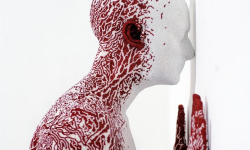
The idea on which he bases his book is, he tells us, simple: “Feelings have not been given the credit they deserve as motives, monitors, and negotiators of human cultural endeavours.” In claiming simplicity, it is possible the author is being a mite disingenuous. The tone in which he sets out his argument is so carefully judged, so stylistically calm and scientifically collected, that most readers will be lulled into nodding agreement. Yet a moment’s thought will tell us that we conduct our lives largely in contradiction of his premise, and for the most part deal with each other, and even with ourselves, as if we were pure spirit accidentally and inconveniently shackled to half a hundredweight or so of forked flesh. “Feelings, and more generally affect of any sort and strength,” Damasio writes, “are the unrecognised presences at the cultural conference table.” According to him, the conference began among the bacteria, which – who? – even in their “unminded existence … assume what can only be called a sort of ‘moral attitude’”. In support of his claim, he adduces the various ways in which bacteria behave that bear a striking resemblance to human social organisation.
More here.
Saturday Poem
a little hopeful song
—for Sile
I give thee the sun as guarantee
and the Egyptian faience beads
and the little silver oar that was gifted once
to an English harbor master.
I give thee the silk dress
with its triple-ruffled sleeves and
the cloaks with big hoods that fall full
though some are pulled in at a central button.
I give thee the little colored goats
that go down on their knees as penitents.
I give thee the death mask
and the plaster hand of Seán Ó Riada,
for he is among the best loved of the musicians.
Friday, February 2, 2018
Merely a Warning that a Noun is Coming
Bee Wilson in the London Review of Books:

Edith Swan, a 30-year-old laundress from the seaside town of Littlehampton in Sussex, was accused of sending a letter to a sanitary inspector called Charles Gardner that contained words of ‘an indecent, obscene and grossly offensive character’. The full letter has not survived, but the gist of it was that Mr Gardner would be very sorry that he had ever called Swan’s ‘dust boxes’ a nuisance. Three witnesses had seen Swan post this letter. Offensive letters had been circulating in Littlehampton for several years, and the police had taken the unusual step of installing a periscopic mirror in the post office’s mail drop. Whenever anyone posted anything, it was retrieved by post office staff and examined by two clerks from the Special Investigation Branch. Looking through the periscope, Edwin Baker, one of the clerks, saw Miss Swan’s hand posting the letter to the sanitary inspector along with a letter addressed to her sister in Woking. The stamps on both letters had been marked with invisible ink, and had been sold to Swan at the request of the police, who had long suspected her of being behind the rash of anonymous letters.
Despite all of this, Mr Justice Avory was not convinced that the slender, self-possessed woman in front of him was capable of writing such a letter. The Brighton Argusreported that he directed the jury to ‘consider whether it was conceivable that she could have written this document’ given that her ‘demeanour in the witness box was that of a respectable, clean-mouthed woman’. The judge said that the jury must ask themselves ‘whether there might possibly be some mistake’.
The Littlehampton Libels by Christopher Hilliard is a short but dazzling work of microhistory. It uses the story of some poison pen letters in a small town to illuminate wider questions of social life in Britain between the wars, from ordinary people’s experience of the legal system to the way people washed their sheets, and is a far more exciting book than either the title or the rather dull cover would suggest.
More here.
How Responsible are Killers with Brain Damage?
Micah Johnson in Scientific American:
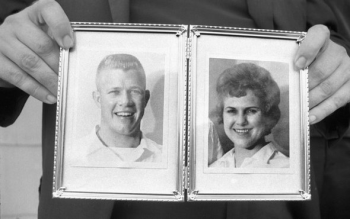
Charles J. Whitman and his wife Kathleen
Charles Whitman lived a fairly unremarkable life until August 1, 1966, when he murdered 16 people including his wife and mother. What transformed this 25-year-old Eagle Scout and Marine into one of modern America’s first and deadliest school shooters? His autopsy suggests one troubling explanation: Charles Whitman had a brain tumor pressing on his amygdala, a region of the brain crucial for emotion and behavioral control.
Can murder really be a symptom of brain disease? And if our brains can be hijacked so easily, do we really have free will?
Neuroscientists are shedding new light on these questions by uncovering how brain lesions can lead to criminal behavior. A recent study contains the first systematic review of 17 known cases where criminal behavior was preceded by the onset of a brain lesion. Is there one brain region consistently involved in cases of criminal behavior? No—the researchers found that the lesions were widely distributed throughout different brain regions. However, all the lesions were part of the same functional network, located on different parts of a single circuit that normally allows neurons throughout the brain to cooperate with each other on specific cognitive tasks. In an era of increasing excitement about mapping the brain’s “connectome,” this finding fits with our growing understanding of complex brain functions as residing not in discrete brain regions, but in densely connected networks of neurons spread throughout different parts of the brain.
More here.
“So you’re saying … we should live like lobsters?” or: Why does politics make us stupid?
Pascal Boyer at the Cognition and Culture Institute:

To provide some background: Jordan Peterson is somewhat famous for defending anti-political correctness positions, for instance arguing that respect for transgender people does justify proposals for legislation that would compel people to use particular pronouns when referring to them, of the kind considered in Canada. He also defends a broadly conservative agenda in social and cultural matters.
But that’s not the point here. The reason that interview became an Internet sensation is the bewildering behavior of the interviewer. Like a Theme and variations piece, the conversation between Peterson and Newman follows a simple pattern that is repeated multiple times:
- Jordan Peterson makes a point, tries to provide arguments and occasionally appeals to some evidence.
- Then Newman interrupts him (often in mid-sentence) with the words “So, you’re saying that…” followed by some fantastically distorted version of what Peterson just said.
The most egregious example occurs towards the end of the segment, when Peterson tries to argue that surely the fact that we have hierarchies in human societies is not surprising, given that there are such hierarchies in very distant species.
More here.
Bell’s Theorem: The Quantum Venn Diagram Paradox
charles I: the collector king

Peter Paul Rubens thought highly of Charles I’s art collection. ‘When it comes to fine pictures by the hands of first-class masters,’ he wrote from London in 1629, ‘I have never seen such a large number in one place.’ In Charles I: King and Collector the Royal Academy has reassembled only a fraction of what the king once owned, yet even so this is a sumptuous feast of an exhibition. Some of what’s on show will be familiar to an assiduous British art-lover, since it comes from the Royal Collection and the National Gallery. But the sheer concentration of visual splendour is overwhelming and the installation spectacular.
The Renaissance, like spring, came late to northern Europe — and last of all to distant Britain. But in painting and architecture, it flowered briefly at the Stuart court. Charles persuaded two of the foremost living painters — Rubens and Van Dyck — to work for him and amassed the works of the great dead in enormous qualities: Raphaels, a small Michelangelo marble, Correggios, Veroneses, Tintorettos, Guido Renis and —above all — multitudes by Titian, the king’s favourite painter (and who can blame him).
more here.
Unstable Masculinity in the Hebrew Prophets
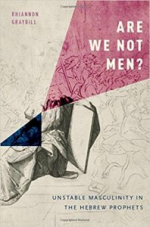
What does it mean to be a man? It is not an easy question to answer. One of the contributions of the field of masculinity studies has been to observe that masculinity is not a stable quality, but one that must be contested and negotiated in different contexts and between different groups. The malleable nature of masculinity has particular relevance in examining biblical characters. The frequent characterization in the biblical texts of God as male creates difficulties for men, an idea that has been detailed by Howard Eilberg-Schwartz. How does a person construct a relationship with the divine within social concepts of gender? Eilberg-Schwartz argues that the natural complementary partner for a male god would be a woman. To have a relationship with a male god, a male worshipper must assume the role of a woman. Because this relationship threatens normal standards of masculinity, women must be excluded from the cult entirely, in order to preserve a tenuous hold on maleness. Although Eilberg-Schwartz did not use this terminology, assuming a female identity in relation to God queers the male body. The male body is no longer exclusively male, but assumes an indeterminate gender identity, moving more toward the feminine. What does this do to the male psyche? What does this do to cultural concepts of women?
Rhiannon Graybill’s book Are We Not Men? takes an innovative approach to the issue. She explores the question of the queer bodies of men in relation to God, specifically the bodies of prophets, who have a direct and intimate connection to the divine.
more here.