
by Brooks Riley
Category: Recommended Reading
Liquid Kitsch: Wine, Beauty and the Obsession with Smooth
by Dwight Furrow

Sacred, lifesaving, having as precedent only those things which are themselves unprecedented, beauty has a fourth feature: it invites deliberation….Beauty almost without any effort of our own acquaints us with the mental event of conviction, and so pleasurable a mental state is this that ever afterwards one is willing to labour, struggle, wrestle with the world to locate enduring sources of conviction – to locate what is true. (Scarry, On Beauty and Being Just, 26-31)
For wine lovers scouring the globe for a glimpse of vinous perfection, Scarry's account of what beauty does surely rings true. However, although we toss the word beauty around quite freely, in the aesthetics of art it has fallen on hard times since early in the 20th Century. With the display of Duchamp's upside down urinal in a New York art studio in 1917 and the mass atrocities of WW1 and the Holocaust haunting artistic production throughout the rest of the century, the idea of beauty no longer seemed to capture what the art world was selling. The problem was that by the 20th Century beauty had been assimilated to what was "pretty", "charming", and easily accessible and had thus lost its power to enthrall or represent the more difficult aspects of human existence. Thus, the art world dumped beauty and embraced the sublime. Art became abstract, difficult, and for most of the public, inaccessible.
There are interesting parallels and cross-currents to this story about art that are beginning to unfold in the wine world today. In the past, prior to the 1980's, great wines were tough when first bottled taking years to develop in the cellar at which time they often developed aromas such as cigar box, old shoes and barnyard. Vintage variation was enormous especially in the storied vineyards of central France where unpredictable weather from the Atlantic Ocean inhibited the consistent ripening of grapes. In some years even great vineyards could produce only thin, weedy wines with harsh acidity and aggressive, under-ripe tannins prompting the addition of sugar to make the wine palatable. Furthermore, the presence of bacteria and the unpredictability of fermentations produced off flavors in the wine that contributed to a wine's character but also to a sense of adventure when opening a bottle. That was the good stuff. Vin ordinaire performed a plausible rendition of battery acid.
Sunday, March 25, 2018
How Genetics Is Changing Our Understanding of ‘Race’
David Reich in the New York Times:

Beginning in 1972, genetic findings began to be incorporated into this argument. That year, the geneticist Richard Lewontin published an important study of variation in protein types in blood. He grouped the human populations he analyzed into seven “races” — West Eurasians, Africans, East Asians, South Asians, Native Americans, Oceanians and Australians — and found that around 85 percent of variation in the protein types could be accounted for by variation within populations and “races,” and only 15 percent by variation across them. To the extent that there was variation among humans, he concluded, most of it was because of “differences between individuals.”
In this way, a consensus was established that among human populations there are no differences large enough to support the concept of “biological race.” Instead, it was argued, race is a “social construct,” a way of categorizing people that changes over time and across countries.
It is true that race is a social construct. It is also true, as Dr. Lewontin wrote, that human populations “are remarkably similar to each other” from a genetic point of view.
But over the years this consensus has morphed, seemingly without questioning, into an orthodoxy. The orthodoxy maintains that the average genetic differences among people grouped according to today’s racial terms are so trivial when it comes to any meaningful biological traits that those differences can be ignored.
More here.
Stephen Hawking’s “Final Theory” is not groundbreaking
Sabine Hossenfelder in Back Reaction:

The headlines refer to a paper titled “A Smooth Exit from Eternal Inflation” in collaboration with Thomas Hertog. The paper was originally uploaded to the arXiv in July last year, but it was updated two weeks ago. It is under review with “a leading journal” which I suspect but do not know is Physical Review D. Thomas Hertog gave a talk about this at the conference which I attended last summer. You can watch the video of Hertog’s talk here.
According to The Independent the paper contains “a theory explaining how we might detect parallel universes and a prediction for the end of the world.” Furthermore, we learn, “Hawking also theorised in his final work that scientists could find alternate universes using probes on space ships, allowing humans to form an even better understanding of our own universe, what else is out there and our place in the cosmos.”
In the Sunday Times you can read that the paper “shows how we might find other universes” and in The Telegraph you find a quote by Carlos Frenk, professor of cosmology at Durham University who said: “The intriguing idea in Hawking’s paper is that [the multiverse] left its imprint on the background radiation permeating our universe and we could measure it with a detector on a spaceship.”
Since the paper doesn’t say anything about detecting parallel universes, I was originally confused whether the headlines were referring to another paper. But no, Thomas Hertog confirmed to me that the paper in question is indeed the paper that is on the arXiv. There is no other paper.
So what does the paper say?
More here.
The Unfinished Quest for the Meaning of Quantum Physics
Peter Woit in Not Even Wrong:
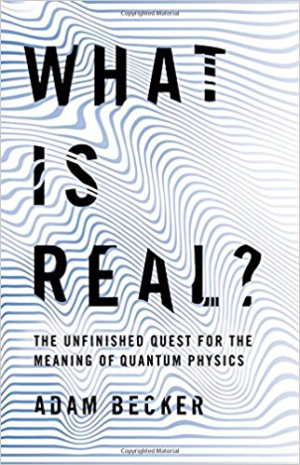
Unfortunately though, the author has decided to take a point of view on this topic that I think is quite problematic. To get an idea of the problem, here’s some of the promotional text for the book (yes, I know that this kind of text sometimes is exaggerated for effect):
A mishmash of solipsism and poor reasoning, [the] Copenhagen [interpretation] claims that questions about the fundamental nature of reality are meaningless. Albert Einstein and others were skeptical of Copenhagen when it was first developed. But buoyed by political expediency, personal attacks, and the research priorities of the military industrial complex, the Copenhagen interpretation has enjoyed undue acceptance for nearly a century.
The text then goes to describe Bohm, Everett and Bell as the “quantum rebels” trying to fight the good cause against Copenhagen.
Part of the problem with this good vs. evil story is that, as the book itself explains, it’s not at all clear what the “Copenhagen interpretation” actually is, other than a generic name for the point of view the generation of theorists such as Bohr, Heisenberg, Pauli, Wigner and von Neumann developed as they struggled to reconcile quantum and classical mechanics. They weren’t solipsists with poor reasoning skills, but trying to come to terms with the extremely non-trivial and difficult problem of how the classical physics formalism we use to describe observations emerges out of the more fundamental quantum mechanical formalism.
More here.
Emma Gonzalez Is Responsible for the Loudest Silence in the History of US Social Protest
Ari Berman in Mother Jones:

After reading the names of her classmates who were killed in the mass shooting, Gonzalez stood at the podium in silence for six minutes, fighting back tears. It was an incredible, chilling moment. All of the major cable networks carried it live. “Loudest silence in the history of US social protest,” my colleague David Corn tweeted.
“Never again,” many in the crowd of 500,000 chanted in response. After her timer went off, Gonzalez said, “since the time when I came out here, it has been six minutes and twenty seconds. The shooter has ceased shooting and will soon abandon his rifle, blend in with the students as they escape, and walk free for an hour before arrest,” she said. “Fight for your lives before it’s someone else’s job.” And then she left the stage.
More here.
nokie edwards (1935 – 2018)
hazel smith (1934 – 2018)
olly wilson (1937 – 2018)
Companion Species
Catherine Pond in Avidly:

Goodall is primarily concerned, in the early years captured by the movie, with a community of chimps centered around alpha male David Greybeard. The lone female of the group, Flo, captures Jane’s interest as well. For a while, Jane observes, interacts, and records the individual personalities of these spectacular primates. In the second half of the footage, though, tragedy strikes: Flo dies, leaving her children and the male chimpanzees bereft. And Jane witnesses something that undoes her prior understanding of the species: the male chimps devolve into violence.
By the end of their warring, one-third of the male chimps in the community lie dead in the river, limbs sprawled, as Goodall looks on with eyes the color of milk: glossy, tear-filled, she turns away from the camera. Her disappointment is far greater than if she had never assumed the goodness of the chimps in the first place: it is, in fact, not disappointment at all, but deep grief. I do not know what it was, for Jane, that restored her faith in the chimpanzees. I do not know how, after that blow, she regained her respect for them, but she did. Her love, though challenged, did not waver, despite witnessing for the first time the violence they were capable of, how in this way, too, they were like the humans she’d sought to avoid.
…In an excerpt from the 2015 New York Times article ‘Jane Goodall is Still Wild at Heart,’ author Paul Tullis describes Goodall’s realization in the early 90s that “there would be no…habitat” for her chimps “if poverty continued to force a growing human population to chop down trees for farmland and firewood. [It] convinced her that the chimps’ lot could not improve until that of the people living near them did.” Thus began “an abrupt career shift, from scientist to conservationist.” Suddenly, Jane’s work bridged an interesting gap.
More here.
Trust Your Own Heart, Write Your Own Story and Fight On
Amy Chozick in The New York Times:
DEAR MADAM PRESIDENT
An Open Letter to the Women Who Will Run the World
By Jennifer Palmieri
180 pp. Grand Central Publishing. $20.

In any other election year, an advice book from a high-ranking campaign official on the losing candidate’s side wouldn’t have much coin. But 2016 wasn’t like any other election year, and as it turns out Palmieri has plenty of wisdom — and even a little dish about Clinton — to dispense. In this slim volume, Palmieri neatly weaves her heartbreaking personal story of losing her sister to Alzheimer’s weeks after losing the election with lessons learned from her long career in Democratic politics and Mitch Albom-style wisdom (“When the unimaginable happens, imagine what else may be possible”). Palmieri had been President Obama’s White House communications director when she agreed to join the Clinton campaign. She (like most of us) thought Clinton would win and didn’t think her gender would be much of an obstacle, especially after Obama had broken racial barriers. Clinton warned Palmieri otherwise. Before the race started, Clinton “held forth for more than an hour” to recap each scandal, from the uproar in Arkansas when she resisted taking Bill Clinton’s name to the White House and her doomed 2008 presidential campaign. “She was as bewildered as anyone by the phenomenon of ‘Hillary Clinton,’” Palmieri writes.
More here.
Saturday, March 24, 2018
The Chinese Typewriter: A History
Jamie Fisher in the London Review of Books:
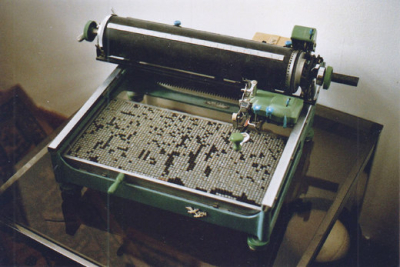
Long before it could be a technological reality, the Chinese typewriter was a famous non-object. In 1900, the San Francisco Examiner described a mythical Chinatown typewriter with a 12-foot keyboard and 5000 keys. The joke caught on, playing to Western conceptions of the Chinese language as incomprehensible, impractical and above all baroque: cartoons showed mandarins in flowing robes, clambering up and down staircases of keys or key-thumping in caverns. ‘After all,’ Thomas Mullaney writes, ‘if a Chinese typewriter is really the size of two ping-pong tables put together, need anything more be said about the deficiencies of the Chinese language?’ To many Western eyes, the characters were so exotic that they seemed to raise philosophical, rather than mechanical, questions. Technical concerns masqueraded as ‘irresolvable Zen kōans’: ‘What is Morse code without letters? What is a typewriter without keys?’ A Chinese typewriter was an oxymoron.
More here. [Thanks to Ali Minai.]
Scott Aaronson’s Review of Steven Pinker’s Enlightenment Now
Scott Aaronson in Shtetl-Optimized:
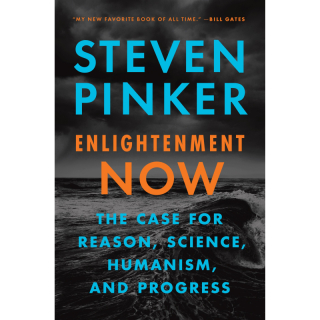
I’ve noticed that everything Pinker writes bears the scars of the hostile mistranslation tactic. Scarcely does he say anything before he turns around and says, “and here’s what I’m not saying”—and then proceeds to ward off five different misreadings so wild they wouldn’t have occurred to me, but then if you read Leon Wieseltier or John Gray or his other critics, there the misreadings are, trotted out triumphantly; it doesn’t even matter how much time Pinker spent trying to prevent them.
More here.
Wael Ghonim: Egypt’s revolution, My life, and My Broken Soul
Wael Ghonim:

I had lived most of my life as an outsider. I never belonged to a majority. As a child, I was the Egyptian kid growing up in Saudi Arabia, and when I moved to Egypt at the age of 13, I became “the kid who came back from Saudi.” At 17, I became religious, and my family and friends called me an extremist. At 30, I was an anonymous activist–who barely knew any activists. And now, at 37, I’m the Egyptian who just moved to the US and is once again struggling to prove his worth.
My early childhood seems to have been contained in a sheltered bubble I went to private schools in Saudi Arabia and Egypt, spent most of my time at home, and my parents knew everything about my friends. But at the age of 14, I burst that bubble. I decided to leave private school and join a public one.
On the first day in public school, I was shocked. Our classroom had benches for forty students but we were over seventy. There was no fan, no AC, no ventilation. The school yard was huge, but not enough to accommodate the thousands of students.
In my third day at school, a fight erupted in the yard. Kids were throwing rocks randomly in the middle of the yard. I saw blood, knives, and swords. The screams of anger and the ambulance sirens were all that I could hear.
More here.
Why Are There So Many Iranians in Los Angeles?
On Thom Gunn’s Selected Poems
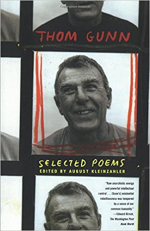
In “On the Move,” the verse-rhythm is already more susceptible, and uncertain, than it seems. The commas in the first two lines quoted are marvelously controlled — a delight for the savoring ear — but they also register that “doubt” which is eventually strapped in and hidden (where the fitting of rhyme to rhyme is the poet’s own version of this process). Writing of Thomas Hardy, Gunn says his “poetry is almost always robust, never fretful or neurotic.” Yet, in this poem, the hidden neurosis is acknowledged. And we shouldn’t miss, in either the essay on Hardy or “On the Move,” the genuinely mitigating (rather than habitual) word “almost” — as crucial here as when it appears twice at the close of Larkin’s “An Arundel Tomb,” from which it tends to vanish whenever that poem is sentimentally quoted. The internal rhyme with “dust” and “robust” emphasizes the word: Gunn won’t wholly idealize his kinetic toughs.
Comparing this with the verse of his following books, we see how Gunn gradually learned to combine his rhymes with soft-hard meter. “In Santa Maria del Popolo” is slicker, less insistent and more insinuating — the syntactical distensions have become second nature. In 1965, Gunn collaborated with his brother Ander on the photo-book Positives (only “The Old Woman” makes the cut here); two years later, Touch appeared, containing the sequence “Misanthropos” (solipsism diagrammed, with a diamond-point chisel), and also the famous title poem.
more here.
Waiting for Steven Pinker’s enlightenment
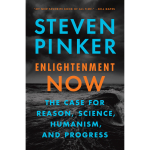
Pinker might also have to concede that, especially outside of France, most Enlightenment thinkers did not oppose reason to religious faith, as his book implies. They certainly did not consider forms of belief “generators of delusions” or consider a belief in the existence of the soul dangerous. He might have to admit that it was not just brave atheists, but devout Christians, above all Quakers, who were among the first who organized to fight the most barbaric European practice of all, namely slavery.
Historians know that there was in fact no single, monolithic “Enlightenment project,” and that the Enlightenment can be generalized about only with great caution. Throwing this caution to the wind, Pinker has taken his own 21st-century values and projected them back onto the intellectual scene of the 18th century. He has described his work as an “evidence-based take on history,” but by “evidence” he clearly means numerical data. Aren’t books evidence as well?
Meanwhile, Pinker fails to acknowledge how very closely his own radical optimism echoes some of the wilder—and more misguided—pronouncements about the human future from the Enlightenment itself. “The human species…is capable of…unbounded improvement…mankind in a later age are greatly superior to mankind in a former age.”
more here.
Le Corbusier’s Modernism in India

Doshi was not alone in infusing Le Corbusier’s modernism with an Indian spirit. A small school of other architects—Charles Correa, Ranjit Sabikhi, Raj Rewal—joined him in this idiom between the nineteen-sixties and the eighties. The Indian state was still building itself out, so there were plenty of public commissions on offer, and the socialist temper of the times agreed with these architects’ interest in planning for utopia. They were displaced only a couple of decades ago, when the country’s economy opened up and a global design aesthetic blew in. Commissions now come from companies that seem to want their buildings to fit into a universal ideal of a central business district. The most ambitious government-funded project in decades—the design of Amaravati, a new state capital—lies in the hands of the world-trotting English starchitect Norman Foster.
India isn’t always a pleasant country for architects. “In some way, architecture has been associated with the country’s urban problems,” Gautam Bhatia, an architect in New Delhi, told me. “The housing is insufficient, the infrastructure is insufficient. When you have these problems, is it even ethical to worry about design? There’s a strange guilt the profession harbors.” Most architects, as a result, work on private commissions, Bhatia said.
more here.
Mary Gordon & Glenda Jackson Talk Poetry, Theater and the State of Feminism
Boris Kachka in The New York Times:

MG: How would you define yourself as an actor in the British tradition?
GJ: I benefited from that huge change in British theater otherwise known as [playwright] John Osborne. When I left drama school, the director said to me, “Don’t expect to work much before you’re 40, because you’re essentially a character actress.” And that was a very accurate assessment, because the British theater then was still essentially a middle-class world. Then Osborne wrote “Look Back in Anger” (1956), and the whole thing just exploded.
MG: I saw “Stevie” (1977) in the West End in London [starring Jackson as British poet Stevie Smith]. I adore her work, and she is just tough as an old boot. Funny, but looks at the darkest things. As Emily Dickinson said, “Tell the truth but tell it slant.”
GJ: I’m so pleased you said that, because I’m a big fan of Emily Dickinson. The view of both Stevie and Emily Dickinson seems to be that here were these two solitary, depressed, lonely women, but they lived in these fantastic worlds!
MG: They’re great, greater than anybody around at that time. But their forms are small. And so, female gets defined as minor. Some of American women writers’ best work was done in the form of the short story: Flannery O’Connor, Eudora Welty, Katherine Anne Porter, Jean Stafford. I think what’s funny is around the same time that Emily Dickinson wrote, “I’m nobody! Who are you?” Whitman wrote, “I am large, I contain multitudes.”
GJ: [Laughs] Well, we had a program, years I’m going back now. This woman went back to Oxford to speak at her college. There’d been a big upsurge in women going to university, but it was very rare that a woman had a first-class degree. So she asked her old professor why, and this professor — also a woman — said because their examiners are still in the main men, and they like a lot of flash and filigree, whereas women go to endless lengths of attribution and details.
MG: I teach at a women’s college, Barnard, across the street from Columbia, which used to be male for donkey’s years, and I say to my students, “Do not speak into your collar when you tell me your name. There are men across the street saying things of immense stupidity at the top of their lungs!”
More here.
Saturday Poem
Syntax
Occasionally a god speaks to you,
rutted tollway a flint knife breaching
gutted fields hung on event
horizon, clear cut contradiction
through soybeans and sheared corn: blue
pickup an orange blaze, white letters
blistered, boiling down to tarmac,
asphalt, sulfur fume cured by a methane
gas burn-off pipe, blue flame chipped
with white raising a buttress of weather
-burnt bricks, flaking wind
totem. We stopped to take some cargo
on, weighted October with a freight
of waiting snow traveling east, panic of
starlings startled from stubble husks
by a harvest moon dangled directly
ahead: drove into the pitted sphere, bloody
pearl punched in a sky just out of reach
(vanishing point retreating, peeling),
one of the yellowed streetlights
by now, dimming, diminishing. The road
says to perspective, wait.
.
by Reginald Shepherd
from Otherhood: Poems by Reginald Shepherd
University of Pittsberg Press