Monday Poem

In the Middle of Hosanna

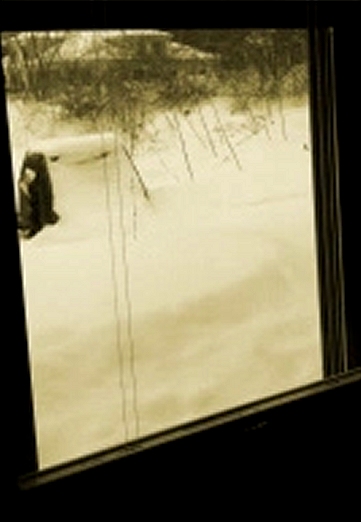
snow’s piled against the generator Hosanna
smooth white talus
at the foot of sheer thought in
arctic regions of mind

through glass the near tangle
of bare forsythia beneath draped wires
pole to pole is a snap of unchecked ruminations
that fold upon themselves in crazy chiaroscuro
a dispensation of light expected in a skull of whims
while further right the barrel arc of a stone wall
familiar now as arrays of spots on the back of a hand
is as solid as the conviction of crystals in a cool savanna
between here and the neighbor’s shed in the middle of
hosanna!
.

Jim Culleny
2/12/17

Freedom, private property, and public access

by Emrys Westacott

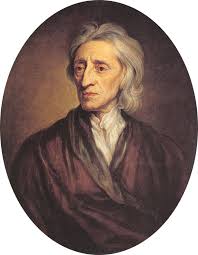
Unknown-1The concept of individual freedom has been central to political philosophy since the time of John Locke, who published his groundbreaking Two Treatises on Civil Government in 1689. Before then, other values were paramount—for example: conformity to God's will, the cultivation of moral virtue in the population, social stability, national power, material prosperity, the quality of the culture, or the glory of the sovereign. These are criteria by which a society might be judged and compared to other societies. The happiness of the population can also be added to this list, although this is usually assumed to be a direct consequence of some of those other goods.

But the modern liberal tradition, which begins in the 17th century with thinkers like Locke, is virtually defined by the central importance given to individual freedom and individual rights. And these come to be viewed as deal-breakers. It doesn't matter how stable the society, or how materially prosperous, or how happy the population; the fundamental rights and liberties of individuals should not be sacrificed just to secure these other goods.

Of course, who should count as an individual endowed with sacrosanct rights has, from the outset, been a topic of controversy. Even now, when no respectable thinker would defend the denial of equal rights on grounds of sex, race, or religion, there are still controversies over the rights of immigrants, children, prisoners, convicted felons, and animals.

The exact meaning of freedom has also never been agreed upon. John Stuart Mill's "harm principle" provides a basic starting point: each person should be free to do as they please so long as they do no harm to anyone else. But specifying what constitutes "harm" is difficult. Am I harming my neighbors if I erect a hideous sculpture on my front lawn? Am I harming you if I say something that offends you? Am I harming society, or a section of it, if I advocate racial segregation or deny the Holocaust?

Read more »

FIVE STARS FOR US! A REVIEW OF STEVEN SPIELBERG’S “THE POST”

by Richard King

The-Post-character-posters-2-600x876I was just four months old when the Pentagon Papers were published in 1971, but I remember very distinctly the mixed emotions that ran through my mind when I first clapped eyes on that historic edition of the New York Times in my local library. For here was everything I loathed and loved in one incredible revelation! On the one hand, imperialism, war and corruption. On the other, the First Amendment and the Fourth Estate. "Mother," I said, as she swiped the paper from the hands of a startled pensioner, "Mother, darling – mark this day! For though a dark cloud in the progress of our species, it has about it a silver lining that in future years will be as a beacon to good men and women of the press the world over! Dry your eyes, mother mine. Here, use my handkerchief." I was a precocious child.

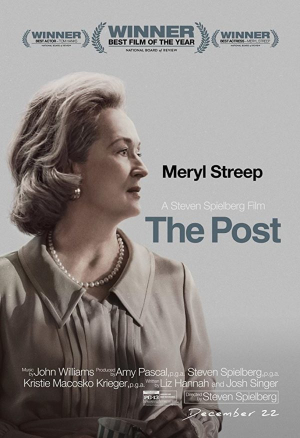
It would be nice, would it not, to rewrite history in a way that made ourselves central to the story, and that made us appear more relevant and prescient and brilliant than we actually are. It would be ludicrous as well, of course, though that doesn't stop some people doing it, especially those who write for a living. I've grumbled before that the "media culpa" following the 2016 US election disguised a deep strain of self-congratulation, as the dead-tree press and major stations affected to glorify themselves with faint praise. ("If only we'd had our game-face on, this tragedy might never have happened!") Now I must return to the subject, one Steven Spielberg having entered the field with a film that polishes the MSM's image to a high and self-reflecting shine. The Post is rather good, as it happens; but it's also very, very bad.

The key points in the narrative are a matter of historical record, so I imagine we can dispense with the spoiler alerts. In 1969 military analyst Daniel Ellsberg made photocopies of ‘the Pentagon Papers', aka United States–Vietnam Relations, 1945–1967: A Study Prepared by the Department of Defense. The documents revealed, inter alia, that the US government had lied "systematically" about the ongoing war in Vietnam and that it had secretly spread the war to Cambodia and Laos. Ellsberg passed the documents to Neil Sheehan, a reporter for the New York Times, and on June 13, 1971, the Times published the first of nine excerpts from the Papers, together with editorial commentaries. On June 15, the Nixon administration sought, and was granted, a court injunction preventing further publication, so Ellsberg passed copies of the documents to Ben Bagdikian at the Washington Post. After much agonising and internal argument, and in defiance of the Attorney General, the Post began running its own series of articles on the Papers on June 18. On June 30, the Supreme Court ruled in favour of the New York Times, putting the Post (and other papers) in the clear.

Read more »

Dialethic Dialectic

by Carl Pierer

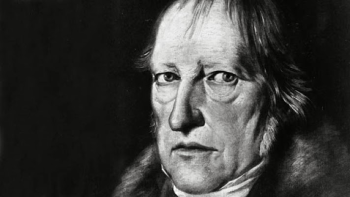
HegelHistorically, formal logic and Hegel's philosophy's relation has been dominated by antipathy. Classical logic, developing from Aristotelian logic to the Frege/Russell logic of the 20th century, has largely rejected Hegel because of his overt embrace of contradictions. Hegel, vice-versa, has not been too charitable to the formal logic of his day. In the second half of the 20th century, however, formal logic has developed massively and in various directions. One of these, paraconsistent logics, have attempted to accommodate contradictions. Classical logic is anathema to contradictions, due to the explosion principle, a.k.a. ex falso quodlibet. A sketch of this principle is the following: since the classical or is non-exclusive, if we start with a true proposition A, the disjunct A or B is true for any proposition B. So, if we have A&~A, we get that A is true and hence A or B is true. But since ~A is true, too, from A or B we get that B must be true. Hence anything follows from a contradiction, or so the classical (and subsequently the Frege/Russell logic) claims. So contradictions seem to be a rather bad thing.

Now, paraconsistent logics deny this explosion principle. There are different ways of doing this, but we will stick with Priest's way in his (Priest, 1989). His is a dialethic interpretation, meaning that he thinks there are sentences that are both true and false. This has some interesting consequences. Note, first of all, that this does not mean that all sentences are true and false. Most importantly, most classical notions are indeed preserve. So, we have, for propositions A and B:

  • ~A is true implies A is false
  • A is true implies ~A is false
  • A&B is true only if A is true and B is true
  • A&B is false only if at least one of A or B is false

These are quite orthodox. Now, of course, on the dialethic point of view, A could be both true and false, and suppose B is true. Then A&B is both true and false. Next, we need the notion of logical consequence, which Priest defines also quite classically:

A is a logical truth just if A is (at least) true under all assignments of values.

A is a logical consequence of B just if every assignment of values that make B (at least) true makes A (at least) true.(Priest, 1989)

What does this mean exactly?

Read more »

Cautionary Fables for Darwin’s Birthday

by Mike Bendzela

ScreenHunter_2964 Feb. 12 16.19Tribes

In the great class of mammalian vertebrates, antagonism arose between the egg-laying monotremes and the marsupials. Neither side could see the other on its own terms, each insisting it was the True Mammal.

An opossum (Didelphis) complained, “The platypus is a shameful pretender! It won’t admit that it is a failed duck, a builder of nests and hatcher of puggles, unable to fly!”

For its part, the platypus (Ornithorhynchus) sought revenge on the marsupials by sowing doubt about their child-rearing abilities: “We’ve seen the opossum abandon its newborn babies at birth! The poor things are doomed to forage for a nipple and live in a pocket!”

Moral: Steady misrepresentation is the chief hazard of tribal membership.

Monitor Lizard versus Cobra

Some monitor lizards (Varanus) that were opposed to the increasing presence of cobras (Ophiophagus) in their midst, held a public meeting to air their concerns. One outspoken lizard said to those gathered, “Fellow Lizards! The cobras intend to surround us, defeat us, and take our land. But they won’t stop there; we all know how snakes are. If we don’t do something quickly, they will swallow all our young!” Inflamed by this speech, the lizards quickly mobilized. They sought out the snakes, surrounded them, and defeated them. But for reasons no one has been able to fathom, the triumphant lizards then devoured every snake egg they could find.

Moral: The most depraved acts may be committed in the name of preventing depravity.

Read more »

Sunday, February 11, 2018

Fake news and the gatekeepers of truth

Kenan Malik in Pandaemonium:

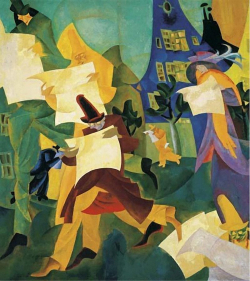
Lyonel-feininger-newspaper-readersBefore Facebook, there was the coffee house. In the 17th-century, panic gripped British royal circles that these newly established drinking salons had become forums for political dissent. In 1672, Charles II issued a proclamation ‘to restrain the Spreading of False News’ that was helping ‘to nourish an universal Jealousie and Dissatisfaction in the minds of all His Majesties good subjects’.

Now, 350 years on, legislators across the world are seeking to do the same. Last week, the House of Commons digital culture, media and sport committee flew to Washington DC to grill representatives of big tech companies, including Facebook, Twitter and Google. The title of their session echoed Charles II: ‘How can social media platforms help stop the spread of fake news?’

If there is a long history to fears about fake news, there is a long history to fake news, too. In 1924, four days before a general election, the Daily Mail published the forged Zinoviev letter, a supposed directive from Moscow to British communists to mobilise ‘sympathetic forces’ in the Labour party; Labour lost the election by a landslide.

In the wake of the Broadwater Farm riot of 1985, in which a policeman, PC Keith Blakelock, was hacked to death, the police and the press organised a lurid campaign against the key suspect, Winston Silcott, depicting him as the ‘Beast of Broadwater Farm’. Convicted on the basis of virtually no evidence, he was released three years later after it was shown that the police had forged their interview notes.

More here.

Plagiarism Software Unveils a New Source for 11 of Shakespeare’s Plays

Michael Blanding in the New York Times:

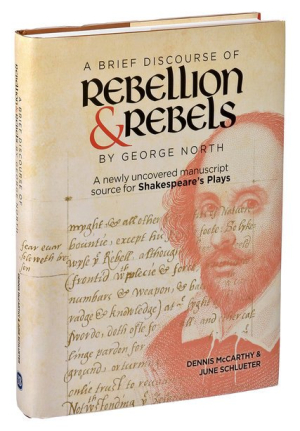
Shakespeare-bookcover-blog427For years scholars have debated what inspired William Shakespeare’s writings. Now, with the help of software typically used by professors to nab cheating students, two writers have discovered an unpublished manuscript they believe the Bard of Avon consulted to write “King Lear,” “Macbeth,” “Richard III,” “Henry V” and seven other plays.

The news has caused Shakespeareans to sit up and take notice.

“If it proves to be what they say it is, it is a once-in-a-generation — or several generations — find,” said Michael Witmore, director of the Folger Shakespeare Library in Washington.

The findings were made by Dennis McCarthy and June Schlueter, who describe them in a book to be published next week by the academic press D. S. Brewer and the British Library. The authors are not suggesting that Shakespeare plagiarized but rather that he read and was inspired by a manuscript titled “A Brief Discourse of Rebellion and Rebels,” written in the late 1500s by George North, a minor figure in the court of Queen Elizabeth, who served as an ambassador to Sweden.

“It’s a source that he keeps coming back to,” said Mr. McCarthy, a self-taught Shakespeare scholar, during a recent interview at his home in North Hampton, N.H. “It affects the language, it shapes the scenes and it, to a certain extent, really even influences the philosophy of the plays.”

More here. [Thanks to Laura Claridge.]

The search for Jackie Wallace

Ted Jackson in The Times-Picayune:

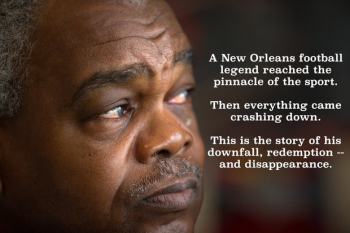
Jackie-wallace---fumbles-and-recoveries-e4592a158522769cOne foot in front of the other, the hulking old man trudged up the ramp to the Pontchartrain Expressway. A cold wind stiffened his face, so he bundled tighter and kept walking. His decision was made. A life full of accolades and praise meant nothing to him now. A man who was once the pride of his New Orleans hometown, his St. Augustine alma mater and his 7th Ward family and friends was undone. He was on his way to die.

The man was tired. In his 63 years, he had run with the gods and slept with the devil. Living low and getting high had become as routine as taking a breath. A hideous disease was eating his insides. He was an alcoholic, and he also craved crack cocaine. He was tired of fighting. He was tired of playing the game.

He crossed the last exit ramp and continued walking the pavement toward the top of the bridge. He dodged cars as they took the ramp. No one seemed to notice the ragged man walking to his suicide. If they did notice, they didn’t stop to help.

Only a half-mile more and it would all be over. One hundred and 50 feet below, the powerful currents of the Mississippi River would swallow his soul and his wretched life. He dodged another car. But why did it matter? Getting hit by a car would serve his purposes just as well as jumping.

How did it come to this? This was long after Jackie had turned his life around, or so we both thought.

More here.

The U.S. is not one two-party nation but two one-party nations

Julia Azari in FiveThirtyEight:

Divisions-4x3We’re now one year into the Trump era, and politics seems more nasty, divided and polarized than ever. A government shutdown is imminent over immigration policy. Congress hasn’t passed a single, major bipartisan bill. President Trump’s approval rating among Democrats has fallen to 5 percent. Some reports suggest that a quarter of Americans have real animosity toward the other party. You’d be forgiven for wondering why we can’t just go back to those halcyon days of bipartisanship. Remember when Ronald Reagan and Tip O’Neill would supposedly come to compromise over drinks?

Here’s the thing: By some measures, the United States is more partisan than ever, but that more peaceful and unified past, that golden age of unity, was … pretty much never.

Let’s think for a moment about what the nature of political division looks like right now in the U.S. Using presidential election results, my FiveThirtyEight colleague David Wasserman found that elections are getting less and less competitive at the county level; a record number of counties in 2016 voted for either Trump or Hillary Clinton in a blowout. This is consistent with findings in political science that even when national presidential races are competitive, many individual states are not. Political scientists have characterized the polarized U.S. as “two one-party nations,” instead of one two-party nation.

The issues we fight over — gender, race, immigration, culture and the role of government — divideAmericans neatly and consistently under party labels. The current moment feels divisive because major policy and political questions are “sorted” between the parties — Republicans are mostly unified around one set of answers, and Democrats are mostly unified around another.

More here.

The Spanking Debate is Over

Noam Shpancer in Quillette:

MaxPixel.freegreatpicture.com-Sad-Crying-Sadness-Boy-Kid-Tears-Child-Mood-219721The scientific case against spanking is one of those rare occasions in which, over a span of 50 years or so, a scientific controversy actually gets resolved, as various programs of increasingly rigorous research converge upon a consensus conclusion.

True, the issue has not been 100% mapped out. Waiting for social science to map any issue out 100% is like waiting for the perfect spouse. You’ll wait forever, pointlessly. Spanking, like any socio-behavioral phenomenon, is bound to have somewhat differing implications depending on multiple variables such as culture, timing, dose, gender, what definition of spanking is used, etc. Local skirmishes about this will continue.

Another hindrance to an air-tight resolution concerns the fact that, due to ethical constraints (you can’t randomly assign parents to spanking and non spanking groups or assign children randomly to parents), true experimentation in this area is all but impossible. In the absence of experimental evidence, causal relations are difficult to establish with certainty. Finding, as we have, that spanking strongly and consistently predicts negative developmental outcome does not in itself settle the question of whether spanking has caused the outcome.

The spanking literature, however, has addressed itself to this problem in several ways.

More here.

Rise up Women!

Caroline Moorehead in The Guardian:

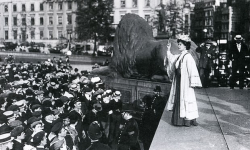
WomenOn 21 June 1908, half a million people gathered in Hyde Park to celebrate “Women’s Sunday”. There were 30 brass bands, bugles and 20 platforms with speakers wearing the purple, white and green colours of the votes for women campaigners. It was, for the most part, a good-humoured event, but it did not persuade the government to extend the franchise to women. Since peaceful protest had clearly failed, Christabel Pankhurst warned the prime minister, Herbert Asquith, “militant methods must once more be resorted to”. What we remember today of the suffragette movement is the image, captured on grainy film, of Emily Davison, the former governess and journalist, throwing herself under the king’s horse at the Epsom Derby on 4 June 1913, and dying four days later of a fractured skull. But as Diane Atkinson makes clear in her collective biography of the movement for women’s suffrage that took place between 1903 and 1914, this was merely the culmination of a decade of relentless confrontation, some of it extremely violent, drawing in not only the middle classes but factory workers, shop girls, teachers and housewives up and down the country, many of them prepared to go to prison again and again for acts that grew increasingly dangerous.

By 1903, seven countries, among them New Zealand and Australia, had accorded some degree of voting rights to women. In Britain, before 1832 some women had a parliamentary vote as property owners, but they were excluded in 1832 by the Reform Act, which extended the franchise to “male persons” over 21, including small landowners, tenant farmers and shopkeepers. The word “male” sparked unease: since the monarch was a woman, had the moment not come to let all women vote? A number of reformers joined forces, gathered signatures and petitioned parliament, but the “shrieking sisters” were briskly brushed aside.

More here.

Saturday, February 10, 2018

Massimo Pigliucci: My modest take on five big philosophical questions

Massimo Pigliucci in Footnotes to Plato:

Number-5An anonymous poster has recently published a short essay over at the Oxford University Press philosophy blog, entitled “5 great unsolved philosophical questions.” How could I possibly resist answering them, I ask you? Presumptuous, you might say. Well, no, that would be the case if I claimed that my answers are original, or clearly the right ones. I make no such claim, I am simply offering my informed opinion about them, in my dual role of a philosopher and scientist. Of course, I’m also totally right.

Before proceeding, I need to remind readers of my take on the nature of philosophical questions, and therefore of philosophy itself. Here it is, in a nutshell. (For a much longer, and far more substantiated, though of course not necessarily convincing to everyone, answer, see here.)

Philosophy began, in the Western tradition, with the pre-Socratics, and at that time, and for many centuries afterwards, its business was all-encompassing. Pretty much every meaningful question to be asked was philosophical, or had a philosophical component. Then gradually, mathematics was spun off as one of many offsprings from Mother Philosophy, followed from the 17th century on by a succession of what today we call sciences: first physics, then chemistry, biology, and eventually psychology. That did not mean any shrinking of philosophy itself, however. The discipline retained its core (metaphysics, ethics, aesthetics, logic, epistemology, and so forth) and added just as many “philosophies of” as new disciplines originated from it (e.g., philosophy of science, of language, of mind, and so forth).

In modern times, I think the business of philosophy is no longer trying to attain empirical truths about the world (we’ve got science for that), but rather to critically explore concepts and notions informed, whenever possible, by science.

More here.

Sounding out swarms: Midges offer unique insights into collective behaviour

Jennifer Ouellette in Physics World:

PW2018-02-oullette_FrontisNicholas Ouellette likes midges. Yes, these tiny flies are infuriating and can bite, but Ouellette, who’s a physicist by training, is intrigued by how and why these insects form giant swarms, sometimes thousands strong. We know the swarms are composed entirely of male midges, which have long antennae and beat their wings at nearly twice the frequency of the females. Attracted by the high-pitched sounds, the females fly towards the swarm in the hope of reproducing, which makes swarming an elaborate midge-mating ritual.

The sensitivity of midges to sound was allegedly discovered by a Finnish ecologist in the 1960s while out walking in the woods. As he sang local folk songs, the ecologist noticed swarms of these flies being irresistibly drawn into his path, seemingly by the sound of his voice. Ouellette knew, however, that he’d need something more scientific than singing folk songs if he was to study swarming using sound. He therefore got one of the postdocs in his lab at Stanford UniversityRui Ni (now at Pennsylvania State University) – to track midges with a microphone and record the beating of their wings.

When Ni and Ouellette blasted the buzzing of swarming midges back at them through a loudspeaker, they noticed some unusual things. If they alternated the level of sound played back through the speaker – loud, soft, loud, soft – the region of highest midge density shifted with the change in volume. And when they played just the sound of a female through the speaker (you can easily spot the females as they lack antennae), the entire male swarm flew over and sat on it.

More here.

Coerced Confession, Miracle Exoneration: The Case of Ex-Monster Jerry Hobbs

Stephen T. Asma in TruthOut:

013011asma"How will you make sure the dirt stays inside the sandwich?" I asked my brother Dave. He was trying to figure out how to send a dirt sandwich to Nancy Grace, the shrieking CNN legal analyst and gossip show host. In 2005, Grace told viewers she was so convinced Jerry Hobbs killed his daughter that she would gladly eat a dirt sandwich if police failed to turn up the physical evidence. My brother Dave and a handful of public defenders finally proved that Jerry was innocent and paved the way for his release in August 2010.

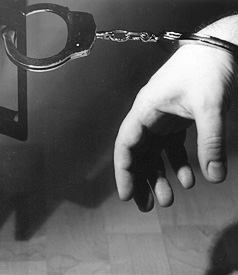
On Mother's Day, May 2005, as the sun began to set in a rural part of Zion, Illinois, Jerry Hobbs grew anxious that his eight-year-old daughter Laura was not back home yet. Laura and her friend, nine-year-old Krystal Tobias, were last seen sharing a single bike around the wooded suburban community north of Chicago. But by nightfall, it became clear that both girls were missing. A frantic search ensued. Jerry and others searched throughout the night and, at daybreak, it was Jerry himself who found his daughter and her friend stabbed to death in the nearby woods of Beulah Park. Several hours later, the distraught father found himself sequestered in a legal "blacksite" – unlocatable to family, friends and legal representation – and under intense interrogation by police.

Within forty-eight hours, Jerry Hobbs, now "Monster Hobbs," was arrested for the murder of Laura and Krystal. This is the inside story of Hobbs' exoneration five years later and his drive back to Texas with my brother Dave.

More here.