Goodbye My Friend, We In India Will Be Denied Your Last Deedar

Syeda Hameed in The Citizen:

Phaili hain fizaon mein iss tarah teri yaadein
Jis simt nazar unthi awaaz teri aaiyee
Sau baar chaman mehka sau baar bahaar aiyee
Duniya ki wohi raunaq dil ki wohi tanhai
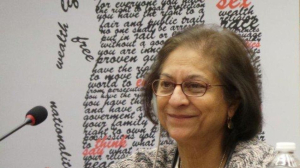
Aasma2You lit up my life as you did the life of thousands like me. Dear friend and mentor Asma Jahangir who would have thought I was seeing you for the last time on November 28 2017, the date is etched on my heart.

On reaching Lahore I wrote to you. You had just returned from Islamabad after a difficult day. But your home and hospitality was ready to welcome me. It was an unforgettable evening around your splendid table with family, friends, bonhomie. Then I heard from you the saddest words I had ever heard you speak. We were talking about the total embargo on visas. Friends from Pakistan were longing to come to India; there were family weddings, there was Jashn e Rekhta, personal bereavements. But visa doors had been slammed on the faces of all applicants. With exception though. I said to you, 'Why don't you come, you are the only one in Pakistan who still has a multiple entry visa'. Then came your heart wrenching words. 'It's not about me. It's about all of us here on this side of the border. Ab dil nahin chahta...we feel unwanted by a country we have stood by consistently for a quarter century despite every possible deterrent'.

Today her janaza procession will be led by her indomitable sister Hina Jilani and carried on the shoulders of women of WAF (Womens Action Forum) which she helped found in the 1970's. But none of us from this side will be there. It would have been so simple for dozens of us to have driven our vehicles for 6 hours. It is only 300 miles from Delhi to Lahore. We who have been choking back our tears ever since the news broke will be denied her last deedar.

We will sit in Delhi and recall the year 2000 when at the height of Kargil she brought to Delhi 72 women in two buses under the banner of WIPSA (Womens Initiative for Peace in South Asia). When the buses pulled into Ambedkar Bus Depot, many of us were there with flowers. The first one to disembark was a small slightly built woman, holding in her hands two white pigeons. The hands opened, the pigeons fluttered away in the Indian skies. That was Asma Jahangir.

The same woman who was the first to welcome a bus load of Indian women who had gone to Lahore on Bus of Peace led by Nirmala Deshapande and Mohini Giri. She came to receive us at Lahore's Faletti's Hotel with bangles and dupattas for each musafir, breaking both stereotypes, in this one Asma-stroke, both became symbols of power.

More here.

Wednesday, February 14, 2018

The non-problem of moral luck

Massimo Pigliucci in Footnotes to Plato:

Nup_178287_0528The Good Place is an unusual comedy on NBC, featuring a professor of moral philosophy among its main characters. My friend Skye Cleary has interviewed the real life philosopher who consults for the show, Todd May of Clemson University, for the blog of the American Philosophical Association. The exchange is definitely worth a read. In this post I will make an argument that one can learn more about moral philosophy from watching a single episode of the show than by listening to a technical talk in that same field while attending the APA’s own annual meeting.

Episode five of the second season of TGP features a sophisticated discussion of the infamous trolley problem, a thought experiment in ethics that has by now generated a cottage industry among both philosophers and neuroscientists. I will not explain for the n-th time what the problem consists of, you can look it up on Wikipedia. Suffice to say that the more I study virtue ethics, the more I become skeptical of the value of much modern moral philosophy, with its indulging in more and more convoluted hypothetical situations that seem to be designed more to show off the cleverness of the people working in the field than to actually help the rest of us live an ethical life. It is no coincidence that the dilemma is always framed in terms of what a deontologist or a utilitarian would do, those two frameworks having gotten further and further away from any relevance to real life, contra to what either Immanuel Kant or John Stuart Mill surely intended.

At any rate, the episode in question features a theoretical lecture on trolleys by the resident philosophical character, Chidi (played by the excellent William Jackson Harper). One of those on the receiving end of the lecture is the demon-turning-good-guy Michael (played by the awesome Ted Danson). During the lecture, Michael becomes impatient with the theory, so he snaps his fingers and transports Chidi, his friend Eleanor (played by Kristen Bell) and himself aboard an actual trolley, about to kill what appear to be real people. Michael then asks Chidi for a real-life demonstration: what is the philosopher going to do when suddenly faced with the dilemma, in the field, so to speak? Hilarity (and mayhem) quickly ensue. The episode is so good that I made my students watch it and comment on it.

More here.

Why Asma Jahangir was Pakistan’s social conscience

Moni Mohsin in The Guardian:

ScreenHunter_2968 Feb. 14 19.29She stood a smidgen over 5ft and had fine, delicate bones. But the bird-like frame contained a courageous heart, an indomitable will and an unflagging social conscience. The death of Asma Jahangir, the Pakistani activist, lawyer and human rights campaigner who passed away on Sunday after suffering a cardiac arrest at her home in Lahore, has left a nation reeling with a profound sense of loss.

Looking through social media I am not surprised by the number of tributes to her, but by the fact that they come from her detractors as well as her supporters. The conservatives who branded her a traitor until last week are now acknowledging her courage. Whether that is out of political expediency or genuine feeling I cannot say. But for the besieged liberal community and the religious minorities of Pakistan, she was indispensable. When plainclothes security men barrelled into my sister’s home one night in 1999, dragging away my journalist brother-in-law at gunpoint, the first person she called was Asma. That’s how it was. If you wanted someone in your corner, you called Asma. And she would respond at once.

When I heard the news of her death, my first thought, regrettably, was for myself: “Who will have our backs now?” I was not the only one. A legal watchdog and a political fighter, Jahangir patrolled the rights of secular liberals, religious minorities, the politically disenfranchised, wronged women, abused children; she even fought for the constitutional rights of the very same religious extremists and hard-right nationalists who would have had her silenced.

More here.

Steven Pinker: The Intellectual War on Science

Steven Pinker in the Chronicle of Higher Education:

ScreenHunter_2967 Feb. 14 19.25The waging of a "war on science" by right-wing know-nothings has become part of the conventional wisdom of the intelligentsia. Even some Republican stalwarts have come to disparage the GOP as "the party of stupid." Republican legislators have engaged in spectacles of inanity, such as when Sen. James Inhofe, chair of the Committee on Environment and Public Works, brought a snowball to the Senate floor in 2015 to dispute the fact of global warming, and when Rep. Lamar Smith, chair of the House Committee on Science, Space, and Technology, pulled quotes out of context from peer-reviewed grants of the National Science Foundation so he could mock them (for example, "How does the federal government justify spending over $220,000 to study animal photos in National Geographic?").

Yet a contempt for science is neither new, lowbrow, nor confined to the political right. In his famous 1959 lecture "The Two Cultures and the Scientific Revolution," C.P. Snow commented on the disdain for science among educated Britons and called for a greater integration of science into intellectual life. In response to this overture, the literary critic F.R. Leavis wrote a rebuttal in 1962 that was so vituperative The Spectator had to ask Snow to promise not to sue for libel if they published the work.

The highbrow war on science continues to this day, with flak not just from fossil-fuel-funded politicians and religious fundamentalists but also from our most adored intellectuals and in our most august institutions of higher learning. Magazines that are ostensibly dedicated to ideas confine themselves to those arising in politics and the arts, with scant attention to new ideas emerging from science, with the exception of politicized issues like climate change (and regular attacks on a sin called "scientism"). Just as pernicious is the treatment of science in the liberal-arts curricula of many universities. Students can graduate with only a trifling exposure to science, and what they do learn is often designed to poison them against it.

More here.

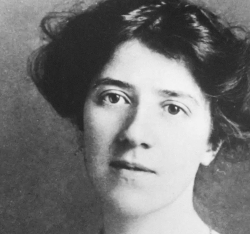
What can we learn from Marie Stopes’s 1918 book Married Love?

Rafia Zakaria in The Guardian:

ScreenHunter_2966 Feb. 14 17.32“More than ever today are happy homes needed,” declared crafty Marie Carmichael Stopes in the very first sentence of her sex manual Married Love, which turns 100 this year. Happy homes, her logic held, were the consequence of happy marriages and thus “the only secure basis for a present-day state”. So a book geared to teaching married couples how to have great sex (and thus a great marriage) was a service to the country.

Stopes’s was a clever argument and it worked, if not for the betterment of society, then certainly for her publisher. Married Love was a huge hit in Britain, selling out six printings within a few weeks of publication, as eager couples gobbled up its contents. The Americans were less keen on better sex for the sake of the state; they immediately banned the book, with US customs barring its import for more than two decades. By that time, Britons had bought more than half a million copies of the book and were far ahead of their prudish US counterparts in the quest to understand female sexual pleasure. They were also well on their way to “entering on a new and glorious state” based entirely on “the joyous buoyancy of their actions”.

Florid as the prose seems 100 years on, Stopes’s deft cloaking of her sex manual in religious sanction (a Father Stanislaus St John provides an endorsement) and state welfare was for good reason. Even while talking about sex was taboo, marriage and its boundaries had shifted considerably by 1918.

More here.

Wednesday Poem

Scaffolding

Masons, when they start upon a building,
Are careful to test out the scaffolding;

Make sure that planks won’t slip at busy points,
Secure all ladders, tighten bolted joints.

And yet all this comes down when the job’s done
Showing off walls of sure and solid stone.

So if, my dear, there sometimes seem to be
Old bridges breaking between you and me

Never fear. We may let the scaffolds fall
Confident that we have built our wall.

by Seamus Heaney
from Open Ground Selected Poems 1966-1996
.

Black Politics After 2016

5812aadd40201.imageAdolph Reed, Jr. at nonsite:

Many pundits and scholars have remarked on how the 2016 election reflected the significance of race in American politics. One strain of commentary to that effect contends that Trump’s election revealed a deep commitment to racism among white voters, especially working-class white voters, who are fundamentally alienated from a Democratic liberalism identified with nonwhites, feminists, LGBTQ people, and liberal technocratic elites.

From that perspective, the strategic moral of the Trump victory is that, as MSNBC Clintonoid Joy-Ann Reid put it in an August 29, 2017 Daily Show interview, the Democrats must recognize that they are the party of “black and brown people, of gay people, of marginalized people” and should stop longing “to be the party of the sort of Pabst Blue Ribbon voter, the kind of Coors Lite drinking voter…the sort of Archie Bunker voters” because the latter are committed Republicans. Reid imagines that, even though most Americans’ incomes have remained flat or declined and their lives have become more precarious over the period, the Democrats have been trying to appeal to those voters’ economic interests for forty years only to be rebuffed consistently because the latter care more about their “values” than their economic interests, and “the Republican party represents their values.”

more here.

The Heart of Conrad

Toibin_1-022218Colm Tóibín at the NYRB:

Joseph Conrad’s heroes were often alone, and close to hostility and danger. Sometimes, when Conrad’s imagination was at its most fertile and his command of English at its most precise, the danger came darkly from within the self. At other times, however, it came from what could not be named. Conrad sought then to evoke rather than delineate, using something close to the language of prayer. While his imagination was content at times with the tiny, vivid, perfectly observed detail, it was also nourished by the need to suggest and symbolize. Like a poet, he often left the space in between strangely, alluringly vacant.

His own vague terms—words like “ineffable,” “infinite,” “mysterious,” “unknowable”—were as close as he could come to a sense of our fate in the world or the essence of the universe, a sense that reached beyond the time he described and beyond his characters’ circumstances. This idea of “beyond” satisfied something in his imagination. He worked as though between the intricate systems of a ship and the vague horizon of a vast sea.

more here.

What are we feeling when we are feeling joy?

WIMAN-600x315Christian Wiman at The American Scholar:

The definition of  joy in the passages by Wordsworth and MacCaig, though both are tethered tightly to the natural world, remains pretty abstract. Even “Small Moth,” clear as it is on the elements of one woman’s happiness, is elusive about that moment of joy. This may be inevitable, though maybe all poems of joy—maybe all poems, period—are aimed against whatever glitch in us or whim of God has made our most transcendent moments resistant to description. (A “revenge of a mortal hand,” is how the Nobel laureate Wisława Szymborska defines the joy of writing.) The great Israeli poet Yehuda Amichai once wondered why it is that we have such various and discriminating language for our pains but become such hapless generalizers for our joys. “I want to describe,” his poem “The Precision of Pain” concludes, “with a sharp pain’s precision, happiness / and blurry joy. I learned to speak among the pains.”

“Among the pains” is where we all learned to speak. The instant the link between word and world appears, so does the rift between them. (I met a Czech scholar once, a man of immense learning and multiple languages, who told me that he didn’t speak a word until he was five years old. “Everything was okay until then,” he said with a shrug.) This link/loss aspect of speech seems true no matter one’s metaphysical dispensations.

more here.

Tuesday, February 13, 2018

Mine Own Neruda

William Archila in AGNI:

W-archilaI was ten and my father was gone, already living here in the States, when my mother woke me up in the middle of the night to listen to a strange voice coming out of the transistor radio. It was Pablo Neruda reciting his love poems while violins and guitars played in the background. For two years I fell asleep to the voice of Neruda rising and falling like waves in the distance, like seagulls swooping down, my head filling with poetry.

The broadcast was interrupted in November, 1980, when I fled El Salvador and the war that was tearing my country apart. I was twelve years old. I arrived in Los Angeles, California, with many questions unanswered, conversations unfinished and years of my young life unfulfilled. I gave up much of my national culture and Spanish language to learn a new culture and language. My English was full of street vernacular and strong raw accents—my words squashed, shredded, forced to dance a Shakespearian rag. I became part of the growing immigrant community, speaking ghetto Spanish. “Go back to your country” echoed throughout these years. Ahead a long road stretched into darkness.

In high school I began writing long before I read any poetry that excited me. My writings were fragments—verses and scribbles not meant to be taken seriously or shared. I pursued this calling in secret, writing only for myself. In college I tried to read the masters of the English language: Shakespeare, Milton, Keats, Dickinson, Whitman, but none of them spoke to me—or maybe I wasn’t ready to listen. It wasn’t until I read Ginsberg’s “Howl” that I was amazed to discover I was not the only young man who saw the best minds of his generation destroyed.

More here.

Our Tribes and Tribulations

Jaspreet Gill in Quillette:

MaxPixel.freegreatpicture.com-Strategy-Chess-Play-Chessboard-Game-Figure-Board-1215079Disagreement has made disagreeable individuals of us all. News channels are littered with platitudes masquerading as thoughtful discussions. Individuals, convinced that the volume of their speech corresponds to the correctness of their arguments, contribute to the cacophony of tirades. The print media publish headlines assassinating opponents’ characters rather than their ideas. Swipes and scrolls lead us to trivial online quarrels which bleed into our personal conversations. Research from the Pew Research Centre suggests that 91 percent of Republicans and 86 percent of Democrats hold unfavourable views of the other. It would be unfair but tempting to lay the blame at the feet of politicians, public intellectuals, and journalists. But we, the people, are also complicit in this potentially slippery slope.

Gathering by the campfire in our ideological tribes, we bask in the warm glow of unchallenged beliefs. We caricature arguments that do not fit neatly into our canonical jigsaw. Foregoing uncomfortable rumination in favour of rhetoric, we have helped to create and perpetuate a climate in which dissent is tolerated only for as long as it is a heresy we find palatable. And because the sacred cow revered by one tribe could be butchered by another, both worship and slaughter are seen as barbaric. Our immune system, fearful the body may contract moral anaemia by merely engaging with opposing viewpoints, triggers a defensive response that renders us allergic (and deaf) to opinions outside our personalised Overton windows. The ultra-networked age leaves us distant and disconnected and facilitates the rapid transmission of viral partisanship.

More here.

Why Is There Something, Rather Than Nothing?

Sean Carroll in Preposterous Universe:

ExistenceIn our everyday lives, it makes sense to ask “why” this or that event occurs, but such questions have answers only because they are embedded in a larger explanatory context. In particular, because the world of our everyday experience is an emergent approximation with an extremely strong arrow of time, such that we can safely associate “causes” with subsequent “effects.” The universe, considered as all of reality (i.e. let’s include the multiverse, if any), isn’t like that. The right question to ask isn’t “Why did this happen?”, but “Could this have happened in accordance with the laws of physics?” As far as the universe and our current knowledge of the laws of physics is concerned, the answer is a resounding “Yes.” The demand for something more — a reason why the universe exists at all — is a relic piece of metaphysical baggage we would be better off to discard.

This perspective gets pushback from two different sides.

More here.

A Dissenter’s Legacy: How to Win Without Violence

Tina Rosenberg in the New York Times:

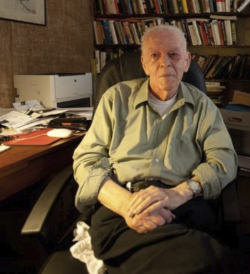
ScreenHunter_2965 Feb. 13 19.48Gene Sharp died last week. What Sun Tzu and Clausewitz were to war, Sharp, who was 90, was to nonviolent struggle — strategist, philosopher, guru. An American academic who worked from his modest Boston home, Sharp studied and cataloged examples of nonviolent resistance, looking at why they succeeded or failed.

His most influential work was “From Dictatorship to Democracy,” a pamphlet written for Burma’s opposition in 1993. It has been translated into dozens of languages — often clandestinely — and became a handbook for civic resistance movements around the world. (Much of Sharp’s writing is available free on the website of his organization, the Albert Einstein Institute.)

Sharp is best known as a strategist for movements in the most dire circumstances — those trying to create political change when there is no institutional path. But his ideas have shaped civic protest movements in the United States and other democracies, and they contain some surprising advice for the resistance to President Trump.

First, here’s a brief summary of what Sharp taught the world…

More here.

Tuesday Poem

If You Go and Look at a Hen For an Hour or Two, You’ll Find in the End
That the Mystery Has Not Diminished but Rather Increased

Its feet yellow and strong.

Its walking rhythm with that kind of ludicrous efficiency,
halting from time to scrabble in the dirt.

Its compact structure in bright feathers, black,
nearly blue when the sun strikes.

Crowned in red, with its beak
exactly the same yellow as its feet,
eyes quick.

As it moves forward on the ground, it scrapes and pecks,
it lifts its head every so often, moving it a bit:
an inexorable atavism
for spotting potential predators.

And now it stretches, flapping vigorously in place.

To perk up, maybe,
to get its circulation going, or something of the sort.
.

by Alejandro Crotto
from Asymptote Journal
Oct. 2017

translated from the Spanish by Robin Myers
.

Monday, February 12, 2018

Asma Jahangir (1952 – 2018): A Life of Fearless Fortitude

by Ali Minai

Asma-jehangir-1600x500A light went out in the world yesterday. Asma Jahangir — Pakistan’s icon of human rights and liberal values — passed away. In her short 66 years, she lived the length — and made the impact — of many lifetimes. If a person’s character is known by the enemies they make, her credentials are impeccable. Every dictator, every autocrat, every paternalistic preacher, every friend of the powerful hated her — and she welcomed their hatred as a badge of honor. Even in death, the barbs of her enemies ennoble her further for posterity.
There are also many who disliked her because of her political views, her liberalism, or her uncompromising positions. As with all those who act only on principle, she sometimes faced difficult dilemmas and found herself taking unpopular positions — including some that were branded “unpatriotic”, as though Patriotism can ever be a higher value than Justice. She may sometimes have ended up on what many thought was the “wrong” side of the line, but she was always there for the right reasons. When all other champions of truth were silent in the face of diktat, she stood up against the oppression of women and minorities, against the lack of due process, and against inhuman laws imposed in the name of God and country. Sometimes she won, and often she did not, but she never wavered.
Many friends have already paid tribute to Asma Jahangir and lamented her passing, and I debated whether I should say anything — especially since it will surely invite controversial comments. But then I thought of my daughters, and what a fearless woman like Asma Jahangir truly signifies for them — and that is why I needed to write this. So Anosha and Afreen, if you ever wonder what sort of person you should aim to be, or how to stand up for justice against all odds, or what a full life of fearless fortitude is like, look to this Pakistani lawyer who packed all the furies of righteousness in her slight body and lived her life like a flame that the winds simply could not extinguish. Now a greater extinguisher has taken her, but the flame will stay alive in the hearts and minds of those who share her values. And even those who do not — or perhaps their future generations — will benefit from the sparks she has sown, because even the unjust want justice when they find themselves oppressed.
* * *
Editor’s Note: Asma Jahangir’s Wikipedia page is here. You can also read obituaries in the New York Times, the Washington Post, Dawn, the Express Tribune, Time, and many others.