
Yascha Mounk at his own Substack:
 A few months ago, on the New York subway, I looked up at the woman sitting opposite me, and found my eyes drawn to her cap: “I don’t give a F**K,” read big white letters stitched into navy blue cotton.
Three million New Yorkers ride the subway every day. On some days, it feels as though a quarter of them have a stupid slogan of one kind or another embroidered on their caps. And yet, there was something about this particular woman, proudly sporting this particular slogan, that felt to me totemic of this particular moment in American life.
I first came to the United States for an academic exchange at Columbia University in 2005, and have spent the bulk of my time here since starting my PhD at Harvard University in 2007. No country changes nature overnight, and America still retains many of the virtues with which I fell in love all those years ago. But there are days when I fear that the place has been transformed so deeply that the qualities that would once have been touted as quintessentially American have forever been lost.
More here.
Enjoying the content on 3QD? Help keep us going by donating now.
 A deep brain device that allowed a man with no limbs to play computer games is one of an increasing number of
 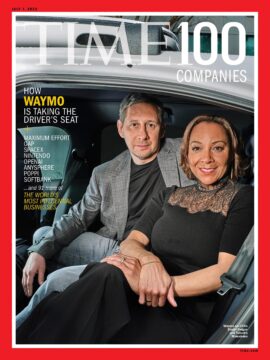 Moments before I hop into my first Waymo in Austin, Texas, the driverless car is already locked in a standoff with a human rival. I’ve hailed the car in a tricky triangular parking lot in the middle of a big intersection, hoping to hitch a ride downtown. After about six minutes of waiting, I see it approaching: a hulking white all-electric Jaguar SUV with whirring sensors on all sides, conjuring a rhinoceros with hummingbird wings. But when the Waymo enters the lot, it takes far too wide of a turn, and finds itself nose-to-nose with a pickup truck driver trying to exit. The driver glares at the Waymo, but sees nobody through the front windshield. For a second, man and machine face off in a very mundane version of The Terminator.

 No, this is no hound. It’s just a dog.
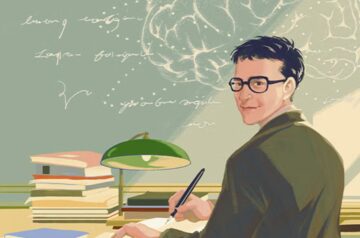 His name was Peter Putnam. He was a physicist who’d hung out with Albert Einstein, John Archibald Wheeler, and Niels Bohr, and two blocks from the crash, in his run-down apartment, where his partner, Claude, was startled by a screech, were thousands of typed pages containing a groundbreaking new theory of the mind.
 In 2023, Sam Altman embarked on a world tour, meeting with heads of state to discuss AI regulation. According to Time’s
  If to err is human, then so too is to regret. At least if we follow Paddy McQueen in his recent book about the nature, normativity, and politics of regret. According to McQueen, regret is, roughly, a painful feeling of self-reproach or self-recrimination for making a “mistake” (21). Like all emotions, regret is more than just a judgment, though it has a constitutive thought type (i.e., “I have made a mistake”), which can be realized by many different token thoughts (e.g., “I wish I had not done that”, “I should have acted differently” or “what an idiot I am!”). Regret’s “phenomenological core” is the feeling of “kicking oneself” or “beating oneself up” for a mistake (21). Regret directs our attention to the mistake in decision-making we have made and motivates us to avoid making the same kind of mistake in the future (72, 136).
 “Unwilling to portray themselves as victims (cringe, politically wrong), or as aggressors (toxic masculinity), unable to assume the authentic voices of others (appropriation), younger white men are no longer capable of describing the world around them,” Savage, who is 41, wrote. What they do write, he added, avoids “grappling directly with the complicated nature of their own experience in contemporary America.”
 Some people have a gift
 “How would you feel about living in another country?”
 If you’ve ever cooed at a baby, you have participated in a very special experience. Indeed, it’s an all but unique one: Whereas humans constantly chatter to their infants, other apes hardly ever do so, a new