Callimachus in Jelly Shoes

Nicholas D. Nace in the Boston Review:

Burt Advice_featureIn the yet-to-be-written history of school supplies, the 1980s was a decisive period. Back-to-school materials had to that point offered little opportunity for individual expression: the static composition book, the stalwart yellow pencil in which deviations of lead softness constituted a classroom crisis, the enduring four-color Bic with the orange or blue barrel. But when it came to so-called presentation folders, a site of self-fashioning that had never evolved beyond the Pee-Chee All Season Portfolio, there were suddenly choices—choices that were, for most, not really choices: kittens or cars, princesses or footballs, unicorns or dinosaurs. We learned to hold our paper under the sign of the gender presentation that peers and parents expected of us, and we often overrode our real preferences to avoid being ostracized. The folders reflected not only how we saw the world but how we performed in it. Many found this nudge toward normativity comfortable or natural, a move closer to the place we were supposed to be headed. Many did not.

The 1980s, the period in which the tween began to be the focus of relentless marketing, is the time and terrain of the majority of the poems in Advice from the Lights, the fourth collection bearing the name of the author Stephen Burt. While Stephen came of age during this time of Velcroed Trapper Keepers and their slick invitations to compulsion, Stephanie Burt, who went full time as a woman in 2017, never got to experience a childhood of “sparkly rainbow crayons” or an adolescence of “glitter pens.” To be subject to ’80s merchandising was to be subject also to its prefab genders and, for Stephen, its troubling lack of choice. Yet in these poems we glimpse only brief rebellions against gender norming—a lip gloss stolen from a drugstore and toenails painted with Liquid Paper only to be scraped clean at parental insistence. Foiled and forced inside, these impulses now feel like lost cathexes lately resumed. What was for Stephen a formative time is for Stephanie a site of longing, of a girlhood that might have led to her present womanhood. Thus the book embraces multiple sides of gendered choice, imagining being clad in both Doc Martens with their grave semiotics of colored laces, and shoes or bracelets made of “jelly.”

More here.

Saturday Poem

The Grand Palace of Versailles

An elephant made of cotton…
Towers of lace under which satin-heeled
Gentlemen sit, playing with the bustles
Of slightly desiccated Grand Dames.
Good morning, Louis, it's a fine day
In the mirror.

A chaise lounge carved
Out of the living body of a white leopard…
Spools of silk placed in buckets
Of gilt milk . . . A three-headed dancer
Prancing to the music of a little bell
Languidly swung by a Negro with a hairlip.
Two visiting kings having their canes reheaded,
With the juice of mildly sickening berries.
What does Salvador Ernst Matta, Louis?
It's a fine day in the mirror.

It must be amusing to be poor, n'est-ce pas?
.

by Kenneth Patchen
from Selected Poems
New Directions Books, 1942
.

Friday, February 23, 2018

Rap/Hip Hop

From Blackpast.Org:

Early_Years_of_Hip_Hop__Bronx_Park_Jam__1984Rap Music, and the culture that surrounds rapping itself, hip-hop, is a genre of music and a lifestyle which originated in the housing projects of New York City, New York in the late 1970s but which now has global influence. While not without controversy and numerous critics, rap music has emerged as one of the most popular musical forms in the world. Its reach and longevity have been much greater that most expected when it was a New York City street phenomenon in the late 1970s.

Although no single individual can claim credit for the founding of rap music or the hip hop culture, New York DJ (disc-jockey) Kool Herc is generally considered the most important figure in the early years of the genre. As a DJ Kool Herc would sample the danceable parts of jazz and funk records, typically the parts featuring drums and a consistent rhythm. These parts were inspired by and helped inspire a new kind of dancing called break-dancing. Kool Herc named the people who would break dance to his music "B-Boys," which was short for break-boys. Kool Herc also spoke and rhymed over the songs he played, which was one of the earliest versions of rapping in the hip-hop style

More here. (Note: Throughout February, at least one post will be dedicated to honor Black History Month)

The Philosophy of the Midlife Crisis

Joshua Rothman in The New Yorker:

ScreenHunter_2975 Feb. 23 18.49When he was thirty-five, Kieran Setiya had a midlife crisis. Objectively, he was a successful philosophy professor at the University of Pittsburgh, who had written the books “Practical Knowledge” and “Knowing Right from Wrong.” But suddenly his existence seemed unsatisfying. Looking inward, he felt “a disconcerting mixture of nostalgia, regret, claustrophobia, emptiness, and fear”; looking forward, he saw only “a projected sequence of accomplishments stretching through the future to retirement, decline, and death.” What was the point of life? How would it all end? The answers appeared newly obvious. Life was pointless, and would end badly.

Unlike some people—an acquaintance of mine, for example, left his wife and children to move to Jamaica and marry his pot dealer—Setiya responded to his midlife crisis productively. In “Midlife: A Philosophical Guide” (Princeton), he examines his own freakout. “Midlife” has a self-soothing quality: it is, Setiya writes, “a self-help book in that it is an attempt to help myself.” By methodically analyzing his own unease, he hopes to lessen its hold on him.

Setiya finds that the history of the midlife crisis is both very long and very short. On the one hand, he identifies a text from Twelfth Dynasty Egypt, circa 2000 B.C., as the earliest description of a midlife crisis and suggests that Dante might have had one at the age of thirty-five. (“Midway on life’s journey, I found myself / In dark woods, the right road lost.”)

More here.

Good News: A.I. Is Getting Cheaper. That’s Also Bad News.

Cade Metz in the New York Times:

Merlin_133556211_5a74b0a3-1ac3-4894-aac9-4bb1a592c266-superJumboA Silicon Valley start-up recently unveiled a drone that can set a course entirely on its own. A handy smartphone app allows the user to tell the airborne drone to follow someone. Once the drone starts tracking, its subject will find it remarkably hard to shake.

The drone is meant to be a fun gadget — sort of a flying selfie stick. But it is not unreasonable to find this automated bloodhound a little unnerving.

On Tuesday, a group of artificial intelligence researchers and policymakers from prominent labs and think tanks in both the United States and Britain released a report that described how rapidly evolving and increasingly affordable A.I. technologies could be used for malicious purposes. They proposed preventive measures including being careful with how research is shared: Don’t spread it widely until you have a good understanding of its risks.

A.I. experts and pundits have discussed the threats created by the technology for years, but this is among the first efforts to tackle the issue head-on. And the little tracking drone helps explain what they are worried about.

More here.

What a fossil revolution reveals about the history of ‘big data’

David Sepkoski in Aeon:

Idea_sized-stenopterygius_fossilIn 1981, when I was nine years old, my father took me to see Raiders of the Lost Ark. Although I had to squint my eyes during some of the scary scenes, I loved it – in particular because I was fairly sure that Harrison Ford’s character was based on my dad. My father was a palaeontologist at the University of Chicago, and I’d gone on several field trips with him to the Rocky Mountains, where he seemed to transform into a rock-hammer-wielding superhero.

That illusion was shattered some years later when I figured out what he actually did: far from spending his time climbing dangerous cliffs and digging up dinosaurs, Jack Sepkoski spent most of his career in front of a computer, building what would become the first comprehensive database on the fossil record of life. The analysis that he and his colleagues performed revealed new understandings of phenomena such as diversification and extinction, and changed the way that palaeontologists work. But he was about as different from Indiana Jones as you can get. The intertwining tales of my father and his discipline contain lessons for the current era of algorithmic analysis and artificial intelligence (AI), and points to the value-laden way in which we ‘see’ data.

My dad was part of a group of innovators in palaeontology who identified as ‘palaeobiologists’ – meaning that they approached their science not as a branch of geology, but rather as the study of the biology and evolution of past life. Since Charles Darwin’s time, palaeontology – especially the study of the marine invertebrates that make up most of the record – involved descriptive tasks such as classifying or correlating fossils with layers of the Earth (known as stratigraphy). Some invertebrate palaeontologists studied evolution, too, but often these studies were regarded by evolutionary biologists and geneticists as little more than ‘stamp collecting’.

The use of computers to analyse large data sets changed this image – particularly because it allowed palaeontologists such as my dad, and his colleague David Raup at the University of Chicago, to expose patterns in the history of life that emerged only on very long timescales. One of their signature contributions was the discovery that life has experienced major, catastrophic mass extinctions at least five times in the Earth’s history (this is why many people now refer to the current biodiversity as the ‘sixth extinction’).

More here.

Friday Poem

Ezra Pound's Proposition

Beauty is sexual, and sexuality
Is the fertility of the earth and the fertility
Of the earth is economics. Though he is no recommendation
For poets on the subject of finance,
I thought of him in the thick heat
Of the Bangkok night. Not more than fourteen, she saunters up to you
Outside the Shangri-la Hotel
And says, in plausible English,
“How about a party, big guy?”

Here is more or less how it works:
The World Bank arranges the credit and the dam
Floods three hundred villages, and the villagers find their way
To the city where their daughters melt into the teeming streets,
And the dam’s great turbines, beautifully tooled
In Lund or Dresden or Detroit, financed
By Lazeres Freres in Paris or the Morgan Bank in New York,
Enabled by judicious gifts from Bechtel of San Francisco
Or Halliburton of Houston to the local political elite,
Spun by the force of rushing water,
Have become hives of shimmering silver
And, down river, they throw that bluish throb of light
Across her cheekbones and her lovely skin.

by Robert Hass
from Time and Materials
Ecco Press, 2007

Towards Non-Being

P7_GrahamTom Graham at the TLS:

That some things – unicorns, the largest number, Sherlock Holmes – do not exist seems so obvious, and is so frequently taken for granted in our everyday discourse, that denying it would be ridiculous in any ordinary context. And so it may come as some surprise that since the beginning of the twentieth century this view has been among the least popular and most berated in anglophone philosophy. Many even claim that the position, so widely held by non-philosophers, is unintelligible, and the British philosopher Gilbert Ryle even went so far as to say that if it were not a dead view in philosophy, nothing was. To revive the view that some things don’t exist (known these days as “noneism”) and situate it as a plausible contender in current debates on existence is the aim of Graham Priest’s formidable 2005 book Towards Non-Being, which has now appeared in a significantly expanded second edition.

A fundamental motivation for the dominant view is that to lack existence, it seems, is to be nothing at all. Things, by contrast, are not “nothing” – they are things! If so, then “being a thing” and “existing” go hand in hand, and there cannot be “things” that do not exist. Adherents of this view thus read the noneist’s claim “some things don’t exist” as entailing the self-refuting “some things are not things” and therefore to be self-contradictory.

more here.

The Politics of Culture in Three Early Images of Luther

Lucas_Cranach_d.Ä._-_Martin_Luther_1528_Veste_Coburg_cropped-388x220Brian Cummings at Marginalia:

Images of Martin Luther abound in his anniversary year, and they tend to conform to a type. Deutsche Bahn, the German railway company, has gone for the bronze statue that stands beneath the Rathaus in Wittenberg. Luther is in a cage, perhaps sensibly, about thirty yards from Philipp Melanchthon. Melanchthon looks pained, as ever, but at least he is out of earshot. Luther holds a Bible out for people in the marketplace to see. The statue is nineteenth-century, the work of Johann Schadow, a friend of Johann Wolfgang von Goethe. There are Luther Denkmäler like this all over Germany. Otherwise, for the new biographies sprouting everywhere, the cover of choice tends to be one of the portraits by Lucas Cranach the Elder from the late 1520s or 1530s. The criterion for the five-hundredth anniversary, as ever, is safety first: the images are correspondingly solid, reliable, recognizably German, dignified if not obviously pious, and above all fat. Even Playmobil Luther, more popular among theologians and academics than children, is Fat Luther with a Book.

The other striking aspect of the proliferating Luther icons is that they are conspicuously lacking in aesthetic appeal. There is an interesting bias at work here, observable from Cranach onwards.

more here.

Why farmers were the first time travelers

20171117_TNA53RobertsMyasoyedovbanner1Adam Roberts at The New Atlantis:

Time Travel, the latest work by James Gleick (pronounced “Glick”) is a pleasingly varied compendium. It mixes accounts of the most famous fictional accounts of time travel — H. G. Wells’s Time Machine, spoiler-heavy summaries of Robert Heinlein’s “By His Bootstraps,” Isaac Asimov’s The End of Eternity, the BBC’s Doctor Who, and the other usual sci-fi suspects — with readings of T. S. Eliot, Marcel Proust, and William James. In between the book reports are lower-calorie accounts of the physics of time as presently understood; philosophical discussions about causality, free will, language, consciousness, and time paradoxes; and an interlude on the craze for burying time capsules.

The whole thing is written with more charm than precision. For example, it’s odd that a study dedicated to Wells’s famous book refers to “the troglodytic Eloi and bovine Morlocks” — those adjectives are the wrong way around. Presumably that’s a slip, as is Gleick’s claim that “No one knows exactly what [ancient Greek philosopher] Heraclitus said, because he lived in a time and place that lacked writing” — Greeks were writing for at least two centuries before Heraclitus, and we have fragments of Heraclitus because he did write a book (On Nature), which was in turn quoted by other writers before the original was lost to time.

more here.

Thursday, February 22, 2018

‘Hawksmoor’ Revisited

Anna Aslanyan in the London Review of Books:

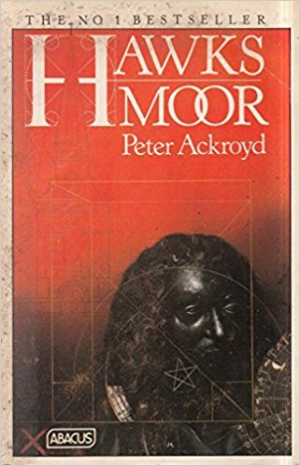
51jD-dxI4wL._SX319_BO1 204 203 200_‘There’s a writer in England called … er, Peter Ackroyd,’ David Bowie said in a short film he made in 2003, ‘who wrote a book called … Hawksmoor I think it was. Wasn’t it? Yeah.’ Ackroyd’s 1985 novel struck him as ‘a very powerful book, and quite scary’, and in 2013 Bowie included it on a list of his favourite 100 books, ranging from the Beanoto The Origin of Consciousness in the Breakdown of the Bicameral Mind. His son, the filmmaker Duncan Jones, recently launched #BowieBookClubto discuss ‘dad’s favs’ on Twitter, choosing Hawksmoor as ‘an amuse cerveau before we get into the heavy stuff’.

The novel’s protagonist, Nick Dyer, partly based on the architect Nicholas Hawksmoor, is a follower of a Satanic cult who consecrates his churches with human sacrifices. Hawksmoor is the name of his pale shadow, a modern-day detective investigating a series of murders that mirror those committed in the name of Dyer’s art. (Bowie had a longstanding interest in the occult. ‘I was up to the neck in magick,’ he said of his Thin White Duke period, when he lived in ‘that whole dark and rather fearsome never-world of the wrong side of the brain’.)

Ackroyd’s narrative shifts between the early 18th century and the 1980s, as does the idiom. ‘In each of my Churches I put a Signe,’ Dyer says, ‘so that he who sees the Fabrick may see also the Shaddowe of the Reality of which it is the Pattern or Figure.’ Hawksmoor’s speech, by contrast, ‘came out of him like vomit … carried him forward without rhyme or meaning’: ‘Sign? I know nothing about signs.’ When I translated Hawksmoor into Russian in 2010, I used a pastiche of late 18th-century Russian as the closest analogue to Ackroyd’s stylisation of early 18th-century English.

More here.

The Virtue of Scientific Thinking

Steven Shapin in the Boston Review:

Shapin-JF15-600_0Can science make you good?

Of course it can’t, some will be quick to say—no more than repairing cars or editing literary journals can. Why should we think that science has any special capacity for moral uplift, or that scientists—by virtue of the particular job they do, or what they know, or the way in which they know it—are morally superior to other sorts of people? It is an odd question, maybe even an illogical one. Everybody knows that the prescriptive world of ought—the moral or the good—belongs to a different domain than the descriptive world of is.

This dismissal may capture the way many of us now think about the question, if indeed we think about it at all. But there are several reasons why it may be too quick.

First, there are different ways of understanding the question, and different modern sensibilities follow from the different senses such a question might have. Some ways of understanding it do lead to the glib dismissal, but other ways powerfully link science to moral matters. Here are just a few of the ways we might think about the relationship between science and virtue, about whether aspects of science have the power to make us good:

• Is there something about what scientists know that makes them better people than the normal run of humankind? Are different sorts of scientists—physicists, mathematicians, engineers, biologists, sociologists—more or less virtuous? And do some sorts of scientific expertise count as moral expertise?

• Are scientists recruited from a section of humankind that is already better than the norm?

• Is there something scientists know that, were it widely shared with non-scientists, would make the rest of us better? Or is there something about how scientists come to their knowledge—call it the scientific method—that would make the practices of non-scientists better, were they to master it? Would wide application of the scientist’s way of knowing make our society fairer, more just and flourishing?

More here.

Lawrence Krauss Faces Allegations Of Sexual Misconduct

Peter Aldhous, Azeen Ghorayshi and Virginia Hughes in BuzzFeed News:

ScreenHunter_2975 Feb. 22 20.01When Melody Hensley first met Lawrence Krauss, she was a 29-year-old makeup artist at a department store, and he was one of her intellectual idols. She ran an atheist website in her spare time and had just started volunteering for the Center for Inquiry (CFI), a nonprofit group committed to promoting science and reason above faith. She was hoping to build a career in the burgeoning “skeptics” movement, and Krauss was one of its brightest luminaries.

At a CFI event in November 2006, Krauss asked Hensley for her card, and later, as she was leaving, asked her if she was “of age.” She brushed off the odd question, excited to meet a star skeptic. When he later emailed to invite her to dinner, she accepted.

“I didn’t care if he flirted with me, I just wanted to be around somebody important, and I also wanted to get a job in this field,” Hensley told BuzzFeed News. “I thought I could handle myself.”

They made a plan to eat in the restaurant at the Washington, DC, hotel where Krauss was staying, Hensley recalled. But first he asked her to come up to his room while he wrapped up some work. He seemed in no rush to leave, she said, ordering a cheese plate and later champagne, despite her suggestion that they go down to dinner.

More here.

The Prowess of Nina Simone’s Early Records

Lead_960 (6)Jason Heller at The Atlantic:

Sixty years ago, Nina Simone was not yet quite an icon. The legendary singer, pianist, songwriter, and civil-rights activist—who will be inducted into the Rock and Roll Hall of Fame in April—turned 25 in 1958. Her debut album, Little Girl Blue, had just been released on Bethlehem Records, an up-and-coming jazz label. Among Bethlehem’s alumni were Duke Ellington, Charles Mingus, and a promising young saxophonist from Miles Davis’s band named John Coltrane. Simone, on the other hand, had been signed as more of a pop-jazz artist; the label, after all, was also the home of Mel Tormé. Relatively unknown, Simone was a fresh face to find success by safely interpreting the standards of the day, albeit by using her uniquely husky voice and bluesy yet classically informed piano playing.

Little Girl Blue kicked off a run of singles Simone made between 1958 and 1963 for both Bethlehem and another New York label, Colpix Records. The singles she released during that period, many of them drawn from the Great American Songbook, have been collected on two anthologies out this month: Mood Indigo: The Complete Bethlehem Singles (via BMG Records) and Nina Simone: The Colpix Singles (via Stateside Records).

more here.

A History of Judaism

PhpThumb_generated_thumbnail (2)Martin Goodman at the LARB:

THE DESTRUCTION OF Jerusalem by Roman troops in 70 CE demanded a religious explanation. If God, the supreme ruler of the universe, had allowed such a disaster to be visited on his people, it must be as part of a divine plan. The author of an apocalyptic text that purports to describe the prophetic visions of Ezra, the priest and scribe of the fifth century BCE, but which must in fact have been composed in the last decades of the first century CE, envisaged divine vengeance on the Roman empire. He pictured Rome as a three-headed eagle destined for destruction during the last days that had now come upon the earth:

The Most High has looked at his times; now they have ended, and his ages have reached completion. Therefore you, eagle, will surely disappear, you and your terrifying wings, your most evil little wings, your malicious heads, your most evil talons, and your whole worthless body, so that the whole earth, freed from your violence, may be refreshed and relieved, and may hope for the judgement and mercy of him who made it.

But we have no idea how many other Jews shared in this eschatological hope. IV Ezra is preserved only through copies and translations made by Christians, among whom the text proved immensely popular, presumably in part because of their strong interest in the imminent end times, but it is not known whether the text held similar appeal for non-Christian Jews.

more here.

Luther vs. Erasmus

Luther-erasmus1Michael Massing at the NYRB:

The publication of Erasmus’s revised New Testament was a milestone in biblical studies. It gave scholars the tools to read the Bible as a document that, while divinely inspired, was a human product that could be deconstructed and edited in the same manner as a text by Livy or Seneca. As copies began circulating, the magnitude of Erasmus’s achievement was immediately recognized. Not since Cicero had an intellectual figure so dominated Western discourse as Erasmus did in that enchanted spring of 1516. “Everywhere in all Christendom your fame is spreading,” wrote John Watson, a rector in England with whom he was friendly. “By the unanimous verdict of all scholars, you are voted the best scholar of them all, and the most learned in both Greek and Latin.”

The term “Erasmian” came into use to describe those who shared his vision. But those Erasmians represented only a small sliver of society. Erasmus wrote exclusively in Latin, for the highly educated, Latin-speaking elite. Dazzled by his readings in ancient Greek, Erasmus began promoting knowledge of that language as no less essential than Latin. “Almost everything worth learning is set forth in these two languages,” he wrote in one of his many educational texts. In these, Erasmus proposed a new curriculum for Europe, with instruction in Latin and Greek at its core.

more here.

Wednesday, February 21, 2018