
 Ferdinand Mount in the LRB:
Philippe Pétain died at 9.22 a.m. on 23 July 1951. He had been tried for treason in 1945, while General de Gaulle was still in his first spell of power. The hero of Verdun was sentenced to death by one vote, but the court asked for the sentence to be commuted to life imprisonment in view of the marshal’s great age, which was a relief to de Gaulle. Since then Pétain had been banged up on the Ile d’Yeu, 11 miles off the Vendée coast. At the time of his death, he was 95 years old and wandering in his wits. Even so, ministers in Paris were anxious to see the back of him. By lunchtime two days later, he was being hustled underground at the Port-Joinville cemetery on the island. Passing on the news to de Gaulle, Georges Pompidou, his directeur de cabinet and a former Rothschild banker, remarked: ‘The affair is now over, once and for all.’ De Gaulle disagreed: ‘No, it was a great historical drama, and a historical drama is never over.’ What an extraordinary drama it was, the relationship between the two men, played out over nearly forty years, encapsulating the whole agony of France, and leaving behind resentments and divisions that are not quite dead even now.
More here.
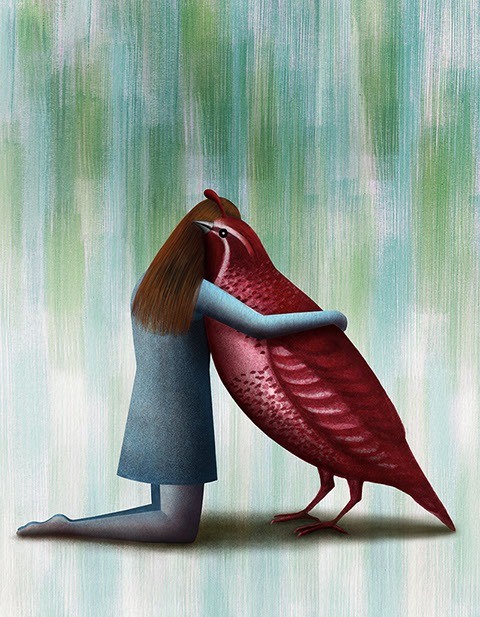
 Alzheimer’s disease has long been considered an inevitable consequence of ageing that is exacerbated by a genetic predisposition. Increasingly, however, it is thought to be influenced by modifiable lifestyle behaviours that might enable a person’s risk of developing the condition to be controlled. But even as evidence to support this idea has accumulated over the past decade, the research community has been slow to adopt the idea. This reluctance was obvious as recently as 2010, when the US National Institutes of Health (NIH) brought together a panel of 15 researchers to consider the state of research on preventing Alzheimer’s disease, at a conference in Bethesda, Maryland. Tantalizing findings had begun to emerge that suggested that behavioural choices such as engaging in physical exercise, intellectual stimulation and healthy eating could reduce the risk of brain degeneration. In a 2006 study
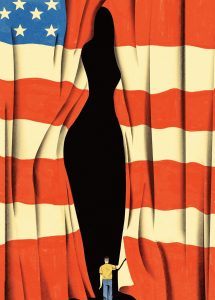 You look at a dark immigrant in that long line at JFK,” Kailash, the protagonist of Amitava Kumar’s new nonfiction novel, “
 If you consider yourself to have even a passing familiarity with science, you likely find yourself in a state of disbelief as the president of the United States calls climate scientists “
 It is widely believed that most Republicans are skeptical about human-caused climate change. But is this belief correct?
 Water attracts trouble. Time and again this ubiquitous and vital substance becomes the subject of controversial claims. The latest is about “raw” or “live” water, consumed directly from natural springs with no treatment or purification.
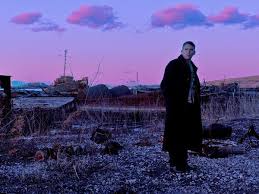 To that end, First Reformed is daring and unrelenting—it searches for and pinpoints real harm. Ten people walked out of the theater where I saw it, most of them Schrader’s age. I think they left because the film’s intensity was too much in a world where they had the option of seeing Book Club at a theater down the street.
 Sunday, late July: the small suburban towns of Persan and Beaumont-sur-l’Oise are almost empty. Persan, the last stop on the H line, is half an hour from the Gare du Nord, through a landscape of woodland and fields. It was a beautiful day. A man was fishing by the banks of the Oise; two others were chatting in front of a hairdresser’s salon. The day before, thousands of people from Paris and the banlieues had filled the streets; some had arrived by bus from further afield, among them party leaders from the left-wing NPA and La France Insoumise, anti-racist activists, relatives of people who had been killed by the police, girls wearing T-shirts saying ‘Justice for Adama’ or ‘Justice for Gaye’, and a man with a placard: ‘The State protects Benallas, we want to save Adamas.’
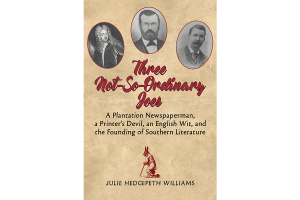 On the surface, the new book by Julie Hedgepeth Williams, Three Not-So-Ordinary Joes, is the story of the long and winding genesis of literary culture in the post-Civil War American South. One of the “not-so-ordinary Joes” referred to in the title is, after all, Joel Chandler Harris (whose childhood nickname was Joe), author of the Uncle Remus stories that sold astoundingly well both in postwar America and around the world and influenced an entire generation of writers, playing a large role in creating a distinctive Southern literary tradition. But in addition to that surface story, there’s also a deeper narrative thread winding its way through “Three Not-So-Ordinary Joes,” a narrative about the unpredictable, often byzantine connections that thread their way from one literary generation to another. In this case, Williams quite delightfully traces this thread through the same name, linking two generations of 19th-century American Southerners with a namesake from 18th-century England, a man who never knew anything about either of them or about the American South itself.
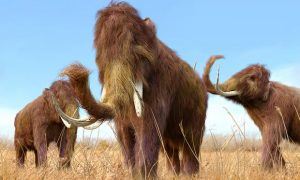 It’s harder than you might think to make a dinosaur. In Jurassic Parkthey do it by extracting a full set of dinosaur DNA from a mosquito preserved in amber, and then cloning it. But DNA degrades over time, and to date none has been found in a prehistoric mosquito or a dinosaur fossil. The more realistic prospect is to take a live dinosaur you have lying around already: a bird. Modern birds are considered a surviving line of theropod dinosaurs, closely related to the T rex and velociraptor. (Just look at their feet: “theropod” means “beast-footed”.) By tinkering with how a bird embryo develops, you can silence some of its modern adaptations and let the older genetic instructions take over. Enterprising researchers have already
 For a Baptist, the Bible exists like gravity. Not believing in gravity will not change the outcome if you step off a building; not believing the Bible will not change the consequences if you ignore its precepts and commands. Both are laws of nature, fixed and unchanging.
 Few topics have captured the attention of the internet literati more than the topic of Jordan B. Peterson. Peterson,