School of the Americas
Sergio has ink-pot eyes, girlish wrists.
He draws superheroes extremely well—
Avengers, Wolfman, El Toro Rojo,
any one wearing a mask. Monday nights
we drive to the art club meeting
in the cream-colored Sunbird
I bought with babysitting money.
I don’t know how he ended up with his mom
in the South, just the two of them, but
I spend 9th grade sitting next to him,
translating a Georgia O’Keefe painting
into pastel chalk: a lily dusted with pollen.
One day during class, Sergio tells me he saw
his grandparents shot before his eyes
back in Colombia. The phrase sticks out
in his heavy accent, like a child repeating
something just overheard. After a few minutes,
we go back to our drawings.
In the evenings that year I sign my name
to stock letters sent by Amnesty International
and mail them to faraway dictators
of the 1990s: Mubarak, Mobutu, Marcos.
All the while a quarter of a tank away,
at the School of the Americas (now the
Western Hemispheres Institute for Security
Cooperation) hundreds of Colombian
soldiers train in truth extraction,
how to intimidate, the best ways
to torture. In the yearbook,
I list my hobbies: poetry
and human rights. I have yet
to draw a picture of anything
from life—the art teacher seems
disappointed that Sergio and I
are mere copyists. After graduation,
Sergio finished a year
of art school in Chicago,
got cancer and died.
I guess I had a crush on him
when we were fourteen,
and I sat next to him,
copying those sexual flowers.
One has to start somewhere.
Just start: before my eyes could see,
I drew things like that lily.
.
by Rebecca Black
from Split This Rock, 2014

 On a cool spring day in April 2014, Dayne Walling, the mayor of Flint, Mich., entered an old water-treatment plant and, amid cheers from a crowd of city officials and engineers, pushed a small black button on a cinder-block wall. With that gesture, the mayor switched Flint’s water supply from a tested and reliable source provided by the city of Detroit to a cheaper and untested one, the nearby Flint River. City officials defended the move as necessary cost-cutting for a bankrupt city. Like his colleagues, Walling — a Rhodes scholar who had a master’s degree in urban studies — believed that Flint, by deciding to rely on its own river for water, was taking control of its destiny. He called it “a historic moment.”
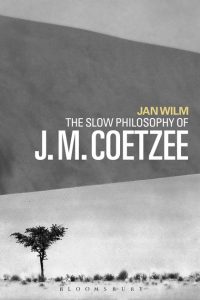 Particularly since the publication of Elizabeth Costello (2003), a strong academic conversation on literature and philosophy has developed around the writings of J.M. Coetzee. As literary scholars and philosophers have approached this nexus, they have confronted questions about what counts as “philosophy” or “literature,” and what benefits are afforded by conversing across the disciplines. So, as this dialogue continues moving forward, there may be some benefit in also slowing down, pausing, and looking back at the one monograph to expressly locate Coetzee’s writings on a spectrum between literature and philosophy. Although not the most recent publication on the topic, Jan Wilm’s The Slow Philosophy of J.M. Coetzee (2016) merits renewed attention for its use of both literary and philosophical tools in explicating how Coetzee’s texts act upon their readers’ very modes of thinking.
 I am staring
  April 13, 1947, holds little significance in the American historical memory, and yet that day was one in a long series that led to the legal desegregation of American schools. On that morning, Marguerite Daisy Carr, a 14-year-old black girl from Washington, D.C., attempted to enroll at Eliot Junior High School, the all-white middle school closest to her home. Carr’s efforts to integrate the school, which were supported by her family and local black community, preceded the landmark Supreme Court decision in
  4:30 Movie, then, is a book about the general ambience of film, although Masini does invoke specific titles—most notably, the original drive-in version of The Blob (1958), which screened in the 4:30 slot during Masini’s childhood and inspired the title of her book. In the film’s final scene, the hero—“his name was Steve in the movie and Steve in real life,” Masini writes, referring to lead actor Steve McQueen—and the police douse the blob with fire extinguishers to freeze it. A police officer observes that the gelatinous creature can’t be killed but can be stopped. The Air Force drops the blob into the Arctic, and then The End? appears on screen, a playful hint that perhaps the terror isn’t over. Masini is bemused by how hokey and silly the film is, the blob “mindless, deadly, malignant. Amorphous, devouring monster. / Why didn’t we laugh?” But by the end of the poem, she asks herself, “Why am I so frightened?” The whiplash of the question mimics the way viewers abruptly surrender to the magic of film.
 On almost every page, The Five Quintets praises conversation’s endless interplay—“those evenings when time’s rigid arrow bends,” as we dance from one topic to another. So it’s appropriate that, when I came into New York to discuss the book with O’Siadhail (pronounced “O’sheel”), I first spotted him on a street corner, leaning into a conversation. The seventy-one-year-old O’Siadhail is hard to miss. He has published more than a dozen volumes of poetry, including his eight-hundred-page Collected Poems in 2014, and he looks every inch the poet: tall and handsome, with a craggy face, deep-set eyes, and a hawk-like nose. And there he was, a few blocks from Commonweal’s offices, where we’d agreed to meet, asking a woman where he might grab a bite to eat. He was “feeling a bit peckish,” he later told me, and was thinking about getting a snack. He wasn’t sure if I wanted to talk first and then eat or have lunch and then talk.
 When young we think there will come one person who will savor and sustain us always; when we are older we know this is the dream of a child, that all hearts finally are bruised and scarred, scored and torn, repaired by time and will, patched by force of character, yet fragile and rickety forevermore, no matter how ferocious the defense and how many bricks you bring to the wall. You can brick up your heart as stout and tight and hard and cold and impregnable as you possibly can and down it comes in an instant, felled by a woman’s second glance, a child’s apple breath, the shatter of glass in the road, the words I have something to tell you, a cat with a broken spine dragging itself into the forest to die, the brush of your mother’s papery ancient hand in the thicket of your hair, the memory of your father’s voice early in the morning echoing from the kitchen where he is making pancakes for his children.
 The giant antenna rises from the desert floor like an apparition, a gleaming metal tower jutting 16 stories above an endless wind-whipped stretch of Patagonia.
 Jennifer Schuessler in the NYT:
 IT WAS THE
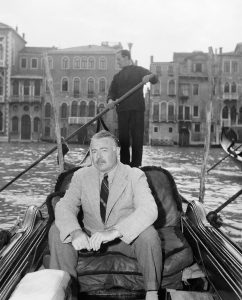 Ernest Hemingway influenced generations of writers with his terse, understated prose, his stoic code of grace under fire and his commitment to producing a strict number of pages each day. In his private life, he showed no such discipline. Married four times and chronically unfaithful, a prodigious drinker and gourmand whose weight ballooned to 240 pounds, a man of savage mood swings, alternately bellicose and sloppily sentimental, a blowhard and relentless self-promoter who claimed to crave privacy, he passed himself off as an icon of machismo, yet wrote a novel, “The Garden of Eden,” rife with cross-dressing and gender fluidity. It would have taxed Sigmund Freud and all his psychoanalytic acolytes to tease out the implications of Hemingway’s rigorous literary standards and his slovenly personal style.
 In the 1920s, decades before counterculture guru Timothy Leary made waves self-experimenting with LSD and other psychedelic drugs at Harvard University, a young perceptual psychologist named Heinrich Klüver used himself as a guinea pig in an ongoing study into visual hallucinations. One day in his laboratory at the University of Minnesota, he ingested a peyote button, the dried top of the cactus Lophophora williamsii, and carefully documented how his visual field changed under its influence. He noted recurring patterns that bore a striking resemblance to shapes commonly found in ancient cave drawings and in the paintings of Joan Miró, and he speculated that perhaps they were innate to human vision. He classified the patterns into four distinct types that he dubbed “form constants”: lattices (including checkerboards, honeycombs and triangles), tunnels, spirals and cobwebs.
 Not long ago, at a conference that brought together academics, writers and artists in Kochi in south India, the historian