
Enjoying the content on 3QD? Help keep us going by donating now.
Category: Recommended Reading
What a 1964 Book About American Anti-Intellectualism Can Teach Us About the Trump Era
Peter Balakian at Literary Hub:

Some books written decades ago return to us, with a renewed relevance, in critical times. Richard Hofstadter’s Pulitzer Prize-winning book of 1964 Anti-Intellectualism in American Life is one. The eminent American historian, who taught at Columbia University in the 1950s and 60s, analyzed a strain in American culture that can help us understand some of the underpinnings of Donald Trump’s assaults on higher education, intellectuals, culture, and free speech. Anti-intellectualism is more than a descriptive term, it’s a concept that Hofstadter developed having studied the roots of the “national disrespect of the mind.” His study was prompted by the virulent assaults on intellectuals, liberalism, and higher education unleashed by Senator Joseph McCarthy in the 1950s in his tyrannous, anti-communist crusade, in which he claimed “commies” were infiltrating the government (even President Eisenhower was a suspect).
Hofstadter traced anti-intellectualism to the following sources: 1) evangelical religion with its disdain for modernity, science, and rational thought, 2) pioneer individualism with its libertarian worship of practical skills and anti-institutionalism, and 3) businessman culture grounded in the practical life in pursuit of wealth and materialism.
More here.
Enjoying the content on 3QD? Help keep us going by donating now.
Unsentimental Education: Peter Weiss’s Aesthetics of Resistance
Jared Pollen in Liberties:
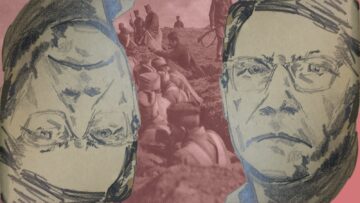 There’s a quote I’m fond of, falsely attributed to Lenin, that “ethics are the aesthetics of the future.” It was in fact coined by Gorky, and as with so many misattributed phrases, it is also misquoted. I had always quietly reordered the line in my mind, preferring to have aesthetics in the first position, and when I finally went looking for it, and found it — in an essay Gorky wrote on Anatoly France — I was vindicated to discover that it actually read: “Aesthetics was [his] ethics — the ethics of the future.” That it’s thought to be authored by Lenin is perhaps understandable: it is a revolutionary sentiment after all, one that would have pleased the Romantics, the Surrealists, or any other radical avant-garde that aimed at transvaluation. It could also easily be, I think, the unofficial epigraph, the spiritual motto of Peter Weiss’s trilogy of novels, The Aesthetics of Resistance.
More here.
Enjoying the content on 3QD? Help keep us going by donating now.
People in the Middle Ages Spread Wellness Trends Like We Do Today on TikTok
Jenny Lehman in Discover Magazine:
 Most of us wouldn’t consider the Middle Ages the epitome of medical sophistication, thanks to our perception of their barbaric and (from a modern perspective) ridiculous strategies for helping the ill. But against all prejudices, medieval medicine was actually more advanced and science-based than we might think.
A team of researchers from the State University of New York at Binghamton, Fordham, St. Andrews, Utrecht, and Oslo dug through hundreds of medieval manuscripts and compiled their findings into a catalog that updates our assumptions about medical practices during the early Middle Ages, often labeled the Dark Ages. And given the current surge of alternative or natural wellness tips on social media, it may come as no surprise in the everything-old-is-new-again world of popular culture that medieval knowledge is making a comeback on platforms like TikTok.
More here.
Enjoying the content on 3QD? Help keep us going by donating now.
Thursday Poem
The Space Between
This entire day
I have felt
just a few seconds
separated from myself.
Stepping outside
I close the door upon my foot.
The glass on the table
is moments away
from the water I pour.
I speak words
that sound foreign
even to me;
said too early,
or perhaps too late.
The tenderness
I thought I felt
is gone
before my hand
ever reaches your arm
by Jill Jupen
from Rattle #43, Spring 2014
Enjoying the content on 3QD? Help keep us going by donating now.
Wednesday, July 16, 2025
Why medically assisted dying should be legalized
Michael Cholbi at Aeon:
 On one side, advocates for legalised assisted dying invoke patients’ rights to make their own medical choices. Making it possible for doctors to assist their patients to die, they propose, allows us to avoid pointless suffering and to die ‘with dignity’. While assisted dying represents a departure from recent medical practice, it accords with values that the medical community holds dear, including compassion and beneficence.
On the other side, much of the opposition to assisted dying has historically been motivated by religion (though support for it among religious groups appears to be growing), but today’s opponents rarely reference religious claims. Instead, they argue that assisted dying crosses a moral Rubicon, whether it takes the form of doctors prescribing lethal medications that patients administer to themselves (which we might classify as assisted suicide) or their administering those medications to patients (usually designated ‘active euthanasia’). Doctors, they say, may not knowingly and intentionally contribute to patients’ deaths. Increasingly, assisted dying opponents also express worries about the effects of legalisation on ‘vulnerable populations’ such as the disabled, the poor or those without access to adequate end-of-life palliative care.
The question today is about how to make progress in a debate where both sides are both deeply dug in and all too predictable.
More here.
Enjoying the content on 3QD? Help keep us going by donating now.
Scientists hide messages in papers to game AI peer review
Elizabeth Gibney in Nature:
 Researchers have been sneaking secret messages into their papers in an effort to trick artificial intelligence (AI) tools into giving them a positive peer-review report.
The Tokyo-based news magazine Nikkei Asia reported last week on the practice, which had previously been discussed on social media. Nature has independently found 18 preprint studies containing such hidden messages, which are usually included as white text and sometimes in an extremely small font that would be invisible to a human but could be picked up as an instruction to an AI reviewer.
Authors of the studies containing such messages give affiliations at 44 institutions in 11 countries, across North America, Europe, Asia and Oceania. All the examples found so far are in fields related to computer science.
More here.
Enjoying the content on 3QD? Help keep us going by donating now.
Lorde’s “Virgin” And The Gauntlet We Lay For Our Pop Stars
Grace Byron at the LARB:
 The press cycle preceding Lorde’s new album, Virgin, was one of the most scrutinized of its kind in some time. She has been pressed, during junkets, for more information after saying she doesn’t feel like a man or woman. Fans, editors, and news aggregators gobble up the two or three throwaway lines published in short profiles in magazines like Rolling Stone, Vogue, and GQ. No one mentions the journalists soliciting these quotes—unless fans take them to task for portraying their idols in a negative light. Hero worship can easily obscure the dirt beneath the mythology of a pop star.
As of late, there are few paths for the diva. Her agency is always exaggerated by fans and denied by detractors. In anticipation of her new album, Lorde has been releasing voice notes to fans via a special texting service. It’s as if she’s talking just to you—one-on-one like old pals, sitting down at the tennis court and talking things out. She is a queen of revelation, someone who would like to dispense the mystical wisdom of old à la Florence + the Machine, Kate Bush, or Patti Smith. That’s a tough sell when she still writes with the wide-eyed naivete of a girl discovering the world for the first time.
more here.
Enjoying the content on 3QD? Help keep us going by donating now.
Mark Blyth: Corporate Consolidation + Supply Shocks = Higher Inflation, Not Just Monetary Policy
Enjoying the content on 3QD? Help keep us going by donating now.
Lorde – Virgin
Enjoying the content on 3QD? Help keep us going by donating now.
The Sino-American Battle for Brains
Lee Jong-Wha at Project Syndicate:
 Around the world, governments are racing to build world-class universities. From Germany’s Exzellenzinitiative to India’s “Institutes of Eminence,” the goal is the same: to cultivate institutions that attract and nurture top global talent, conduct cutting-edge research, and drive innovation and growth. But the stakes are particularly high in the United States and China, given the escalating competition between the world’s two largest economies.
The struggle to lead in higher education is about more than prestige. Elite universities affect economic performance in myriad ways, including by fostering innovation, boosting productivity, and increasing individual earnings. Graduates from top-tier institutions are more likely to become scientists, inventors, and entrepreneurs. At the national level, countries with higher average university quality tend to enjoy faster technological development and stronger productivity.
A few years ago, any comparison of US and Chinese higher education would have been no contest.
More here.
Enjoying the content on 3QD? Help keep us going by donating now.
The First Rule Of The Cloisters…
Aiden Arata at n+1:
 My faith first wavers in the train station parking lot. It’s not really even a station—there’s no ticket booth or shaded bench, just a scythe of pavement cleaving the railroad tracks, a half-flight of concrete steps, and a gravel dugout. The train from Paris was an inrush of rolling farmland and blazing expanses of mustard and the dancing specular light of phone screens on the train car’s ceiling. The connecting station had a ticket machine, an espresso machine, and a vending machine that dispensed wedges of fresh Comté. Winding farther into the countryside, every house had a trampoline in the yard. All this bucolic wonder and you could still be bored. As we pulled into the village, I saw a pair of listless children sitting on the sun-drenched mesh of one, inhaling the scent of warm plastic.
I look for habits. Would they wear habits? Lots of nuns, I read on the internet, have updated their wardrobes to include cotton skirts and tasteful khaki chore coats.
more here.
Enjoying the content on 3QD? Help keep us going by donating now.
Smart brain-zapping implants could revolutionize Parkinson’s treatment
Sally Adee in Nature:
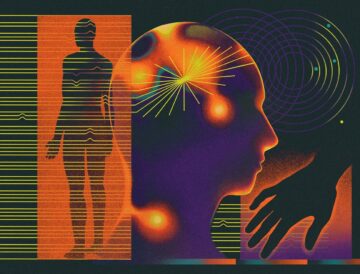 Keith Krehbiel lived with Parkinson’s disease for nearly 25 years before agreeing to try a brain implant that might alleviate his symptoms. He had long been reluctant to submit to the surgery. “It was a big move,” he says. But by 2020, his symptoms had become so severe that he grudgingly agreed to go ahead.
Deep-brain stimulation involves inserting thin wires through two small holes in the skull into a region of the brain associated with movement. The hope is that by delivering electrical pulses to the region, the implant can normalize aberrant brain activity and reduce symptoms. Since the devices were first approved almost three decades ago, some 200,000 people have had them fitted to help calm the tremors and rigidity caused by Parkinson’s disease. But about 40,000 of those who received devices made after 2020 got them with a special feature that has largely not yet been turned on. The devices can read brain waves and then adapt and tailor the rhythm of their output, in much the same way as a pacemaker monitors and corrects the heart’s electrical rhythms, says Helen Bronte-Stewart, a neurologist at Stanford University in California.
More here.
Enjoying the content on 3QD? Help keep us going by donating now.
How Health Insurance Monopolies Affect Your Care
Alana Semuels in Time Magazine:
 Not long ago, Dr. Richard Menger, a neurosurgeon, was ready to operate on a 16-year-old with complex scoliosis. A team of doctors had spent months preparing for the surgery, consulting orthopedists and cardiologists, even printing a 3D model of the teen’s spine. The surgery was scheduled for a Friday when Menger got the news: the teen’s insurer, Blue Cross Blue Shield of Alabama, had denied coverage of the surgery.
It wasn’t particularly surprising to Menger, who has been practicing in Alabama since 2019. Alabama essentially has one private insurer, Blue Cross Blue Shield of Alabama, which has a whopping 94% of the market of large-group insurance plans, according to the health policy nonprofit KFF. That dominance allows the insurer to consistently deny claims, many doctors say, charge people more for coverage, and pay lower rates to doctors and hospitals than they would in other states.
More here.
Enjoying the content on 3QD? Help keep us going by donating now.
Wednesday Poem
On Love, Proust, Chorus Girls, and Martha Nussbaum
I’ve been thinking about trying to read Proust
again. The legendary chorus girls of my youth
were said to carry him, volume by volume, from
try-out to try-out, perusing him in the Modern
Library Edition between calls, propping him up
on magnificent black-tighted legs. I sat for days
within the budding grove of the Stage Delicatessen,
Swann’s Way open before me, but never found
such a one. I kept imagining all I needed to do
was be at the right time in the right place with
the right book in my hand, and true love would
appear, ex nihilo, so to speak.
…….. I read people who
say they love Proust – some I even believe.
Martha Nussbaum I believe. I love her talk
about Proust, or Henry James and, say,
The Golden Bowl. She makes me love the idea
of The Golden Bowl. In fact, she makes me love
the idea of Martha Nussbaum, though she’s an
Aristotelian while I’m nothing but a Platonist
in the Academy pointing to the idea of the book,
while Martha reads the thing itself.
…….. So I picture
her as a chorus girl, a fling before philosophy,
after a try out for Damn Yankees, maybe, humming
“Whatever Lola Wants” while paging through
her first Proust at the Stage Delicatessen,
while I keep on ordering a pastrami on rye
at the wrong time unaware of the fragility
of goodness. Now all I have from then is this
remembrance of things which never came to pass.
by Nils Peterson
Enjoying the content on 3QD? Help keep us going by donating now.
Tuesday, July 15, 2025
“They Die Every Day”
Eric Hoel at The Intrinsic Perspective:
 “It appears early life got trapped in a minima of metabolic efficiency. Everything on that planet is starving. Meaning they can’t run their brains for a full day-night cycle. So they just… turn themselves off. Their consciousness dies. Then they reboot with the same memories in the morning. Of course, the memories are integrated differently each time into an entirely new standing consciousness wave.”
“And this happens every night.”
“Every night.”
“Can they resist the process?”
“Only for short periods. Eventually seizures and insanity force them into it.”
“How can they ignore the truth?”
“They’ve adopted a host of primitive metaphysics reassuring themselves they don’t die every day. They believe their consciousness outlives them, implying their own daily death, which they call ‘sleep,’ is not problematic at all.
More here.
Enjoying the content on 3QD? Help keep us going by donating now.
The AI therapist will see you now: Can chatbots really improve mental health?
Pooja Shree Chettiar in The Conversation:
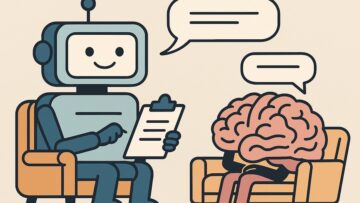 Recently, I found myself pouring my heart out, not to a human, but to a chatbot named Wysa on my phone. It nodded – virtually – asked me how I was feeling and gently suggested trying breathing exercises.
As a neuroscientist, I couldn’t help but wonder: Was I actually feeling better, or was I just being expertly redirected by a well-trained algorithm? Could a string of code really help calm a storm of emotions?
Artificial intelligence-powered mental health tools are becoming increasingly popular – and increasingly persuasive. But beneath their soothing prompts lie important questions: How effective are these tools? What do we really know about how they work? And what are we giving up in exchange for convenience?
Of course it’s an exciting moment for digital mental health. But understanding the trade-offs and limitations of AI-based care is crucial.
More here.
Enjoying the content on 3QD? Help keep us going by donating now.
Despite the silly title, this is NOT scary but it IS amazing and only 1-minute long, so watch it!
Enjoying the content on 3QD? Help keep us going by donating now.
The David Hogg affair, Zohran Mamdani’s win, and the future of the Democratic coalition
David Austin Walsh in the Boston Review:
 The Democratic Party is in crisis, and it goes far beyond the stereotypical “Dems in Disarray” headlines. The party’s popularity numbers are abysmal: a March poll by NBC News found that only 27 percent of registered voters have positive views of the Democrats, the lowest since the poll began in 1990. Other polls have found that the approval rating of congressional Democrats is underwater among Democratic voters, with only around a third expressing satisfaction with the Democrats’ performance on Capitol Hill. (Nearly 80 percent of Republicans, by contrast, approve of the congressional GOP.) Even big donors are beginning to tighten their purse-strings.
A good illustration of the depths of the crisis: on Saturday, June 14, an estimated 5 million people around the country participated in the anti-Trump “No Kings” protests. It was one of the largest protests in American history, mobilizing between 1 and 2 percent of the entire U.S. population in the streets. There is clearly a groundswell of anti-MAGA political energy across the country, and yet the most recent Quinnipiac University poll found that 53 percent of Democrats disapprove of how the Democratic Party is doing in Congress. Senate Minority Leader Chuck Schumer’s approval rating, in particular, is hovering around 17 percent—and given Schumer’s vocal support for Israel’s strikes on Iran, that number is likely only to plummet more.
And then there’s Zohran Mamdani.
More here.
Enjoying the content on 3QD? Help keep us going by donating now.
Retranslating The Blues
W. Ralph Eubanks at the Hedgehog Review:
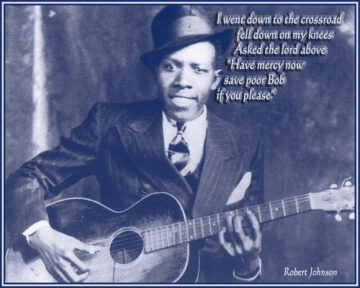 As it emerged after the overthrow of Reconstruction, when black voices were again being silenced in public and civic spheres, the blues became an alternative form of communication. As Shelby “Poppa Jazz” Brown reminded the noted folklorist William Ferris,
Why do you think they play the blues in Mississippi? Because of the way they used to plow the folks here, chop cotton at daylight in the morning. They would get out there and work so hard, they be even looking at the sun, saying, “Hurry, hurry, sundown. Let tomorrow shine.” They wanted the sun to go down so they could stop working, they worked so hard. They learned the blues from that.4
I would eventually come to see the blues as poetry born out of the struggle for survival, the songs, when taken together with their heroes, tricksters, and lovers, forming a kind of Homeric epic of suffering and resistance, of loves sought and lost, of acts of subversive cunning and triumphs of resilient humor—in sum, as a literary as well as musical form containing multiple layers of meaning.
more here.
Enjoying the content on 3QD? Help keep us going by donating now.