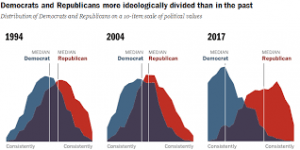
That’s the starting place of our new paper: “Common-Knowledge Attacks on Democracy.” In it, we look at democracy through the lens of information security, trying to understand the current waves of Internet disinformation attacks. Specifically, we wanted to explain why the same disinformation campaigns that act as a stabilizing influence in Russia are destabilizing in the United States.
The answer revolves around the different ways autocracies and democracies work as information systems. We start by differentiating between two types of knowledge that societies use in their political systems. The first is common political knowledge, which is the body of information that people in a society broadly agree on. People agree on who the rulers are and what their claim to legitimacy is. People agree broadly on how their government works, even if they don’t like it. In a democracy, people agree about how elections work: how districts are created and defined, how candidates are chosen, and that their votes count—even if only roughly and imperfectly.
We contrast this with a very different form of knowledge that we call contested political knowledge, which is, broadly, things that people in society disagree about.
Bacon’s various London studios became notorious for their chaotic admission of decadence and squalor. The most famous of these was his studio at 7 Reece Mews in South Kensington, which was posthumously donated in its entirety to the Hugh Lane Gallery in 1998. The first-floor studio at Reece Mews was reached by climbing a steep wooden staircase with a thick rope used as a makeshift handrail. Visitors entering through the narrow studio door were immediately confronted by a deluge of materials. Detritus mounds of old paint tins, tubes and slashed canvasses reached up toward the pale skylight. The floorboards were covered in a congealing mass of magazines, photographs, catalogues. Bacon’s maxim was that “chaos breeds images” and he absorbed the anarchic atmosphere of his studio space into his developing art practice and aesthetic. Spontaneity and chance were portals of discovery. He drew inspiration for his nightmarish scenes from the photographic collage of screaming dictators, hysterical patients, bullfighters and wrestlers strewn beneath his easel across the studio floor. Images suddenly suggested themselves on the rough unprimed canvass in the slip of a brush or an accidental spatter of pigment. A single strong stroke could define the outline of a man’s jaw, a cloth smearing animate a recoiling movement. Bacon even brashly mixed dust from the floorboards into one of his early paintings to capture the charcoal texture of a suit lapel.
All creators of fiction contain multitudes. Writers write to discover themselves, and to hide themselves. “I know that my books can only be female,” you have written. “But I also know that female (or male) absoluteness is inconceivable. We are tornadoes that pick up fragments with the most varied historical and biographical origins.” No matter who is writing under your name, Elena, your work loses none of its urgency, none of its power. Sometimes I think back to the last passage of The Story of the Lost Child, the final Neapolitan novel. Lenù has again found traces of Lila. “Unlike stories, real life, when it has passed, inclines toward obscurity, not clarity,” Lenù thinks. This is precisely the feeling I have after reading your books. It’s the fiction that offers the clarity. The real life, the lived experience that might drive the imagination, remains a mystery.
Peter van Ham’s Alchi, the third volume of a monumental trilogy published by Hirmer on the Buddhist art of western Tibet, must be one of the finest art books ever produced. Its subject, the site of Alchi, sits on the bank of the Indus River in Ladakh, in the high mountain ranges to the east in what is now the Indian state of Kashmir, some thirty-five miles northwest of the capital city of Leh. Unlike Guge, the subject of van Ham’s second volume, Alchi is relatively accessible—good roads now connect Alchi to Leh and (a little less smoothly) to the haunting monastery of Lamayuru, still farther to the north and west.
I visited there with my wife in 2004. A caretaker monk unlocked for us the eleventh-century carved doorway to the Dukhang, every inch of which is painted with Buddhas, Buddhas-to-Be, gods, goddesses, demons, hungry ghosts, imps, flying nymphs, other celestial beings, royal hunters and patrons, monks, Yogi magicians, and many hallucinatory figures that seem to have floated up from the stuff of our dreams. The monk was bored and impatient; after some thirty minutes, he shooed us away. Needless to say, we had no time to unravel even one of the painted tableaux. But I was left, then as now, after spending some weeks with van Ham’s book, with a sense of a dizzying proliferation of vital beings mobbing my eyes. In all of South Asian art, there is nothing quite like these densely painted murals.
Is it possible to have mild tyranny? It sounds like an oxymoron, and certainly not the kind of thing citizens in a democracy might choose. But when you consider the relationship many of us have with technology there is something gently tyrannical involved. In theory we are free to abandon our computer screens, at liberty not to check our phones. In practice we are ensnared in digital networks for most of our waking hours (and longer, for those with smart watches that monitor sleep patterns). In submission to devices, we surrender vast quantities of personal data. Somewhere in the information harvested by powerful tech companies – Amazon, Apple, Facebook and Google – there is a reliable account of where you are, where you are going and who you will see. With a bit of algorithmic extrapolation, it is possible also to predict how you feel.
This knowledge goes beyond any monitoring apparatus established by an authoritarian state. Jamie Susskind writes about a new era of mass “scrutability”, a degree of penetration into our private realms more profound than old-fashioned surveillance. And we sign up for it. We tick the box confirming we have read the terms and conditions, although, of course, we haven’t, because the immediate utility outweighs any abstract cost. Susskind defines this as the “data deal” – a new form of social contract, insufficiently understood by most who enter into it, that entrenches an imbalance of power between the givers of information (you and me) and those who benefit from it (companies and states). He quotes the legal scholar Tim Wu: “Consumers on the whole seem content to bear a little totalitarianism for convenience.”
This week, on the eve of the International Summit on Human Genome Editing in Hong Kong, China, He Jiankui, a Chinese researcher, shocked many with claims that his team had used CRISPR-Cas9 to engineer the DNA of twin baby girls born recently to cripple a key receptor on white blood cells to make them HIV-resistant. The claim—yet to be reported in a scientific paper—was met with a firestorm of criticism, with some scientists and bioethicists calling the work “premature,” “ethically problematic,” and even “monstrous.”
NASA’s InSight spacecraft survived its harrowing descent through the thin atmosphere of Mars and successfully landed on the planet’s surface this week. Although InSight didn’t hit the bull’s-eye of its target landing zone, the soil-filled crater into which the craft touched down offers a good environment for the lander to deploy instruments for studying the planet’s interior.
This week, only one prominent scientist quickly spoke out in defense of He Jiankui, the Chinese research who claimed to have created the first gene-edited children: geneticist George Church, whose Harvard University lab played a pioneering role in developing CRISPR, the genome editor used to engineer embryonic cells in the controversial experiment. Although Church has reservations about He’s actions, he also says the frenzy of criticism surrounding the experiment was extreme.
I met Naguib Mahfouz once. It was in the winter of 2006, and I’d been living in Cairo for three and a half years. The writer Gamal Al-Ghitani, an old friend of Mahfouz’s, provided me with an introduction to one of his weekly gatherings. I went to a Holiday Inn in the suburb of Maadi. The hotel faced the Nile across four lanes of traffic. There was a metal detector at the front door. Ever since he was nearly killed by a young fundamentalist in 1994, Mahfouz no longer frequented the downtown cafés where he had met friends and fellow writers for half a century.
It was a small group; I can’t remember any names. There must have been a few of Mahfouz’s old friends and a few new admirers such as myself. Also in attendance was a well-known Cairo character, a middle-aged American who favored white suits and who claimed, for decades now, to be writing Mahfouz’s biography.
Mahfouz was 94 then. He was enveloped in an overcoat that was too big for him and made him look like a small, wizened, sympathetic turtle.
The “Easy Problems” of consciousness have to do with how the brain takes in information, thinks about it, and turns it into action. The “Hard Problem,” on the other hand, is the task of explaining our individual, subjective, first-person experiences of the world. What is it like to be me, rather than someone else? Everyone agrees that the Easy Problems are hard; some people think the Hard Problem is almost impossible, while others think it’s pretty easy. Today’s guest, David Chalmers, is arguably the leading philosopher of consciousness working today, and the one who coined the phrase “the Hard Problem,” as well as proposing the philosophical zombie thought experiment. Recently he has been taking seriously the notion of panpsychism. We talk about these knotty issues (about which we deeply disagree), but also spend some time on the possibility that we live in a computer simulation. Would simulated lives be “real”? (There we agree — yes they would.)
In my six decades in public service, I’ve seen many changes in our nation and its institutions. Yet the most profound change I’ve witnessed is also the saddest. It is the complete collapse in respect for virtually every institution of government and an unprecedented cynicism about the nobility of public service itself.
These are not just the grumblings of an angry old man lamenting the loss of “the good old days.” In December 1958, almost exactly three years after I entered the House of Representatives, the first American National Election Study, initiated by the University of Michigan, found that 73 percent of Americans trusted the federal government “to do the right thing almost always or most of the time.” As of December 2017, the same study, now conducted by the nonpartisan Pew Research Center, found that this number had plummeted to just 18 percent.
There are many reasons for this dramatic decline: the Vietnam War, Watergate, Ronald Reagan’s folksy but popular message that government was not here to help, the Iraq War, and worst of all by far, the Trumpist mind-set.
The earliest letters are sometimes very funny, as Larkin tries on attitudes. At Oxford he claims to be lumbered with ancient and/or mentally defective tutors; his work appears in magazines but is no good; he is upbraided when he reads for pleasure. He tailors his tone to the recipient: bluff and undeluded for Sydney Larkin (‘Pop’), safely and tenderly domestic for Eva (‘Mop’) and affectionately satirical for his older sister, Kitty. He includes some moody Oxford scenery: ‘the playing fields wait for the games of this afternoon; through the unecstatic street the gowned bicycles are whirling.’ This is pretty sophisticated for an eighteen-year-old – partly a parody of the promised bicycle races in Auden’s ‘Spain’, partly the kind of ‘real’ thing that finds its way into Larkin’s poetry and fiction. His description of trying to access a copy of Lady Chatterley’s Lover at the Bodleian is a small-scale classic that would slot perfectly into Lucky Jim. You enjoy the voice without ever quite believing what Larkin says, but ‘what he says’, the making over of the humdrum world of college and digs into curmudgeonly comedy, is what matters. This spirit of negation persists into his maturity, but it hardens from playfulness into habit.
Culture shapes who we are, so it follows that it would also shape our manifestations of stress, mental disorder, emotion. Yet, that also implies a kind of messiness that modern psychology and psychiatry, particularly the American kind, have spent the last 100 years struggling to tidy up.
Since their founding, psychology and psychiatry have strove to standardize the diagnosis and treatment of mental disorders — to bring some certainty to what can feel like a very uncertain field.
But increasingly, clinicians are recognizing the downside of those strictures. Delivering the best care for patients will require something broader and more adaptable — mental health care models that can accommodate hundreds of individual cultures. And because no individual patient experiences a culture the same way, those models will ultimately have to do something even more radical: create the sort of super-personalized mental health care that the profession has aspired to — or, perhaps, should have aspired to — all along.
It is worth noting how unerring Berlin’s taste was. She spoke of both Chekhov and William Carlos Williams as models. Her characters read Middlemarch the way other people read Flowers in the Attic: dangling from one hand. The editor of A Manual for Cleaning Women, Stephen Emerson, describes exchanging books with her. He gave her Dreiser once and she hated it, saying he wrote like a guy. I have a soft spot for Dreiser, but it’s because half his writing is made up of descriptions of girls’ trim waists in tight suits twinkling up the steps. The only reason to read Dreiser at age 11 is to become bisexual, and Lucia was far too straight to fall for that. Or perhaps I’m talking about keeping it classy. Do you read Racine when you’re drunk? No, I read a novelisation of One Tree Hill called A Heart So True and it’s awesome, and that’s the reason I’ll never have a story in the Atlantic Monthly.
There is less to say about writers who know what to leave out. Even Davis, in her introduction to A Manual for Cleaning Women, seems somewhat at a loss, though their affinity is a given: a woman who writes a story like Davis’s ‘Mown Lawn’ is going to like a woman who writes: ‘There are certain perfect particular sounds. A tennis ball, a golf ball hit just right. A fly ball in a leather glove. Lingering thud of a knockout. I get dizzy at the sound of a perfect pool break, a crisp bank shot followed by three or four muffled slides and consecutive clicks.
Timothy Aubry in The Chronicle of Higher Education:
However inclined by their training to vacillate, scholars in the humanities are increasingly being asked to take sides. Should they support or oppose their students’ efforts to ban a reactionary speaker from campus? Should they defend the feminist philosopher who affirms the possibility of transracial identity or join those demanding her article be retracted? Should they remove an influential writer from the syllabus because of his fascist sympathies? Should they sign the petition urging their professional organization to join the Boycott, Divestment, and Sanctions campaign against Israel? So much of academic life seems colored by high-stakes political struggles, and so many decisions large and small are now treated as gestures of allegiance to particular ideological camps and as betrayals of others. It’s difficult to even list these polarizing campus scenarios without attracting political labels.
Literary scholars will very likely regard this situation as nothing new. Their discipline, after all, has been insisting for decades that everything is political. As far back as 1968, a group of radical scholars sought to take over the Modern Language Association’s annual conference. Louis Kampf was arrested for taping a poster to the wall of the conference hotel announcing that “The Tygers of Wrath are Wiser than the Horses of Instruction,” and Noam Chomsky led a Vietnam War teach-in with 500-plus attendees. Then, as anyone even glancingly familiar with the culture wars of the 1980s and 1990s knows, the emphasis on politics gave birth to an attitude of suspicion toward the canon. While authors like Shakespeare and Woolf were sometimes celebrated for their works’ subversive power, many others, like Conrad, were condemned for reinforcing dominant ideologies. The urge to dethrone literary heroes on the basis of their bad politics has persisted up to the present moment, gaining strength as the Black Lives Matter and #MeToo movements have emerged. The past year witnessed an especially heated debate about how to treat Junot Diaz’s work in light of allegations that he sexually harassed several women, with many now identifying conspicuous signs of misogyny in his fiction, while other scholars have maintained that he is being scapegoated because of his ethnic background.
If you’re an expert in climate science, you probably get this question a lot.
“I do,” said Kate Marvel, associate research scientist at the NASA Goddard Institute for Space Studies. “And I’ve been hearing it more recently.” It’s no mystery why. Reports of the threats from a warming planethave been coming fast and furiously. The latest: a startling analysis from the Intergovernmental Panel on Climate Change predicting terrible food shortages, wildfires and a massive die-off of coral reefs as soon as 2040, unless governments take strong action. The Paris climate accord set a goal of keeping the global temperature from rising more than 2 degrees Celsius, or 3.6 degrees Fahrenheit, above preindustrial levels.At 2 degrees, things are bad enough: Arctic sea ice is 10 times more likely to disappear over the summer, along with most of the world’s coral reefs. As much as 37 percent of the world’s population becomes exposed to extreme heat waves, with an estimated 411 million people subject to severe urban drought and 80 million people to flooding from rising sea levels.
But if we can hold the global temperature increase to 1.5 degrees Celsius, Arctic sea ice is far likelier to survive the summers. Coral reefs will continue to be damaged, but will not be wiped out. The percentage of people exposed to severe heat waves would plummet to about 14 percent. The number exposed to urban drought would drop by more than 60 million people. Still, no major industrialized nation is on track to meet the 2-degree goal, much less the 1.5-degree mark. And the Earth has already warmed by 1 degree. Even if, through huge effort and force of will, we cut our greenhouse gas emissions greatly, the effects of today’s carbon dioxide in the atmosphere will be felt for centuries to come.
While that is undoubtedly grim, it’s not as bad as it could be. Reducing the amount of greenhouse gases in the atmosphere could eventually reverse some of the most troublesome effects of warming.
I met Rene Magritte a few weeks ago at the Starline Social Club in Oakland. A surprisingly jolly fellow, it turns out he’s working these days as a pedicab driver in San Francisco. Surrealism isn’t my jam, but when he offered me a pickup the next morning at the BART and mushrooms and tickets for two to the retrospective of his work at SFMoMA, well—I had to accept.
There are many things one could say about the SFMoMA. It’s massive, it’s powerful, and it’s complicated. I have a sneaking suspicion that it operates as a kind of Leviathan in the Bay Area that sucks aesthetic energy into its great maw, gobbling up the local, less well-endowed swimmers and forcing an evacuation of the surrounding area that threatens to leave the gallery and studio scene like a bleached-out coral reef bereft of any but the largest predators. The regular reports of artists fleeing the Bay Area and moving to Los Angeles would seem to bear this out, as would the wriggling, lamprey-like presence of a Gagosian outpost since 2016 across the street.
That said, the collection SFMoMA contains is nothing short of incredible. Bracketing for the time being the delicious irony of the Fisher holdings—one of the world’s most extensive collections of post-war and contemporary art, a collection of some of the most sublime works of 20th century art, built from a fortune made by erasing the distinction between high and low culture (The Gap), valued at well over a billion dollars—visiting SFMoMA is an eye-widening, jaw-dropping experience. It has everything, all of it, and it is informed by a profound and generous curatorial intelligence. Each visit promises new understandings, a renewed interest in old favorites (“Here’s a room full of Paul Klee!”), and a reminder of what art and artists can do: the limitless reach of human creativity. It doesn’t engage in easy juxtapositions or cheap didactics. It just quietly and seductively invites you to join the conversation. There are some very smart people working there.
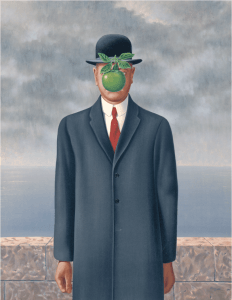
Le fils de l’homme (The Son of Man), by Rene Magritte, 1964.
The Magritte exhibit was proof of that. It was exquisitely curated. But whether it was because I didn’t eat the mushrooms or because surrealism is a movement that appeared during the hour when the sun casts its shortest shadow, I found the curatorial effort behind the exhibit more compelling than the work itself. Sorry, but I was underwhelmed. Magritte (for my taste) is neither creepy enough, nor playful enough, nor philosophical enough to warrant bathing with. Spending that much time with that much of his work was a lesson in the limits of puns and dreams. There’s a reason that it appeals to children, and we are not living in child-like times. These are ugly, impoverished times. Wounded times. Magritte doesn’t help us negotiate them. So at the end of it, I went in search of some art that would explode in my face or deepen my emotions or fill me with awe. Give me some Kara Walker, please, or some William Kentridge. Like I said, SFMoMA has it all. Finally, I found myself looking at a bunch of paintings by Philip Guston. Read more »
Popular political commentary from across the spectrum is replete with warnings social about “bubbles,” “silos,” and “echo chambers.” These are said to produce “closure,” “groupthink,” and an “alternate reality.” In turn, these forces result in the dysfunction of polarization, a condition where political officials and ordinary citizens are so deeply divided that there is no basis for compromise or even productive communication among them.
That polarization is politically dysfunctional might seem obvious. Where polarization prevails, the ground for compromise recedes, and so politics becomes a series of standoffs and bottlenecks. Yet politics still needs to get done. Hence democracy devolves into a numbers game of modus vivendi truces and strained compromises, resembling nothing like self-government among social equals.
In order to know what to do about polarization, we need a more precise view of what it is. It is helpful to distinguish (as we have elsewhere) between two different kinds of polarization: political polarization and belief polarization. The former refers to various ways of measuring the distance between political rivals. This distance can be conceived in terms of policyand platformdivides or else in terms of inter-party antipathy. But in either case, where political polarization prevails, the common ground among politically opposed parties falls out, resulting in political deadlock. The latter, belief polarization, refers to a phenomenon to which we are all subject by which interactions with like-minded others transforms us into more extreme versions of ourselves. Read more »
There’s a door behind her ear—or really in the fold where the ear meets the skull where a down of short brown hairs nestles up to her ear-cup, the door sometimes burns and she drags one long fingernail deep along the crease like an animal scratching itself with a claw to quiet whoever it is who lives there— she’s pretty sure it’s a door but it could be a wall.
* * *
Here you have the ear parade the hearing party the masquerade of ears that meet by the waterfront under the train bridge where the waves are at their reckless loudest—all cloaked in deep fur muffs or decorated with a little pretty lace hanging from a hat or jeweled with a flesh-tone hearing aid like a prehistoric statue.

 Democracy is an information system.
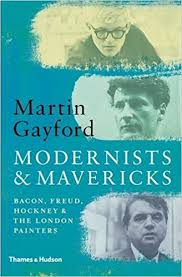 Bacon’s various London studios became notorious for their chaotic admission of decadence and squalor. The most famous of these was his studio at 7 Reece Mews in South Kensington, which was posthumously donated in its entirety to the Hugh Lane Gallery in 1998. The first-floor studio at Reece Mews was reached by climbing a steep wooden staircase with a thick rope used as a makeshift handrail. Visitors entering through the narrow studio door were immediately confronted by a deluge of materials. Detritus mounds of old paint tins, tubes and slashed canvasses reached up toward the pale skylight. The floorboards were covered in a congealing mass of magazines, photographs, catalogues. Bacon’s maxim was that “chaos breeds images” and he absorbed the anarchic atmosphere of his studio space into his developing art practice and aesthetic. Spontaneity and chance were portals of discovery. He drew inspiration for his nightmarish scenes from the photographic collage of screaming dictators, hysterical patients, bullfighters and wrestlers strewn beneath his easel across the studio floor. Images suddenly suggested themselves on the rough unprimed canvass in the slip of a brush or an accidental spatter of pigment. A single strong stroke could define the outline of a man’s jaw, a cloth smearing animate a recoiling movement. Bacon even brashly mixed dust from the floorboards into one of his early paintings to capture the charcoal texture of a suit lapel.
 Peter van Ham’s Alchi, the third volume of a monumental trilogy published by Hirmer on the Buddhist art of western Tibet, must be one of the finest art books ever produced. Its subject, the site of Alchi, sits on the bank of the Indus River in Ladakh, in the high mountain ranges to the east in what is now the Indian state of Kashmir, some thirty-five miles northwest of the capital city of Leh. Unlike Guge, the subject of van Ham’s second volume, Alchi is relatively accessible—good roads now connect Alchi to Leh and (a little less smoothly) to the haunting monastery of Lamayuru, still farther to the north and west.
 Is it possible to have mild tyranny? It sounds like an oxymoron, and certainly not the kind of thing citizens in a democracy might choose. But when you consider the relationship many of us have with technology there is something gently tyrannical involved. In theory we are free to abandon our computer screens, at liberty not to check our phones. In practice we are ensnared in digital networks for most of our waking hours (and longer, for those with smart watches that monitor sleep patterns). In submission to devices, we surrender vast quantities of personal data. Somewhere in the information harvested by powerful tech companies – Amazon, Apple, Facebook and Google – there is a reliable account of where you are, where you are going and who you will see. With a bit of algorithmic extrapolation, it is possible also to predict how you feel.
 CRISPR bombshell: Chinese researcher claims to have created gene-edited twins
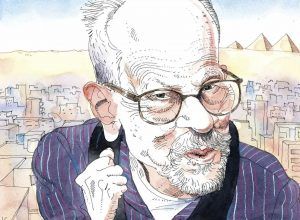 I met Naguib Mahfouz once. It was in the winter of 2006, and I’d been living in Cairo for three and a half years. The writer Gamal Al-Ghitani, an old friend of Mahfouz’s, provided me with an introduction to one of his weekly gatherings. I went to a Holiday Inn in the suburb of Maadi. The hotel faced the Nile across four lanes of traffic. There was a metal detector at the front door. Ever since he was nearly killed by a young fundamentalist in 1994, Mahfouz no longer frequented the downtown cafés where he had met friends and fellow writers for half a century.
 The “Easy Problems” of consciousness have to do with how the brain takes in information, thinks about it, and turns it into action. The “
 The earliest letters are sometimes very funny, as Larkin tries on attitudes. At Oxford he claims to be lumbered with ancient and/or mentally defective tutors; his work appears in magazines but is no good; he is upbraided when he reads for pleasure. He tailors his tone to the recipient: bluff and undeluded for Sydney Larkin (‘Pop’), safely and tenderly domestic for Eva (‘Mop’) and affectionately satirical for his older sister, Kitty. He includes some moody Oxford scenery: ‘the playing fields wait for the games of this afternoon; through the unecstatic street the gowned bicycles are whirling.’ This is pretty sophisticated for an eighteen-year-old – partly a parody of the promised bicycle races in Auden’s ‘Spain’, partly the kind of ‘re
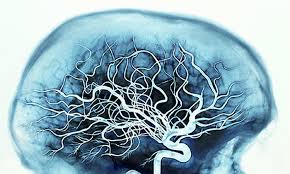 Culture shapes who we are, so it follows that it would also shape our manifestations of stress, mental disorder, emotion. Yet, that also implies a kind of messiness that modern psychology and psychiatry, particularly the American kind, have spent the last 100 years struggling to tidy up.
 It is worth noting
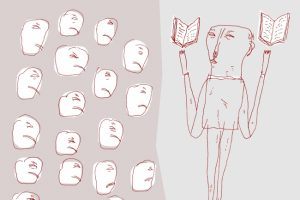 However inclined by their training to vacillate, scholars in the humanities are increasingly being asked to take sides. Should they support or oppose their students’ efforts to ban a reactionary speaker from campus? Should they defend the feminist philosopher who affirms the possibility of transracial identity or join those demanding her article be retracted? Should they remove an influential writer from the syllabus because of his fascist sympathies? Should they sign the petition urging their professional organization to join the Boycott, Divestment, and Sanctions campaign against Israel? So much of academic life seems colored by high-stakes political struggles, and so many decisions large and small are now treated as gestures of allegiance to particular ideological camps and as betrayals of others. It’s difficult to even list these polarizing campus scenarios without attracting political labels.
 Are we doomed?
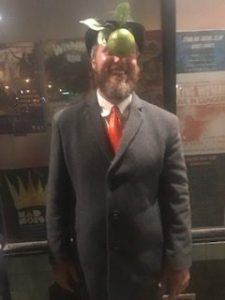 I met Rene Magritte a few weeks ago at the Starline Social Club in Oakland. A surprisingly jolly fellow, it turns out he’s working these days as a pedicab driver in San Francisco. Surrealism isn’t my jam, but when he offered me a pickup the next morning at the BART and mushrooms and tickets for two to the retrospective of his work at SFMoMA, well—I had to accept.