
Anita Makri in Nature:
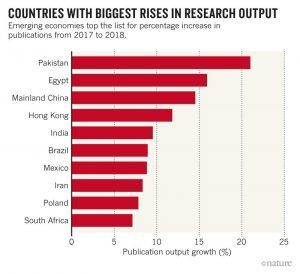 Emerging economies showed some of the largest increases in research output in 2018, according to estimates from the publishing-services company Clarivate Analytics. Egypt and Pakistan topped the list in percentage terms, with rises of 21% and 15.9%, respectively. China’s publications rose by about 15%, and India, Brazil, Mexico and Iran all saw their output grow by more than 8% compared with 2017 (See ‘Countries with biggest rises in research output’). Globally, research output rose by around 5% in 2018, to an estimated 1,620,731 papers listed in a vast science-citation database Web of Science, the highest ever (see ‘Research output rose again in 2018’). This diversification of players in science is a phenomenal success, says Caroline Wagner, a science and technology policy analyst at Ohio State University, and a former adviser to the US government. “In 1980, only 5 countries did 90% of all science — the United States, the United Kingdom, France, Germany and Japan,” she says. “Now there are 20 countries within the top producing group.”
…It’s not yet clear what has driven the strong gains by Egypt and Pakistan. One reason could be that both countries started from a low base — near the bottom of the list of top 40 countries in overall numbers of papers, says Robert Tijssen, head of science and innovation studies at Leiden University in the Netherlands. The figures might also reflect changes in how the database is curated, which has added more local or national journals to the mix. But some geographical regions, notably in Africa, are still under-represented, says Tijssen. Increases in funding and international collaborations might also have boosted the rise in publications in Egypt and Pakistan, say Tijssen and Wagner.
More here.
 Pablo Calvi in The Believer:
 Fara Dabhoiwala in The Guardian:
 An interview with Adam Tooze in Jacobin:
 Sheri Berman in Dissent:
 His book is a lie, a black, infernal creation of a twisted, distorted mind.” It was a Democratic representative from Oklahoma who gave this verdict of The Grapes of Wrath, John Steinbeck’s chronicle of migrants leaving the Dust Bowl for California. Disdained by the political elite and much of the literary set, it was nonetheless the best-selling book of 1939. Today’s parallels with the 1930s give Steinbeck’s work renewed urgency. He writes about farm labourers, shopkeepers and the denizens of village taverns – the kinds of people who, before the enormous political upheaval of 2016, the chattering classes barely remembered. In the age of Trump, mass-migration and the phenomenon of the ‘left behind’, Steinbeck’s work is just as relevant as when he wrote it. But more than that: reading Steinbeck fifty years after his death is the perfect antidote to the culture war that has gripped America.
 Jan Mattlin was having what counts as a bad day in Kauniainen. He had driven to the town’s train station and found nowhere to park. Mildly piqued, he called the local newspaper to suggest a small article about the lack of parking spots. To Mr. Mattlin’s surprise, the editor put the story on the front page. “We have very few problems here,” recalled Mr. Mattlin, a partner at a private equity firm. “Maybe they didn’t have any other news available.” Such is the charmed life in Kauniainen (pronounced: COW-nee-AY-nen), a small and wealthy Finnish town that can lay claim to being the happiest place on the planet. Finland was
  In reviewing “Intimations of Ghalib”, a new translation of selected ghazals of the Urdu poet Ghalib by M. Shahid Alam, let it be said at the outset that translating classical Urdu ghazal into any language – possibly excepting Persian – is an almost impossible task, and translating Ghalib’s ghazals even more so. The use of symbolism, the aphoristic aspect of each couplet, the frequent play on words, and the packing of multiple meanings into a single verse are all too easy to lose in translation. And no Urdu poet used all these devices more pervasively and subtly than Ghalib, and even learned scholars can disagree strongly on the “correct” meaning of particular verses. As such, Alam set himself an impossible task, and the result is, among other things, a demonstration of this.
 In 2018, Earth picked up about 40,000 metric tons of interplanetary material, mostly dust, much of it from comets. Earth lost around 96,250 metric tons of hydrogen and helium, the lightest elements, which escaped to outer space. Roughly 505,000 cubic kilometers of water fell on Earth’s surface as rain, snow, or other types of precipitation. Bristlecone pines, which can live for millennia, each gained perhaps a hundredth of an inch in diameter. Countless mayflies came and went. As of this writing, more than one hundred thirty-six million people were born in 2018, and more than fifty-seven million died.
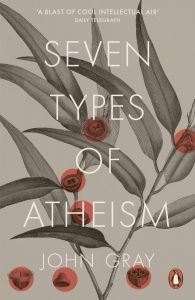 It is simultaneously awkward and exciting to read about your own consciously and responsibly adopted beliefs as something to be anatomized. It is also something atheists are not always much disposed to. On the contrary, perhaps: many forms of atheism present themselves as a consequence of free thought, of emancipation from tradition. The internal logic of their arguments prescribes that while religious beliefs, being non-rational, are in need of cultural or psychological explanation, atheism is really just what you will gravitate towards once you finally start thinking. One question here will be whether this is necessarily the case.
 Certain phrases choke us with their ubiquity at some point:
 As we approach the end of the year, it’s that time again. Not to flip the page to the next month, but to buy a new calendar. (Who am I kidding? It’s probably only me and your grandmother who still uses paper wall calendars…) And also to reflect.
  Guinea and Redhead were part of a large food chain. Beyond campus’ freshly-baked sidewalks, a Cowboy Mafia ferried contraband from the south. They landed small prop planes on ranch land outside of town, cut powder with dental anesthetics and broke up the bales. Their wares clumped on our cafeteria trays and glinted in tiny screw-top bottles. The capo, a local big-hat business man,who ran a palatial kicker-dance hall and owned the ranch. That legit business and his crew’s discipline kept them out of jail. Maybe a hat full of cash in the bargain.
 The new year approaches and with it comes our annual habit of self-promises in the form of New Year’s resolutions. Statistically speaking, though, 2019 won’t be your year. While many of us start strong, we tend to flounder come February, and studies cite the failure rate to be anywhere from 80 to 90 percent.