
Enjoying the content on 3QD? Help keep us going by donating now.
Category: Recommended Reading
The Lonely Neighborhood
Joseph Lawler at the New Atlantis:
 Americans are living ever more isolated lives. We get married later, start families later, have fewer children, and report more loneliness than ever before. Everyone suspects that new technology has something to do with this. But what if we’re also suffering from the failure of a very old technology?
Somehow it has become astonishingly expensive to buy a house in the United States. The median house sale price is now $417,000. Fifty years ago, in today’s dollars, it was $232,000. And the young are getting priced out: In 1981, the median first-time homebuyer was 29 years old. Today he or she is 38.
In this new essay series, originally reported by Joseph Lawler, we will explore how the U.S. housing market suffers from a series of distortions created by misguided government policies.
The series will address why we keep building single-family-housing suburbs when most people report that they would prefer to live in lively neighborhoods with retail, churches, restaurants, cafes, and other third spaces.
more here.
Enjoying the content on 3QD? Help keep us going by donating now.
Why Love Matters Most
Cathy Mason at Aeon Magazine:
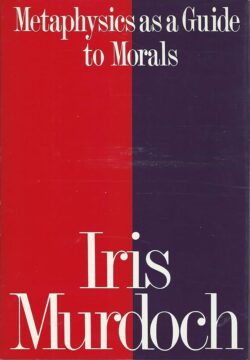 To see how Murdoch ends up thinking that love is central to morality, it is first worth asking a broader question: what is morality? Murdoch’s answer is that at the core of our moral life is the way we see the world, our ‘vision’ of it. We are always looking at something, in some manner, and in doing so we either build up a fairer, more just, more adequate picture of it, or we distort our vision of it. This is a continuous part of our lives.
Our vision, she thinks, largely determines how we go on to act: if I see you as my enemy, there will be no surprise when I start treating you like my enemy. If I had instead seen you as a potential friend, then I would naturally treat you with warmth and care. Acting rightly matters, she thinks, but how we act depends on how we see, principally on how we see other people.
Correspondingly, she sees the key moral activity not as choice but as attention – an idea she gets from the activist, mystic and philosopher Simone Weil. On Murdoch’s picture, our most basic moral activities are activities of attending to particular things in particular ways, since this is the activity that shapes our vision of the world.
more here.
Enjoying the content on 3QD? Help keep us going by donating now.
James Baldwin’s Apotheosis
Brooke Allen in The Hudson Review:
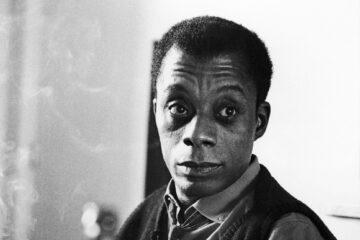 The last time I wrote about James Baldwin, in the late 1990s, I concluded that his first novel, Go Tell It on the Mountain, was his best, and that his second, Giovanni’s Room, was sentimental, artificial, and populated by stock figures—in fact I agreed with Norman Mailer’s assessment that the novel, dealing openly in Eisenhower’s America with homosexuality, was “brave” but “bad.” Now hailed as a seminal work, it had been turned down by Knopf, who had published Go Tell It on the Mountain. (The novel was eventually published by Dial.) Baldwin assumed that Knopf had expected him to take up the mantle of “Negro writer” and stick to racial subjects, which Giovanni’s Room did not address; or perhaps they had been made nervous by the gay content. But Henry Carlisle, the editor who ruled against it, was not an unworldly man, and I think one can take at face value his objection that the book lacked credible characters and would not enhance the author’s reputation.
More here.
Enjoying the content on 3QD? Help keep us going by donating now.
‘A Politics of No Translation.’ Zohran Mamdani on His Unlikely Rise
Mark Chiusano in Time Magazine:
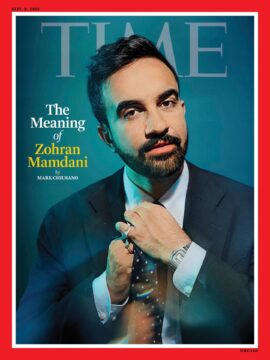 It’s not easy to move around New York City as Zohran Mamdani anymore.
Like when the 33-year-old Democratic nominee for mayor leaves a union meeting to walk to his Manhattan campaign office, as he did one Monday morning in July. Within a block, a phone–wielding crowd forms and follows. “Oh my God, hello,” someone blurts. People clap. Cars honk. Traffic down Fifth Avenue comes to a standstill as a plumber’s van stops and a guy hops out to shake Mamdani’s hand. There is some heckling. “Antisemitic!” someone shouts. But mostly it is star treatment, in multiple languages and from all generations.
All this is new: the adulation, the notoriety, the xenophobic death threats that have prompted an entourage of men with spaghetti earpieces. Before 2025, basically no one knew who Mamdani was. Over the course of eight months, the democratic socialist and backbench state assemblyman went from local long shot to likely mayor of America’s biggest city. Suddenly he is a main character in national politics—the ubiquitous subject of cable news segments, a lightning rod on the left and right. Senior Democrats have weighed in for and against him. President Donald Trump has pioneered a dark new birtherism by questioning his immigration status and floating his possible arrest. (Mamdani, who would be the city’s first South Asian and Muslim mayor, was born in Uganda and became a U.S. citizen in 2018.) To many progressives, his style of politics—principled, pocketbook-focused, and online—was an electrifying answer for a moribund party.
More here.
Enjoying the content on 3QD? Help keep us going by donating now.
Friday Poem
Equinox
Dear child of the near future,
here is what I know—hawks
soar on the updraft and sparrows always
return to the seed source until they spot
the circling hawk. Then they disappear
for days and return, a full flock,
ready. I think we all have the power
to do what we must to survive.
One day, I hope to set a table, invite you
to draw up a chair. Greens steaming garlic.
Slices of bread, still warm. Honey flecked with wax,
and a pitcher of clear water. Sustenance for acts
of survival, for incantations
stirring across our tongues. Can we climb
out of this greedy mouth,
disappear, and then return in force?
My stars are tucked in my pocket,
ready for battle. If we flood
the streets with salt water, we can
flood the sky with wings.
By Tamiko Beyer
from Split This Rock
Enjoying the content on 3QD? Help keep us going by donating now.
Thursday, August 14, 2025
Giordano Bruno And Frances Yates, Magic And Modern Science
Enjoying the content on 3QD? Help keep us going by donating now.
Gaza. Israel. Palestine: History, Horror, And Karma
Lawrence Weschler at Wondercabinet:
 Three months after the 1929 Hebron massacre {which saw the deaths of nearly 70 Jews and scores of others maimed or wounded}, the celebrated historian Hans Kohn – active in the Zionist movement since 1909 – wrote the following letter: “I feel that I can no longer remain a leading official within the Zionist Organization… We pretend to be innocent victims. Of course, the Arabs attacked us this past August. Since they have no armies, they could not obey the rules of war. They perpetrated all the barbaric acts that are characteristic of a colonial revolt. But we are obliged to look into the deeper cause of this revolt. We have been in Palestine for twelve years [since the start of the British occupation] without having even once made a serious attempt at seeking through negotiations the consent of the indigenous people. We have been relying exclusively upon Great Britain’s military might. We have set ourselves goals which by their very nature had to lead to conflict with Arabs… for twelve years we pretended that the Arabs did not exist and were glad when we were not reminded of their existence.” (Jewish National and University Library 376/224, Kohn to Berthold Feiwel [1875–1937]. Jerusalem, 21 Nov. 1929).
more here.
Enjoying the content on 3QD? Help keep us going by donating now.
Review of “The Confessions of Samuel Pepys” by Guy de la Bédoyère – journal of a predator
Kathryn Hughes in The Guardian:
 Samuel Pepys’s diary, which covers 1660 to 1669, is regarded as one of the great classic texts in the English language. Words spill out of Pepys – 1.25m of them – as he bustles around London, building a successful career as a naval administrator while navigating the double trauma of the plague and the Great Fire of London. Historians have long gone to the diary for details of middle-class life during the mid‑17th century: the seamy streets, the watermen, the taverns and, as Pepys moves up the greasy pole, the court and the king. Best of all is his eye for the picturesque detail: the way, for instance, on the morning of 4 September 1666, as fire licks around his house, Pepys buries a choice parmesan cheese in the garden with the intention of keeping it safe.
Not all of the diary is in English, though. Quite a lot of it is in French (or rather Franglais), Latin, Spanish and a curious mashup of all three. Pepys increasingly resorted to this home-brewed polyglot whenever the subject of sex came up, which was often.
More here.
Enjoying the content on 3QD? Help keep us going by donating now.
The Cold And Forbidding Worlds Of Cynthia Ozick
Hannah Gold at The Nation:
 You know you’re in a Cynthia Ozick short story when the wind is merciless and the leaves have dropped. It may already be snowing. In “Bloodshed,” we are greeted by the “icy scenes” that a gun-toting rationalist sees from a Greyhound bus on his way to a “town of the hasidim” outside New York City, where he is ultimately shamed and disarmed by a local rebbe. In “The Biographer’s Hat,” snowflakes adorn the fur collar of a crooked biographer who mouches off a proofreader and persuades her to falsely insert herself into his subject’s history. “A Mercenary” concludes with the haunting vision of a man lying dead “under the stone-white hanging stars of Poland…. Against the stones and under the snow.”
These stories conjure a world that is cold and forbidding. What was once full of fresh promise is now buried. This isn’t to say that Ozick isn’t capable of depicting a fairer climate every now and then—but it will be in Fascist Italy, and a critic, fast approaching middle age, will be made to look catastrophically foolish on every page, as in “At Fumicaro.”
more here.
Enjoying the content on 3QD? Help keep us going by donating now.
Susan Sontag, E.O. WIlson & Roger Penrose at MIT
Enjoying the content on 3QD? Help keep us going by donating now.
Schrödinger’s Chatbot: LLMs beyond subject and object
R.B. Griggs at Tech For Life:
 It would be easy to insist that LLMs are just objects, obviously. As an engineer I get it—it doesn’t matter how convincing the human affectations are, underneath the conversational interface is still nothing but data, algorithms, and matrix multiplication. Any projection of subject-hood is clearly just anthropomorphic nonsense. Stochastic parrots!
But even if I grant you that, can we admit that LLMs are perhaps the strangest object that has ever existed? It is an object that relentlessly trains on the language output of all human subjects until every semantic association has been harvested from the syntax. The result is an interface where any possible persona, both real and imagined, is just a prompt away.
If it is an object, then it is one that has mastered the subject so completely that we eagerly dream up entirely new intersubjective realities to explore with it. We want every child to experience personalized tutoring with chatbot teachers. We simulate historical figures, create AI therapists, and even, with the right fine-tuning, chat with dead relatives. LLMs are becoming a general purpose tool for filling any subject-sized hole in our very human lives, for both good and ill.
You can’t help but sense that chatbots are starting to fill a strange new ontological space. A chatbot is not fully a subject, nor merely an object. But what?
More here.
Enjoying the content on 3QD? Help keep us going by donating now.
Cancer Super-Survivors May Hold Keys to New Treatments
Frieda Klotz in Undark Magazine:
 The stomach pains had persisted for a couple of months when Yann Bizien, a business developer in the software industry who was 35 at the time, finally ended up in the emergency room at a hospital in Versailles, France. He had already seen his family doctor who prescribed antacid medication. But the true diagnosis, when it came, was devastating: Pancreatic cancer, which had spread to his liver. Bizien, a married father of a young child who exercised regularly and did not smoke, realized that if the disease followed its normal course, he would have just months to live.
That was in 2017. Bizien embarked on the standard treatment for pancreatic cancer — a grueling regimen of chemotherapy over a six-month period. He responded extremely well. “I was like, in a warrior mode. Like, ‘Okay, I’m going to go for the treatments,’” he told Undark, speaking from his home outside Paris. “And even if I have one chance, I take my chance.”
More here.
Enjoying the content on 3QD? Help keep us going by donating now.
Sabine Hossenfelder on Free Will
Enjoying the content on 3QD? Help keep us going by donating now.
Was Pakistan necessary?
Muhammad Raiyd Qazi at the Express Tribune:
 Post-independence, Pakistan faced deep identity dilemmas. Should it be a secular Muslim-majority state or an Islamic theocracy? The 1971 secession of East Pakistan into Bangladesh exposed the fragility of religious unity in the face of linguistic and ethnic differences. As Akeel Bilgrami (Secularism, Identity and Enchantment, 2014) observes, the premise of a single Muslim identity was flawed when confronted with South Asia’s diversity.
In India, Muslims who stayed behind became a vulnerable minority. The rise of Hindutva politics under BJP has reinforced some of Jinnah’s warnings, but others contend that the partition itself hardened communal divisions, making reconciliation harder.
So, was Pakistan necessary? It depends on the perspective.
More here.
Enjoying the content on 3QD? Help keep us going by donating now.
Thursday Poem
World Without Suffix
Why do you ask my name, which is mysterious?
……………………………………… —Judges 13:18
Methylchloroisothiazolinone.
It’s in all the shampoos that sit on the bathtub’s
edge. Having no idea what it is, I look it up
and after scanning some abstruse periodic
letters, I discover it belongs to a class
of heterocycles that kill various bacteria.
As I have no idea what a heterocycle is,
I look it up and learn it’s a cyclic
compound with atoms of differing
elements that form part
of the ring or rings.
But I don’t know what most of that
means, either, and everything hyperlinks
to yet another obscure Latin term
that makes me think of papal decrees
and bad news from the doctor.
I walk away from the screen
of blue words, trying to imagine
a world before altar bells
and liturgies and the scattered
debris of Babel’s fall.
Before all the drama
with serpents and apples—
when animals had not yet been named,
and the garden was wild
with coconut and sativa—
Before the first cry in the desert
became an alphabet,
and God became a word
we couldn’t say.
by Martin Vest
from Rattle Magazine
Enjoying the content on 3QD? Help keep us going by donating now.
Wednesday, August 13, 2025
Two savvy new books offer hope that there’s more to being terminally online than sore thumbs and brain rot
Alexandra Jacobs in the New York Times:
 This much we know: Smartphones are making us dumber. Compelling essays suggest we memorize handscratched poetry in the morning before opening Pandora’s inbox, and warn that the declining literacy of the digitally oversaturated threatens democracy.
Phones are expensive. So are digital detox retreats where devices get squirreled in safe deposit boxes as if they were the house deed or Grandpa’s gold watch.
This summer, as an experiment, I decided to go the other way and submit utterly to the pleasures and terrors of the phone when alone, without self-recrimination or judgment.
More here.
Enjoying the content on 3QD? Help keep us going by donating now.
What (Not) To Expect from AGI Agents
Ali Minai at Bounded Alignment:
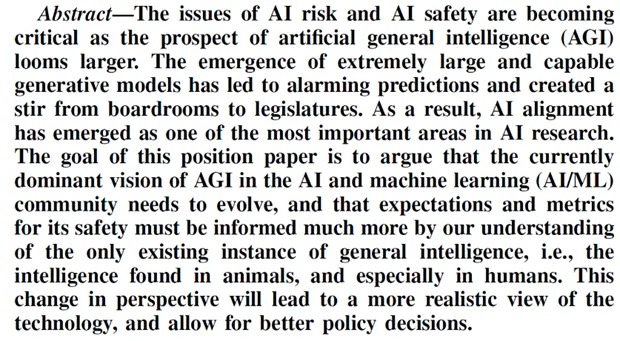 The main point made in the paper is that, to be meaningful, general intelligence should refer to the kind of intelligence seen in biological agents, and AGI should be given a corresponding meaning in artificial ones. Importantly, any general intelligence must have three attributes – autonomy, self-motivation, and continuous learning – that make it inherently uncertain and uncontrollable. As such, it is no more possible to perfectly align an AI agent with human preferences than it is to align the preferences of individual humans with each other. The best that can be achieved is bounded alignment, defined as demonstrating behavior that is almost always acceptable – though not necessarily agreeable – for almost everyone who encounters the AI agent, which is the degree of alignment we expect from human peers, and which is typically developed through consent and socialization rather than coercion. A crucial point is that, while alignment may refer in the abstract to values and objectives, it can only be validated in terms of behavior, which is the only observable.
More here.
Enjoying the content on 3QD? Help keep us going by donating now.
Rise Of The City: Babylon
Enjoying the content on 3QD? Help keep us going by donating now.
Francois Chollet: “I’ve updated my AGI timeline”
Enjoying the content on 3QD? Help keep us going by donating now.