Dear Reader,

Dear Reader,
Viv Groskop in Literary Hub:
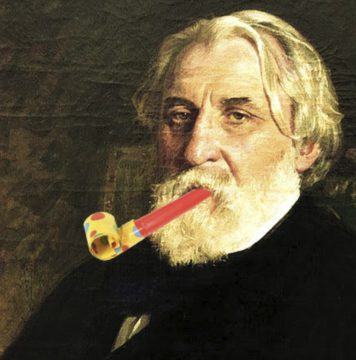
The author of Fathers and Sons and A Month in the Country was easily the most colorful and hedonistic figure in Russian literary history. He had a longtime mistress who was an opera singer he followed around Europe. He was grumpy, volatile, and camp. He threw an inkwell at his mistress when she annoyed him and told the actress Sarah Bernhardt that she reminded him of a toad. One time, when he forgot to turn up to a tea party he wrote in his letter of apology that he couldn’t come because his thumbs were too small.
He had a love-hate friendship with Tolstoy. When they were on good terms he was well-known amongst Tolstoy’s children for being the fun uncle. He would entertain them by dancing jigs for them and by impersonating a chicken whilst he was eating soup. (I say this but I am also in the throes of a violent argument with the Russian translator of my book about whether Turgenev was impersonating the chicken whilst he was eating the soup or whether he liked to do impressions of soup-eating chickens. Either way, Turgenev could be fun.)
More here.
K. C. Cole in Quanta:
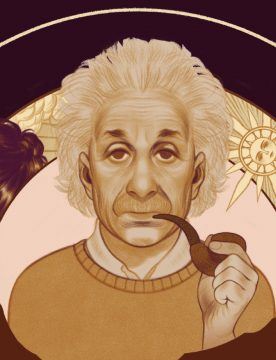 The flashier fruits of Albert Einstein’s century-old insights are by now deeply embedded in the popular imagination: Black holes, time warps and wormholes show up regularly as plot points in movies, books, TV shows. At the same time, they fuel cutting-edge research, helping physicists pose questions about the nature of space, time, even information itself.
Perhaps ironically, though, what is arguably the most revolutionary part of Einstein’s legacy rarely gets attention. It has none of the splash of gravitational waves, the pull of black holes or even the charm of quarks. But lurking just behind the curtain of all these exotic phenomena is a deceptively simple idea that pulls the levers, shows how the pieces fit together, and lights the path ahead.
The idea is this: Some changes don’t change anything. The most fundamental aspects of nature stay the same even as they seemingly shape-shift in unexpected ways. Einstein’s 1905 papers on relativity led to the unmistakable conclusion, for example, that the relationship between energy and mass is invariant, even though energy and mass themselves can take vastly different forms.
More here.
Kenan Malik in Pandaemonium:

From America to the Philippines, the rise of populist movements reveals a yearning for belonging and identity that liberalism cannot satisfy. The emergence of non-liberal economic powers such as China calls into question the postwar ‘liberal order’. Putin, FTeditor, Lionel Barber, told Radio 4’s Today programme, ‘feels he is on the right side of history’. Many liberals fear that, too. Hence the global impact of Putin’s comments.
The real issue, though, is not that social attitudes have become more illiberal, but that liberalism has been unable to address the fundamental issue of the relationship between the individual and society even as that issue has become one of the most salient.
More here.
Caroline Eden at Literary Hub:
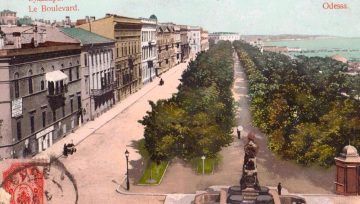 Odessa is a young city by European standards, but what it lacks in historical gravitas it makes up for with its splendid architectural bones and worldliness. Cosmopolitan from its inception, its life began when Neapolitan officer General Don Jose de Ribas seized a Tatar-built fort, Hadji Bey, from the Turks in 1789. His conquest complete, de Ribas asked Catherine the Great if she liked the Grecian name Odessos. She did, but only once she’d feminized it to “Odessa.”
Subpar roads connecting Odessa to Moscow played to the city’s advantage, with the port offering easier access to Europe, the Mediterranean and Aegean Seas via the Bosphorus and the Dardanelles Strait. From the outset outward looking, Odessa refused to rely on the empire in the north, instead always looking to the sea for its fortune. This benefited its inhabitants greatly. De Ribas reveled in the world that began to open up, one that allowed small pleasures like drinking European wine and eating mastic-laced sweets.
more here.
David Wootton at Lapham’s Quarterly:
 This problem is particularly acute in our modern consumer economy, in which political institutions, the economic system, and popular culture are all now primarily dedicated to the pursuit of happiness. This has had the perverse effect of creating a world of frustration and disappointment in which so many discover that happiness is beyond their grasp. The economy fails to deliver for the majority but urges everyone to spend beyond their means. We engage in “retail therapy,” spending for the momentary gratification of acquisition. We encounter advertisements that wrap themselves around us like a blizzard of snow, each promising that if we spend, and go on spending, we will be rewarded with endless delights. This spending helps drive climate change, which threatens to make the planet uninhabitable. Moreover, our sense of who we are seems to be increasingly detached from reality; we live out fantasy versions of ourselves, playing our own private form of air guitar. To constantly pursue something you can never catch is a form of madness. We have built this madness into the very structure of our lives. Every society in the world aims at economic growth, and every society encourages the endless accumulation of wealth. When it comes to wealth, we have great difficulty in saying enough is enough, because it is hard to know when we can safely say we have enough to face down every possible catastrophe.
How then have we come to build a whole culture around an impossible, futile, self-defeating enterprise?
more here.
Andrei Codrescu at The Paris Review:
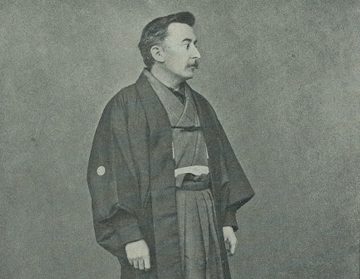 At the end of the nineteenth century, Lafcadio Hearn was one of America’s best-known writers, one of a stellar company that included Mark Twain, Edgar Allan Poe, and Robert Louis Stevenson. Twain, Poe, and Stevenson have entered the established literary canon and are still read for duty and pleasure. Lafcadio Hearn has been forgotten, with two remarkable exceptions: in Louisiana and in Japan. Yet Hearn’s place in the canon is significant for many reasons, not least of which is how the twentieth century came to view the nineteenth. This view, both academic and popular, reflects the triumph of a certain futuristic Modernism over the mysteries of religion, folklore, and what was once called “folk wisdom.” To witness this phenomenon in time-lapse, sped-up motion, one need only consider Lafcadio Hearn, the Greek-born, Irish-raised, New World immigrant who metamorphosed from a celebrated fin-de-siècle American writer into the beloved Japanese cultural icon Koizumi Yakumo in less than a decade, in roughly the same time that Japan changed from a millennia-old feudal society into a great industrial power.
more here.
Ed Yong in The Atlantic:
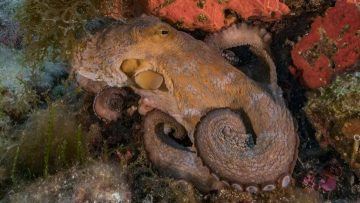
A small shark spots its prey—a meaty, seemingly defenseless octopus. The shark ambushes, and then, in one of the most astonishing sequences in the series Blue Planet II, the octopus escapes. First, it shoves one of its arms into the predator’s vulnerable gills. Once released, it moves to protect itself—it grabs discarded seashells and swiftly arranges them into a defensive dome.
Thanks to acts like these, cephalopods—the group that includes octopuses, squid, and cuttlefish—have become renowned for their intelligence. Octopuses, for example, have been seen unscrewing jar lids to get at hidden food, carrying coconut shells to use as armor, barricading their den with stones, and squirting jets of water to deter predators or short out aquarium lights. But why did they become intelligent in the first place? Why did this one group of mollusks, among an otherwise slow and dim-witted dynasty of snails, slugs, clams, oysters, and mussels, evolve into creatures that are famed for their big brains? These are hard questions to answer, especially because cephalopods aren’t just weirdly intelligent; they’re also very weird for intelligent animals. Members of the animal kingdom’s intelligentsia tend to be sociable; indeed, the need to remember and manage a complex network of relationships might have helped drive the evolution of their brains. Smart animals also tend to be long-lived, since a large brain both takes a long time to grow and helps an animal avoid danger. Apes, elephants, whales and dolphins, crows and other corvids, parrots: They all share these traits.
Cephalopods do not. With rare exceptions, most of them are solitary animals that aren’t above cannibalizing one another when they meet. Even those that swim in groups, like some squid, don’t form the kinds of deep social bonds that chimps or dolphins do. Cephalopods also tend to live fast and die young. Most have life spans shorter than two years, and many die after their first bout of sex and reproduction. This combination of short lives, solitude, and smarts is unique to cephalopods. And according to a recent paper by Piero Amodio from the University of Cambridge and five of his colleagues, the traits are all linked to a particular development in the octopus’s evolutionary history: Its ancestors lost their shells.
More here.
Ashley Yeager in The Scientist:
 “Anytime we take Tylenol because we have the flu and we feel terrible, that’s actually you playing with tolerance,” says Stanford University microbiologist David Schneider, Ayres’s former advisor. By quieting the immune reaction that is making you feel sick, “you’re making yourself feel better, even though you might not be affecting how much of a pathogen is in your body.” As they come to appreciate that disease tolerance exists in animals, including humans, researchers want to tap into its mechanisms—analogous to the way they are tapping into the immune system to develop disease-fighting immunotherapies. Specific kinds of supplements, as Ayres has shown in mice, may be one solution. And bacteria that live in the body as part of its microbiome have been shown to help mice tolerate malaria, Salmonella, and pneumonia infections. “During infection, we all appreciate that there are these immune defenses that largely are designed to get rid of an invading pathogen, and that’s been thought to be the only or main way that we deal with infections,” says Ruslan Medzhitov, an immunologist at Yale School of Medicine. “What’s being appreciated more recently . . . is that there is also this other mechanism, so-called tolerance to infection, where instead of trying to get rid of a pathogen we change something about the body, about the physiology, and that lets us tolerate the presence of a pathogen.”
Until about a decade ago, researchers had largely overlooked the idea of disease tolerance in animals. But the physiological strategy didn’t go unnoticed among plant biologists. In research dating to the late 1800s, for example, scientists described how one variety of wheat crop infected with a fungus called leaf rust fared better and produced more grain than other infected wheat crops.2 Follow-up studies spanning the 20th century and into the 21st suggested that plants have internal ways to tolerate infections in addition to defending against them with immunity. These findings led researchers to wonder if a similar sort of tolerance exists in animals.
Researchers reported the first hints of disease tolerance in humans in 2006, when they found that people who have a type of alpha thalassemia, a blood disorder that typically reduces hemoglobin production, are somehow protected against the severe iron deficiency associated with a malarial infection. In a study published the following year, disease ecologist Andrew Read, then at the University of Edinburgh, and his former postdoc Lars Råberg found that certain strains of mice had genetic variations that boosted their tolerance to the malaria parasite Plasmodium chabaudi. Those mice had improved health, the researchers noted, but comparable numbers of P. chabaudi cells in their bodies to those in mice that weren’t as tolerant to the infection.3
More here.
—from “Nikes”
Just as the President
who could only say, “If I had a son
he’d look like Trayvon”
instead of, “If I had a son
he’d look just like me.” So often
the body is used
as a way to mediate chaos.
Just like the Statue of Liberty
looked “just like Trayvon”
but America couldn’t not swim
under the body of a black girl
& still feel free. And yes
this is a vulgar elegy. I ask:
What is it in you, that they
don’t want to look like you?
by Shayla Lawson
from I Think I’m Ready To See Frank Ocean
Saturnalia Books
Elizabeth Winkler in The Atlantic:
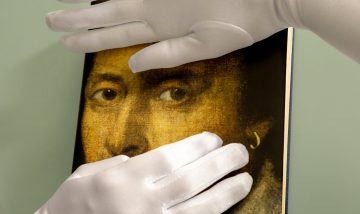 On a spring night in 2018, I stood on a Manhattan sidewalk with friends, reading Shakespeare aloud. We were in line to see an adaptation of Macbeth and had decided to pass the time refreshing our memories of the play’s best lines. I pulled up Lady Macbeth’s soliloquy on my iPhone. “Come, you spirits / That tend on mortal thoughts, unsex me here,” I read, thrilled once again by the incantatory power of the verse. I remembered where I was when I first heard those lines: in my 10th-grade English class, startled out of my adolescent stupor by this woman rebelling magnificently and malevolently against her submissive status. “Make thick my blood, / Stop up th’ access and passage to remorse.” Six months into the #MeToo movement, her fury and frustration felt newly resonant.
Pulled back into plays I’d studied in college and graduate school, I found myself mesmerized by Lady Macbeth and her sisters in the Shakespeare canon. Beatrice, in Much Ado About Nothing, raging at the limitations of her sex (“O God, that I were a man! I would eat his heart in the marketplace”). Rosalind, in As You Like It, affecting the swagger of masculine confidence to escape those limitations (“We’ll have a swashing and a martial outside, / As many other mannish cowards have / That do outface it with their semblances”). Isabella, in Measure for Measure, fearing no one will believe her word against Angelo’s, rapist though he is (“To whom should I complain? Did I tell this, / Who would believe me?”). Kate, in The Taming of the Shrew, refusing to be silenced by her husband (“My tongue will tell the anger of my heart, / Or else my heart concealing it will break”). Emilia, in one of her last speeches in Othello before Iago kills her, arguing for women’s equality (“Let husbands know / Their wives have sense like them”).
I was reminded of all the remarkable female friendships, too: Beatrice and Hero’s allegiance; Emilia’s devotion to her mistress, Desdemona; Paulina’s brave loyalty to Hermione in The Winter’s Tale; and plenty more.
Sean Carroll in Preposterous Universe:
 What does it mean to be a good person? To act ethically and morally in the world? In the old days we might appeal to the instructions we get from God, but a modern naturalist has to look elsewhere. Today I do a rare solo podcast, where I talk about my personal views on morality, a variety of “constructivism” according to which human beings construct their ethical stances starting from basic impulses, logical reasoning, and communicating with others.
In light of this view, I consider two real-world examples of contemporary moral controversies:
Probably everyone will agree with my takes on these issues once they listen to my eminently reasonable arguments.
More here.
Audrey Farley at Marginalia Review:
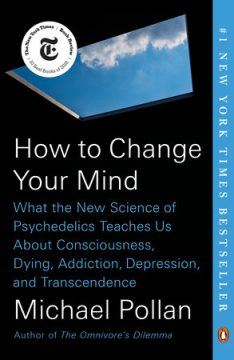 Under the influence of mind-altering drugs, individuals cannot distinguish between subjective experience and external objects. Even after the ego returns and normal cognitive processes resume, people have an unshakable belief in what they encountered in their altered cognitive state. This isn’t to say that psychedelic-users are deluded. To the contrary, Pollan suggests, they may have been granted access to hidden truths. Pollan invokes Aldous Huxley’s notion of a “mind at large” and philosopher Henri Bergson’s theory of distributed consciousness to explain this phenomenon. Both thinkers purported that the human brain does not singularly produce consciousness; rather the brain enables humans to “tune in” to certain frequencies like someone turning the dial of a radio. For Huxley and Pollan, psychedelics increase the number of stations available.
This philosophy raises important questions that Pollan doesn’t answer. For instance: do schizophrenics and others who experience hallucinations have greater access to hidden truths? Is it possible that these individuals are not “mad,” but instead clued in to facets of the universe not readily apparent to “healthy normals?”
more here.
Rita Koganzon at The Hedgehog Review:
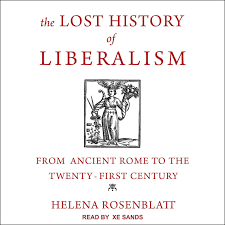 Rosenblatt’s effort to vindicate liberalism by demonstrating that it was never what critics on the right and left said it was in the first place results in a highly readable and engaging history of nineteenth-century French politics, but it’s not entirely convincing. The distinction Rosenblatt relies on between “liberality” as an individual virtue and “liberalism” as a set of government policies is blurred by precisely those seventeenth- and eighteenth-century thinkers most often held up as the first liberals, and whom Rosenblatt is determined to exclude from that category. On Rosenblatt’s own account, Locke understood toleration as a personal virtue, but he also required the state to defend it as a matter of policy. Nineteenth-century French liberalism may well have been a more self-conscious political movement, but, in Rosenblatt’s telling, it was not notably more coherent in its substance than eighteenth-century British Whiggism, and certainly not more politically effective than its nineteenth-century British counterpart, which operated within a stable constitutional order and consequently achieved much more in practice than the French model. French liberalism is undoubtedly philosophically significant and deeply intertwined with other European liberalisms, but Rosenblatt does not definitively show that the precedence we tend to give to the British as progenitors and exemplars of liberalism is misplaced.
more here.
Alejandro Zambra at The Believer:
 Its body is light blue and 100 percent synthetic. It’s a good-natured and naive octopus, and its smile is genuine. Its eyebrows are green, as are the two blushing spots on its cheeks. It weighs 11.4 ounces. It’s clearly intelligent—as nearly all octopuses are, of course. It wears a bow tie, and a sailor’s cap is cocked rakishly just a little to the left. If you squeeze the animal’s head (which is objectively small, but enormous compared to its body), a melody plays (Bach, I’m almost positive). Really, there are four melodies (all four by Bach, I think): to go from one to another, you just have to squeeze the creature’s head.
There is much to be said about the octopus’s tentacles, with their matching, somewhat indecipherable images embroidered in eight different colors. When you press them, a surprisingly feminine voice recites the names of those colors.
more here.
Charles McGrath in The New Yorker:
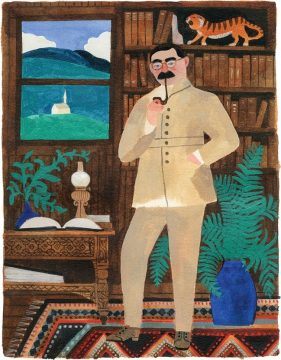 Rudyard Kipling used to be a household name. Born in 1865 in Bombay, where his father taught at an arts school, and then exiled as a boy to England, he returned to India as a teen-ager, and quickly established himself as the great chronicler of the Anglo-Indian experience. He was Britain’s first Nobel laureate in literature, and probably the most widely read writer since Tennyson. People knew his poems by heart, read his stories to their children. The Queen wanted to knight him. But in recent years Kipling’s reputation has taken such a beating that it’s a wonder any sensible critic would want to go near him now. Kipling has been variously labelled a colonialist, a jingoist, a racist, an anti-Semite, a misogynist, a right-wing imperialist warmonger; and—though some scholars have argued that his views were more complicated than he is given credit for—to some degree he really was all those things. That he was also a prodigiously gifted writer who created works of inarguable greatness hardly matters anymore, at least not in many classrooms, where Kipling remains politically toxic.
In a prologue to “If: The Untold Story of Kipling’s American Years” (Penguin Press), Christopher Benfey, a professor at Mount Holyoke, writes that some of his friends, when they learned what he was working on, asked him what on earth he was thinking, and warned that he’d better be ready to defend himself. Benfey’s best defense turns out to be the book itself, which doesn’t attempt a full-throated rehab job. An Americanist who has written very good books about Emily Dickinson and Stephen Crane, among others, Benfey mostly steers clear of Kipling’s politics, and instead concentrates on a little-known chapter in Kipling’s life: the four years that this outspoken defender of the British Empire spent living just outside Brattleboro, Vermont, where he wrote some of his best work, including “The Jungle Book” and “The Second Jungle Book,” “Captains Courageous,” and the first draft of “Kim.” Kipling’s American sojourn is hardly an “untold story”—it figures in all the biographies—but Benfey tells it well, catching nuances that some biographers have missed. He argues that Kipling was profoundly altered by his experience of America, and that America, in turn, was altered by its experience of Kipling. But you could also make a case that neither was changed enough. Kipling never learned to lighten up—or to appreciate American humor and informality—and America, by his lights, never got over being headstrong and overly sure of itself.
More here.
Inspired by Frank Relle’s “Amano,” Jack Bedell
composed his ekphrastic poem of the same name.
Even what’s left of this broken cypress tree
hasn’t given up reaching for the sky.
Busted dead center, and toppled over
into the lake, its branches still climb
toward the stars bursting over this swamp.
The sun has surrendered its sky, glowing
just under the horizon line, the lake’s surface
stilled to exhaustion absent any breeze.
Even herons have tucked in for the night.
This old tree, though, standing tip-toed
on its roots, just won’t cede to the pull
of water, the notion that all things
must go to ground patiently. As long
as there is light somewhere, it’s worth the reach.
by Jack Bedell
from The Ecotheo Review
Carl Zimmer in The New York Times:
 At three o’clock in the afternoon on September 4, 1882, the electrical age began. The Edison Illuminating Company switched on its Pearl Street power plant, and a network of copper wires came alive, delivering current to a few dozen buildings in the surrounding neighborhood. One of those buildings housed this newspaper. As night fell, reporters at The New York Times gloried in the steady illumination thrown off by Thomas Edison’s electric lamps. “The light was soft, mellow, and grateful to the eye, and it seemed almost like writing by daylight,” they reported in an article the following day. But nature invented the electrical grid first, it turns out. Even in 1882, thousands of miles of wires were already installed in the ground in the New York region — in meadows, in salt marshes, in muddy river bottoms. They were built by microbes, which used them to shuttle electricity. Electroactive bacteria were unknown to science until a couple of decades ago. But now that scientists know what to look for, they’re finding this natural electricity across much of the world, even on the ocean floor. It alters entire ecosystems, and may help control the chemistry of the Earth.
“Not to sound too crazy, but we have an electric planet,” said John Stolz, a microbiologist at Duquesne University in Pittsburgh. In the mid-1980s, Dr. Stolz was helping to study a baffling microbe fished out of the Potomac River by his colleague Derek Lovley. The microbe, Geobacter metallireducens, had a bizarre metabolism. “It took me six months to figure out how to grow it in the lab,” said Dr. Lovley, now a microbiologist at the University of Massachusetts at Amherst.
More here.