
Peter Martin in Aeon:
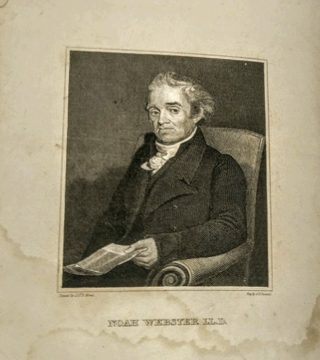 In the United States, the name Noah Webster (1758-1843) is synonymous with the word ‘dictionary’. But it is also synonymous with the idea of America, since his first unabridged American Dictionary of the English Language, published in 1828 when Webster was 70, blatantly stirred the young nation’s thirst for cultural independence from Britain.
Webster saw himself as a saviour of the American language who would rescue it from the corrupting influence of British English and prevent it from fragmenting into a multitude of dialects. But as a linguist and lexicographer, he quickly ran into trouble with critics, educators, the literati, legislators and much of the common reading public over the bizarre nature of his proposed language reforms. These spelling reforms – for example, wimmen for ‘women’, greeve for ‘grieve’, meen for ‘mean’ and bred for ‘bread’ – were all intended to simplify spelling by making it read the way that words were pronounced, yet they brought him the pain of ridicule for decades to come.
His definitions were regarded as his strong suit, but even they frequently rambled into essays, and many readers found them overly aligned with New England usage, to the point of distortion. Surfeited with a Christian reading of words, his religious or moral agenda also shaped many of his definitions into mini-sermons or moral lessons rather than serving as clarifications of meaning.
More here.

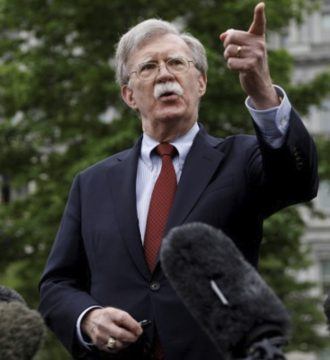 The conventions of mainstream journalism make it difficult to challenge America’s self-conception as a peace-loving nation. But the unlovely truth is this: Throughout its history, America has attacked countries that did not threaten it. To carry out such wars, American leaders have contrived pretexts to justify American aggression. That’s what Donald Trump’s administration—and especially its national security adviser, John Bolton—is doing now with Iran.
 Griffin was referring to a revolutionary new type of weapon, one that would have the unprecedented ability to maneuver and then to strike almost any target in the world within a matter of minutes. Capable of traveling at more than 15 times the speed of sound, hypersonic missiles arrive at their targets in a blinding, destructive flash, before any sonic booms or other meaningful warning. So far, there are no surefire defenses. Fast, effective, precise and unstoppable — these are rare but highly desired characteristics on the modern battlefield. And the missiles are being developed not only by the United States but also by China, Russia and other countries.
 It was the
 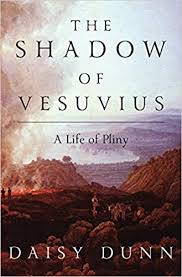 Herculaneum, a town on the Bay of Naples that was buried beneath volcanic ash when Vesuvius erupted in AD 79, has only been partially excavated. Some buildings stand open to the sky; others, such as the theatre, can only be accessed through cramped and winding tunnels; many lie entirely entombed within rock. A visitor’s reaction to this can be an interesting gauge of character. The glass-half-full person will exult in the chance to walk the streets of an ancient city. The glass-half-empty person will wish there were more streets to walk. In Herculaneum, where furniture, bread and figs were all carbonised by the pyroclastic surge, the trace elements of life as it was lived in the heyday of the Roman Empire can serve to tantalise as well as satisfy the curious. To study the distant past is always to be greedy. It is to be like Orpheus, snatching after ghosts.
 HOW DID LIFE
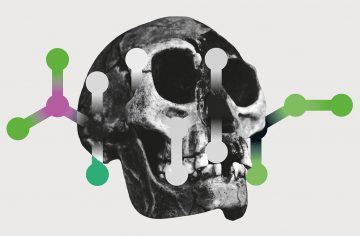 Some time in the past 160,000 years or so, the remains of an ancient human ended up in a cave high on the Tibetan Plateau in China. Perhaps the individual died there, or parts were taken there by its kin or an animal scavenger. In just a few years, the flesh disappeared and the bones started to deteriorate. Then millennia dripped by. Glaciers retreated and then returned and retreated again, and all that was left behind was a bit of jawbone with some teeth. The bone gradually became coated in a mineral crust, and the DNA from this ancient ancestor was lost to time and weather. But some signal from the past persisted.
 Antitrust law, established originally to limit corporate power, has become its friend. Think about the following anomalies:
 Games play an important, and arguably increasing, role in human life. We play games on our computers and our phones, watch other people compete in games, and occasionally break out the cards or the Monopoly set. What is the origin of this human impulse, and what makes for a great game? Frank Lantz is both a working game designer and an academic who thinks about the nature of games and gaming. We discuss what games are, contrast the challenges of Go and Poker and other games, and investigate both the “dark energy” that games can sometimes induce and the ways they can help us become better people.
 Ronald Dworkin has
  In 1998, with 250,000 of its citizens dying of AIDS each year, South Africa’s Parliament
  Adam Dannoun, the protagonist of Elias Khoury’s powerful new novel, calls himself a child of the ghetto. He does not mean the Warsaw ghetto — although, growing up in the newly established state of Israel, he allows his university colleagues to make that assumption. He means the “ghetto” of the Palestinian town of Lydda, created by Jewish forces who uprooted tens of thousands of Palestinians on a death march in one of the bloodiest massacres of the 1948 Nakba. (That term, which Arabs use for the founding of the Jewish state, means “catastrophe.”) Adam, a baby at the time, was one of those who remained.
 But a new study shows that many species plan out intricate detours to reach their prey—smarts usually associated with far bigger creatures.
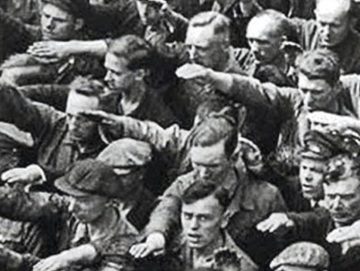 It can often feel hopeless to be an activist seeking social change on an obscure issue where most people seem opposed or at best indifferent to you. But according to a new book by Professor Cass Sunstein, they shouldn’t despair. Large social changes are often abrupt and unexpected, arising in an environment of seeming public opposition.