
by Thomas Fernandes
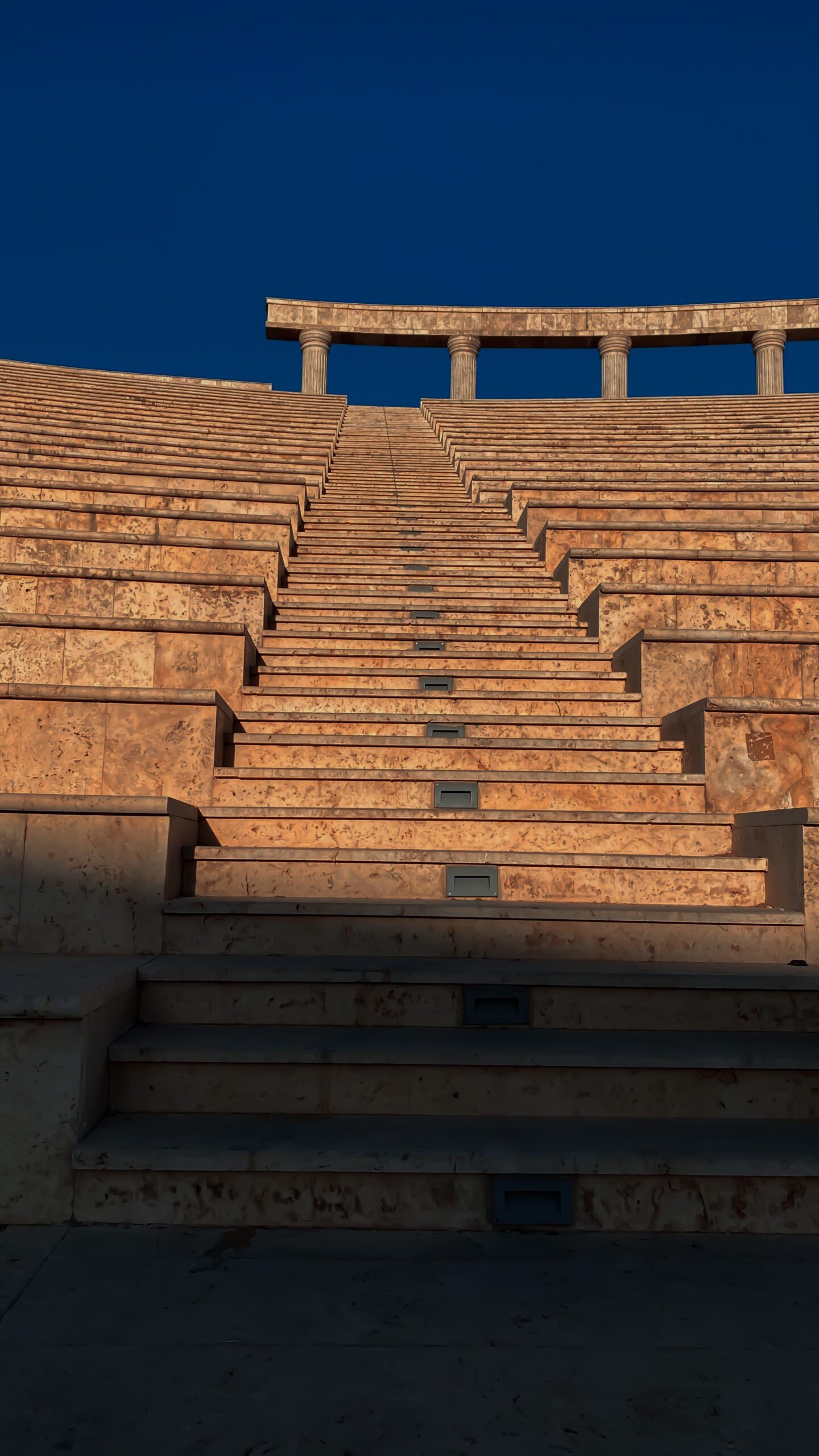
I assume you read the title easily enough. Now, can you read this?
这很容易
No? Come on, not even if you try really hard? Hmm, I know it’s difficult, but it seems to me like you are not trying that hard. It’s just 3 words!
You might think you do something difficult, on occasion. Maybe you also think other people accomplish difficult stuff. However, another framing of how we function is that we can only do easy things.
At first sight, easy-difficult is a low effort-high effort continuum. In this I agree we are capable (if reluctant) of doing effortful thinking. For most people, most of the time, walking is absolutely easy. Walking 40km across 2,000m of elevation gain becomes “hard” because it is too effortful. If broken up into tiny chunks, however, it would become easy again.
But this is not difficulty. Or at least, if this is how we define difficult, then we conflate two things: the one I just mentioned, and the ones where chunking doesn’t help, where the step is just too high for you to climb. This would be like running 100m in under 10s. If anything is difficult, this would be it since only 233 men have ever done it.
And here we have it. We say something is difficult because most people can’t do it. It is only valid as a probability that the person you meet can accomplish it, on an interpersonal level. On an individual level there are only two cases: either it is impossible or it is easy. For those 233 men, it was no more difficult than it is for you to sprint 100m as fast as you can, was it? Meaning pretty easy, if tiring. So difficulty is just about how many people find it easy versus those who find it impossible; there is nothing in the difficult zone for you. Only easy (but limited by effort) or impossible.
Why is this framing important? Because of the idea that you can “effort” yourself into solving difficult problems. You can’t. At least not short term. The physical example of running very fast makes this clear. Maybe in time you will be able to, via training, but in the moment there is nothing you can do to accomplish it.
Even if we might not like it, this is true of many mental tasks as well. You can’t expect people to accomplish stuff only with effort (short term), and if you look at someone accomplishing something, you can rest assured that for them, it has become easy and that is the only reason they can (even if it might also be effortful). Can you solve this with no computer or phone?
325,434 × 327,356?
You probably can’t be bothered (it’s fine, I really didn’t expect you to do it), but I am confident you would be able to, if needed, using a pen and paper. Easy but effortful. Now how about this:
∫ 1/(x² − 1) dx
If you never studied calculus, this is almost like reading Chinese. Maybe you can read it, but still can’t solve it. This is pretty much easy or impossible, yet again, and let me tell you from experience that university math teachers can solve it so easily that they actually have trouble explaining how they do it (I will come back to the solution later).
Here I am taking simple examples, unlikely to be part of your daily life, but this is not cherry-picking. Quite the contrary, all of those are examples of low complexity. Real-world problems will only create more occasions for difficulty to come up.
For this we can turn to Naturalistic Decision Making. This is a field of psychology that studies decision making and expertise not in a lab with controlled experiments but in the field, where people make fast decisions to solve complex, high-stakes, real problems. Jared Peterson has many well-written Substack posts on this for more detail, but the best way he expresses human expertise is as the development of an uncommon common sense (a.k.a. intuition), because experts don’t think that what they do is hard; they don’t even think what they do is easy. Instead, they often don’t realize they are doing anything! In the words of Gary Klein, the psychologist who pioneered the field with a study of firefighters, in a 1995 talk: “As we started the study, we found that each expert firefighter told us that they had never made any decisions.”
This is how easy it becomes for them (the decision making, not the work). They establish what matters and what doesn’t, an amazing feat we all perform, called relevance realization. By simplifying the problem, they let it solve itself. Like a weather model simplifying the complexity of weather into a little sun or cloud on your app: from there it becomes quite easy to say whether or not it will rain tomorrow.
Back to our sub-10s 100m runners. How do they do it? They just run. The best they could tell you is how to train to be able to do it, not how to do it. Think of riding a bicycle. How do you do it, really? You can’t explain it. And how do you turn? Do you work out a turning radius that grows with the square of your speed? No, you just turn.
Again, physical examples might not convince you of how transferable this is to mental skills. Let’s go back to the integral.
∫ 1/(x² − 1) dx
Here is just enough explanation to follow:
A derivative is a calculation with a recipe, like a multiplication. You can learn by heart and follow the steps and the answer comes out. An integral is the reverse of a derivative where you are shown the result and must find out what was derived to produce it. There is no procedure for this, only recognition. You might know, for instance, that the derivative of ln(x) is 1/x. So when you see the integral of 1/x, you just know it was ln(x). Here that doesn’t help, since we have 1/(x² − 1), not 1/x. So what a math enthusiast would immediately see is that 1/(x² − 1) is half the difference between 1/(x − 1) and 1/(x + 1). A really weird way of restating the problem, but now you have two fractions shaped like 1/x, so each has a known answer: ln(x − 1) and ln(x + 1). Once you see it, it takes three lines:
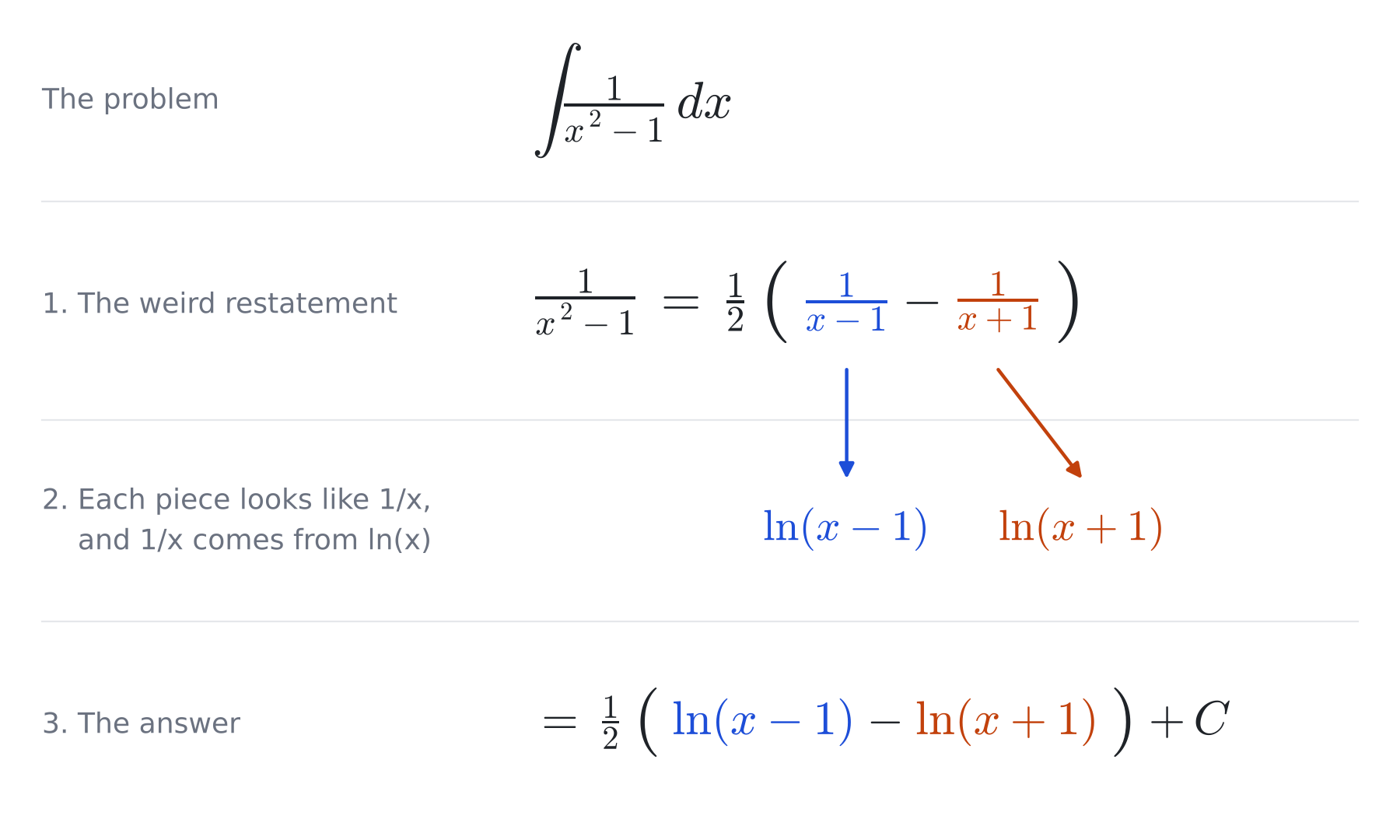
But how can you see it if you don’t already?
One thing we have is very high cerebral plasticity, and therefore learning ability, so that we can, during our lifetime, develop expertise in some domains. Despite how it might appear from the outside, professionals or experts are not climbing a difficult high step but have made the step smaller, easier to climb. Or perhaps more accurately, they have grown so that the step is now easy to climb. When you ask people to evaluate whether a real physical step is too high or not, you obtain no indication of the actual height of the step, but instead of the ratio between their leg length and the height of the step. Tall or short, we all say a step is too high when it reaches more than 88% of our leg length. Easiness can only tell us about this ratio, not the real height of the step.
Which brings us to the second part of the claim, the height of the steps: nothing we do is easy. It feels easy because we can climb it, but that tells us nothing of the real height, and for this, instead of easy, I will use simple.
Simple sits on another continuum, that of simple to complex. Fortunately for our purposes of looking at the “real” height of the step, this continuum can be more objectively defined. Notably the mathematical definition of complexity is about the number of “bits” needed to encode a situation in the most efficient way. So a chain of 10 numbers is more complex than one of 2 numbers or a chain of 10 coin tosses (only 2 values to a coin toss). A cloud would be way more complex and meteorological models very complex, yet wildly simplified versions of the phenomenon they try to anticipate. So while agreeing on what is simple or complex is relative, there is common ground and objectivation possible.
Let’s go back to the briefly mentioned relevance realization, singling out what matters and what doesn’t. Every day or even every second, people have an almost infinite amount of available information to sort. Each of your eyes alone takes in over a billion bits per second. Or, if you think sensory inputs are cheating, just give someone access to the internet. Yet, with no time to explore each one (which would be almost an infinite time), we manage to retain only a handful of them in any given situation and often the correct ones. In short, you almost continuously select options out of a list without even checking or knowing the list and you select the right options (most of the time) while not even realizing you did anything.
This is of immense complexity. By contrast, a bacterium is mostly concerned with checking whether the concentration of food is increasing or the concentration of toxins is increasing, ignoring almost everything else in the world. Our sorting feels easy (like everything we can do), but it is far from simple. To see it clearly, we often need to step away from our own perspective, which always informs us of our abilities rather than of the complexity of the task.
In 1999, a car crash left Clark Elliott with a severe concussion. He later told the story in a memoir, The Ghost in My Brain (which I have not read). From a review of the book on Astral Codex Ten:
One of the most striking passages in the book is when Elliott, hungry, decides to make himself a snack. He heads to the kitchen to eat a piece of salami and an apple, but finds he can’t. As though trapped in an old Tom and Jerry cartoon, he finds himself literally unable to choose which of the two to eat first. He can’t initiate action selection. He goes to the living room, returns to the kitchen, fails again. He repeats this loop ten times, like “a rat repeatedly traversing a dead-end maze.” Two days pass before he eats.
It ended when he called a friend, who told him (very easily): “Okay, go eat the salami first, then eat the apple.”
Choosing had felt easy to Elliott all his life but now it was not “difficult,” it was impossible. And integrating information toward making the optimal choice was always very very complex. A high step.
We can also step into living beings other than us. One animal fact that I never forgot is that when desert ants go out foraging, they first explore around with semi-random pathing, but when they go back to their nest, they run straight for it and if they encounter any obstacle, they go around it and directly back again. How? They track the position of the sun, count the number of steps they take in every given direction (defined as an angle with respect to the sun) and integrate those paths (vectors) so they always know their relative position to the starting place.
The organism doing this is the size of a grain of rice and has about 100,000 neurons to our 86 billion (nearly a million times fewer). Despite this, I wouldn’t be able to do it. Even if I were given a compass, I couldn’t go out, count my steps while I run around, evaluate my direction at every moment and integrate everything in my head so I know exactly where I started from. For navigators to do the same required not just extensive learning but the use of extended cognition: tools that extend our cognitive ability like maps and logbooks to keep track of their ships at sea. It took logging heading and speed at regular intervals and plotting them on the chart for fear of being lost. For the ants, I bet it is as easy as you pointing to where your hand is.
The lived experience of solving a problem has nothing in common with the real-world complexity of the problem to solve.We have built-in “hardware” and most of it is dedicated to solving the complex problems we don’t think about, like walking and sensing the world around us. About 27% of our cerebral cortex is mainly devoted to vision.
We also think of ourselves as the smartest animal, but elephants have brains about four times as large as ours, with three times as many neurons. Their intelligence does not go into the reasoning we value; instead, it goes into sensing and controlling their larger bodies. Put our brain in their bodies and we would not be able to walk around, most likely. Then we would feel pretty dumb.
This is because reasoning is only a thin layer on top of everything else our brain does. During a hard mental task, an exam say, we only use about 5% more brain energy compared with lying on the beach. So of course many reasoning tasks seem effortful and even difficult (a.k.a. impossible to many and easy only to a few); we are very short in this respect and most steps appear steep. Yet the problems we find difficult are not always very complex.
Whenever solving a Rubik’s cube, what is hard for us is working out the moves. For a computer with a standard program, it takes a fraction of a second to find the 20 or so moves that solve it. When it comes to the actual turning of the faces, however, it took OpenAI’s robot hand the equivalent of 13,000 years of simulated practice to be able to finish only 2 of 10 attempts on a fully scrambled cube. Eight times out of ten, the hand dropped the cube or got stuck. In this engineering challenge, we can calibrate the real complexity. Manipulating a cube with such hand dexterity is way harder than solving it.
The title’s contradiction restated is that nothing we need to do as living organisms is simple, but everything we do has to be easy and so evolution made it easy for us. Easy to the point of being invisible. Learning and training toward new, variable and unpredicted tasks can do the same on a shorter time scale, making us taller, within the limits of our plasticity.
***
Thanks for reading to the end! If you liked this post, I also write on my Substack, LibrOtium, and it would help me a lot if you subscribed. I post new content (not as often as I would like but at least you won’t be spammed) and some old 3QD favorite posts of mine.
Enjoying the content on 3QD? Help keep us going by donating now.