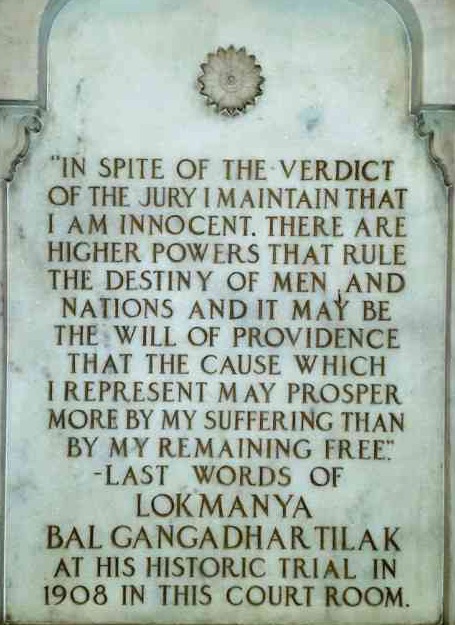
So there’s a plaque with the great freedom fighter Bal Gangadhar Tilak’s famous words about “higher powers that rule the destiny of men and nations.” There’s another that remembers John Duncan Inverarity, who practiced here from 1879 “until his death on 4th December 1923“. Still another spells out how this edifice was built, and it reveals that the “Actual cost” was slightly less than the “Estimate as sanctioned“.
Then I walk past a paper sign in Marathi, stuck on one of the pillars, advertising an upcoming puja. And on another pillar, this admonition: “Do not spit.”
There are higher powers, no doubt. One or more of them, about to be propitiated via prayers, itself an odd thing to stage in a Court. But we must certainly not spit.
The Bombay High Court and its signs. But if I sound cynical, it’s only in passing. I’m actually a fan. And that’s why, several years ago, I spent many long mornings and afternoons in this High Court, following a few cases and hearings. The chance of a firsthand look at the functioning of justice was seductive, and I found every excuse to take that chance.
Though those were simpler times. There was none of the heavy-handed security that’s everywhere now: gunmen behind sandbags at each gate; pass them and run the gauntlet of metal detectors and pat-down cops. They were some seriously contentious proceedings I attended, but nobody felt the need for security measures like today. Which left me wondering: does visible, heavy-handed security actually make us any safer? Or are there subtler ways?
A fair chunk of the contentious proceedings were during the hearings of Justice BN Srikrishna’s Commission of Inquiry, set up to investigate the horrific violence in Bombay in late 1992 and early 1993. I won’t recount the gory details we heard so much of in one of the Court’s high-ceilinged courtrooms. But I remember well the time I sat in on the Commission’s examination of my then-Member of Parliament, one Madhukar Sarpotdar of the Shiv Sena party.
The Commission was examining Sarpotdar because he had led some loud and violent processions in those weeks. He had also been taken into custody by the Army – the Army! that had been called out because the violence was out of control! – in January 1993, for roaming a notified area in a jeep crammed full of weapons.
In court, Sarpotdar had a constant smirk plastered on his face as he testified. He also told a series of what I knew were untruths and obfuscations, each more egregious than the last. So when the inquiry broke for lunch one day, I was so angry and disgusted that I couldn’t hold myself back. I walked up and tapped the still-smirking fellow on the shoulder, faintly repelled by even that action. I said: “I’m ashamed to have you as my MP.”
Not quite the polite and friendly words to introduce myself to the man, I’ll admit. But his immediate reaction was telling, if not surprising. “You meet me outside,” shouted my MP, his florid face flushing red, his hands clenching into fists, “and you’ll find out what I do to you.”
My own elected representative, threatening violence in the Bombay High Court.
Justice Srikrishna’s final inquiry report mentioned Sarpotdar’s misdeeds, and he was later actually convicted in another case from that time. But he promptly got bail, never went to prison and died a free man in 2010. Srikrishna’s report has remained completely ignored. Today, it’s as if neither the riots nor the inquiry ever happened.
Higher powers, maybe.
* * *
More recently, I roamed the Court corridors on a guided heritage tour, learning a little about the history and architecture of the place. Some sort of judicial system began functioning in Bombay as early as the 1670s, and in its current form the Court dates from the 1870s. According to our tour guide, the faraway American Civil War resulted in an increased demand for Indian cotton and textiles. The city grew rapidly in those years, and eventually felt the need for its own dedicated High Court.
There’s much to admire in this splendid edifice. Like its design, and I don’t mean just the exterior that’s neo-Gothic or Indo-Saracenic or whatever-it-is. That interests me far less than what I learned about the high ceilings and the “mansard roof” with its trapezoidal opening. These features allow for natural light and plentiful ventilation – important in those colonial days before electric fans and air conditioning. The thick stone walls also help lower temperatures to bearable levels, even in Bombay’s humid summers. The smartly-suited Justice BN Srikrishna can vouch for that, as can I – attending his inquiry invariably in jeans and a light cotton shirt.
In that vein, our guide points out another detail. Outside each door are strong metal hooks, now mostly rusting, nailed into the lime mortar that fuses the stone blocks together. Why? If a Justice wanted to allow the breezes of Bombay to waft through as he listened to legal arcana, the hooks serve to hold the large wooden doors open.
We turn a corner to find a gleaming glass and steel structure – an elevator shaft. Climbing flights of stairs must have at some point got tedious for those who use the Court. Now this elevator is pretty much contemporary, but its very presence here – obtrusive and incongruous as it is – speaks of what this place once was. Our heritage walking group of about fifty eager Bombayites slows to a trickle just to get beyond the elevator. Its bulk allows only one person at a time to edge past.
And this slowdown allows me time to notice: The young woman immediately in front as we sidle through has a pad on which I had assumed she was, like me, taking notes. But no. Instead, her page is filled with spare, strong sketches of the
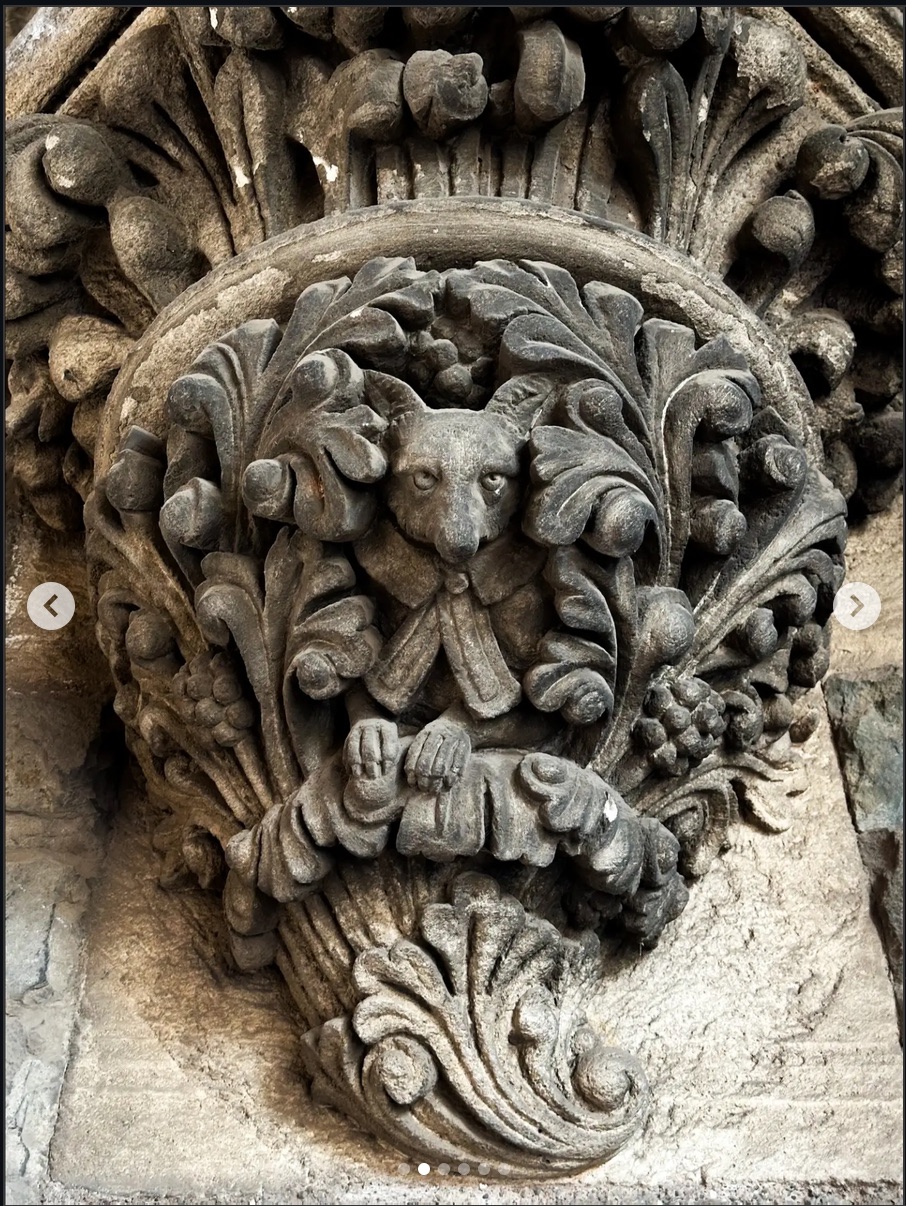
Fox as lawyer (image courtesy @gnluobiter on Instagram)
various sculpted features of the High Court. And just minutes later, she gasps, points and begins sketching what our guide has mentioned and what we’ve been eagerly anticipating. Two sculptures – a fox dressed as a lawyer and a monkey dressed as a judge. These whimsical beings peer at us – well, not the monkey, who has a strip of cloth sculpted over an eye – from above the pillars. Were they meant as not-so-subtle commentaries on legal authorities? Our otherwise knowledgeable guide either doesn’t have or won’t give us the answer.
Soon after, we’re in the splendid courtroom where Tilak once spent many long hours. In Bengal in 1908, two young revolutionaries, Khudiram Bose and Prafulla Chaki, tried to kill a British official with a bomb, but killed two British women by mistake. Chaki committed suicide to avoid capture by the police, and Bose was tried and executed.
Writing in his Marathi newspaper, Kesari, Tilak argued that it was British oppression that was fundamentally responsible for what Bose and Chaki had done. The only way to end such violence, he went on, was to grant Indians “swaraj” (self-rule). A few years later, he used that idea in what became the freedom struggle’s clarion call, the line that fired the imagination of even young post-Independence Indians like me: “Swarajya ha maza janmasiddha hakka aahe ani to mi milavnarach” (“Swaraj is my birthright and I shall have it”).
For his writings in Kesari, the British arrested Tilak. This room is where he was tried.
As I sit there with him on my mind, two things to note. One, we’re directly under the mansard roof, and it’s true: the natural lighting here is remarkable. The slight coolness, though? “Oh, that’s the airconditioning,” says our guide, promptly putting a spoke in my notion of the felt benefits of natural ventilation and thick stone walls, and also explaining why those large hooks are rusting, unused.
Two, several boards list the judges who have served the Bombay High Court over the years. There are Chief Justices and “Puisne” judges. What’s “puisne”, I ask our guide. “Ah, puny!” she says, and I wonder why, if the Court means “puny”, it doesn’t spell it that way. Turns out it doesn’t mean “puny”. The word refers to judges who do not rise to Chief Justice. The boards list names like Aguiar and Zoting, Chandiwal and Pinney, with only a sprinkling of women. Justice Sujata Manohar is one, the first woman judge of this High Court, appointed in 1978. In fact, one of my mornings spent in this building was in her court. Not long after, she was appointed the first woman Chief Justice of the Bombay High Court. So far, the only such.
Back in 1908, Tilak was found guilty. Just before he was sentenced, the Judge asked if he had anything to say. Immediately outside this room is the plaque I mentioned, his calm response carved in marble:
“In spite of the verdict, I maintain that I am innocent. There are higher powers that rule the destiny of men and nations and it may be the will of providence that the cause which I represent may prosper more by my suffering than by my remaining free.“
There are higher powers
Reading that well over a century later, I get a whiff of the mood and passion, the currents and struggles, of our struggle for freedom. But that’s not the only whiff.
Tilak was charged with sedition, the colonial offence that free India has continued to use against its citizens into the 21st century. He served his six-year sentence in Mandalay, Burma. In 1916, authorities took note of three speeches he made. A lower court ruled that they were seditious and ordered Tilak to execute a bond of good behaviour. He appealed this decision in the Bombay High Court. His lawyer argued that demanding swaraj and criticizing British colonial officers did not constitute sedition and was in fact completely lawful. Contemporary accounts spoke of his eloquence and legal acumen. The High Court agreed with him, and overturned the lower court’s ruling.
And who was this lawyer? The man so many Indians hate viscerally today, the man we blame for the Partition of 1947: Mohammed Ali Jinnah.
So: there in my state’s highest seat of justice I sit thinking of a time when India was united in the pursuit of a rightful destiny. Not bloodily partitioned as in 1947, not represented electorally by venal Sarpotdars as in the 1990s, not polarized by partisan political divides as in 2026, but united by an electric dream.