
by Charles Siegel
When I was born, in Houston in 1960, my parents named me after my paternal grandfather, who had died at age 32, and gave me the middle name of “Stein,” my mother’s maiden name. At the time, my parents lived in an apartment. In 1963, my younger brother came along, and in 1965 we moved into a house, with my parents taking out a $40,000 mortgage. It took them decades to pay it off, but eventually they did, and my mother proudly announced that they now owned the house “free and clear.” In 1966 another brother arrived.
My parents lived the rest of their lives in that house. They were there for 58 years after we moved in, until 2023, when they died two weeks apart. My mother passed away first, at 91, and then my father at 94.
My parents didn’t throw much away. In addition to their many hundreds of books, there were dozens of boxes of old pictures, family records, correspondence and so on. My brothers, who both live in Houston, have gradually been making their way through it all.
A few boxes contain letters in Polish or Yiddish. My grandparents on both sides all emigrated to America as children; both my parents were thus first-generation Americans. Like millions of other Jews, they came from Eastern Europe — primarily Poland. Or what is now Poland.
We recently hired a Yiddish translator to translate some of these papers. Our parents, mostly our mother, sometimes spoke Yiddish around the house. Looking back, I think they did so when they wanted my brothers and me not to understand what was being said. In any case, we ourselves never learned to speak the language.
Last week, we received the first completed job from the translator. It is a letter to my maternal grandfather, Mitchell Stein, from his brother Isaac in Bialystok, Poland. His brother actually was not Isaac Stein, of course, but Izak Sztejn. And Izak addressed his brother not as Mitchell, but Mikhoel.
This letter was written 100 years ago in 1926. My grandfather was by then in his twenties, living in Houston with a wife and two young children – my aunt and uncle. My mother, his youngest child, wasn’t born until 1931.
Here is the original letter, followed by the translation:
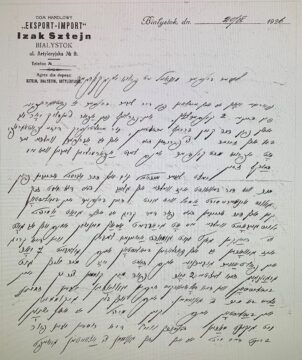
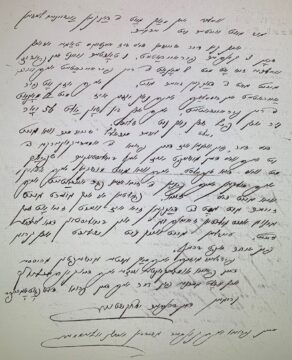
My dear brother Mikhoel with your wife and children,
Last week I received from you, dear brother Mikhoel, a photograph of your two little children. Over the past decades I had not received a single letter from you, but receiving this photograph I am very happy that I have a brother who has a wife and children, living a family life as it needs to be.
Now, Mikhoel, I owe you some writing because I believe that you were interested at one time how your brother in Białystok was doing. So I can write you that before the war I had built up a mill which employed many people, and thank God, I made quite a nice living.
When the war started, I left Białystok and lived 7 years in Poltava Gubernia and there it also went well for me the last two years before I came back to Białystok.
When the Bolsheviks won, they took everything away from me. I came to Białystok — and I could not make a mill. The Russians burned the mill. So I started a second business from which, thank God, I make a nice living, may it continue.
I can write you that I have already married off my children. One daughter lives in Paris. She was married 8 months ago, and thank God it is very good. And a son married in Russia. And another son married a month ago. And I am already 56, but I do not feel badly yet.
But now, Mikhoel, write me how is everything going for you. Where does your wife come from? An American or not? And what is your business? In the Białystok language, with what do you trade? And how are your children? Are they married?
For Taybl things are also not bad. I get letters from her often.
Stay well and be successful in business. Regards to your wife (whom I do not know) and children. I would want more photographs from you and your wife.
Your brother, Yitskhok Sztejn
My wife and children send you all regards.
Izak leads off with a gentle but unmistakable rebuke of my grandfather for never writing. The second line — “Over the past decades I had not received a single letter from you but receiving this photograph I am very happy that I have a brother who has a wife and children, living a family life as it needs to be”– is poignant but also pointed. It reminded me immediately of the classic scene in “Fiddler on the Roof,” in which Tevye is talking to Lazar Wolf, the butcher who thinks they are talking about his marrying Tevye’s daughter Tzeitl. They start out with this exchange, which comes at 1:48 of this clip:
https://www.youtube.com/watch?v=0EMlwLk_h-M&t=79s
Lazar: “How is your brother-in-law in America?”
Tevye: “Oh he’s doing very well.”
Lazar: “He wrote you?”
Tevye: “No, not lately.”
Lazar: “Then how do you know?”
Tevye: “If he was doing badly, he would write.”
After the mild admonishment, Izak continues in normal fashion, recounting his struggles in business, giving news of his children, and so on. He ends with a warm request for more news and photos.
My brothers and I are looking forward to much more from the translator. Izak and others are people we never knew and never even met — two generations and an ocean separated us. They are but stern, austere figures in sepia photographs.
It is impossible to read these letters, of course, without thinking about the nightmare that lay ahead. Izak died in Bialystok in 1937, at the age of 67. We don’t have information about his wife, but we assume she died in the Holocaust. Of their four children, two died young, and two lived to adulthood.
Those two were Raya Glinka and Maks. Raya’s name is recorded in a Yizkor book, or book of remembrance, as having been killed in the Holocaust with her husband David and son Clemens, perhaps near Munich.
Of Izak’s four children, then, Maks was the only one to survive into adulthood and survive the Holocaust as well. With his wife Zofia, daughter Bianka, and son Jakob, they somehow made their way east, eventually to Bombay. From Bombay they were able to make it to New York City, arriving in 1941. They were sponsored by another brother of Izak’s and Mikhoel’s, Pinchas Stein. Bianka, who I suppose would be my second cousin, died in New York in 2001. Her obituary in the Times records that she was the “devoted daughter of the late Maks and Zofia Stein,” that she was the “loving mother” of two children and the “cherished grandmother” of six grandchildren, that services would be held at Riverside Memorial Chapel and that contributions to Kadima Hadassah or West Side Hatzoloh were welcome. The Nazis did not succeed in expunging Izak’s line entirely.
We know that many other persons on our family tree died in Poland or Germany during the Holocaust. But who knows how many? People whose names I will never even know? How fortunate for my brothers and me that Mikhoel had made it to Galveston before the unfathomable happened.
There is another strange feeling I have, reading this letter. One hundred years later, I am trying to go back the other way. I have been investigating the possibility of obtaining Polish citizenship through my grandparents. This would in turn entitle me (and my children) to full European Union citizenship. I will take up this topic, and the surreal juxtaposition it presents, in my next column.