
by Eric Feigenbaum
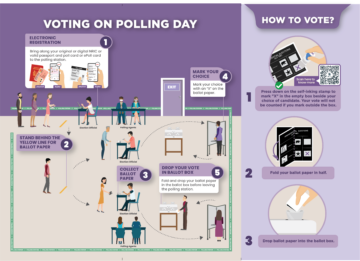
In a week of elections at a time when many questions whether both democracy and the structure of our republic – let alone other democracies and republics – will withstand the storms they currently face, maybe it’s worth talking about democracy itself.
Like most former British colonies, Singapore has a democratic republic based on the Westminster System, only unlike Canada, Australia, New Zealand and a number of other countries, Singapore chose to have a president as a stand-in for the sovereign.
Sure, there are those who question whether Singapore is truly a democracy given only the People’s Action Party has ever held a majority. Moreover, in many Singaporean districts candidates run in blocs – meaning three to six candidates sit as one choice on a ballot, leaving the political parties in a “winner takes all” position.
To further the criticism, Singapore’s election commission is not independent and answers to the Prime Minister. Election cycles are also very short – campaigning is restricted to ten days which many feel puts opposition parties on the back foot.
That said, international monitoring bodies have always confirmed Singapore is free of election rigging, promotes strong voting secrecy and has high institutional trust among its citizens. Singapore has ranked highly for decades on government transparency and citizens feel election administration is no different. Surveys and studies show there is genuine support and satisfaction with the PAP, largely because of the prosperity it has ushered in since 1965.
Like every other democracy, Singapore uses a one person, one vote system. But it has considered alternatives.
In 1994, founding Prime Minister Lee Kuan Yew brought a new concept into national debate and spent the rest of his life bringing it into conversation in interviews in the international press as well.
I’m not intellectually convinced that one-man, one-vote is the best. We practice it because that’s what the British bequeathed us. One-man-one-vote is a most difficult form of government… Results can be erratic.
Then he said something that would likely be inflammatory today.
There are some flaws in the assumptions made for democracy. It is assumed that all men and women are equal or should be equal. Hence, one-man-one-vote. But is equality realistic? If it is not, to insist on equality must lead to regression.
Before anyone puts the wrong spin on this, let’s clarify he didn’t mean men versus women – but is substituting “man” for what might be better to have said as “person”. In other words, are all PEOPLE equal? His conclusion: no.
But I’m convinced, personally, that we would have a better system if we gave every man over the age of 40 who has a family two votes because he’s likely to be more careful, voting also for his children. He is more likely to vote in a serious way than a capricious young man under 30.
Again, “man” really translates to “person” and after a little time, he revised his age 40 threshold to 35. In other words, people raising a family get twice the voting power because they have more skin in the game.
Their contributions to the economy and to society is greatest at this stage of life. Also, they need to vote for themselves and also for their children (who) have an interest that needs to be protected.
This is kind of radical stuff in a rather conservative package. Or is it?
There is actual precedent for Lee’s views among some of the stalwarts of modern democracy.
Until 1948, The UK had a formal “university constituency” and “business franchise”. If you were a graduate of certain elite universities, like Oxford or Cambridge, or owned a business in a different constituency than your home, you legally received a second vote.
Northern Ireland maintained this practice longer than the rest of the UK, keeping it until 1960.
From 1894 to 1919 in Belgium, adult men got one vote, but fathers, property owners, and citizens with higher education degrees were granted one or two additional votes.
In perhaps a less shining and short-lived example, from 1889 to 1893 New Zealand allowed wealthy European settlers to cast votes in every electoral district in which they owned land.
Lee didn’t just believe middle-aged parents held more societal stake, but also feared the elderly – an active voting group in most democracies – had short-term interests keeping them for guiding the state for posterity. Keep in mind in 1994, the aging population were among a generation that was less educated and literate than their children and grandchildren.
Lee Kuan Yew feared that as Singapore’s population aged, an “army of the elderly” would use a pure democratic system to vote themselves unsustainable welfare benefits at the expense of the economy.
You need a certain standard of literacy, moral and ethical values, to be able to run a one man, one vote system. It is necessary to try and put some safeguards into the way in which people use their votes to bargain, to coerce, to push, to jostle and get what they want without running the risk of losing the services of the government…
Under Lee’s proposal, the second vote would disappear at age 60.
Once past 60, their children would have grown up, and would vote for themselves. Then the parents should drop back to one vote. But during those critical years, 35-60, people who carry twice as much responsibility should have two votes.
Unlike so many other things in Singapore, Lee Kuan Yew did not get his way on the weighted, two-vote-per-parent system.
For the time being, modern democracy – everywhere it exists – remains a one-person, one-vote institution. Perhaps that’s exactly as it should be. It also doesn’t hurt to ask ourselves if just because something has always worked a certain way, should it continue as such?
I suppose the last word on democracy remains with Winston Churchill – someone Lee greatly admired.
Many forms of Government have been tried, and will be tried in this world of sin and woe. No one pretends that democracy is perfect or all-wise. Indeed, it has been said that democracy is the worst form of Government except for all those other forms that have been tried from time to time…
Enjoying the content on 3QD? Help keep us going by donating now.