
From Nature:
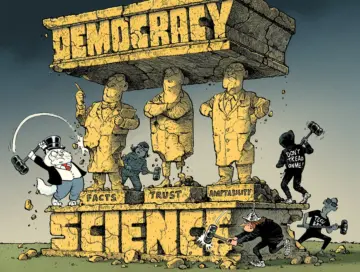 For scientists, thoughts about democracy can feel distant from their work. Yet, around the world, governments are limiting academic freedom and interfering with decisions about what research is funded and who performs it1. Some scientists are also facing politically motivated interference and attacks2. As members of the European Commission’s Group of Chief Scientific Advisors, we feel it is urgent to address this concern and that we have a responsibility to make scientists’ voices heard. Science and democracy are often viewed as distinct — science as a source of discovery, expertise and innovation and democracy as a set of institutions, rules and procedures. But, in reality, the two are intertwined3.
Science is an essential backbone of democracy. In an increasingly complex and fast-changing world, people need access to verified information and independent knowledge to make informed decisions4,5. Research aids that by generating reliable evidence and fostering critical enquiry, thus enabling a plurality of views to be discussed and creating conditions in which societies can learn from experience.
More here.
Enjoying the content on 3QD? Help keep us going by donating now.