
by Michael Liss
My dearest Friend, your dearest Friend never had a more trying day than Yesterday. A Solenm Scene it was indeed and it was made more affecting to me by the Presence of the General, whose Countenance was as serene and unclouded as the day. He Seem’d to me to enjoy a Tryumph over me. Methought I heard him think Ay! I am fairly out and you fairly in! see which of Us will be happiest. —John Adams to Abigail Adams, March 5, 1797, Adams Family Papers, Massachusetts Historical Society
Such are beginnings, even when laden with pessimistic prophesy. And such are endings, four years later, as when an angry, bitter John Adams skipped the Inauguration of his successor, Thomas Jefferson, by jumping on a 4 a.m. stagecoach headed toward Quincy.
Adams had a tendency to hyperbolize, even catastrophize—Ben Franklin, while otherwise giving him style points for intelligence and commitment, said Adams was “sometimes and in some things, absolutely out of his Senses.” Franklin was being unkind, but he wasn’t wrong. Adams had been tripped up by forces he didn’t expect nor have the tools to combat—the new game of political parties and partisan politics, the tepid support he got from his fellow Federalists, and, finally, the personal betrayal by his successor, his one-time friend, collaborator, and Vice President, Thomas Jefferson.
Such are subsequent beginnings. Jefferson took the job, gave an Inaugural Address filled with the promise of a new and better day, and, in his first term, largely delivered on it. Joseph Ellis, in American Sphinx, calls that first term “glorious.”
Jefferson’s second term seems to have been an extended demolition derby. Europe again was at war, and American interests were targeted—a situation exacerbated by Jefferson’s decision to dry-dock much of American’s navy. To add to this potentially existential crisis, a bit of bizarre betrayal karma came into play. Jefferson’s first-term Vice President, Aaron Burr, allegedly hatched an incredible scheme to detach a portion of the western United States and make it an independent country with Burr in the dictator’s role. President Jefferson was not amused, and went to great lengths (some might say unseemly unconstitutional great lengths) to see that Burr would end up on the gallows.
In this, Jefferson was too optimistic. Burr was eventually captured and brought to Washington for trial, where an obstacle presented itself in the form of Jefferson’s hated Chief Justice, John Marshall. After the great defense lawyer Lester Martin presented some exculpatory material and testimony, Marshall acquitted Burr on September 1, 1807.
The crises ate at Jefferson. Burr was free, and Jefferson was still bedeviled by his Federalist Chief Justice—indeed, still bedeviled by Federalists everywhere, particularly in New England. Jefferson’s passion for partisanship went unsatisfied, and Britain and France remained hostile.
In December of 1807, just as Congress approved Jefferson’s answer to the international situation by passing the controversial Embargo Act (essentially a total international trade ban), he made it public that he would follow Washington’s example and not seek a third term.
You wonder what might have happened if he had chosen otherwise. The Embargo Act, after a brief honeymoon period, became deeply unpopular. It did little to impact France and Britain’s policies, while being objectively damaging at home—and especially so in New England, the last redoubt of the Federalists. The country’s economy staggered under the weight of Jefferson’s choices.
Having said he was leaving at the end of his term, Jefferson acted on it in an unusual way. He effectively withdrew from many of his presidential duties, turning them over to James Madison (then Secretary of State and Jefferson’s chosen successor) and Albert Gallatin (Treasury Secretary). Ellis points out that this made for drift at a time when executive leadership was needed to explain unpopular measures. Of Jefferson’s second term, he says it “had proved just as disastrous as his first term had been glorious.”
Jefferson must have known it. The power he gave to Madison and Gallatin could have been retrieved at any time, but he chose not to. For a man so very conscious of his image, perhaps he could carry the weight no more. In a letter to P.S. Dupont de Nemours dated March 2, 1809, he said, “Never did a prisoner, released from his chains, feel such relief as I shall on shaking off the shackles of power.”
Jefferson and Adams, eight years apart, each heading home to the rest of their lives. Imagine what it must have been like—not merely as an ex-President, but as a Founder, with the nation’s continued existence still challenged by foreign powers. Imagine as well that the two are the physical embodiment of two fundamentally different ways of thinking about individual liberties, about the shape and scope of government, about the allocation of power.
Both men were 65 when they left office and must have had some sense of mortality—if there was a story to be told, it would have to be told soon, while they were around to tell it. Would they tell it together, or at least in parallel, and how, given the depths of their estrangement?
I have described their halting steps toward a reconciliation, encouraged (vigorously) by their mutual friend Benjamin Rush here and will take the luxury of not repeating myself, except to say that when John Adams finally broke a dozen years of silence with his January 1812 letter, Jefferson was ready and responded with warmth. Through the balance of their lives (as most people know, providentially they both died on the 50th Anniversary of the Declaration), they continued writing, 158 letters in all, 47 by Jefferson, the rest by Adams. This difference wasn’t the byproduct of a lack of care—it reflected Adams’ percussive way of thinking and expressing himself, and Jefferson’s extraordinarily long list of correspondents.
Both men were formidable intellects with wide interests, and many of their letters were on subjects having little, if anything, to do with politics. But some did, and they represent a treasure-trove of serious discussions on theory and practice unlike those of any other presidents in our history.
Moreover, they did it with the familiarity that came from being primary sources. After all, they had lived this. These two men wrote things, or conversed with those who did, debated them not just as an intellectual exercise, but as a means of creating a body of law, and understood they were not just interpreting the past, but building for the future.
I want to talk about just one letter, from Thomas Jefferson to John Adams, dated October 28, 1813. By this time, the men had rebuilt their friendship to the degree that they could rationally discuss (some) topics on which they had fundamental differences. Adams, in two previous letters of August 16, 1813 and September 2, 1813, had returned to a topic that was a bit of a long-time mania for him, aristocracy. Jefferson was now answering him.
Below, I’ve taken selected portions of the text directly (without changing spelling or punctuation) from this site: You can also find links to Adams’ two letters there, but I want to give Jefferson the floor.
[I] agree with you that there is a natural aristocracy among men. the grounds of this are virtue & talents. formerly bodily powers gave place among the aristoi. but since the invention of gunpowder has armed the weak as well as the strong with missile death, bodily strength, like beauty, good humor, politeness and other accomplishments, has become but an auxiliary ground of distinction.
“Virtue and talents” to Jefferson’s way of thinking are central, but they don’t operate in a vacuum, nor does each talent always maintain its status.
[T]here is also an artificial aristocracy founded on wealth and birth, without either virtue or talents; for with these it would belong to the first class. the natural aristocracy I consider as the most precious gift of nature.
Inherited titles, inherited status, mere possession of wealth, do not make a true aristocrat—real virtue and talent does. Jefferson adds something I missed the first time I read it, but becomes more relevant here:
…it would have been inconsistent in creation to have formed man for the social state, and not to have provided virtue and wisdom enough to manage the concerns of the society.
Now we are getting to a core Jefferson concern—a society, to succeed, must have not only wise laws, but wise men of virtue and wisdom to lead it.
[T]hat form of government is the best which provides the most effectually for a pure selection of these natural aristoi into the offices of government? the artificial aristocracy is a mischievous ingredient in government, and provision should be made to prevent it’s ascendancy.
The second part of this is tantalizing—it’s not enough to include men of virtue and wisdom, it’s also critical to keep out (or at least render ineffectual) the “artificial aristocrats.” Jefferson, for all his democratic preferences, wasn’t entirely ready to let the people choose: “provision should be made.” You can discern, even at a distance, the political Jefferson thinking his opponents were artificial aristocrats who needed to be marginalized.
Jefferson got right to it, pulling in Adams as he did.
[Y]ou think it best to put the Pseudo-aristoi into a separate chamber of legislation where they may be hindered from doing mischief by their coordinate branches, and where also they may be a protection to wealth against the Agrarian and plundering enterprises of the Majority of the people.
Let’s unpack that just a bit. The first part is fair—Adams did want a Senate to act in a cool contemplative way, and he was a consistent advocate for checks and balances. The second is flammable—“a protection to wealth against the Agrarian and plundering enterprises of the Majority of the people.”
Maybe I’m over-analyzing? I’d argue no, because Jefferson followed with
I think that to give them power in order to prevent them from doing mischief, is arming them for it, and increasing instead of remedying the evil.
Jefferson’s solution?
I think the best remedy is exactly that provided by all our constitutions, to leave to the citizens the free election and separation of the aristoi from the pseudo-aristoi, of the wheat from the chaff. in general they will elect the real good and wise. in some instances, wealth may corrupt, and birth blind them; but not in sufficient degree to endanger the society.
So, trust the people, says Jefferson. They will separate “the wheat from the chaff.” Who could argue with that?
Well, Jefferson himself. Patriarchal Jefferson didn’t really mean “citizen,” because he didn’t believe women should participate beyond being supportive wives and mothers. And he didn’t really mean it when it came to the opinion of those who didn’t live his agrarian ideal—a man should own some land before he votes.
So, Jefferson wasn’t fully ready for full-blown participatory citizenship. He wanted voters to look and think like him, and to be steeped in a political culture that reflected his values.
How do we know this? Well, he planted his flag in this letter. He compared Adams’ New England to his Virginia.
It is probable that our difference of opinion may in some measure be produced by a difference of character in those among whom we live. from what I have seen of Massachusets and Connecticut myself, and still more from what I have heard… there seems to be in those two states a traditionary reverence for certain families, which has rendered the offices of the government nearly hereditary in those families.
Just a bit of warmth of speech? Not exactly, as Jefferson concluded his New England tour with:
[T]hese families are canonised in the eyes of the people on the common principle ‘you tickle me, and I will tickle you.’
Virginia, of course, was entirely different. One might, if one were John Adams, wonder how one would see a Commonwealth dominated by large planters with a long history of slavery as a bastion of liberality and purely merit-based advancement, but Jefferson insisted that
a Randolph, a Carter, or a Burwell must have great personal superiority over a common competitor to be elected by the people, even at this day. at the first session of our legislature after the Declaration of Independance, we passed a law abolishing entails. and this was followed by one abolishing the privilege of Primogeniture, and dividing the lands of intestates equally among all their children, or other representatives. these laws, drawn by myself, laid the axe to the root of Pseudo-aristocracy.
Once animated, Jefferson went on. He almost (almost) lost his eloquence rapidly spooling out a list of Virginian initiatives, actions, and reforms. Some were in the matter of civic improvement, but even more might have be seen as advancements in the cause of liberty. He took justifiable pride in his plan for educating the young by creating what he called wards, each ward providing free schooling for reading, writing and basic arithmetic. The strongest students would be advanced and supported at public expense, and
worth and genius would thus have been sought out from every condition of life, and compleatly prepared by education for defeating the competition of wealth & birth for public trusts.
Here is where we get to some of Jefferson’s best instincts. Regardless of his ingrained prejudices and his contradictions, he wanted to create a country of citizens not only entitled to choose their own destinies, but educated enough to do it competently. Armed this way, they would, on their own, reject just wealth and birth in favor of intellectual and moral capacity.
With respect to Aristocracy we should further consider that, before the establishment of the American states, nothing was known to History but the Man of the old world, crouded within limits either small or overcharged, and steeped in the vices which that situation generates. a government adapted to such men would be one thing; but a very different one that for the Man of these states. here every one may have land to labor for himself if he chuses; or, preferring the exercise of any other industry, may exact for it such compensation as not only to afford a comfortable subsistence, but wherewith to provide for a cessation from labor in old age. every one, by his property, or by his satisfactory situation, is interested in the support of law and order.
I like John Adams. I admire his doggedness, his total dedication to the cause of liberty, his willingness to sacrifice his own needs for a greater good, and finally, his moral courage. Yet, as Gordon Woods points out, he was perhaps too much the pessimist to inspire—too many qualifiers, too much of a reliance on institutional structures, too much realism that transmits as darkness.
Jefferson was qualitatively different. Read the whole October, 1813 letter, and you can see the energy of the builder and believer. Jefferson knew what he opposed, but he also knew what he was for. Adams saw aristocracy as inevitable, but Jefferson was thinking about how to narrow the gap. Above all, Jefferson sought liberty and equality, and transmitted it in a way that gave light and inspired.
There’s a grace note to Jefferson’s letter. Perhaps it comes from the self-assurance of the superior, but grace note it is. He wrote:
[W]e acted in perfect harmony thro’ a long and perilous contest for our liberty and independance. a constitution has been acquired which, tho neither of us think perfect, yet both consider as competent to render our fellow-citizens the happiest and the securest on whom the sun has ever shone. if we do not think exactly alike as to it’s imperfections, it matters little to our country which, after devoting to it long lives of disinterested labor, we have delivered over to our successors in life, who will be able to take care of it, and of themselves.
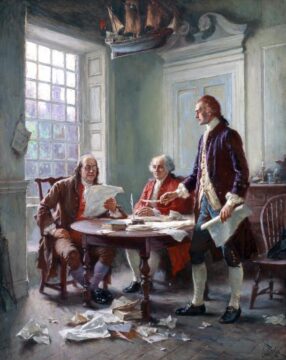
There are many reasons to reject Jefferson. We can deplore his personal conduct, his slave-holding, his exploitations, even his politics. But we can’t ignore the power of his message of July 4, 1776. Adams (and Franklin) may have been on the drafting committee, but the words were Jefferson’s. We don’t have to embrace his life to reach for his aspirations. Then it will be our obligation to “delivered over to our successors in life, who will be able to take care of it, and of themselves.”
Such are beginnings and endings.
Notes:
Thanks to Steven A. Steinbach for sharing his knowledge of Jefferson.
There is a tremendous amount of material out there—certainly about Jefferson.
Three books that are accessible that I think you will enjoy:
Friends Divided: John Adams and Thomas Jefferson, by Gordon Wood.
Thomas Jefferson: The Art of Power, by John Meacham.
American Sphinx: The Character of Thomas Jefferson, by Joseph Ellis (Sphinx is a 1997 National Book Award winner).
Additional books for research:
The Adams-Jefferson Letters, edited by Lester J. Cappon.
Thomas Jefferson Writings, edited by Merrill D. Peterson.
Online:
National Archives: Founders online https://founders.archives.gov/
UVA’s Miller Center: https://millercenter.org/president
Massachusetts Historical Society: https://www.masshist.org/
National Constitution Center: https://constitutioncenter.org/
Enjoying the content on 3QD? Help keep us going by donating now.