
by Thomas Fernandes
It’s easy, inevitable some might say, to want something and aim for it. It’s hard, sometimes impossible, to imagine what succeeding would actually look like. Drawing out those implications is what psychologists call unpacking. Adam Mastroianni explains it best with careers. Here are two of his examples:
Do you want to be a surgeon? = Do you want to spend 35 years doing the same operation 15 times a week?
Do you want to be a wedding photographer? = Do you want to spend every Saturday night stone-cold sober at a stranger’s party?
On one side, the upsides are obvious and appealing. On the other, the downsides are “deliberately hidden and tolerable only to a tiny minority.”

Any wish that stays at the level of the obvious benefit, I call a fantasy. A fantasy is fine to have, more than fine, necessary. It’s just that you don’t want it to come true, which is what people mean when they say “be careful what you wish for, it might just happen.” Only once you’ve unpacked it (and still want it) does it become a dream.
I see a lot of fantasy about collectivism but little dreaming. Shall we unpack?
Tolerated theft
We can start with one of collectivism’s go-to examples: hunter-gatherer societies. These small-scale societies are usually highly egalitarian and often depicted as an ideal of sharing, bonds and equality. Lots of autonomy and free time, in a tight-knit group where you know everyone. And they share almost everything. Can you imagine how good friends they must be for that? Or how good people? But the more anthropologists dug, the more the “they’re just so selfless” picture broke down.
The Hadza of Tanzania are one of the most studied hunter-gatherer groups in anthropology. Among them, men tried to hide meat in an anthropologist’s Land Rover. Anecdotes like this, of people trying to avoid sharing, piled up.
After the anecdotes came more controlled studies, using economic games like the ones psychologists run on Western students. In the dictator game, you get some food or money and can anonymously give part of it to someone else. Western players usually give 20% or more. Hadza players often give closer to 10%.
How does that fit with camps where more than half of a hunter’s game ends up in other households? Maybe the game doesn’t look enough like camp life.
So researchers built a give-or-take version. The food starts out split unequally between the player and a real but anonymous campmate, and the player can move it either way. Among players who started ahead, 41% gave something back but 30% widened the gap further in their own favor. Among players who started behind, 43% took more than they needed to reach equality, and about a quarter took everything. Big picture: left alone to decide, only 1 in 10 stopped at an even split.
The key words being “left alone.” In a real camp, you’re never left alone. The explanation that now dominates puts taking, more than giving, at the center of sharing. In the words of the study’s title, the Hadza are “averse to inequality primarily when personally unfavorable.” Anthropologists refer to this as demand sharing or, more bluntly, tolerated theft. People demand that food be shared, and you tolerate it because refusing would cost you more. It isn’t entirely against the sharer’s will either. Tomorrow they’ll be the one asking, so it pays to opt into a system where everyone has to share. From Spain to Poland and the United Kingdom, people would make the same choice.
An unrelated 2006 experiment shows this happening in real time using a public goods game. Each player gets tokens and secretly decides how many to put into a shared pot. The experimenter multiplies the pot (by 1.6 in these studies) and splits it equally among everyone in the group, whether they contributed or not. Whatever you kept, you keep. So the group does best if everyone contributes, but each player does best by keeping their tokens and letting the others pay, leading to some “free riding” strategies.
Players could join one of two groups. One had no extra rule, and in the other, members could pay to punish those who held back. Instinctively, most players started in the group without punishment. Pretty soon, though, the groups that could punish free riders got more cooperation and higher earnings. Seeing this, players moved over, and by the last round 93% had chosen to be exposed to enforcement, as long as everyone else was too. The study was replicated in 7 European labs and all 7 leaned the same way (rare enough in psychology to point out). This works when cooperation is long-term for the benefits to grow and when enforcing is cheap (in these games, spending 1 token cost the free rider 3).
“Enforcing” tends to call up violence or someone locked up, but that’s not what it means here. Here it’s just talk, letting reputation and group pressure do most of the work. Talk is cheap, but it can cost you your reputation, and your reputation is all you have.
Among the Ju/’hoansi (!Kung) of the Kalahari, Polly Wiessner sorted daytime conversations by topic. 31% were about economics (like where to hunt) but 34% were complaints, criticism and gossip. In another set of 308 conversations, criticism of someone breaking a norm came up in 56% of them, and praise in 7% (so even when talking about other subjects, criticism slips in). When something like punishment does happen, it’s usually cooperation withdrawn. The Hadza say they move away from people who don’t share.
So, do you want to be in a tight egalitarian community? = Do you want to negotiate and demand every day, keep track of what everyone has, be tracked in return and know that once you walk away, the others will go over everything you did today?
A forest is not a tree
These enforcement strategies only work at small scale. At large scale, you can’t keep track of thousands of people, and it’s for large-scale societies that the collectivism-individualism divide was defined and studied.
The best-known definition comes from Geert Hofstede, who first scored countries on it: “On the individualist side we find cultures in which the ties between individuals are loose: everyone is expected to look after him/herself and his/her immediate family.
“On the collectivist side we find cultures in which people from birth onwards are integrated into strong, cohesive in-groups,” which protect them in exchange for loyalty.
Hofstede defined it “as a societal, not an individual characteristic.” Much of the confusion, as Akaliyski and colleagues point out, comes from using the same words for people and for societies. What matters to people living in a culture is a downstream effect of how their society is organized, and it doesn’t always look like the label.
Their example is hierarchy. In a hierarchical society you can be a great leader or a great follower, and both get praised. So at the country level, valuing power comes, a little unexpectedly, with valuing humility. Yet within a country, the people who most value power are not the ones who most value humility.
By contrast, an egalitarian society prevents leaders, so the rule is to not stand out. Do. Not. Brag. Among the !Kung (the hunter-gatherers I mentioned earlier), understatement is expected and people play down their accomplishments so they don’t look too good.
The anthropologist Richard Lee wanted to thank the !Kung he lived with, so he bought the biggest, fattest ox he could find as a Christmas gift. For days everyone told him it was a bag of bones and people would go hungry. He was really affected, until someone explained:
“When a young man kills much meat he comes to think of himself as a chief or a big man, and he thinks of the rest of us as his servants or inferiors. We can’t accept this. We refuse one who boasts, for someday his pride will make him kill somebody. So we always speak of his meat as worthless. This way we cool his heart and make him gentle.”
I cut it short, but you should read the full story to really sense how troubling an experience it was, even for the anthropologist studying them. Again, unpacking the consequences is often surprising.
Warm and fuzzy
Confusing the tree with the forest, Western scientists expected individuals in collectivist societies to be nice, in the way their own culture defines nice: warm and fuzzy toward everyone. So the classic surveys mixed questions about warmth into the measure of collectivism. How wrong they were fits in one image:
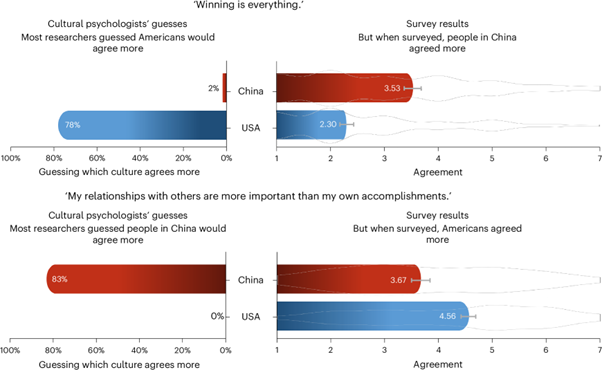
Talhelm and colleagues set out to build a new measure of collectivism as originally defined, and it predicted real-world differences far better. In high-collectivism countries, people are more likely to lie in court for a friend. In high-individualism countries, they’re more likely to give blood to strangers. Giving blood to a stranger is an odd thing to file under individualism. Since the old labels carry so much confusion, they renamed them “responsibilism” for collectivism that favors close ties and “warm fuzzy collectivism” for warmth extended to everyone.
But the real question…
Beware of friends
A study comparing friendship in Ghana and the US sheds light on how a more responsibilist culture changes interactions between individuals. The researchers interviewed 50 people in each country about friendship. Here are the main differences coded by the authors: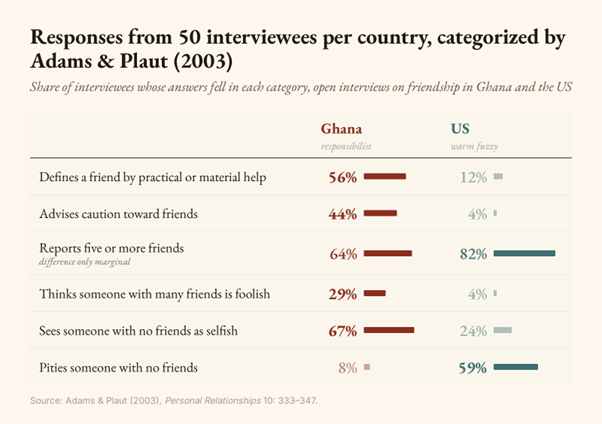
The authors’ reading is that in the American world, relationships are chosen since people are self-reliant. Friendship is about emotional closeness, having many friends is good and a friendless person is a sad case. In the West African world, relationships come with obligations inside a dense web of people. This is favored when you can’t easily make it alone. Friends are expected to help each other out a lot, so many friends means many obligations and possibly being drawn into unwanted shenanigans. No wonder Beware of friends is one of the slogans painted on West African trucks. Someone with no friends is not pitied but looks like he just failed to honor ties of reciprocation, so he is selfish.
You can think of it as a market. In one, anyone can compete for your friendship, and a bad friend just gets dropped. In the other, you’re stuck together, if only because every other group sticks together too, so you have to make it work.
Seen as a market, warm and fuzzy isn’t all upside. If your friends can drop you anytime, you’re competing to be funnier, better or more exciting than the alternatives. Look at the social media landscape, where unfollowing costs nothing. This makes interactions nicer (hence the “warm and fuzzy”) but possibly limited to “happy” emotions.
After the theory, a lived experience. Here’s Batja Mesquita, a Dutch psychologist, on moving from the Netherlands to the US. Both countries score low on responsibilism, so read it with the egalitarian script, the friendship market and the story of the ox in mind:
“I noticed that Americans praised each other constantly, and me also, and thanked me. And when that happened, I felt very uneasy. […] in America it’s a big goal to make each other feel good about ourselves constantly, so you want to say to people how special they are, and you’d like to hear how special you are. In the Netherlands, it’s a very different cultural logic. The idea is that nobody is any more special than anybody else. We’re all equal, and so if you praise me, then I become embarrassed, because there’s no real script for that.”
Mesquita’s lab also watched couples argue about things they disagreed on. Belgian couples got angry and pushed back, using anger to protect their own needs. Japanese couples expressed empathy in the middle of the disagreement, to stay connected.
Anger reasserts your worth. It’s a bargaining move that, at some level, says “I could leave or impose a cost on you.” (If this seems weird to you, check the evolutionary psychology account of anger.) Going straight to empathy says “we’ll have to fix this, because we’re staying together.” Empathy first probably looks like the better reaction to us. But the same reflex can stop people from voicing their needs, especially when those needs go against the group. It makes Abilene paradoxes more likely, when nobody says what they really think or feel, for fear of rocking the boat or being a burden.
The urban village
Because the fantasy to unpack was collectivism, one last example: the West End of Boston, as described in The Urban Villagers, Herbert Gans’s 1962 ethnography of working-class, mostly second-generation Italian Americans. I haven’t read the book. I’m going on Clara Collier’s account, which I’ll break into two parts. First:
“Work was not a central organizing activity of West End life. West Enders worked just enough to support their lifestyle, which revolved around what Gans calls the peer group. […] An adult peer group might include a married couple’s same-age relatives […] and perhaps a few childhood friends, who would probably be “adopted” in as godparents to the couple’s children. These people would spend almost all of their time together, meeting in the apartment of one family or another after work and staying late into the night. […] mostly, they talked, and talking mostly meant gossip.”
The community ties are the good part. You more easily measure what you value when you lose it, and the researcher Marc Fried measured the loss from the destruction of the West End neighborhood. It shows how real the good was. Among women who had called the West End their real home, 68% had severe grief reactions. Even two years after the move, at least 46% of the women and 38% of the men still showed fairly severe grief. One man described his evenings now: “I come home from work and that’s it. I just plant myself in the house.”
Fried notes that this attachment to a place is so far from middle-class habits that “it is difficult to appreciate the intensity of meaning, the basic sense of identity involved in living in the particular area.” Now the second part of Collier’s account:
“[West Enders] are exclusive. A West Ender knows all the same people from early childhood. They’re very skeptical of outsiders, including members of other ethnic groups who’ve lived in the same neighborhood their whole lives. […] [They] spend an enormous amount of energy policing deviant behavior. In the West End, this usually means sexual promiscuity for women, effeminacy for men, and class aspirations for anyone. A boy might be mercilessly bullied for doing too well in school or for wanting a white-collar job. Even unusual success is frowned upon. A person’s primary source of dignity is not their own achievements, but their relationship to the group.”
Also, the peer group was egalitarian and distrusted anyone who set himself up as a leader. One reading of the destruction of the neighborhood is that, with no leaders, there was no organized fight against the demolition (not that the blame should ever fall on those who fail to prevent something).
Thick as thieves
I get the appeal of the collectivist (sorry, responsibilist) fantasy. It’s the stuff of great movies and novels: the idea of “honor among thieves,” of loyalty and strong bonds. Unpacked, the crew that has your back is also the crew that takes for granted that your stuff is theirs, calls your great gift a shitty one so you don’t think too highly of yourself and bullies the kid who wants to study. And it can’t organize to save its own street.
On the warm and fuzzy end, you’ll probably notice the lack of unconditional bonds, the pressure to perform (you have to make it to have a group, instead of having a group to make it with) and maybe a struggle to find purpose or meaning. But you get friends picked for your passions (because they’re nice and you have fun together), warmth from strangers and more openness to a variety of experiences.
I don’t think either is better. Like a career, it has to fit you. Unpack it first, and if you still want it, it’s a dream.
* * *
For more posts, follow me on Substack at Librotium, where a backlog is already waiting for you!
Enjoying the content on 3QD? Help keep us going by donating now.