
by Anton Cebalo

I have been digging through many 1960s psychedelic and acid rock collections that I never knew existed. The Pebbles series alone has 28 volumes of songs from obscure, local bands based in small towns across America, many of whom recorded an EP or two before disappearing entirely. Some were brief stars on local college radio, others found absolutely no success at all—and in a few lucky cases, they’ve been revived on YouTube as of late, often marked with a comment from an old bandmate or their adult kid writing, “That’s my dad, thank you for listening!”
When you think of psychedelia, you might imagine a summer of supposedly happy love, bright colors, and flower power. But in listening to the genre now, I hear something altogether different: a sobering attitude about life ultimately not being able to provide and meet desire. To think that one magical tab could provoke an experience that could “change the world” is profoundly cynical, as if everything else—politics, institutions, the masses—was irredeemable.
That was effectively the entire political program of Ken Kesey’s Merry Pranksters bus and Timothy Leary’s followers: there is no actual manifesto, just take this tab and you’ll understand. You can view this as a kind of dead end, when there’s nothing left to say.
And so you find this soft nihilism and existential loss all over psychedelic music.
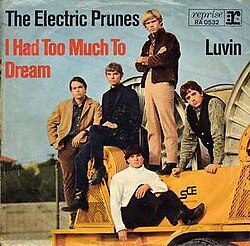
In their minor 1966 hit, “I Had Too Much to Dream Last Night” by the Electric Prunes, over-dreaming is portrayed like a hellish nightmare when you awake. Before the chorus, distorted vocals conjure up feelings of sinking deeper into some abyss as the lonely reality sets in. “I’m not ready to face the light / I had too much to dream last night.”
Then you have Syd Barret’s strange psychedelic goodbye “Jugband Blues,” which closes out Pink Floyd’s A Saucerful of Secrets (1968). Already suffering from schizophrenia, Barrett tells the listener it was “awfully considerate of you to think of me here,” but he must be obliged to tell you, he simply is not here. Childish observations in the closing lyrics ask why, as he severs himself from the band and his life in one of rock music’s great tragedies.
But perhaps the best example of darkness creeping into psychedelia to my ears is surprisingly Cream’s famous album, Disraeli Gears (1967). The opening track, “Strange Brew” is about a poisonous love festering inside you. “World of Pain” looks outside one’s window, focusing on a solitary tree amid meaningless in a grey city. (An odd side-note: both songs were written by producers Gail Collins Pappalardi and her husband Felix Pappalardi, who she would come to murder in 1983). The first side of the record ends with “Blue Condition” about living a life not of your choosing.
Already by 1967, the hangover of psychedelia was creeping in. “Please open your eyes / Try to realize / I found out today we’re going wrong,” sings Jack Bruce on “We’re Going Wrong” on side two.
The wicked excesses of the psychedelic era are popularly understood to be the Manson murders and cultish control it involved. But the era also gave way to another sentiment, that of anger projected outward. At some point, the relentless search inward led to neurotic emptiness as desire clashed with reality. From psychedelia, and the many garage bands that it produced, came punk as a refutation.
This link was made explicit in 1972, when the compilation Nuggets: Original Artyfacts from the First Psychedelic Era was released. Written in the album notes was one of the earliest uses of the term “punk rock” to describe music. And what followed was a new orientation toward the world amid the malaise of the 1970s.