
by Paweł Skała-Piękoś
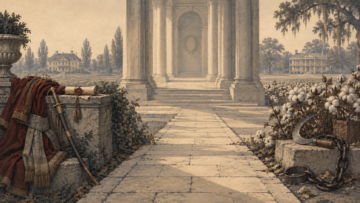
The Polish noble republic as a laboratory for anyone who wants to imagine America under the Confederacy; and why a liberal owes no apology to those who call privilege freedom
In 1770, Pitt the Elder warned the House of Lords that England’s freeholders risked being “reduced to a condition baser than the peasantry of Poland”. Two years later, in Somerset’s case, the Court of King’s Bench ruled that an enslaved man brought to England could not be carried out of it by force.
In America in 1770 soldiers fired into a crowd in Boston, and in Virginia two fifths of the population lived in slavery. In Poland, peasants on private estates had long lacked dependable royal protection in disputes with their own lords. Their state had two years left before the first cut: in 1772 Russia, Prussia and Austria took nearly a third of its territory; further partitions in 1793 and 1795 erased the state for a hundred and twenty-three years. Polish memory calls this the partitions, and they are to it what the Civil War is to Americans: the date from which everything is counted. That story hides an older division.
Who freed Poland’s peasants, the majority of its population? Three foreign monarchies, each in its own time; their own state tried at the very end and ran out of time. I am not defending the partitions. I am defending a question to which Polish memory has had a ready answer for two hundred years, and the readiness is the problem.
The familiar national story fits in three words: greatness, fall, return. Poland was once one of the largest states in Europe, then absent from the map for a hundred and twenty-three years, and is today a mid-sized member of the European Union whose material problems are slowly becoming ordinary European ones. The cultural problems do not appear in that story, and they have stayed; they are the same age as the greatness, and they have the same cause.
The Polish-Lithuanian Commonwealth, the republic of the nobility, is the closest record that exists of what the South would have looked like had it never needed to leave the Union, because it had already won. For three centuries one group, the szlachta, a broad hereditary noble class rather than just a titled aristocracy, enjoyed a liberty that was enormous, jealously guarded and resting in large part on the forced labour of the peasantry; there was no North to arrive with an army; and we know how it ended. What a victorious Confederacy would have looked like, nobody knows; what a ruling class that has won and no longer has to listen to anyone does to a country, we know.
Politically, I am a child of 1989, a liberal and a defender of Poland’s transformation; from that position I will tell my country’s history in the wrong order, because it has been told in the right one long enough. The question that leads me through it: what happens to a community when the liberation of part of its members cannot be told as that community’s own victory?
The manor gate
At the turn of the sixteenth century, Poland’s nobility was tightening its control over the peasantry. Restrictions on leaving the village and the growth of the lord’s judicial authority deepened that dependence. On private estates, disputes between peasants and their lords generally fell under seigneurial jurisdiction: courts controlled by the landowner. Peasants retained legal rights and could sometimes reach other courts. But there was no general, dependable route to protection against their own lord. For much of the rural population, the state’s protection too often ended at the manor gate.
The contrast is clearest on royal estates. Their peasants could bring complaints against royal estate administrators before the referendary court. The Commonwealth therefore had a way to hear a peasant’s case against someone stronger. What it failed to provide was comparable, dependable protection against a private lord. The state was too weak to impose it on its own nobility, or did not wish to be strong; from the peasant’s point of view, the difference scarcely mattered.
The Constitution of 1787 began with “We the People”, yet its fugitive slave clause required people who escaped slavery into another state to be returned on their enslaver’s claim. The law did not simply stop at the plantation gate. It reached beyond it to enforce the master’s power.
The peasant was not the only one left outside the gate. The nobility closed the towns as well: townsmen’s right to buy landed estates was restricted, merchants’ foreign trade was curtailed, and a nobleman who took up a town trade risked losing his nobility. The Polish Constitution of 3 May 1791 finally extended the rights of townsmen, four years before the end of the state. In the name of liberty it was overthrown by the Confederation of Targowica, a league of magnates whose founding act was drafted in St Petersburg and which brought in the Russian army to help.
South Carolina’s 1860 declaration of secession offered a comparable argument: Northern states were violating Southern rights by obstructing the return of people who had escaped slavery. Targowica’s leaders defended noble power against constitutional reform; South Carolina’s secessionists defended slaveholders’ power against interference. In both cases, a ruling group presented limits on its power over others as an assault on its own liberty.
I will call this the internal partition: the division of the country into those who had a state and those for whom the state was the manor. It was older than the three partitions the world knows, and it lasted longer. I think it was this partition, more than those, that decided what kind of nation would come out of the nineteenth century.
Three uniforms
Since the Commonwealth did not lift the yoke from the peasant, someone else did, in stages and in foreign uniforms: Austrian, Russian, Prussian. Poland’s own attempts came late. In 1794 Kościuszko cut the peasant’s labour dues and appointed overseers to whom a peasant could complain, but gave him no land, and his state had a year left. In his American will he left his estate in the United States to buy and free enslaved people; Jefferson declined to execute it, the litigation dragged on into the 1850s, and the will freed no one.
The underground government of the 1863 uprising against Russia abolished labour dues by decree and granted the peasants land; in 1864 the tsar introduced his own land reform, competing with the insurgents’ promise and outbidding it, so that the peasant would remember who had given him the land. In Galicia in 1848 Polish circles were preparing to abolish serfdom; the Austrian governor pre-empted them. Polish reforms came late and had no time to take hold, and the partitioning powers carried them out in the Poles’ stead, in Galicia and in Russian Poland with an explicit calculation: that liberation should not bear a Polish name.
The partitioning power gave the peasant something more than land. The imperial administration, to which a Galician peasant could bring a complaint against the manor, offered protection beyond the private lord’s jurisdiction.
That is why 1846 is not a riddle. When the Galician nobility rose for Poland, the peasants killed more than a thousand people from the manors, and they did it out of loyalty to the emperor. Not out of blindness; out of a calculation the imperial administration had helped them make: Austrian officials took their complaints, and Poland was the name of the owner.
Jan Słomka, a peasant village headman, recalled in his memoirs that in his youth the peasants around him used the local name Mazurs rather than calling themselves Poles, and that he came to feel Polish only when he began reading books and newspapers. In his village the word Pole meant a gentleman. But Słomka did not only write this down; his generation used Austrian schools and Austrian elections to found a party of its own and send its own deputies to Vienna.
Under the partitions it stopped being certain what Poland was, who counted as a Pole and what the word meant. A slow levelling of the concept began, and it was completed only in post-war Poland, where peasant children filled the cities and the offices and the word “Pole” no longer belonged to a single social class. That same Poland did not abolish the manor’s social logic; it carried out a forcible redistribution of narcissism: new groups gained the privilege of looking down on someone else. The nation that voted in its first post-independence parliamentary election in 1919 and in 1989 is the child of that uncertainty, not of the noble republic; it was born when the nobility lost its monopoly on the word “Pole”, and the monopoly was taken from it by the partitioning powers and by the peasants themselves.
Virginia, second act
Edmund Morgan described a Virginia where the freedom of the free stood on the labour of the enslaved, and where the planter elite bought the peace of poor whites by giving them something cheaper than bread: somebody lower.
An American hears in the word bondage the trade in human beings and a caste marked by skin, and rightly: serfdom was not the same system. Peasants were traded too, even without land, but their children carried no mark on their faces; the nobility had to invent its own distinctness, and it did, deriving itself from the Sarmatians and the peasant from Ham, the same Ham the Southern pulpit would later put to work. So the comparison does not carry the slave ship or the racial caste. It carries three things: a private jurisdiction in which the owner decides whether a complaint leaves the gate at all; the freedom of some resting on the forced labour of others; and the refusal of protection in a polity that knew what protection was.
In America the enslaved were freed by an army the South still calls an invader on its monuments; from the planter’s point of view it was an occupation, and he called it one. And when, as part of a political compromise, the troops were withdrawn, the South did what the Polish nobility would have done had it regained its state: it restored the internal partition under a new name and kept it for nearly a century. A Black American received his freedom from Washington the way a Polish peasant received it from Vienna: from outside, from someone his master called a stranger; and like the Polish peasant he did not wait: within a few years of the war he sat in state legislatures and in Congress, until that was taken from him.
The myth of the Lost Cause did in the South the same work that the martyrology of the partitions did in Poland: it commemorated an elite’s loss of power as everyone’s loss of a homeland and pushed the internal partition beyond the horizon of memory. The partitions were a wrong done to the peasant as well, differently in each partition: foreign conscription, a foreign language in court. But the dominant voice in telling that wrong was taken by one group, and in that sense, not in 1795 but later, in memory, the Lost Cause won in Poland.
The Polish myth admitted the peasant most readily as a scythe-bearer: a peasant with a scythe blade remounted upright as a pike, in 1794, marching behind Kościuszko for the gentleman’s Poland. In Fort Mill, South Carolina, a monument to “faithful slaves” shows a Black man resting with a harvesting tool in his hand: a tool of labour, not a weapon. In Richmond, the former capital of the Confederacy, the enslaved rebels Nat Turner and Gabriel were given a place on a pedestal only in 2021, two weeks after Lee came down from Monument Avenue.
The larger difference: America had a North. The liberator came from the same country; the internal partition was rebuilt openly, in law, and later openly dismantled, and the Lost Cause had to fight for memory against a rival. Poland had no North: the liberator was foreign, serfdom ceased to be law, but the manor survived in property and in custom, in the habit of measuring one’s own dignity by the distance to somebody lower. That is why in Poland memory won. The memory of the nobility became the memory of the nation: the canon was written by authors from the nobility, the uprisings were led by the nobility, and in the dominant story the question of who had actually possessed that independence was pushed to the margin.
This inheritance may also explain why the nationalist right can so readily cast domestic critics as serving foreign interests. Once defending the nation means defending its inherited image, naming a wrong committed at home can be made to sound like an attack from abroad. The critic has to prove that they belong before anyone needs to answer what they have said.
Who hears the appeal
These histories share a constitutional pattern. A state that knows what protection is stops it at the threshold of a private jurisdiction: the manor’s, the plantation’s. The questions are four, the same ones I put to every institution in my previous essay: can you contest the category you have been assigned; must the institution give reasons; does a path of correction exist; can you actually use it? Neither the manor nor the plantation offered a general, dependable right to challenge the owner’s power. The contemporary platform, which sets the rule itself, measures the deviation itself and hears the appeal itself, looks like their heir; European regulation is opening routes to independent review; the danger is real.
A polity that knows what independent recourse is and refuses it inside private property always ends the same way: people go looking among strangers for an authority that will hear them. The Galician peasant sought protection from Austrian officials; the freedman from the federal army. After 2015, Polish citizens looked for it to the EU’s Court of Justice in Luxembourg, as a right-wing government brought the Constitutional Tribunal and the National Council of the Judiciary, which nominates judges, under political control. The captured tribunal replied that in this matter European law must yield to the Polish constitution.
Part of the Polish right speaks of Brussels in the vocabulary of the partitions, and there is more truth in that language than its authors suspect: the EU court is to the Polish citizen what the Austrian administration was to the Galician peasant, an authority outside the arrangement in which the lord rules; not foreign, though, in the sense that the partitioning powers were foreign, because Poland entered it of its own will and helps to make it.
The emperor, however, was not an accountable authority; he was a protector. He had offices and rules, but he heard the peasant because he wanted to weaken the lord. Washington heard the freedman for similar reasons and after 1877 stopped hearing him; the freedman had rights on paper but was losing the tools to enforce them.
A protector protects as long as it suits him. An accountable institution protects through rules I can invoke against it too, and qualifies as such only when those rules work in practice.
The European Union qualifies as an accountable institution only as long as its decisions can actually be challenged. In a 2025 qualitative study by CBOS, a Polish public opinion research centre, farmers described growing bureaucracy and controls as a loss of autonomy. That is a warning. Where the people affected have no usable way to challenge a decision, the EU acts as a protector rather than an accountable institution, and my criterion makes no exception for it. An authority that can be challenged is better than a lord who cannot; and Polish liberalism has a reflex of treating its own footing in Europe as an embarrassing prosthesis rather than as an independent authority above its own manor.
No apology
I return to Targowica. The privileged, when a privilege is being taken from them, usually experience it as an assault on liberty. Calhoun defended slavery as a condition of liberty. Poland’s new right speaks today in the language of free markets and personal freedom, and in that language it offers a project whose effect would be to curtail the full personhood of women, minorities and nonbelievers.
A liberal who faces that language in a country like mine has a reflex of apologising, and it comes from conditions, not from character. Where liberal norms are not the norm, where an independent judiciary, a secular school and equality before the law are the achievement of a single generation rather than the air one breathes, the liberal speaks a language most people did not learn at home. Every sentence of his requires a justification, while the sentences of the right require none. Out of that asymmetry the apologising is born: for reforms made in his language, and for being right about things the majority sees differently.
A familiar American episode is instructive for the opposite reason. In September 2016, Hillary Clinton used “basket of deplorables” for “half” of Donald Trump’s supporters, citing racism, sexism and other forms of bigotry. She regretted saying “half” the next day but stood by her criticism of racist rhetoric. That is the right distinction: correct an overgeneralisation without apologising for opposing prejudice.
The wrongs done in the name of reforms are another matter. There, apology alone is cheap: it is the manor’s guilt without the loss of the manor. The voice of the losers is preserved in an archive and in a paragraph about social costs, and the rule does not move by a millimetre. An apology does not replace the repair of the rules that produced the harm.
To defend liberal principles you have to be able to get angry. Michael Dukakis, asked in 1988 whether he would support the death penalty for a man who raped and murdered his wife, calmly said no and moved on to the statistics. He lost that scene not because he opposed the death penalty but because he could not show how reason passes through anger, love and the reflex of defence without losing its rationality. A liberalism that has extinguished in itself the reflex that something is unacceptable looks, to the heirs of the manor and the heirs of the plantation, like the manor: educated, and somebody else’s.
The anger I want has two sides, tenderness and vigilance; in Polish the two words, czułość and czujność, are nearly one, and the kinship is not only in the sound. Olga Tokarczuk, the Polish Nobel laureate in literature, called tenderness the most modest form of love in her Nobel lecture; Constant, two centuries earlier, called vigilance the price the moderns pay for their liberty. Tenderness without vigilance can be walked around; vigilance without tenderness hardens into a shell.
And one must be able not to apologise when fighting a privilege, and to be ashamed when defending one’s own. Privilege in this essay means what the Latin privilegium meant: a special law for one person or one social class, an exemption from the rule that binds everyone else. The Commonwealth’s unequal access to legal protection shows privilege at work: the law supplied a check on the king’s administrators without giving peasants comparable protection against private lords.
A difference between people is not yet an injustice, and a hierarchy that serves a function and carries responsibility is not an evil. An advantage is admissible as long as it can be justified by a function, as long as it can be lost and as long as it can be challenged; it becomes a privilege on the day it stops transmitting anything but itself and buys itself an exemption from those conditions.
A judge’s authority can protect someone weaker. The royal courts offered such protection to peasants on the king’s estates, but not on equal terms to those whose lord was a nobleman. Jim Crow drew a different barrier, through race, between people and the protection the law promised them. In each case, legal barriers made the power of one group harder for another to challenge. Whoever dismantles independent courts or other avenues of redress to preserve that privilege should meet resistance within the law.
So I am not arguing for identical roles or outcomes; I am arguing for equal standing as persons in the face of unequal competence. I am arguing for an advantage that is fair: one that has to go on being earned, that a function justifies and that can be challenged. And I owe no apology to anyone who calls his own privilege freedom.
The Commonwealth had a tribunal for peasants on royal estates, while those under private lords had no equivalent general right to that protection. America, after the Reconstruction amendments, had a promise of equal protection written into its Constitution, yet across the South discriminatory laws and violence stood between Black citizens and its fulfilment.
In Columbia, North Carolina, a 1902 monument to a Confederate soldier stands today in front of the county courthouse, with the inscription “In appreciation of our faithful slaves”. Four Black plaintiffs from a local citizens’ group brought a lawsuit in 2024, initially seeking the monument’s removal. Their amended complaint narrowed the demand to removing or covering the six-word inscription. They used the court against what stands in front of the court, and in July 2026 the county covered the words with a metal plate. They had made the county change how it publicly remembered slavery.
Liberal democracy wins here in its most infuriating form. The inscription is covered; the soldier still stands. There is something here for everyone to resent, and the compromise takes a perversely stable shape.
On method
I developed this essay in Polish with support from Anthropic’s Claude Fable 5.1 and OpenAI’s ChatGPT (GPT-6 Astra), the latter configured for my personalized project architecture. I used them to challenge the argument, explore counterarguments, support fact-checking and source comparison. They also helped transcreate the text into English and refine its structure and phrasing. I selected, rejected and revised the suggestions; the final argument, editorial decisions and responsibility for publication are mine.
Enjoying the content on 3QD? Help keep us going by donating now.