
by Mike O’Brien
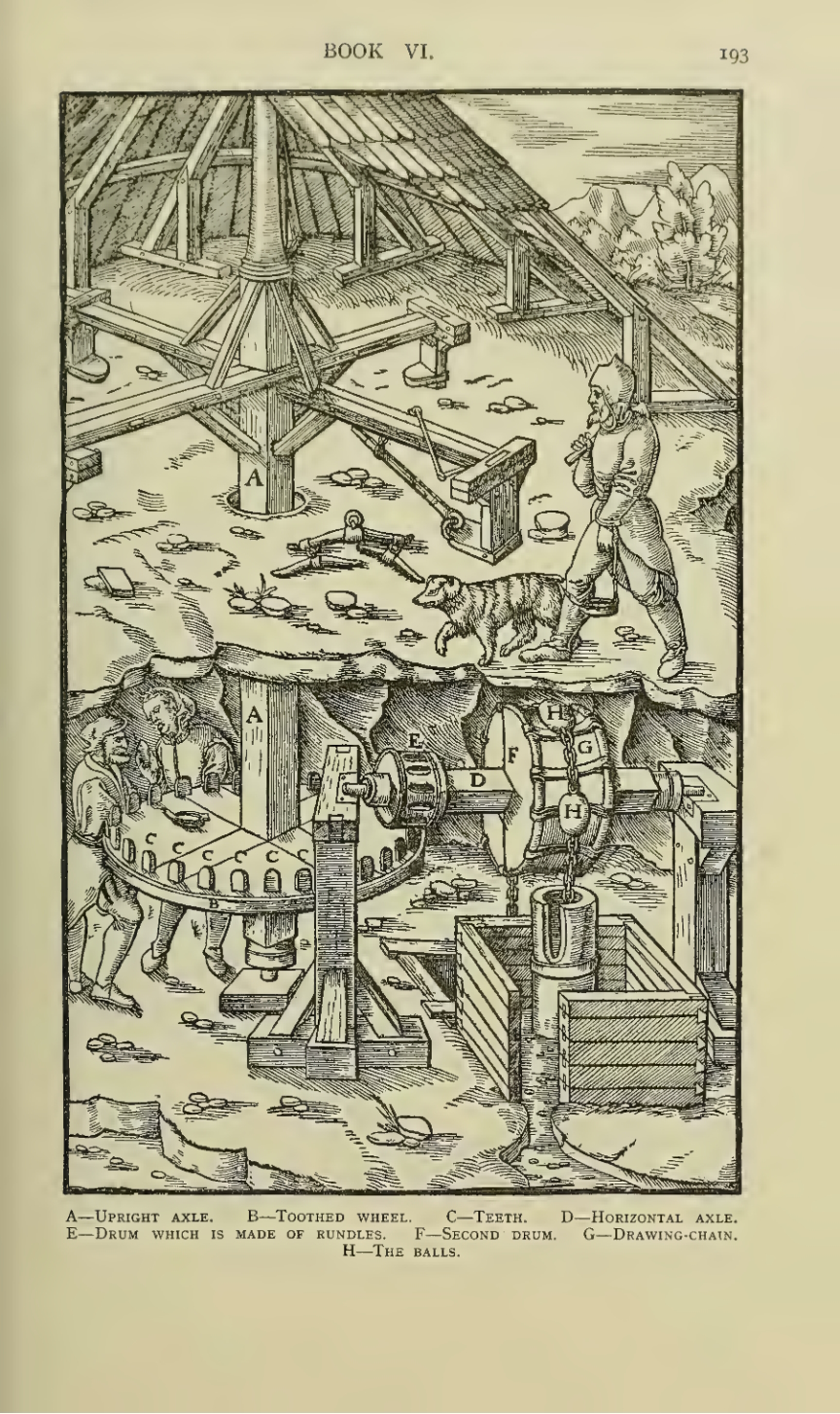
It takes me a long time to finish books. The last one I finished was published about a century ago, or four and a half centuries ago, depending on how you figure it. In my defence, it was very dense, and very long, and packed with voluminous footnotes in such small font that I was obliged, for the first time in my life, to wield reading glasses to decipher the tiny spacklings of ink (known colloquially as “fly shit”). But, as a rabbit-hole-diving lay reader of technical arcana, it was worth the effort.
De Re Metallica is a treatise that attempts to collect and systematically arrange all surviving information on mining and metallurgical industry available in its time, that time being the early to middle sixteenth century. Published in 1556, it was written over the course of 30 years by Georg Agricola, a scholar and physician. His works were published in Latin, as was usual at the time, so I read the 1912 English translation by Herbert Hoover (yes, that Herbert Hoover, the thirty-first president of the United States and namesake of the Hoover Dam. He wasn’t president yet, so I guess he had some free time). Hoover was at the time a very successful and esteemed mining engineer, whose lectures at Columbia and Stanford had already been published as a standard textbook.
(Before going any further, I would like to share a mining joke. A man walks into an employment office and says “I’d like to get a job in the mining industry”. The clerk says, “Alright, we currently have openings in a copper mine and in an iron mine, which would you prefer?”. “Either ore”, the man replies.)
(You’re welcome.)
Agricola’s book is a real soup-to-nuts overview of everything involved in the extraction and processing of mined materials, from choosing where to dig all the way to separating and purifying metals for sale. The accompanying woodcut illustrations are indispensable, at least to this reader, for elucidating long passages describing three-dimensional objects in classical measurement units (e.g. “to this lower beam is affixed a second beam, transverse to the first, measuring six feet and two hands length and two hands and two digits height and breadth, at such distance from the main wall that a man may pass between them without great difficulty”. I just made that up, but it gives a fair impression.) They also feature the occasional dog, which is nice. I’ve done enough reading and watching of similar old technology (Eric Sloane’s books on early American colonial tools and building, and many articles and videos on steel making) to scaffold the information in Agricola’s writing somewhat, though a reader with zero prior knowledge would probably do alright with the occasional Wikipedia search.
I do admit to skimming some of the more exhausting sections, like Book XI which is almost entirely devoted to describing all the minutely different ways in which people from this or that locality go about melting silver and copper apart. Agricola’s dedication to completeness often leads to long enumerations that a more lay-oriented text would summarize. However, a “good enough” summation of technical details, employed to actually build mining and refining works, could have resulted in many (more) dead workers and a few (more) incinerated towns, so let’s not begrudge Agricola’s attention to detail.
The work is divided thus (I am giving you an index that does not exist in the front matter, so you’re welcome again.) Book I defends the honour of mining as reputable and skilled work. Book II describes the qualities of a good miner, and how to choose good locations for mining operations. Book III describes the shape and three-dimensional orientation of underground deposits (“veins” etc.) relative to the surrounding terrain. Book IV describes the operational, territorial and legal-political administration of mining. Book V describes the digging and reinforcement of mine shafts. Book VI describes the implements and machines used by miners. Book VII describes the tools and methods used by assayers to assess the nature and quality of the material produced by the mines. Book VIII describes the methods and equipment used to mechanically separate and refine precious material (crushing, roasting, washing, etc.). Book IX describes the smelting of metals from ores. Book X describes the refinement and separation of smelted metals (e.g. separating gold-silver alloys). Book XI further describes the separation of smelted metals, specifically copper-silver alloys. Book XII describes the collection and preparation of mineral “juices” such as alum, vitriol, and bitumen.
Of these, I was most struck by Books VI and VIII, the former featuring surprisingly (to me) refined and elaborate machines for circulating air and removing water from the mines, as well as for bringing miners and materials in and out of the mines via vertical shafts. It should be obvious, I suppose, that such devices would be necessary to avoid killing too many miners (by the standards of the day), or to reach any but the most readily accessible deposits in well-exploited areas. Just as striking as the mechanical ingenuity of these devices is the degree of automation by which some of them were operated, turned by beasts and men where necessary but often too by continuous water and wind power. Once you have a machine that runs continuously by a spinning shaft, you can adapt it to be spun by steam power, electric motor, harnessed unicorns, etc., and the future rolls out before you in iterative steps (As the torque, speed and running time increases, you of course must also iterate better bearing and linkage technologies to keep pace.) The scale, in terms many identical machines running in parallel, also surprised me. Book VIII describes ore-crushing machines (nine-foot-long vertical posts with iron “shoes” at the bottom, lifted and dropped by cams on a wheel-driven shaft) arranged fifteen in number in some operations. This cam-driven water-powered arrangement was also used to operate bellows, some seemingly the size of a small car, feeding rows of charcoal smelting furnaces. One can imagine how much of this machinery could fit within the foundations of ruined Roman works, and understand where all that steel and bronze came from.
The scale of operations described also made me think of the scale of their environmental impact. The extensive use of mercury (the fumes of which, Agricola notes, “loosens the teeth”) and lead is one matter (especially given how much was lost in smoke and vapour with imperfectly sealed furnaces). Another matter is the use of charcoal as fuel. You can do a lot with charcoal (it can exceed 1200 degrees Celsius with a forced air supply), including melting iron ore into brittle cast iron, and then decarburizing it (removing the excess carbon by combining it with oxygen) into workable wrought iron, which brings you pretty close to nineteenth century steel manufacture. But it’s an incredibly energy-inefficient and weigh-inefficient fuel, and you need to use a lot of it. It weighs about a quarter as much as the wood from which it was made, and gases off relatively huge quantities of hydrocarbon gases as you kinda-but-not-quite burn the wood to produce charcoal. Ideally you roast the wood with an external heat source in a low-oxygen environment, but practically it’s much easier to cook it slowly in a pretty-well-closed vessel using the burning wood itself as the heat source. Copicing (growing trees which are periodically limbed and allowed to grow back) was a means of off-setting the deforestation caused by growing charcoal demand in Europe, but trees grow slower than economic demand and eventually fossil coal supplanted charcoal as a fuel source (though charcoal was still used for metallurgical purposes, as fossil coal contains too many impurities). It makes me wonder if the Industrial Revolution really started millennia earlier with charcoal, and what is commonly called the Industrial Revolution was really the Fossil Fuel Revolution, draped in valour stolen from earlier times.
(Book XII, on mineral “juices”, discusses bitumen, i.e. petroleum, only briefly, but Hoover adds a lengthy footnote on its occurrence and uses in the ancient world, noting among other things that the Egyptians used it for embalming and that “mummy” is derived from the Persian world for bitumen, mumiai. He adds dryly, “The plentiful occurrence of bitumen throughout Asia Minor, and particularly in the Valley of the Euphrates and in Persia, is the subject of innumerable references by writers from Herodotus […] down to the author of the company prospectus of recent months”.)
Agricola was preceded by many ancient, Medieval and near contemporary authors. His principal classical sources were Aristotle and his disciple Theophrastus, who lived some eighteen centuries prior. Theophrastus was particularly important for his description of minerals, and of the touchstone and its use for estimating gold and silver content. (Touchstones were often garnet-containing coticule rocks, which I have mentioned in previous articles for their use as sharpening stones since pre-Roman times. Needles of gold-silver alloys with known ratios are rubbed against them, leaving a residual mark, which is compared to the residue left by rubbing gold and/or silver of unknown content against the stone. Hence the metaphorical use of “touchstone” for a standard of comparison.)
Some two centuries or so later came Diodorus of Sicily, whose work Hoover describes as “traveller’s notes” (as so many ancient histories and compendia are), most useful for his accounts of Egyptian mining and British tin. (He deplored the misery and abuse under which the Egyptian miners were worked to death. Had modern country music existed then, one wonders if there would have been songs celebrating the rugged dignity of serving the pharaohs, performed between columns inscribed with the hieroglyphic symbols for “Make Egypt Great Again, Again”. Egypt is very, very old.)
In the first century AD came the geographer Strabo, from whom Agricola drew descriptions of Spanish mining works, and the physician Dioscorides, who described the making of various medical preparation from mineral sources. Contemporaneously, the Roman author Pliny wrote his Natural History (which Hoover praises as encyclopedic, and not so bad accuracy-wise compared to other “travellers’ tales” accounts), drawing mostly on Greek writers, and from this work Agricola took most of his Latin terminology. (Hoover notes that Agricola’s insistence on using Latin without resort to his native German made for rather unwieldy descriptions, which needed to be reverse-engineered in translation, since no Latin terms were readily available for more recent inventions and discoveries). Another first century Roman, the architect Vitruvius, provides some references to mining-related machinery and the chemical preparation of pigments.
Among Medieval writers, from the tenth century Agricola drew on the Islamic Aristotelian Avicenna, mostly known for his monumental works on medicine, and Theophilus, a monk who wrote about the preparation of metal and glass-work (according to Hoover, mostly for ecclesiastical decoration). Also mention is Geber, apparently of disputed identity and origin (the literature at Hoover’s time placed him somewhere between the seventh and thirteenth centuries) to whom are attributed detailed works on metallurgy and alchemy, including the preparation of various acids and salts, as well as methods to amalgamate and separate precious metals by melting. Hoover states that these works dominated alchemical studies for centuries.
Hoover also mentions three important books contemporaneous to Agricola, written in vulgate, that were already circulating when the writing of De Re Metallica had begun. The first, Eyn Nutzlich Bergbuchlin, was written anonymously and is credited by Hoover as being the first work on mining geology. Agricola was apparently not a fan and would bring it up to denounce its errors. The second, Probierbuchen, was a sort of recipe book for mining and refining operations, more a reference for professionals than a treatise to educate laypeople, and was amended and republished many times. The third, Biringuccio’s De La Pirotechnia, is for the most part dismissed by Hoover as an inferior fore-runner to Agricola’s work on metallurgy.
As for Agricola himself, he was born Georg Bauer in Saxony in 1494 (a year after the birth of Martin Luther, and forty years after Gutenberg’s first pressing), with the Italian Renaissance underway but the German Renaissance (and the Reformation) still to come. He earned a Bachelor of Arts degree around 1518 at Leipzig, then worked administering a municipal school (assisted by Johannes Forster, who was Luther’s collaborator in translating the Bible into German), returning eight years later to Leipzig as a lecturer, and then two years later departing to Italy to study medicine, philosophy and natural sciences. He met Erasmus during these travels, who later became his friend and patron. In 1526 he returned to Germany and was later appointed town physician in a small city in Bohemia, surrounded by some of the most active mining areas in central Europe at that time. Agricola claimed that, when not attending to his medical duties, he spent his time visiting mining and smelting operations and talking to the most learned workers there, while also absorbing all he could from classical texts on related matters. From this experience he first produced Bermanus (published in 1530), a dialogue on mining and minerals whose titular interlocutor was based on one of the miners that Agricola had befriended, Lorenz Berman. After the publication of Bermanus, he left his physician job and spent three years travelling and studying mining, before taking up another physician job in Saxony in 1533 (the same year he published a book on weights and measures, no doubt an invaluable resource for readers of classical texts replete with pants-on-head-crazy measurement systems). He lived in Saxony for the rest of his days (dying in 1555, a year before the publication of De Re Metallica), during which time he wrote another eight published works related to mining, as well as several lost or unpublished works, including some on medicine and theology. (This all comes from Hoover’s biography of Agricola in the introduction of the 1912 translation).
Quite the life. Agricola lived at a time when the goal of being an expert in all available knowledge had just recently become unattainable (or rather, the pretense of such expertise became untenable). The movable-type printing press and the Renaissance expanded the wealth of knowledge to be mastered faster than any one person could digest it, and the time was approaching when the methods of commentary and interpretation of classical texts would be supplanted by the Scientific Revolution’s methods of hypothesis-testing by means of physical experiments. Hoover the translator lay on the other side of that revolution, and of the Industrial/Fossil Fuel Revolution, and would go on to witness the dawn of the Atomic, Computer and Space Ages before his death at ninety years old in 1964.
Beyond its contents, De Re Metallica is fascinating (to me) as a cultural object. Containing references from ancient Egypt and the Old Testament, owing much of its Latin and Greek sources to Islamic scholars who preserved and interpreted classical texts, these texts being later recirculated by European printing houses mere decades before De Re Metallica was written, all historically re-framed by Hoover’s modern scientific perspective, and finally made available to me by a publisher of public domain texts from the Internet (Andesite Press, in their “Scholar Select” series). I remember, from my liberal arts studies in college, a series of philosophy textbooks entitled “The Great Conversation”. Agricola’s (and Hoover’s) work here is very much part of its own great conversation, entwined with and older than Western-defined “philosophy”, and in reading it I was made quite aware of the long continuity shared though millennia of common pursuit, from the earliest river-bed sifters up to modern advances in low-gravity magnetically-levitated induction smelting (i.e. metals suspended and internally heated into molten blobs by invisible electromagnetic fields, in space. Real Weyland-Yutani stuff. Thanks, YouTube algorithm. I was fairly sure the video was fake, but then I found an article about it in Nature.)
This continuity through changing eras and media was even more poignantly evident when I goofed off from writing for a couple of hours to watch a YouTube channel entitled “Primitive Technology”. This channel, started eleven years ago, features a man (unnamed, as far as I know) trying to create various tools and devices using only the materials around him (somewhere in northern Australia). If he wants to cut wood, he needs to make a stone axe. If he wants to haft that axe into a shaft, he needs to make rope out of plant fibres. You get the idea. In a few years he has gone from thatching grass huts to building iron-smelting charcoal furnaces super-charged by water-wheel-driven air blowers (the iron comes from reddish bacterial slime in a nearby stream, which concentrates trace iron present in the soil and water). He accomplishes this with clay, sticks, leaves, and a 21st century awareness of basic engineering and chemistry. So it is more “recreational archaeology” than “experimental archaeology” in the technical sense, since he is not trying to determine how earlier generations of people did what they did, but rather trying to see what he can do within his freely chosen limitations. Nonetheless his accomplishments are impressive and quite strikingly illustrate the expansive space of technological possibility that humans (and other species with cumulative material cultures) have always inhabited. It’s a shame he goes through so much charcoal though.
A digital version of De Re Metallica can be found at Project Gutenberg:
www.gutenberg.org/ebooks/38015
The Nature article on levitating induction melting witchcraft can be found here:
www.nature.com/articles/s41526-023-00281-4
The Primitive Technology YouTube channel can be found here:
www.youtube.com/@primitivetechnology9550
Enjoying the content on 3QD? Help keep us going by donating now.