
Philip Ball in Nature:
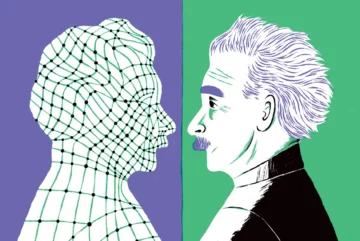 In 1915, Albert Einstein unveiled his general theory of relativity and transformed our view of the fabric of the physical world. The theory, which explains gravitation as a deformation of space-time by mass, is a pinnacle of modern physics that underpins cosmology, from work on black holes to measurements of gravitational waves, and is used routinely to guide space missions and GPS satellites.
It has also become a yardstick for leaders in the field of artificial-intelligence technology, who are asking whether their creations could ever make a breakthrough on that level. At the India AI Summit in New Delhi this February, Demis Hassabis, the co-founder of Google DeepMind in London, proposed training a large language model (LLM) on all that was known before a particular cut-off date — he suggested the year 1911 — to see whether it could reproduce general relativity.
More here.
Enjoying the content on 3QD? Help keep us going by donating now.