
by Michael Liss
Wise men never sit and wail their loss, but cheerily seek how to redress their harms. —William Shakespeare, Henry VII
One would think that a man like John Adams, who called Shakespeare a “great teacher of morality and politics,” might heed the Bard’s advice.
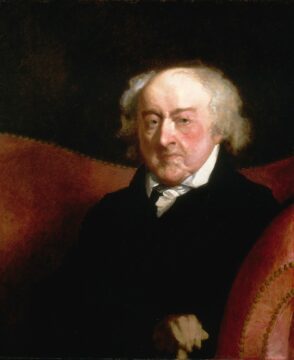
One would be wrong. He couldn’t help himself. Lose he did, and wail he would, so when he climbed into that pre-dawn stagecoach headed north from Washington D.C., the bags he carried contained both physical and emotional weight. It had been just yesterday, March 3, 1801, that he had been the President of the United States. Today, March 4, he was a has-been, chased from office by a fickle electorate, not to be lionized as his predecessor George Washington, but scorned and mocked as a loser, a man to be rejected and isolated. The truth was he had failed—failed at the job he never wanted, to be a party leader, and failed at the job he desperately did want, to be a two-term President. He failed, and the taste was acrid in his mouth.
For most in the Inaugural audience, Adams was gone and good riddance to him. A new sheriff had come to town, tall and handsome, a writer of words that, like Joshua’s trumpet, blew so hard as to cause the walls of English tyranny to come down. Thomas Jefferson was a thoroughly modern man, a man of the future, the man to lead a new country to its destiny. John Adams, the last President of the 18th Century, with his old-fashioned, allegedly monarchal values and his odd sense that a President ought to be above it all, as a non-partisan player, was definitely a figure of the past.
That “past” of Federalist rule was to be closed off, packed away in metaphorical steamer trunks and relegated to a space in the attic. The American Revolution, propelled by the Declaration of Independence, had freed the colonies from the harsh hand of a grasping king. The “Second Revolution,” as Jefferson came to call it, would free the country from the stultifying ideas and intrusive reach of the Federalist way of governance. Men would be liberated to achieve their best destinies.
The worthies gathered, the sun rose and smiled, and Jefferson, a man of prodigious talents, the political “Natural” of his day, stepped up to the plate, ready to hit it out of the park.
You would have to have been made of stone to not feel something. Adams was not a young man upon leaving office—at 66, his time was apparently done—and he knew this was final, an ending. His time as a public figure was over. For more than three decades, he had served his Commonwealth and his country, and he’d done so with honor and real ability. Now he was going home, leaving behind the skeptics and doubters, the whisperers and the plotters—and his once friend and fellow partner in negotiating and nation-buiding, Thomas Jefferson.
We use the word “friend’ too easily at times, especially when talking about political “friends.” Collegiality is not per se friendship, and associates, allies, and golf partners, are often not true friends. The historian Richard Ellis calls Washington, Hamilton, Franklin, Madison, Adams, and Jefferson “Founding Brothers,” but they were brothers in the sense of a quarrelling family tied together in search of a common cause. Jefferson and Adams were therefore brothers, but they were also, quite genuinely, friends, until politics and ambition changed the calculus.
The strain started in earnest in 1796, when incumbent VP Adams defeated former Secretary of State Jefferson and his new Democratic-Republican Party. This is as it should have been—George Washington had selected Adams to be his Vice President, and, by extension, his successor. Still, to do as Jefferson and Madison did, and quietly build an entire opposition political party? To compound matters, under the rules of the day, as the candidate who received the second highest number of Electoral Votes, Jefferson was to be Adams’ Vice President.
It cut Adams to the bone that it was Jefferson, along with his close friend and collaborator Madison, who did the most to undermine him and his Presidency. He had respected Jefferson, had offered him a more substantive role as VP than the Constitution granted, and had been turned down. Whatever political instincts he might have possessed surely failed him here. He didn’t quite understand that only Washington could have pulled off the Voice of God stance and that unique personal standing was not transferrable. He didn’t grasp that new tools were required to succeed in the emerging political market, including more fluid loyalties. And he clearly didn’t expect that Jefferson and Madison would be virtuosos in that market, and so he became its most prominent early victim.
Whatever the hurt feelings, in late February 1801, after Jefferson was finally declared the winner, Abigail Adams invited him to come for cake and tea. No record exists of how it went, but it appears that whatever words were exchanged did nothing to change sentiments. On Inauguration Day, Adams was many miles away when Jefferson declared “We are all Republicans, we are all Federalists….”
Cold silence descended over the relationship. A sad incident between Abigail and Jefferson punctuated the point. In 1804, Jefferson lost his youngest daughter, Maria, to complications in childbirth. Abigail, recalling that she had cared for Maria when Adams was posted to London and Jefferson to Paris, expressed deep sympathy—a sympathy notwithstanding their political differences, and not ignoring them. Jefferson mistook the moment, wrote back a long letter recalling with favor some of his and John’s previous partnerships and conjuring up a purported mutual respect even when they were political opponents.
Perhaps if he’d stopped there, it would have been fine, but he went on to toss in his own grievance—his unhappiness over Adams’ “Midnight Judges” appointments. Let’s call that one “ill-advised,” and since Abigail had a real facility for language, she responded by expressing herself quite pungently and at some length about the tactics used by Jefferson and his Party to bring Adams down. Those letters were part of a remarkable seven-letter exchange between Abigail and Jefferson from May to October of 1804 that managed to cover a tremendous amount of ground of simmering displeasure. Abigail was letting it out, and Jefferson was falling back on one of the less favorable aspects of his character, his tendency to deflect by arguing facts on the one hand while inserting falsehoods on the other. What made it worse was that Jefferson and Abigail both recognized the game, and while John and Abigail had no right to expect Jefferson to put aside his political ambitions, it was how Jefferson did it that was a betrayal of trust. The argument continued until Abigail included some peremptory “close this correspondence” language toward the end of an October 25, 1804, letter to Jefferson, and thankfully, Jefferson took the hint.
Four more years of silence passed. Jefferson completed his second term, markedly less successful than the first. He made missteps in handling the relationships with the at-war England and France, and adopted the Embargo Act of 1807, which closed all U.S. ports to shipping by either domestic or foreign vessels, and restricted trade with Great Britain. Jefferson didn’t want to be in a shooting war, but the weight of his economic sanctions fell mostly on Americans, particularly farmers in New England and New York shipping interests. He was no longer nearly as popular.
Still, he left office to his Republican successor, Madison, with his reputation largely intact and returned to Monticello to resume his old life as the inheritor of Franklin’s role of “Most Interesting Man in America.” He was feted and hosted lavishly. He invented, experimented with new techniques to keep his plantation viable, played the violin, acted as architect, bought way too many books, and kept spending money he didn’t have and borrowing money he couldn’t possibly pay back. He dreamed of and lobbied for the creation of what would become the University of Virginia. Perhaps above all, he corresponded—not merely with friends and neighbors, but with philosophers, artists, diplomats, political theorists, and scientists. Roughly 1200 letters per year arrived, and he was driven to respond to them all.
1200 letters a year, 1809, 1810, 1811, but none from Quincy, Massachusetts, none from John Adams. What was Adams doing? He got letters as well, at about one tenth the rate of Jefferson. He pulled weeds, cultivated his garden. He enjoyed his growing extended family. He penned an autobiography notable for its bombast and chaotic organization. He read voraciously. He held tightly to his political principles, and just coincidentally, and surely only occasionally of course, he critiqued Jefferson’s and Republican policies.
Finally, he did something quite close to his heart—he tended to his image, his rightful place in history. In this, Adams had an impossible task: he wanted people to believe what he believed about himself—a colossus at the center of every critical point of the Revolution.
Above all, he watched with horror as the Declaration of Independence rose to totemic status. Jefferson’s Declaration. Jefferson’s inspiration. Jefferson’s brilliance. Jefferson’s insights. Thomas Jefferson’s immortal prose. Didn’t people know he honed the language of the final draft? Didn’t anyone care he personally picked Jefferson?
Adams told this tale to whomever would listen, cajoling, buttonholing, filling his correspondence with it. In 1805, Adams had a stroke of luck. He renewed exchanges with an old friend, Benjamin Rush, a fellow signer of the Declaration of Independence. With Rush, Adams could discuss both history and the big events of the day. Adams valued the relationship, and especially since he knew Rush was a friend of Jefferson’s, he curbed his worst impulses. It took him two years to raise the matter of Jefferson, and when he did, he approached it with a measure of caution.
It was not all praise. The gods are not always just when they hand out talents, and Adams, for all his stupendous ego, felt it acutely with Jefferson. First, Jefferson possessed what the later telling of history largely confirms…an ability to be a leading man, to attract attention, to attract people and organizations to want him to join them, to accept power when offered but never demand it—because you know it’s going to be offered. If you are a Doonesbury fan, Jefferson was Sam Smooth, the guy who always gets the girl with just a look. If there’s anything we can say with certainty about John Adams, it’s that he was no Sam Smooth.
Second, and Adams held to this for the rest of his life: Jefferson was wrong on England—it was not in decline. He was very wrong on France. The French Revolution would never end in a democratic paradise of liberty, equality, and brotherhood, and Americans (Republicans, largely) who embraced it were not merely choosing self-deception, but exposing the new nation to instability and chaos. Adams believed in a rules-based order.
Rush listened, he responded, and finally he suggested…wouldn’t Adams like to discuss these things directly with Jefferson? If Rush could elicit from Adams an even elliptical interest in resuming relations with Jefferson, then perhaps he could get the two men to communicate. He was, after all, employing a similar strategy with Jefferson, just adding a little drama (telling him the aged Adams was nearly at death’s door).
It worked, just a little bit, but pride has a mighty gravitational pull. Adams would do it, if Jefferson went first. Jefferson would make time in his busy schedule, but Adams would have to take the first step. No deal. Two more years passed. Finally, a Jefferson friend, Edward Coles, visited with Adams in Quincy and drew from him a profession that, politics aside, he retained his affection for Jefferson. Coles shared this with Jefferson and the ice melted just a little bit more. Rush continued his advocacy, spinning tales of remarkably detailed dreams he’d been having about the reunion of these two greats.
It’s amazing how stone-headed two aging men could be. Finally, Adams took the plunge. On January 1, 1812, he sent Jefferson a short note promising “two pieces of Homespun” to follow. Rush was ecstatic (Adams being Adams, he did whatever he could to diminish the importance of the moment). Jefferson received the note and responded with his own letter. These two extraordinarily prideful, extraordinarily gifted men found ways to deflect their self-consciousness. Adams’ “Homespun” turned out to be two volumes of John Quincy Adams’ lectures. And Jefferson, misunderstanding the allusion, and with the books not arriving til later, responded with a Jeffersonian discourse on domestic manufacturing and some history on the non-importation movement.
And so, the relationship renewed. Fourteen years, 158 letters between them, most from Adams to Jefferson, Adams being more prolific, and certainly more loquacious.
It took them time to get going, time to reestablish a dialog that was both substantive and personal. The world didn’t always wait for them. Small personal triumphs and great personal tragedies were ahead. But they kept at it, exchanging felicitations, sharing health and family news, and talking about the great issues that faced the entirely extraordinary child they had helped midwife. In time, they grew comfortable enough for frankness in the areas where they disagreed, past and present.
Credit should be given to Jefferson for what might be thought of as selective hearing when Adams was at his hottest. And credit must go to both men for navigating around the release of an 1801 letter from Jefferson to the English scientist Joseph Priestly, in which Jefferson had described Adams as a retrograde thinker opposed to progress. When Adams saw it, he vented, but Jefferson did something a bit unnatural for him—he told the truth (or at least some of it). He explained to Adams that it had just been politics—even though his side knew that the Federalist policies they most objected to were not Adams’, but rather were attributable to High Federalists, Adams, as President, had been titular head of the Party, and thus had to take some fire. It was a lesson that Adams rejected on personal grounds, but seemed to absorb on intellectual ones. Politics, whether you like it or not, is the way to power, and power is the only way to affect policy. Adams went to his grave rejecting the model, but, placed in this context, it allowed him to continue the conversations he clearly otherwise valued.
Joseph Ellis sees the Priestly exchanges as a defining moment in the men’s conversations. The rawness moved them from the “still life picture of poised patricians” and gave life to an argument about competing versions of the revolutionary legacy. From that they could start to talk about fundamental differences between the Republicans and Federalists, the value of freedom over order, of collective action versus individual efforts, of the monarchal principle versus the hurly-burly of living in the public square. Perhaps central to all of these, they could talk about their differences in the way they measured and valued social equality and the role of the elites. Those were all big topics, discussed at a very high level over a long period of time by perhaps the only two men with the standing to do so. We’ll talk about those next month, as the pair tried to fulfill the wish Adams proposed to Jefferson in his July 15, 1813 letter:
You and I ought not to die, before We have explained ourselves to each other.