
by Carol A Westbrook
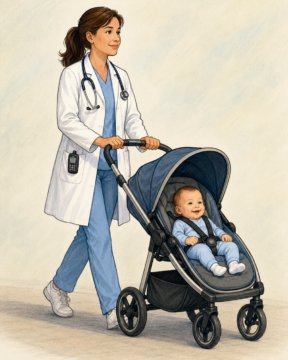
I was the first resident to become pregnant and deliver a child at the University of Chicago–perhaps in any medical residency in the country at the time. It was 1979. I had suffered several months of “internship amenorrhea” before I realized I might be pregnant; a trip to the ED to sneak a pregnancy test confirmed my suspicions. By then I was 16 weeks along.
I imagined that other residents in similar situations would have left their medical training for motherhood; others would have terminated the pregnancy and then continued on with their training. In 1979, abortions weren’t restricted as they are today, but I had a (failed) IUD in place in the cervix, which made termination a bit riskier. After discussion with my husband (also a medical student) we decided to carry the pregnancy to term; we had planned to eventually have a family, we might as well continue since we already had a start. We were thrilled and delighted, and terrified.
One reason that pregnancy and motherhood were uncommon among medical students in1979 was that the percentage of female med students was low, only about 24% of the entering class. But by 2018-2019 the gap between men and women was beginning to close, and the distribution is now about equal.
Still, until recently, medical schools conducted themselves as if the student body were primarily male. At a recent reunion, the women in my class discussed the problems related to this perception. These problems are due to inequalities in facilities and in women being “outsiders” – they will never become part of the men’s “club.”
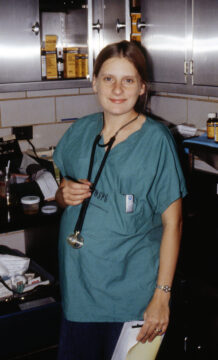
For example, the surgeon’s locker room, where the surgical greens were distributed, was understood to be the MALE surgeons’ locker room. The nurses’ locker room (AKA WOMEN’S locker room) distributed little pink dresses. There was no way a female resident wanted to be caught dead dressed as a nurse! In order to get a pair of teens, you had to sneak in to the men’s room and hope no one was undressed.
Private and separate call rooms were important—expecting women to sleep in a dorm room with men just does not work.
Sports contributes to this outsider feeling; during long surgical sessions the talk inevitably goes to sports teams (and most women are not well informed in these areas); men students and residents frequently establish teams for playing sports: there might be an intramural basketball team, for example, or a golf outing. We women were not welcome into the team. And last but not least, the off-color jokes told by older professors in the classroom or the operating room., which today could be considered workplace harassment.
You have to remember that this was the 70’s and 80’s, when women were fighting for equality. We wanted to be accepted into the men’s “in crowd” and we had to fight to keep our positions equivalent to men’s.
Little by little these and other problems were being solved; even today, when the number of men and women med students is about equal, there are still difficulties perceived by the women med students, in particular problems that arise when the female med student is married. Married male med students generally did not have these problems, as they expected their wife, mother, or housekeeper to tend to them.
These problems stem from the fact that society expected a married woman to manage the household and raise children full-time, and to support their husband with meals, shopping, and so on. Combining this with the grueling round-the clock demands of medical practice was so difficult that many early women doctors consciously chose to remain single to protect their careers. Those of us who married, especially with children, were perpetually tired.
My experience, and that of my medical school colleagues who were married with children, found the med school and residency years to be extremely difficult. There was never enough time to keep up with the household duties and med school clinical demands ; we were perpetually tired. Only the nurses understood our demanding lifestyles. I remember an incident when I was on call, sleeping in the hospital call rooms, when a patient on my service died, and I didn’t learn about the death until morning; the nursing staff allowed me to sleep through it since they felt that this patient was not expected to live the night and had “Do Not Resuscitate” orders written. They felt that I needed the sleep, with a little baby at home. Still, I felt pretty bad that I wasn’t there for the family.


The 70’s and 80’s were the years of women’s liberation, when we felt men should be doing their share of childcare and housework, and most husbands were agreeable to the idea. Yet, it was difficult for the woman in the family to give up her traditional responsibilities.
The time demands were difficult, but the hardest parts of being a student or resident with children was (1) getting adequate parental leave, and (2) finding adequate child care.
One of the most difficult issues revolved around how much time a resident could take off from work for childcare, and still fulfill the necessary requirements for certification. Did fathers deserve time off for childcare? And there was always the problem of time off placing an excess burden on the other residents in the program.
For myself, I pieced together 6 paid weeks from my vacation time and electives, starting at the day of the child’s birth. I’m sorry I didn’t ask for more time, because this precedent that I set is inadequate for a new mother who has just given birth; there is barely enough time to recover physically from a delivery or a C-section. These 6 weeks should have been paid time off rather than using my vacation time; sadly, many institutions still do not have a definite policy regarding parental leave. There should be at least 3 months off, but the big concern is whether such a long leave will require a student or resident to repeat the year, thus interfering with future jobs, delaying certification, and requiring additional tuition for another year. The institution will have to solve these problems, which might require hiring extra residents to provide the coverage needed if most of the female residents decide to start families during their clinical training. This policy does not even address the question of whether new fathers should get parental leave.
Time off is precious, and can lead to annoyance and inconvenience to your colleagues, because any time you take away from clinical duties must be covered by another medical staff person. It is illegal to leave a patient who is under your care without designated medical coverage. This applies also to time away that is needed when you are back to work full-time; for example, a nursing mother may need to breast pump to prevent discomfort or even mastitis—this might require temporarily leaving a long surgery or a busy clinic, to the annoyance of the surgeon or clinic director.
I was surprised to find that there were separate medical schools for women. In 1848 Boston Female Medical college opened with 12 students and two instructors, because the director, Samuel Gregory, MD. felt it was unnatural for male doctors to attend women at birth. The college soon expanded beyond midwifery and became the New England Female Medical College. Between 1850 and 1895 there were 20 more medical schools for women fueled by the nation’s feminism movement; by 1910 there were only 2 left, as men’s medical schools began to accept women.
I was also surprised to learn that most of the women involved in these women’s med schools were gay, and thus not married to men. Though many had stable partners or wives. Perhaps their marriages / relationships were more balanced, and their time commitments to their partners were about more equal than in heterosexual relationships.
Take, for example, Nancy Warner SB 44, MD 49, who was name chair of Pathology at the University of Southern California—a promotion that made history. She was the first woman to chair a pathology department at a coeducational institution. Warner and her wife and partner of more than six decades, Christine Reynolds, longtime supporters of many areas of the University, made a gift last year to help women scholars flourish across the disciplines.
One of the most difficult issues revolved around how much time a resident could take off from work for parental leave, and still fulfill the necessary requirements for certification. Did fathers deserve time off for childcare? And there was always the problem of time off placing an excess burden on the other residents in the program. For myself, I pieced together 6 weeks from vacation time and electives, starting at the day of the child’s birth.
What about the father/ husband? Did he have to contribute more of his time to housework and childcare? Remember, these were the early days of feminism, and married couples spent a great deal of time negotiating household duties to have a “fair” division.
How have things changed for mothers in medical training? I will provide a comparison with my daughter, Cecilia. WE have a lot in common; We are both MD-PhD students (Cecilia, PhD in psychology; me, PhD in biochemistry). I encouraged her utilize oocyte cryopreservation, since she expected to be much older when she would start her family, and having a cache of banked younger eggs would provide a safety net. She had her first pregnancy at age 42; I was 29 when I had my first child, 32 for my second, and 34 when I had my daughter. I had 6 weeks of maternity leave, so did she. However, hers did not require her to give up her vacation or elective time as mine did. She had completed her PhD and MD studies, and was in line for a faculty appointment at Pitt. I was still completing my residency, and in line for an appointment as Instructor at the University of Chicago. Both our husbands participated in child care and housework duties, having jobs with flexible hours
Among the problems we faced, finding adequate childcare was one of the most difficult, and expensive. Doctors don’t keep regular hours—they often work late, and the care setting must take that into account. My daughter has enrolled her child in a group care setting; this was made available to her through the institution for which she worked. I had hired an au pair, a foreign young lady who lived at home with us—I had 3 children at the time.
Overall, medical institutions are beginning to realize that women med students and residents cannot be expected to give up having families, and the existing provisions for their support are inadequate and put strain on the other students. A sensible solution would be to hire extra residents to take up the slack when others are absent. The maternity leave for the student or resident should be paid time off, and not utilize vacation days or elective time. Finally, the school or hospital must contribute to the development of adequate day care for children of all ages, that makes it possible for the clinicians to attend their patients and cover emergencies.
***
Enjoying the content on 3QD? Help keep us going by donating now.