
by Mike Bendzela
It is said that farmers grow things, but that is not right. I view it as a metaphorical statement. The organisms grow themselves as they have been doing for hundreds of millions of years. Farmers stand by and select, tend, and kill. Mostly they kill. It is built into the way the system works. Sometime around 10,000 years ago we discovered how to usurp the powers of natural selection (not that we knew what we were doing) to wrench the earth into providing for us alone rather than following the law of willy-nilly. We have been reaping the whirlwind ever since. The planet is now terraformed to grow large-brained apes and its favorite crops, the wilderness reduced to a shadow of itself, the atmosphere severely perturbed.
Historically, we would rip weeds out of the soil with wood or iron implements and pick off adult bugs by hand. In the last one hundred years or so we’ve come up with many clever ways of suppressing weeds and exterminating arthropods that compete for our crops. This usually involves novel chemical formulations, frequently using petroleum as a feedstock, that when applied to organisms shut down metabolic pathways in plants and impair the nervous systems of insects. For the mammals and birds that feed on crops, there are traps, poisons, barriers, and bullets. Your picturesque Midwestern farm sits atop a charnel house.
We try to outwit nature itself by using “natural” and mechanical methods to avoid and/or eliminate pests, but these are usually insufficient at scale. This is called Integrated Pest Management (IPM). We can select organisms that have natural resistances, provide barriers or even structures to protect them from hazards, plant beneficial companions next to vulnerable crops to suppress pests, release natural predators into the environment that feed on the hungry hordes waiting to decimate our crop. But unlike chemical means which work indiscriminately — they kill every pest they touch — IPM is not so thorough and is a lot of work on top of it. In the end, a farmer will resort to chemical means to get a crop through the season.
“Think First, Spray Last,” the IPM slogan goes. Over time, the thinking period grows shorter. I’ve seen this shit before. Once while working at an organic farm, I asked the field manager why she didn’t rotate the potato crop to a new field to outrun the armies of Colorado potato beetles that ate the plants down to nothing. She turned and looked at me and said, “They fly.” It was a matter of getting the potatoes planted as early in the season as possible then spraying them with an expensive, “natural, certified organic” nerve poison as soon as the beetles showed up.
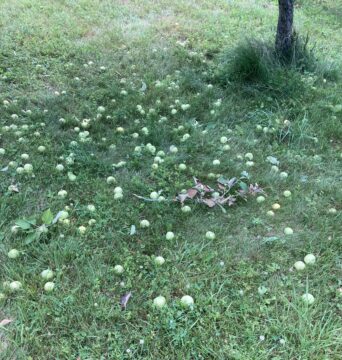
After twenty years of taking care of a small apple orchard (along with a few pear, peach, and plum trees), I’ve learned that farming involves the continuous management of a controlled holocaust of sorts. I recently finished a task that new growers find difficult to complete properly, which is the destruction of most of the crop produced by trees. Apples especially tend to over-produce, usually on a biennial schedule, whereby the fruit crop is so large the apples cluster on branches, weighing them down and possibly breaking them. The bunches of apples provide a terrific protective cover for pests, too, while also taxing the energies of the trees: The crowded apples will not grow to size, and the trees will shut down production of fruit buds for the next season, exacerbating their biennial tendencies. The remedy is to kill as many of those apples as you can.
The problem is apparent from the onset of bloom in mid-May. You can just look at the number of blossoms and tell that a tree will have too many apples, and you will have to begin planning out your genocide. First, after the petals fall, I spray on an insecticide, carbaryl, which kills the early pests plum curculio and codling moth but which also acts as a growth regulator or “thinner”: What this means is the chemical causes the trees to abort apples, which can be kind of hair-raising as the chemical’s thinning property is affected by temperatures, and the different varieties of apples respond differently to the thinner. Some trees hardly respond at all, whereas others might lose most of their fruit. One, two, maybe three sprays later, I will begin to notice which trees have responded, which not; which have lost most of their crop, which are still overloaded.
Thus, the hands-on killing begins. Even after using the chemical thinner, I have to go tree-to-tree and decide how much of the crop I have to pick off and throw away. One benefit is that I can remove the apples that are small or that have been damaged by insects. I can select for space and exposure to sunlight. Out of a cluster of five blossoms that have set fruit, only one fruit can remain; and on a branch crowded with these clusters, many must be wholly removed. One must have completed this process a few seasons in a row to become familiar enough with the results — large, perfect apples and regularly producing trees — to become inured to the horror of throwing most of the fruit away.
This is natural selection taken in-hand.
And the reward for the apples that survive? They get eaten.
But their relatives get propagated out in other lines, in other trees.
*
It’s not hard to imagine how farming might have started. Everything begins with a hunch: Those fruited plains are so far away. What if we scattered some seeds not far from the mouth of the cave? Those shrubs that sprout up among the crop plants, what if we pulled them out? Shall we propagate this variety because it stores far better and longer? . . . Those piglets are so cute when they’re babies. Should I steal a few from the sow for my daughters to raise? The ones that are intractable, I will kill and eat. . . . Shouldn’t we allow cats to patrol the rodents near the storehouses?
Jared Diamond calls agriculture “the worst mistake in the history of the human race,” given that its sequelae include pandemic zoonotic diseases, intensely hierarchical societies and gender inequality, and, at least at the outset, deteriorating human health due to unbalanced, even unnatural diets. Add to these the depletion of soil fertility and aquifers, the loss of wild lands and other species, and the changing chemical compositions of the atmosphere and oceans, and there’s a lot to rage against. But such rage is fruitless.
That the baby steps leading to agriculture eventually led us into the current environmental and demographic cul de sac is no one’s and everyone’s fault. No one could have anticipated the despoilation of the planet because no one had a planetary view. By the end of the Neolithic period, it must have seemed that we had been farming forever: There were no reliable written histories to fall back on. “Cursed is the ground because of you; through painful toil you will eat food from it all the days of your life.” For most of that time, there were no written histories at all.
No one could have anticipated, either, that someone would set afire a lump of coal. From that point on — and add to that the discovery of petroleum in Titusville, Pennsylvania — the transformation of the planet into an anthropoid’s greenhouse spread almost literally like wildfire, with advances and damages proceeding apace, even at exponential rates: Diesel-powered equipment; infrastructures of steel, aluminum, and plastics; whole spectra of petrochemical inputs. As the changes take place over generations, agriculture emerges as a novel, domesticating mechanism, operating without a governor.
There are two points to consider: The onset of what has become known as the Anthropocene is simply the newest iteration of a primeval natural process: succession. In surviving off the environment, all life forms alter their environments in unanticipated ways. The warm little pond eutrophicates and prepares the way for the boggy field, which prepares the way for the forest, which thrives until struck by lightning, then the process starts over. But none of these life forms is actually capable of anticipating the consequences of its existence. Nothing knows what it’s doing. Why, then, should we? New innovations simply ratchet up the competition for ever-newer innovations. In this view, the Levant, site of the earliest agriculturalists, is the John the Baptist for the Cargills and Monsantos of the world. “After me comes one more powerful than I am.” You can call it “progress” if you want. What succeeds them, goddess only knows.
The second point: Killing is what we do. Even birds do it. Ask the mouse depredated by the owl, the larva ripped from under bark by a peckerwood. Even bees do it. Ask the mammal interloper with worker bees glommed onto its eyes, the robber bees stung to death by guard bees at the hive entrance. Killing works to remake the world in one’s own favor. Our species simply possesses this ability in spades.
And, most horrifyingly, it is too easily generalized into other domains.
Concentrate those animals into that locale there. If they don’t do what you want them to do, just shoot them all.
***
Enjoying the content on 3QD? Help keep us going by donating now.