
by Derek Neal
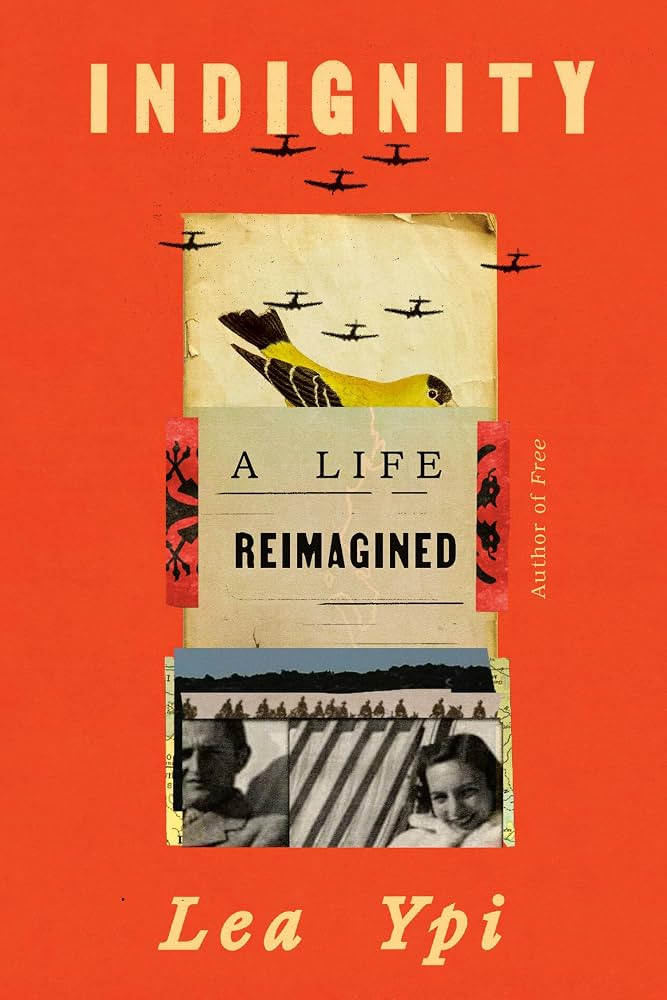 Lea Ypi’s first memoir, Free, began with a scene of her hugging a headless statue of Stalin in Durrës, Albania as a child. The image was effective in showing the young Ypi’s devotion to communism, which was important as the book dealt with her disorientation upon its fall and the realization that much of what she believed about her life had been a lie. Some readers, however, took issue with what they considered Ypi’s excessive use of artistic license: there was no statue of Stalin in Durrës, just a small bust with its head intact.
This controversy was related in Thomas Meaney’s review of Free in the London Review of Books, with Meaney siding with Ypi’s critics. Ypi responded, in the first instance, by referencing Walter Benjamin’s essay “Excavation and Memory,” which argues for a more nuanced understanding of truth and history, and in the second instance, by questioning those who would try to “police the memory of an eleven-year-old.” In Indignity, Ypi’s new book detailing both the life of her grandmother and her own investigation into that life, Ypi doubles down on her storytelling approach blending memory, historical fact, and imaginative literature, but she faces an even more difficult task as she is dealing not with her own memories, but those of her grandmother.
In “Excavation and Memory,” Benjamin writes that memory produces “an image of the person who remembers” and that this person must note “where he gained possession of” a memory. In other words, how one remembers is just as important as what one remembers, and the two cannot be neatly separated. Understood in this way, Ypi’s memory of hugging Stalin could be considered “genuine” in that it captures a historical consciousness unavailable to the present-day reader—the feeling of an eleven-year-old girl who thinks there’s nothing better in the world than communism—and it does so more effectively than a dry accounting of historical fact can. Ypi’s insistence on “the memory of an eleven-year-old” is key as well—for the past to come alive, it can’t be revisited through the perspective of the adult Ypi, only that of the child.
But how does one do this with memories that are not one’s own? Here “excavation,” or “the cautious probing of the spade in the dark loam,” as Benjamin writes, is insufficient. Creation and invention become necessary to draw a complete picture of a life. This is the challenge facing Ypi in writing about her grandmother, Leman Ypi, whom readers of Free will remember as “Nini,” the young Lea’s stately and dignified French speaking family matriarch. Indignity is framed as a search into the life of Leman sparked by the publication of a photo on Facebook showing her and her husband, Asllan Ypi, on their honeymoon in the Italian Alps in 1941. When Lea sees this photo, along with various online comments scandalously accusing Leman of being, alternatively, “a fascist collaborator,” “a communist spy,” or simply “a bitch,” she decides to find out the truth behind the photo, but this proves impossible, leading to the hybrid form of Indignity.
There are precedents for the sort of book Ypi has written. In A Sorrow Beyond Dreams (1972), Peter Handke wrote the story of his mother, a poor and destitute Austrian woman whose life was marked by World War II and who later committed suicide, but he did so in the most spartan way possible, refusing to “represent” her or turn her into a “character” (in the analysis of Karl Ove Knausgaard). The result is a strangely moving and affecting portrait, achieved by some sort of lexical alchemy that works by removing all that is superfluous. Patrick Modiano, who has written numerous novels about France during World War II, takes a different approach, using historical material discovered in war era newspapers and phonebooks as inspiration for his characters, which he then fleshes out with archival research and imagination. Reading his novels, one feels as if surrounded by fog, as if life is not a logical unfolding of events but a series of random happenings with innumerable paths one finds oneself on, completely disoriented. The question then becomes—which way of writing is truer? Does one arrive at understanding by excavating the archives, sticking firmly to facts, or by filling in the blanks, imagining what life might have been like in the foreign country of the past?
Ypi begins Indignity, after recounting the posting of her grandmother’s photo and her initial bewildering visit to the archives in Tirana, with a long novelistic section about her grandmother’s childhood in early 20th century Salonica (now Thessaloniki), which had recently become part of Greece. This reads as historical fiction—Ypi removes herself from the story and enters the minds of characters she never knew, such as her great-great-grandmother (Mediha Hanim), the family doctor (Doctor Elias), and Gustav, a German businessman and the suitor of Selma Hanim (Mediha’s daughter). Through these characters and their fates, the reader learns about historical events such as the fall of the Ottoman Empire after World War I, the subsequent Treaty of Lausanne, and the refugee crisis resulting from the treaty’s “population exchange.” Ypi’s goal is to draw connections between the past and present, and to show how the desire of those in power to classify and direct the lives of ordinary people leads to reification and oppression.
At one point, the child Leman asks herself “what she is:”
Was she Leman Leskoviku or Ibrahim Bey, was she a boy or a girl, was she Greek or Turkish or Albanian, and, in all this, why did she speak French?
Leman could conceivably answer “yes” to all these questions, but the “subcommittee” from the recently created League of Nations will not allow for ambiguity in its “framework,” which has been created to facilitate the population exchange between Greece and Turkey, with Muslims in Greece forced to move to Turkey, and Orthodox Christians in Turkey forced to move to Greece. One of Ypi’s strengths as a writer is her ability to divest bureaucratic language of its talismanic power (“subcommittee” and “framework” are italicized in the text) and to expose its human cost. Readers of Free will also remember the way the term “structural reforms”—an initiative from World Bank “experts” as Albania emerged from communism—was juxtaposed by Ypi with the Romani port workers whom her father had to lay off as part of these reforms.
Whether discussing liberalism or communism, democracy or dictatorship, Ypi’s ear is always attuned to the different ways in which power can abuse the freedom and dignity of ordinary people, and she never tires of showing the reader how this is a constant throughout history. While reading, I was often reminded of the famous line from Giuseppe Tomasi di Lampedusa’s The Leopard, “Everything must change so that everything can stay the same,” an idea which is humorously dramatized in a conversation between Ypi and the taxi driver who brings her to the archives—Ypi points out the recent increase in traffic and the new trees that have been planted, but the driver responds by saying, “Trust me, nothing has changed, it’s all the same as it was.” Throughout the story, as Ypi notes the changing of street names, of nations’ names, and of political power—all while human suffering continues—one feels inclined to agree with the taxi driver.
After the first historical section in Salonica, Ypi recounts Leman’s move to Tirana as a young woman in 1936, with this section also exploring the relationship between Leman and Asllan, her future husband and the son of one-time Albanian Prime Minister, Xhafer Ypi. The book continues to use its characters to dramatize political conflict, while also using dialogue as a means of exposition to inform the reader of historical events. Occasionally, this creates distance from the story itself, and I found myself wishing that Ypi would trust the reader to understand the narrative on its own terms, to see the resonance between past and present, rather than ensuring that we don’t miss anything. The characters, at times, seem to be more like caricatures, with each one meant to personify a certain political or social view. Doctor Elias is the eternal optimist, even going so far as to imitate Voltaire’s Pangloss by saying that “all is for the best, in the best of all possible worlds.” Xhafer Ypi is the political bureaucrat; his son, Asllan, is the idealistic, progressive reformer; Gustav is the capitalist businessman who insists that “everything has a price.” Leman, who isn’t burdened with representing anything but herself, is the most lifelike character for this reason.
At other times, Indignity strikes a better balance. In Ypi’s recounting of the period leading up to Asllan and Leman’s marriage, for example, they come alive as people, tentatively flirting as they walk the streets of Tirana, and the mutual fondness that develops feels like an authentic relationship. Information recedes into the background, if only for a short time. Primary sources are included here, too—when Asllan mentions that he’s working on an article for a new Albanian journal called “Bota e Re” (The New World), Ypi includes an excerpt of the real article in the text; when Asllan and Xhafer argue over the correct direction of Albanian politics, Ypi includes the (seemingly) authentic text from Xhafer’s 1939 speech welcoming Italian troops to Albania and proclaiming Victor Emmanuel III, the King of Italy, also the King of Albania. With the inclusion of these primary sources, the novelistic sections are removed of the burden of exposition. Ypi also decides to comment directly on the events she’s fictionalizing, and in doing so—in underlining their fundamental instability—Ypi’s story becomes more truthful, not less.
When the narrative reaches the time of Leman’s honeymoon, Ypi finally puts all her cards on the table:
Thinking of family members in a past before we existed is like taking a fairground ride: you know you are going to end up where you started, but the point of the journey is the thrill of the ride rather than the destination. They are abstract characters whose stories are inevitably coloured by our own imagination—often by what we would like them to have been, or even by what we would like ourselves to have been in their place.
Now we are back to the dilemma posed by Benjamin’s “Excavation and Memory.” Ypi’s memories cannot be considered primary sources—she wasn’t there—but something more like memories of her grandmother Leman’s memories. She must invent, must imagine herself in the place of Leman, because, as she writes, “the archive is silent.” When Ypi searches in the Tirana archives, as well as those in Greece, she finds contradictory and false information, likely due to both human incompetence and citizens forced to inform on friends and acquaintances who are caught between protecting themselves and acting ethically. Ypi writes that “the facts that ought to inform my interpretation sometimes just add to the confusion.”
Ultimately, Ypi’s search does not reveal any shocking or surprising information about her grandmother, who was simply an ordinary person trying to navigate life and history as we all must. Ypi’s investigation does not lead to clarity—she doesn’t even find the original photo of her grandparents in the Alps, which is supposed to be in the archives—but by the end of the story, the idea that arriving at the source would lead to some sort of revelation comes to seem foolish.
After finishing Indignity—which ends with a final twist, making the recounted events even more mysterious—I went to Lea Ypi’s Facebook page to see if I could find the post that had inspired the book. I couldn’t. I searched for “Çim,” the user who had posted the photo, but I didn’t find his account. I reverse image searched the photo, which accompanies almost every review of Indignity, but all I found were more book reviews, with the photo credited to Ypi and her publisher. I found myself, like Ypi in the archives, more confused than enlightened. What if she made it all up, I wondered. What if there was no Facebook post? Or what if that’s simply what I want to be true, because it would make for such a delicious metacommentary on the questions raised by Ypi?
I stopped searching, wrote the above paragraph, then had a thought: what if I searched “Leman Ypi” on Facebook? I immediately found the photo, just as described in Indignity, along with some (but not all) of the comments mentioned. My perfect conclusion to my article was ruined, undone by the social media archive, which had verified something, rather than leading to uncertainty, as it so often does in Ypi’s search. The photo is real, but what if it hadn’t been? Would that have undone the story Ypi tells? Would that have jeopardized the truth that the story does contain—that of Lea Ypi attempting to understand her grandmother’s life? I don’t think it would have, because Indignity is just as much about Lea as it is Leman, just as much about “the person who remembers” as the object of memory itself.
Enjoying the content on 3QD? Help keep us going by donating now.