
by Thomas Fernandes
Hot days bring the urge for cold drinks. I’ve never been much of an ice user for cooling but, in a rare event for me, I walked into a Starbucks and was given a cold brew with more ice than liquid in it. It looked suspiciously like a way to sell water at a premium, but it also got me wondering: how much ice do you actually need to cool a drink?
We have so much data on the properties of materials now that a quick calculation gets you the answer. For 500 ml of liquid at 26 °C (room temperature on a hot day) you need 134 g of ice, about 18 cubes 2 cm a side, to reach a final temperature of 4 °C. I included the fact that the ice also has to cool the glass holding the drink, though that only accounts for 7 % of the total energy. The rule of thumb is roughly 25 % of the drink in ice.
Four times less ice than liquid matches everyday experience well enough, which makes the Starbucks move look plainly dubious. But if you think about it, it’s almost magical that so little matter can cool so much, and the reason is the energy of fusion. The energy needed to turn ice at 0 °C into water at 0 °C is enough to heat that water from 0 °C to 80 °C. Overall, 86 % of the cooling from ice starting at -17 °C comes from the melting itself, not from the cold.
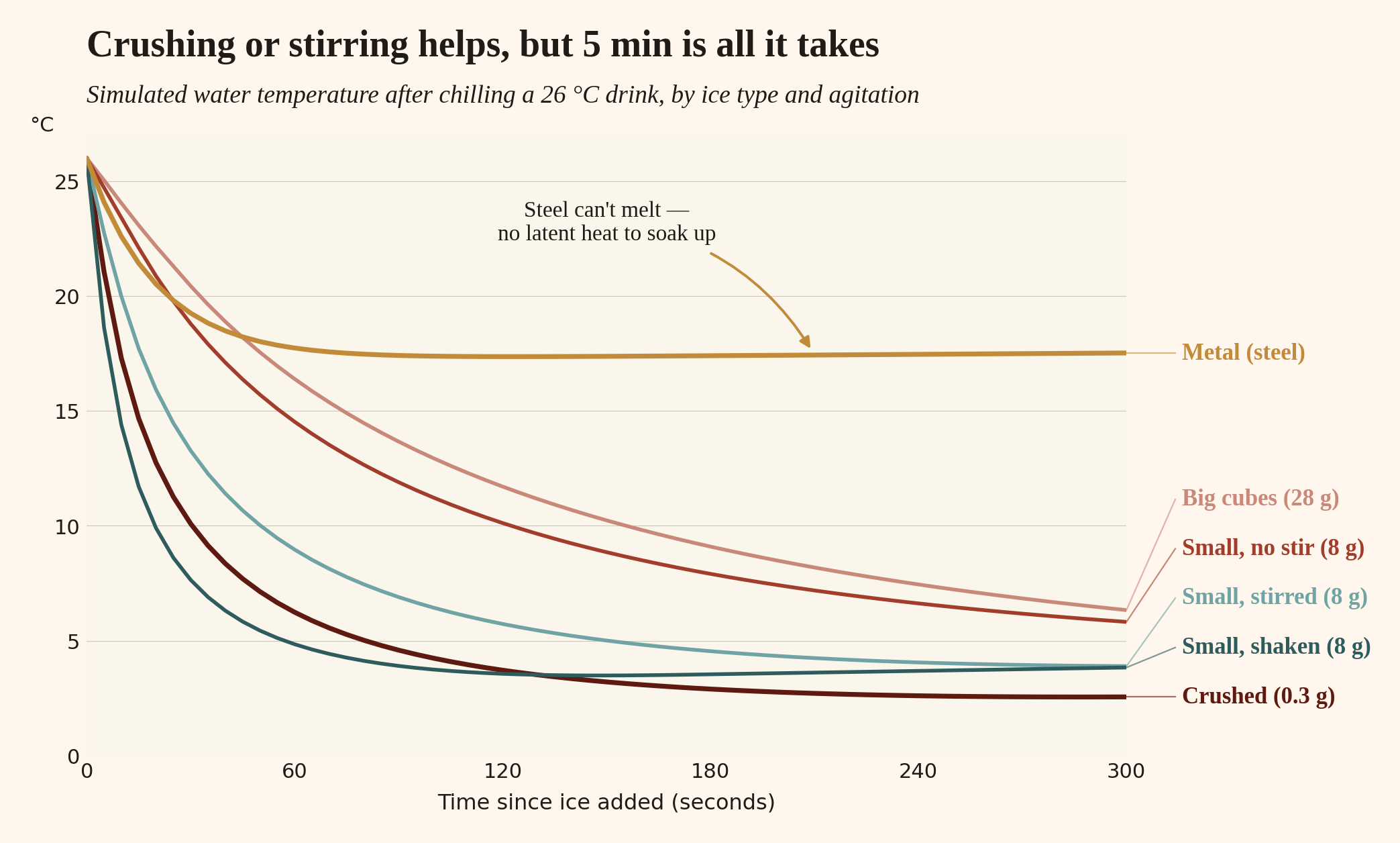
Knowing how much ice you need is one thing, how fast if cools your drink is another. I wanted a back of the envelope estimate but this soon turned into a real engineering problem and reminded me of the messiness of fluid dynamics. Nobody understands it, people just pretend to by using neat formula masking a messy reality. Here is what I simulated anyway.
I checked the no-stirring case myself by timing how long ice takes to melt, about 400 seconds, though it was nearly done by 300 s, which lines up with the prediction.
Circling back to the wonder of ice-cooling, I calculated what an equal volume of steel “ice” would produce. The metal cools fast but only 8 °C, and that “same volume” is already 1 kg of steel cubes at -17 °C. It brings out the magic of melting nicely, and it explains why every cooling system you own (fridge, air conditioning, and so on) runs on a liquid that changes phase.
Back to ice. For speed you have two levers, break the ice into smaller pieces or stir. The first works less well than you would think. Between 8 g cubes and 28 g ones the gap is not that large, you have to go all the way down to crushed ice in tiny particles for it to really change. Stirring, even with a spoon, speeds things up a lot, and a shaker rattled hard even more. Heat-transfer people call this cooling by convection.
Water is a terrible conductor of heat. If the water were perfectly still it would take days for the heat to move through it. Picture it this way. Heat is molecular agitation, and to pass it along the molecules have to hold onto each other. Water molecules are fairly free, so shaking a few of them carries poorly to the next ones, like billiard balls with nothing clearly linking them, the energy passing only by the luck of a collision. In a solid the network is tight, so you move one end and the far end also moves, almost at once. The tighter and stiffer the network, the faster it goes. Copper conducts at 400 W/m·K, diamond at 2000. Liquid water at 0.6 but freeze it as ice and it goes up to 2.2, purely because the molecules are locked in place.
But that number is for conduction over distance. At the molecular scale, right at the contact surface of the ice, heat is taken up almost instantly. This is where convection matters. Stirring exposes every molecule in turn to close contact with the ice instead of waiting for the cold to diffuse through the liquid. And contrary to what you would think, the heat exchange is entirely conductive at the interface. Convection is real as the agitation of the fluid but whatever the formulas suggest, there is no separate “cooling by convection” as its own mode of heat transfer. All it does is keep renewing the conductive contact. A good example of a calculation constant hiding what is actually going on.
Big picture, your drink is cooled in under 5 minutes with a bit of stirring. The obvious downside is dilution, and since I had already built the Excel model, I compared it with cooling a bottle in the fridge instead. I figured an insulating glass bottle would behave differently from a PET one or an aluminum can, so I simulated all three.
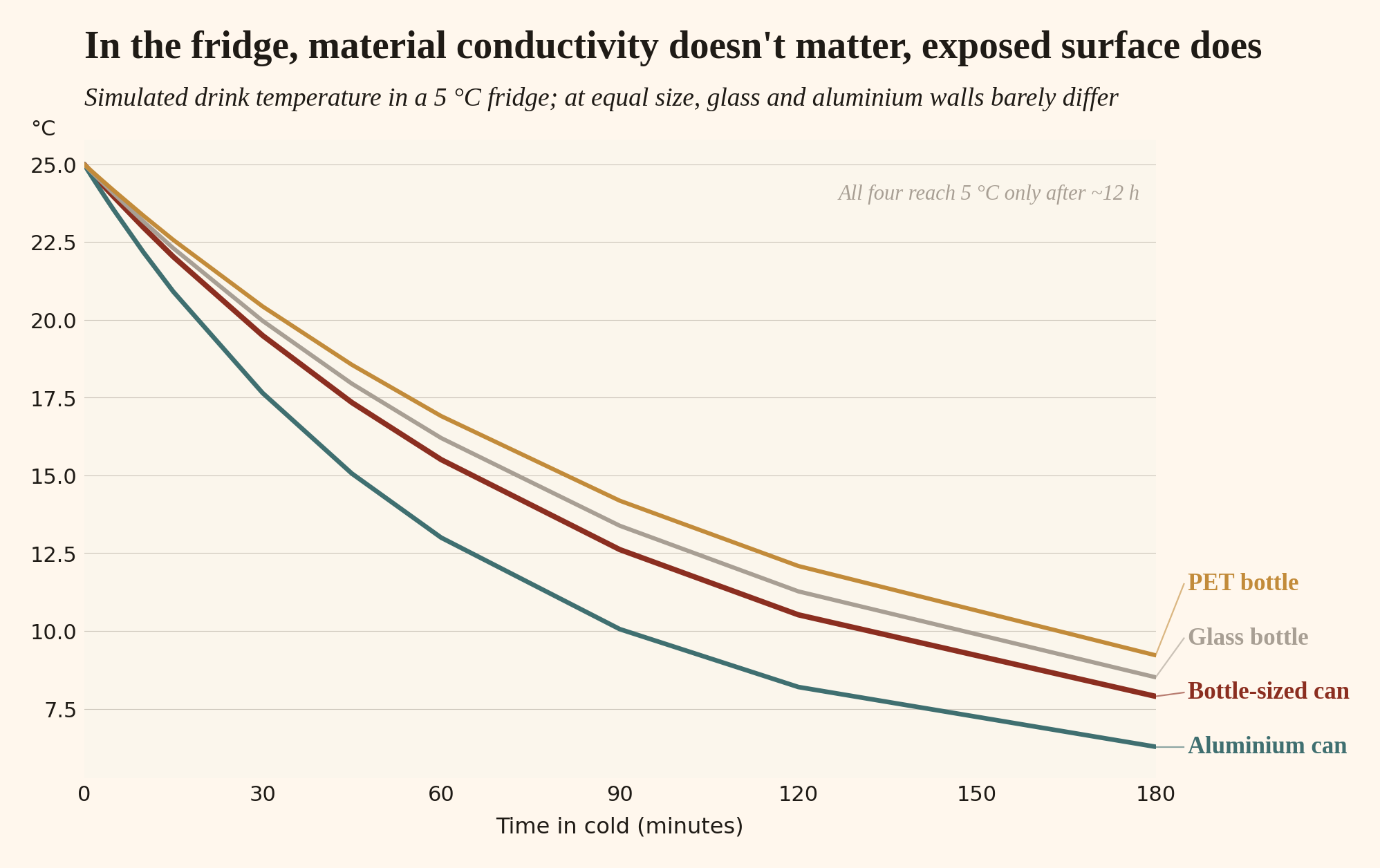
At first you would assume that aluminum wins because it conducts better, but that is not it. To show how I added a curve for a bottle with an imaginary aluminum wall the same thickness as the can and as you can see, the wall’s insulation barely matters. What sets the speed is the heat exchange between the fridge air and the bottle and the can is faster because of its shape and lower amount of liquid to cool in it.
No way to speed it up, then, but at least you get a simple rule: it takes 3 hours in the fridge to get under 7 °C. here the drink started at 25 °C but even from 18 °C you would barely gain anything, because the first few degrees are where the exchange is fast.
If you want a whole bottle cold fast but without diluting it, there is another route, the ice water bath. The ice-water mix holds itself at 0 °C and sets up a natural convection that cools faster than air. How fast ?
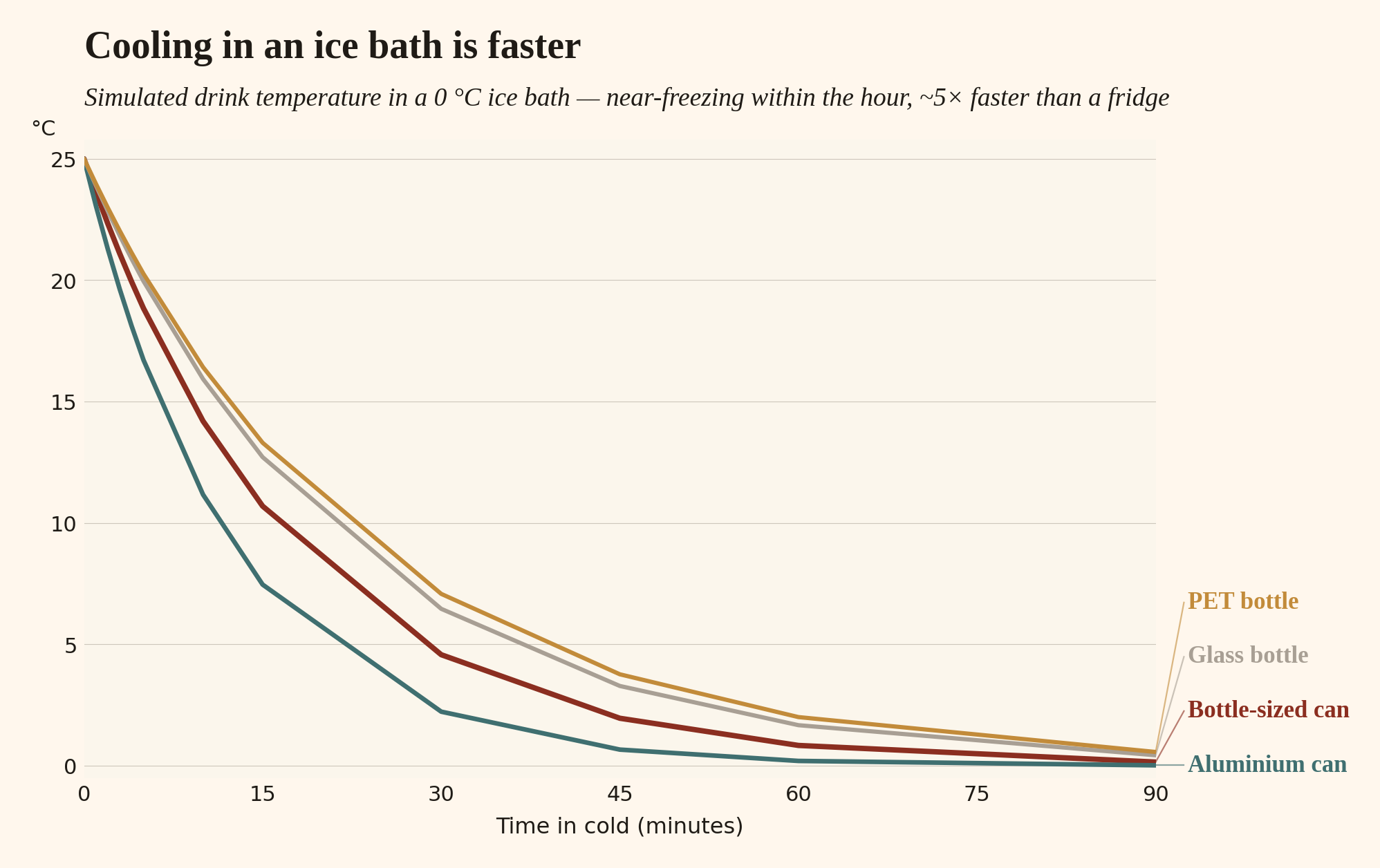
Even here the material barely matters. An aluminum bottle cools noticeably faster, but it is a minor factor. The limit now is how fast the liquid inside can absorb heat. The can wins for the same reason, it holds less liquid for the same outside surface. Overall you need to wait 5 minutes with ice, 30 minutes in ice water, or 3 hours in the fridge for a cold drink.
When I brought this up, the people most interested in the numbers were wine drinkers. Wine drinkers are the sort of people who will argue over whether wine should be served at 15 °C or 16 °C. I mostly wonder how they know the real temperature of what they are drinking once it is poured. So, I simulated it.
Take a bottle sitting perfectly at 15 °C. How does the temperature move the moment you start pouring?
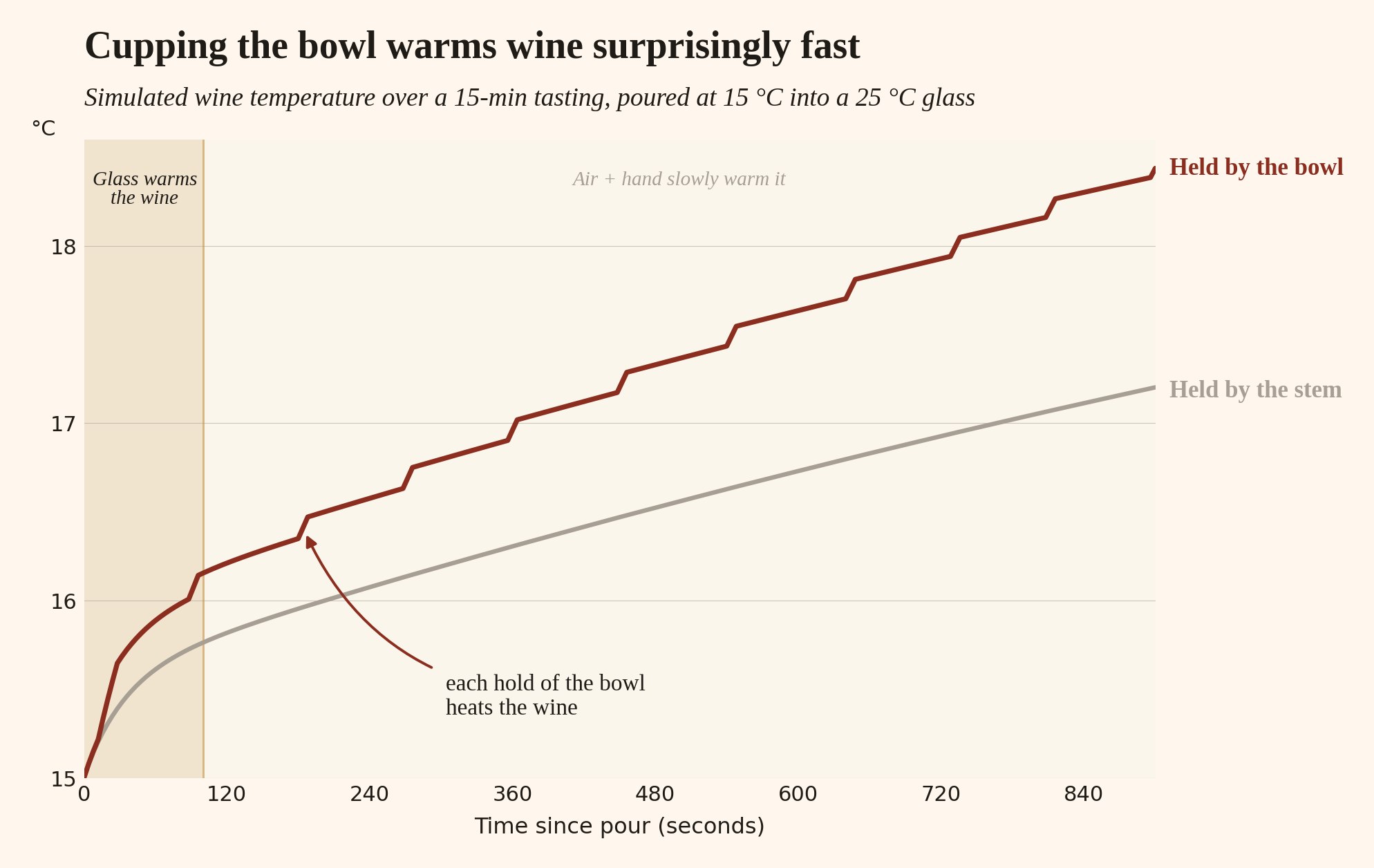
First contact is the glass itself. The wall is a good insulator, so only the layer in direct contact with the liquid really moves the temperature, but for a 150 ml pour, if the glass is at 25 °C when you serve, that is already a 0.64 °C rise in under 2 minutes.
Then, if you make the mistake of holding the bowl instead of the stem, your skin at about 32 °C warms the glass fast. A 4-second sip is 0.06 °C, undetectable on its own, but ten sips a glass plus 15 seconds of swirling at the start adds up to 0.76 °C. Even if you are careful with the serving temperature and hold it right, there is still the 25 °C air warming the wine. Over a 15-minute apéritif that is a 2 °C swing from first sip to last.
Various details from the simulation: 80 % of the exchange with the outside air comes from the sides of the glass, not the top. Vertical air currents can form efficient convective loops, but the air chilled by contact with the wine tends to sit on the surface rather than circulate. There is also cooling from evaporation, water evaporates even at room temperature and ethanol more so, which chills the liquid. That effect is 10 times weaker than air convection, so usually negligible, but interesting to think about.
While checking my results I stumbled on a paper that simulates exactly this, far more seriously. Three mechanical engineers at the University of Darmstadt, a coupled-thermal CFD model, validated against experiment, on 150 ml of wine in a medium red-wine glass. Who but wine drinkers would get a peer-reviewed numerical simulation of their glass warming up?
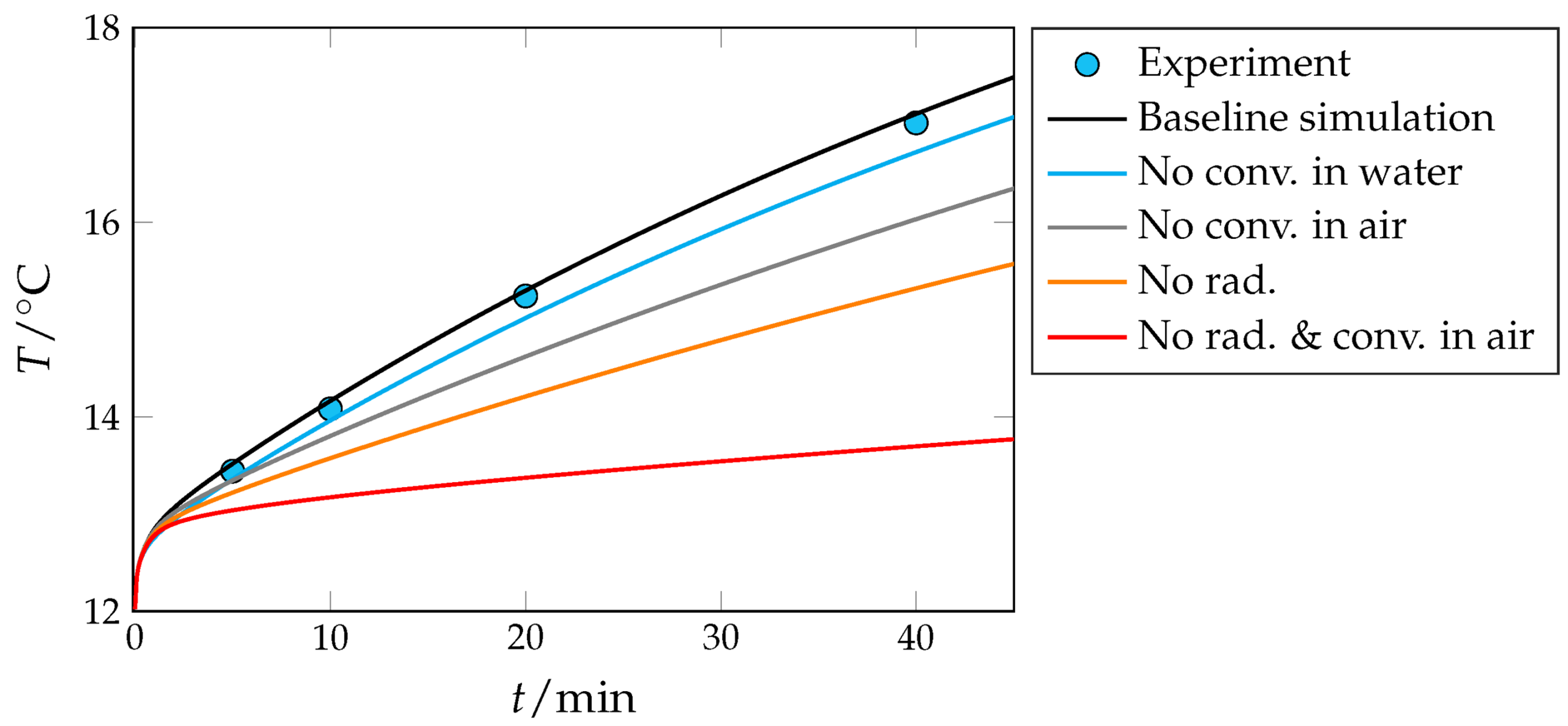
It shows two things. One, my one-afternoon Excel simulation holds up. I stopped at 15 minutes (by then there is usually not much liquid left), and with no hand contact my wine warmed by a bit over 2.2 °C while theirs comes in below 3 °C. Two, I had neglected radiative energy. Every warm body emits heat, usually as infrared. At low temperature it is often negligible, but when there is little else exchanging, not so much, and that is the gap. Adding it back for a shaded room would gain another 0.5 °C over 15 minutes. Which makes me think of another case: if you leave your glass in the sun. Now the radiative heating will be more like 5 °C. The rest of the difference is that they simulate wine in a completely empty, still room, whereas I assumed people would be around to drink it. People stir the air, which warms it faster, and that partly made up for the radiation I had left out.
It all started with a Starbucks cup carrying too much ice, and it ends with a recommendation to serve your wine about 3 °C below the temperature you want to drink it and to stop pretending to control temperature to the degree.
***
For more investigations into random subjects, you can follow me on Substack.
Enjoying the content on 3QD? Help keep us going by donating now.