
by Sean Murphy
i.
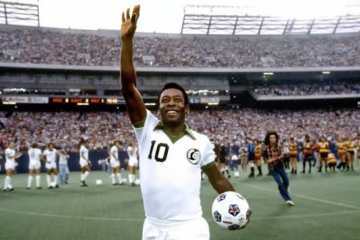
I learned about death and taxes later but first; I understood that there was also the World Cup. It loomed almost as large as reality and, for large segments of the world, was as important as existence, was existence—at least every four years. Those of us in the states didn’t have those emotional or historical attachments, but in the ‘70s we all had Pelé.
It’s difficult to explain to someone raised in this century, but it’s not enough to merely suggest Pelé was the Michael Jordan of his time. He was much, much more: an amalgamation of every single athlete in every sport, as well as the coolest rock star, actor, politician, and superhero. He was Pelé, and he didn’t wear a cape. He played football, or Jogo Bonito (The Beautiful Game, translated from the Portuguese and the Brazilian team that, for a decade as golden as their shirts, epitomized the ethereal grace of this sport, elevating to its own artform.)
Pelé was among the first icons who could be—and always was—known by a single name, and he was ubiquitous before attaining ubiquity was the apotheosis, after achievement and wealth, of any celebrity’s career. It’s all but impossible, in 2026, to articulate how well-known, and beloved, Pelé was in a pre-internet world. As the man himself once remarked, the arrogance underscored by its unassailable truth: “Wherever you go, there are three icons that everyone knows: Jesus Christ, Pelé, and Coca-Cola.”
Pelé also did the impossible on more than one occasion. No, I’m not referring to his bicycle kicks, or his single-handedly making soccer gain traction in the United States (that it still languishes as the least popular of our major sports is a travesty that he can in no way be faulted for), or his winning role as a big-time movie actor (via the seminal young man’s soccer fantasy flick Victory); no, Pelé was even able to make Henry Kissinger, the seemingly unkillable cretin who never found an opportunity or occasion he could not personally sully, seem prescient, even brilliant.
It was Kissinger who helped convince Brazil to let their hero practice the beautiful game in America (Brazil had, in 1961, actually declared Pelé a non-exportable national treasure). To get a handle on the chain reaction of sports, culture, and surreal celebrity that ensued, the miraculous documentary Once in a Lifetime: The Extraordinary Story of the New York Cosmos cannot be more highly recommended.
All of which is to say, in the late 1970’s soccer never had a better chance than it did here in America. The NASL, for a time that, in hindsight, was almost embarrassingly brief (how quintessentially American: we came in hot, made bets impossible to bank, then walked away to greener pastures, or at least the unholy spectacle of astro-turfed stadiums where our baseball and football players made their bones, and broke them, during the subsequent decade).
ii.
By 1980, soccer was increasingly like jazz music: something a small and shrinking number of fanatics loved (or understood), and the only thing more off-putting to the non-initiated than the game itself was listening to these fanatics explain it. Still, we’d always have the World Cup. Many of us who cared had a rooting interest in Brazil, in part because we pretended to be Pelé on the playground, in part because their brand of football was, especially compared to the staider and more sluggish European teams, a joy to behold.
It was around 1982, on the cusp of adolescence, that I first learned superheroes weren’t invincible. When hugely favored Brazil fell, impossibly, to Italy, it was like figuring out there was no Santa Claus, only more so. And worse, that the bad guys sometimes win. Paulo Rossi going from disgrace to hero? Mio dio.
The time waiting between ‘82 and ‘86 was agonizing, at least for the dwindling fans of what, we were reminded every four years, was the most popular sport everywhere else on the planet. Of course, the rest of the planet didn’t have MLB or NFL or even NHL, so what did they know? They knew then what everyone knows now: America was still growing into what it might become, and no one would deny it was very pleased with itself. A few recessions and Iran Contra debacles aside, being America was our business and business was good.
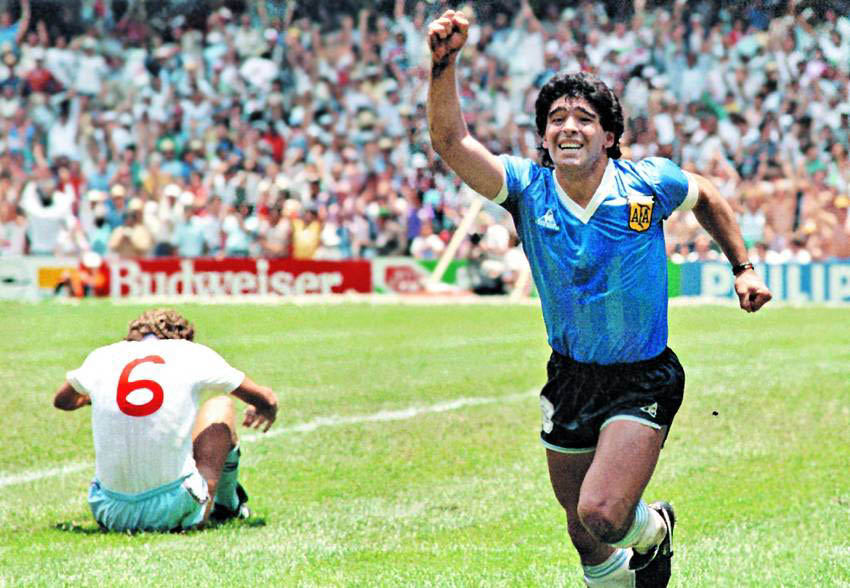
By 1986, I was certain Brazil was going to win the Cup (and I was not alone). Naturally, they went out early, to France no less. Mon dieu. Of course, that year’s tournament only had room for one man and his name was Diego Maradona. No one was calling him the next Pelé just yet, but we were watching his metamorphosis from undersized caterpillar into The Supreme Butterfly in real time. His two goals against England are the stuff novels aren’t made of, because even novels can scarcely contain such multitudes. Revenge, on the biggest stage, for England’s grotesque remake of The Empire Strikes Back, also known as Guerra de las Malvinas? Check. Getting away with a blatant hand ball (something that, even four years later, would have been caught by refs)? Check. Argentina, during a decade when everything south of the border was depicted in movies and media as less than, got their own back, big time.
As this year’s knockout stage reminds us, the World Cup is undefeated at humbling favorites and turning cads into conquerors. And occasionally, the best team wins. Thank you, Spain; gracias a Dios.
iii.
Getting back to the ‘80s. Like any bully on the global stage (football pitches excluded) we did not need to ask any questions because we already had all the answers. We didn’t know how much we did not know, but we knew what everyone else seemed to understand, however reluctantly. Such as, the U.S.A. could kick some Soviet ass if it had to (ask Rocky IV), that God existed (and, assuredly, was a Capitalist God), that He Who Dies with the Most Toys Wins (ask Gordon Gekko). Also, high schoolers high on this jingoistic supply predicted exactly what we’d become after graduating from our first- or second-choice colleges: some of us would be practicing L.A. Law, some of us would be sporting Top Gun bomber jackets, some of us would get wealthy on Wall Street, and the rest of us would have the old-fashioned types of jobs that you could actually describe in one or two words. What we were not going to be was forgettable. We did not know where we were headed, but we were emboldened by an instinctual understanding that our parents’ wallets would insulate us from too much reality—or at least break our fall if any of us tripped climbing up that American ladder.
Right around this time an execrable movie arrived stateside that, in hindsight, is an ideal cultural time capsule. St. Elmo’s Fire didn’t represent what America was, circa 1985, in any meaningful way. Rather, it represented what certain (very privileged, untalented, opportunistic) types of Americans wanted the country to be, and not surprisingly, it looked a lot like themselves: white, wealthy, able to stroll away from the real fires they started. We have a (literally) crooked line tracing from The Great Gatsby’s Buchanans to the Brat Pack, again all leading to the apotheosis of everything Ugly American in Donald Trump.
In this sense, not much has changed since 1985. Or 1925. Here we are, still being sold an American Dream that talks a big game and continues to count the bucks being made off this mirage. This is America’s version of Jogo Bonito, except it’s not beautiful in any way. During this last decade, a narrative that used to be easily dismissed as either reactionary or self-defeating has been increasingly codified: being a red-blooded American means not having to consider other nation’s history or History itself; we’re always-already better by virtue of being American.
This desire to remain comfortably numb, both intellectually and morally, is seldom on better and more appalling display than during wars or sporting events. As it happens, this summer we had both, which coincided with the 250thanniversary of our founding—a welcome chance for self-reflection (just kidding). As a recalcitrant soccer fan, it felt at once unfamiliar and jarring to see fellow Americans whose default setting is “what is soccer?” realizing our team might actually be good this time. During a surreal summer when patriotic zeal was ramping up like the price of gas and groceries, what might have been a positive learning experience provided the ugliest kind of America.
Was there a moment, for instance, when fans of Trump’s preferred immigration policies reflected on the fact that, if things were the way MAGA voters fantasize about, some of our team’s best players—including Folarin Balogun, the very man our president put his short, vulgar fingers on the scale to reinstate from suspension—would not be a legal citizen? Or any calm acknowledgment that six of the 26 players on the 2026 Team were born outside the U.S.A., and more than a third of the squad are children of immigrants? Of course not. Whatever modest appetite this spectacle—the humility of hosting so many nations—might have provided for dialogue, the bandwagon was too noisy for such trivial and uncomfortable things.
Until Team U.S.A. lost, eventually, inevitably. We were then treated to the spectacle of scapegoating, but also the truly perverse argument by the loudest (and whitest) voices that America is not a soccer superpower because…we don’t make it a priority and invest in it. For once, just being American isn’t sufficient to declaring victory, so it must be an issue we can throw money at. Or, ignore the usually infallible free market which, for over a century, has put soccer last place in the hearts, minds, and wallets of its paying customers.
The World Cup forces a very specific subset of Americans to confront the fallacy that our exceptionalism is axiomatic, established, incorruptible. Usually, it requires a failed military campaign (see Vietnam or Iraq or, for those late to this game, Iran), or the collapse of entire industry bubbles (like we saw in 2001 and 2008), but the World Cup can condense the cycle with ruthless, impossible to deny efficiency. So, the collective mob howled, who’s the scapegoat? The team? The coach? The sport? The system? For once, not only can’t we conveniently blame immigrants, but we must also accept—at least on some level—that without our immigrants, our soccer program would be in (more) dire straits. There’s abundant irony here, as well as opportunity for engagement, but the smart money says we’ll table these concerns for another four years So it goes.
All the way back in the before times (circa 1991) the brilliant British novelist Martin Amis wrote “Being more or less unembarrassable, Americans are fatally attracted to the embarrassing.” The World Cup exposes this phenomenon as much as, say, Donald Trump does, but it goes deeper, and gets at the dark heart of why soccer simply won’t catch on over here. Dominating this sport is not something we can buy, or bribe, or market, or slogan, slip into a happy meal, or turn into a mini-series. Because soccer can and will embarrass the most earnest fan, it never had a chance in such a cynical, fickle nation. We can’t hate the players, so we hate the game. And we love ourselves too much to give our hearts to a beautiful game, anyway. If that means we choose to be led by a man who bankrupted a casino, that’s the sales pitch we’ll play on.
***
Enjoying the content on 3QD? Help keep us going by donating now.