
by Carol A Westbrook
My orchids bloom after the winter solstice, in December, the shortest day of the year. The days begin to get longer after this, and soon it’s early spring. Orchids, like all plants, are highly dependent on light. They eat light, water, and carbon dioxide, to make sugar. In fact, every single molecule of sugar on this earth was made by a plant.
As the days get longer and the sunlight increases, plant life gets richer, allowing the plants to get on with living—growth, reproduction; nectar and pollen production; fighting off predators and attackers. In other words, the plants goes on to do everything that we non-plants do, with the exception that plants don’t move, they are rooted in place.
Because of this, plants have evolved a very complex lifestyle that is different from ours; they have to reach for as much sunlight as they can get, and they have an amazing ability to synthesize complex molecules that are needed for these processes, including communication with other plants of their species, attracting pollinators, and warding off predators.
Orchids are epiphytes, they grow on other plants in the wild, though we can also grow them in pots in greenhouses. Orchids are selective for their epiphytes host– they don’t prefer all plants. Furthermore, they don’t bloom every year, and it’s not easy to tell when they are going to bloom, but if they do bloom that year, it’s usually in the winter, and with other plants of the same species.
In general, we think go plant growth as passive. The seeds sprout, the plants grow, they make flowers that get pollinated to produce seeds, and that was it. Scientific research is beginning to show us that plant growth is much more complex than this; what has this new plant science taught us about how plants interact with their environment? What have we learned about this complex growth?
I had a pair of light pink orchids that lived in pots among large philodendron plants, among other orchids. They bloomed beautifully and regularly, every February. These rhododendrons were in a south window. When my husband rearranged the furniture in the living room, he moved the philodendron plants out of the sun, toward the back of the room. So I put the orchids into several pots that were again in the south window, as before. These orchids refused to bloom for the next few years. The difference is that these orchid pots were living adjacent to cacti. It was clear to me, though I couldn’t prove it, that the orchids did not like living adjacent to the cacti. These were not topical plants, like the rhododendrons and the other orchids; they were suited for dry, arid climates. Finally I gave these lovely pink orchids to my sister, who had an orchid-growing area under plant-lights. And they bloomed happily after this, every February, as before. This, to me, is an example of plants interacting with their environment, though I don’t have any scientific data to back it up.
This personal experience with plants and their environment got me sufficiently interested to do more reading on the topic. My opinions about plants were beginning to change.
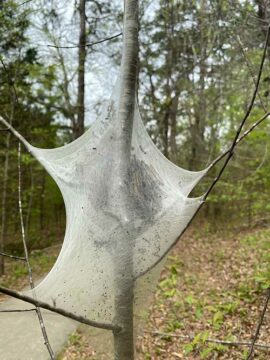
A more rigorous scientific experiment occurred at the University of Washing at; the end of the 1970’s. The University had a forest which was slowly getting decimated by tent caterpillars. You must know these creatures. They create large webs that ensnare trees, creating a net that provided the caterpillars with a protected environment in which they devour tree leaves to their hearts content. The tent building increased and went on for several years, when all of a sudden it stopped. No more tent caterpillars in these trees and, surprisingly, no more in trees that were distant and not in contact with the infected trees; it was as if the near and distant trees were communicating with each other. The infected trees turned their leaves into weapons; the caterpillars that ate these morphed leaves got sick and died from diarrhea. But distant trees, too far away to spread their info through the roots, also changed the chemistry of their leaves.
Rhoades, the author of the study, wrote, “This suggests that the results might be due to airborne pheromonal substances.” The trees were signaling to each other, he said, over long distances through the air, by airborne plant chemicals that contained information. This idea seemed outlandish to the botanists of the day—1979!—that plants would willingly communicate, that Rhodes had few followers and eventually lost his position.
I wonder if a similar effect explains why my orchids did not like to grow and bloom next to cacti, but were perfectly happy with tropical plants like rhododendrons and other orchids.
There are other examples of plants interacting with their environment. Being able to hear and understand their surroundings is a very useful skill for organisms that are rooted in one place. For example, some plants can recogonize the sound of a caterpillar chewing on its leaves and, in response, mount a defense by poisoning the leaves which the insects are eating.
The caterpillar of the white cabbage moth, for example, eats arbidopsis plant leaves in a very specific pattern, and the sound they make while doing this is very reproducible .The plant responds specifically and exclusively to the sound of its genuine predator chewing. If something is happening outside an organism that could be useful for its survival, that organism will develop a way to sense it. Evolution will give the organism ways to use its awareness to further its survival. This is perceived as acoustic vibrations, which we perceive as sound.
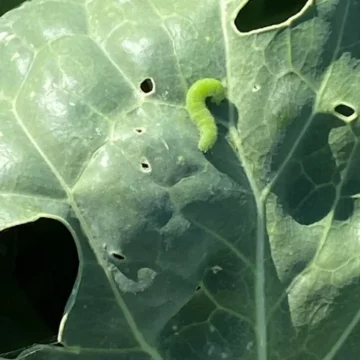
The leaf’s reaction to being bitten isn’t limited to just that leaf. The bite triggers a cascade of hormonal changes in the whole plant, which means different plant parts have a way of talking to each other. The scientific experiments that confirmed that plants can really hear in their own earless way; they will do something about it when they sense a vibration that they know is associated with their own harm. Like a caterpillar moth chewing plant flesh.
With all of these associations, it seems clear that the plant must have a way to remember these experiences. This suggests that plants have memories.
Nasa poisoniana, a plant in the flowering Loasaceaea Familly that grows in the Peruvian Andes is one of the best known examples of plant memory. These beautiful, multicolored starburst-shaped flowers were able to remember the time intervals between bumblebee visits, and anticipate the next time their pollinator was likely to arrive. We know about plants listening to their surroundings, feeling touch, and exchanging information. Each of these abilities are abilities are limited by their fleeting temporality. What good is all that sensation without the ability to remember it? Not the genetic sort of memory, of birds returning to the same migratory grounds each year, but individual memory . Elastic memory which changes with the circumstances
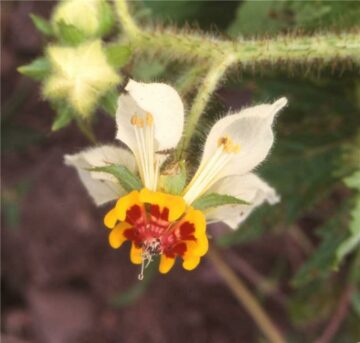
Nasa poisoniana is one of very few plants that move their body parts slow enough for a human eye to watch, In this case, they move their stamens from horizontal to vertical within 2 or 3 minutes. The flowers’ stamena start out lying down, each one tucked into one of the concave petals that circle the flower’s center. When a bee arrives at the flower, it slips its straw-like mouthpart beneath a petal and lifts up, revealing a pool of nectar that the bee drinks. The lifting of the scallop triggers one of the flower’s several stamens—the male fertilizing organs of the flower. Up goes the stamen, topped in a little yellow package of pollen, gathering into a slender cone shape. After the first bee leaves with all of the nectar, the next bee to arrive won’t get any. An insect that finds no nectar won’t try another flower on the same plant, but will fly further away to a neighboring plant, fertilizing the flower of this next plant. Then the next bee was on the way, and the stamen was already raised before the bee arrived.
These experiments were performed in 2019. Although this plant had been studied for years, no one had ever noted this behavior–memory– before. The fact that plants have memories makes them, closer to us. WE have memories, too. Where are the memories stored? What are they made of? Do memories imply consciousness? Do they guide our future activities?
There is a whole new science of plants developing memories— now that is a promising subject that can answer new questions. For example, are there plants on other planets? Are there plants on these other planets that are so far removed from their sun that literally no sunlight reaches the surface? If that’s the case, how will sugars be made to support the animal life? to provide structural materials for these animals?
Studies of deep, deep undersea trenches on the earth have been undertaken to try to answer some of these questions. The Mariana Trench is the deepest oceanic trench in the world, located in the western Pacific Ocean about 200 km east of the Mariana Islands At the southern end of the trench lies Challenger Deep, a narrow slot-shaped valley that reaches a maximum depth of 10,935 ± 6 meters (35,876 ± 20 feet), This is more than 2 km (1.2 miles) deeper than the peak of Mount Everest The water pressure at the bottom is about 1,086 bar (15,750 psi), roughly 1,071 times the atmospheric pressure at sea level.
Despite extreme pressure, cold temperatures (1–4 °C), and no sunlight, the trench supports unique ecosystems. Microbial life has been found at depths of up to 10.6 km (35,0000 ft) and specialized organisms thrive in this region, the halal zone.
Instead of sunlight, these plants rely on chemosynthesis, They use chemical energy (like hydrogen sulfide emitted from hydrothermal vents) to manufacture sugars. Chemosynthesis replaces photosynthesis for these plants.
It’s quite a remarkable finding, and something we must take into consideration when we explore planets and moons for signs of life. There are six moons known so far that are extremely distant from the sun; six that that are covered in salt oceans and have thermal vents or other sources of power to replace the sun. At present we ae looking for life in planets ha have a similar atmosphere and temperature as the earth; these new findings suggest that we must expand our horizons as we look for signs of life in other worlds that include plants.
***