
by Anton Cebalo
In the past few months, I have been reading about the personalities present in Young Bosnia for a forthcoming essay. The group was not formalized by any means, made up of decentralized cells of 3-5 people, and a scattered array of political influences. But in Gavrilo Princip—its most famous member and who would ultimately kill Archduke Franz Ferdinand—you see a distillation of the temperament that made them.
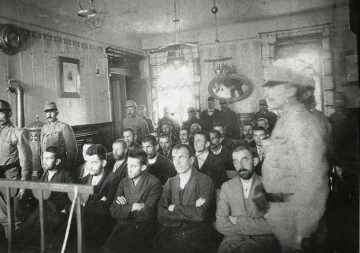
The Austro-Hungarian press after the assassination was eager to assign outside influences to the group. Princip and his co-conspirators were said to be molded by dark forces not of their making. Instead, a profile by psychoanalyst Martin Pappenheim reads the opposite. In the last year of Princip’s life, while kept in solitary confinement in Bohemia, Pappenheim conducted multiple interviews.
What we find is an absolutist mindset bred from the poor, difficult, and rural soil that these young men were raised. Six of Princip’s siblings died in infancy. The assassination was a violent act from the periphery, as if its spirits were tortured for centuries, and the real shock was that it actually reached modern Europe at all. The fact that it did was happenstance. Princip initially thought the moment was forever lost until he saw Archduke Franz Ferdinand while loitering in front of a delicatessen.
Pappenheim’s terse sentences read like a drama report that tightens as it goes on:
Father a peasant, but occupies himself with enterprises. Father a quiet man, does not drink. Father lives at Grahovo, Bosnia. No diseases in the family.
Always has been healthy. Knew nothing of serious injuries before the assassination. At that time injuries on the head and all over. At that time senseless. Scarlet fever. No bed-wetting. In the Gymnasium, sleepwalking. Walking about the room. Only during one year. Was waked up. In the third class. Never had attacks of unconsciousness.
Always “excellent student” up to the fifth class. Then fell in love. Began to have ideals. Left the school in Sarajevo in 1911. At that time nationalistic demonstrations were taking place against Tisza. Was in the first lines of the students. Was badly treated by the professors.
Bought books himself; did not speak about these things. Father not occupied with political matters. Was not much with other schoolboys, always alone. Was always quiet, sentimental child. Always earnest, with books, pictures, etc. Even as a child was not particularly religious.
The sketch outlined by Pappenheim depicts Princip less a bloodthirsty barbarian, and more like an intensely private and bookish young man full of unrequited relationships, romantic and otherwise. He was even too weak to join the army before World War I and was rejected.
While emotionally intense, Princip and Young Bosnia did not cross between hedonism and violence as is so commonly expected in psychological profiles. Instead, historian Vladimir Dedijer in The Road to Sarajevo (1966) makes clear that they were ascetics. They abstained from sex and also did not drink. Because they viewed Austro-Hungarian authorities as morally corrupting the public, they avoided what could be misconstrued as pleasure-seeking egoism so as to remain “pure.” The motives, Pappenheim writes, were “revenge and love.”
Somehow this was flipped on its head in the aftermath of World War I. Because the assassination had been so brazen, the entire Balkan region was permanently given the label of “barbarism”—a place where sex, violence, petty crime, and emotional extremes co-existed in some potent larger-than-life mix. This is best extravagantly shown in Emir Kusturica’s film The Underground (1995).
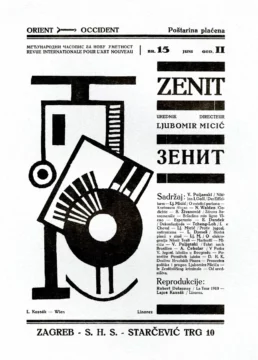
But even in the aftermath of World War I, Balkan artists took these labels in stride. Flipping it around, the avant-garde journal Zenitism (1921-1926) celebrated the new barbarian human (barbarogenij) as a central motif. One of its founders, Ljubomir Micić, wrote that the Balkan barbarogenij would revive Europe spiritually, as though it were some virile and primordial force, because they were untouched by the sapped spirit of the continent’s empires.
“Are you a deist or an atheist?”
“I am a believer!”“How could you reconcile your religion with the murder of a man… have these young men no faith?”“Not the faith you think; they have a national religion of a higher type.”
The national religion was a stand-in for everything that was supposedly beautiful being repressed. The act would “release” it free into the world. And if not by their act, then somebody else would commit it, as Princip told Pappenheim.
They struggled to give the future a form aside from clearly knowing who was its enemy. To the bureaucratic Austro-Hungarian authorities, this could only be interpreted as madness.
***
Enjoying the content on 3QD? Help keep us going by donating now.