
by Dilip D’Souza
Let’s get this out right away: I want to write about defecation.
It’s not the first time, I’ll admit. Some years ago I wrote an article about, of all things, a mathematical model for defecation. This was based on a 2017 paper I read with great interest. It had the fascinating title “Hydrodynamics of Defecation” and was published in a journal with the even more fascinating title Soft Matter. The researchers’ finding? That all mammals big or small take about 12 seconds to defecate.
As one of the authors commented, “The smell of body waste attracts predators, which is dangerous for animals. If they stay longer doing their thing, they’re exposing themselves and risking being discovered.”
Now let’s get this out right away too: most humans I know – mammals all, certainly – take rather longer than 12 seconds “doing their thing”. They are, of course, usually behind closed doors and not taking any particular risk of “being discovered”, or even attracting predators.
Yet there’s the rub: closed doors. Hold that thought.
Some years ago, I found myself in a tiny village in the Indian state of Madhya Pradesh. I had to spend the night, and it turned out the only place to lay down to sleep was the terrace of a local temple. It was actually a very pleasant night, breezy and quiet.
Early the next morning, I woke and strolled down to the nearby river for a wash. It was still dark. To my astonishment, I heard some very feminine giggles as I strolled. I couldn’t see anyone or anything, but the giggles seemed only feet away. I quickly realized that these were the women of the village. Out of their homes for their morning ablutions, they had lined up on the road, squatting to relieve themselves, the pre-dawn darkness their modicum of privacy.
And here I was, disturbing them in the act.
No closed doors for these women. Yet it’s not really their privacy, or its lack, that I’m making a point of. These women, like many other Indians every day, were defecating in the open.
Yes, I do mean “many other Indians”. I live near a mile-long promenade along the Mumbai coastline. I often walk its length to get my morning exercise. At its northern end is a densely-populated slum pocket. When I reach that stretch, and if it’s low tide, there are invariably several men squatting on the rocks. No doubt they were preceded by women, before night turned to day. At low tide, this is a common sight in various corners of the city that abut the sea, so common that nobody really even notices or remarks on it. My fellow citizens, defecating in the open.
Common or not, there are times I think I must be imagining what I see on the rocks. For on July 7 2017 – nearly nine years ago – Devendra Fadnavis, the then- and current-Chief Minister of my state, Maharashtra, announced “Great news for Mumbai! Congratulations to all Mumbaikars! Mumbai becomes Open Defacation [sic] Free (ODF).” To mark the occasion, he even presented flowers to the city’s Municipal Commissioner. Three months later, the then-President of India, Ramnath Kovind, declared the urban areas of Maharashtra open defecation free. Six months later, Fadnavis declared all of Maharashtra open defecation free.
So if this city that I live in, and this state, is ODF – and if both were declared so nearly a decade ago – why in 2026 do I see men squatting on the rocks at low tide? In fact, why has this been a routine, regular sight all through that decade? In fact, soon after Fadnavis declared Mumbai ODF, the author and film star Twinkle Khanna posted this ironic tweet, in which she points to a hapless citizen squatting on one of the city’s beaches.
What’s happening here? Well, India’s reality is that many of our citizens still defecate in the open. This is not just my eyewitness anecdotal evidence from the northern end of the nearby promenade. In 2022, the Ministry of Health and Family Welfare published its National Family Health Survey 2019-21 (NFHS-5). As the MHFW website tells us, the survey “provides information on population, health, and nutrition for India and each state and union territory.”
In the report, a section titled “Sanitation” starts with this paragraph:
“Sixty-nine percent of Indian households use improved toilet facilities, which are non-shared facilities that prevent people from coming into contact with human waste and can reduce the transmission of cholera, typhoid, and other diseases. Shared toilet facilities of an otherwise acceptable type are also common, especially in urban areas; 11 percent of urban households use a shared facility, compared with 7 percent of rural households. Nineteen percent of households do not use any toilet facility, meaning that they practice open defecation.” [emphasis added]
Nineteen percent. That’s 280 million Indians – we can assume many in Mumbai – who practice open defecation. And this is data from well after Fadnavis made his pronouncement.
Now there is a NFHS-6, based on surveys done in 2023-24, that was released on May 29 2026. The government’s press release about it is overflowing with phrases like “notable progress”, “significant improvement”, “improved access” and “expanded significantly”. The idea, of course is to show off India’s steady progress in every possible respect. The cover of the report reinforces that theme of upward movement, with a meaningless graphic and soaring arrow in gold.
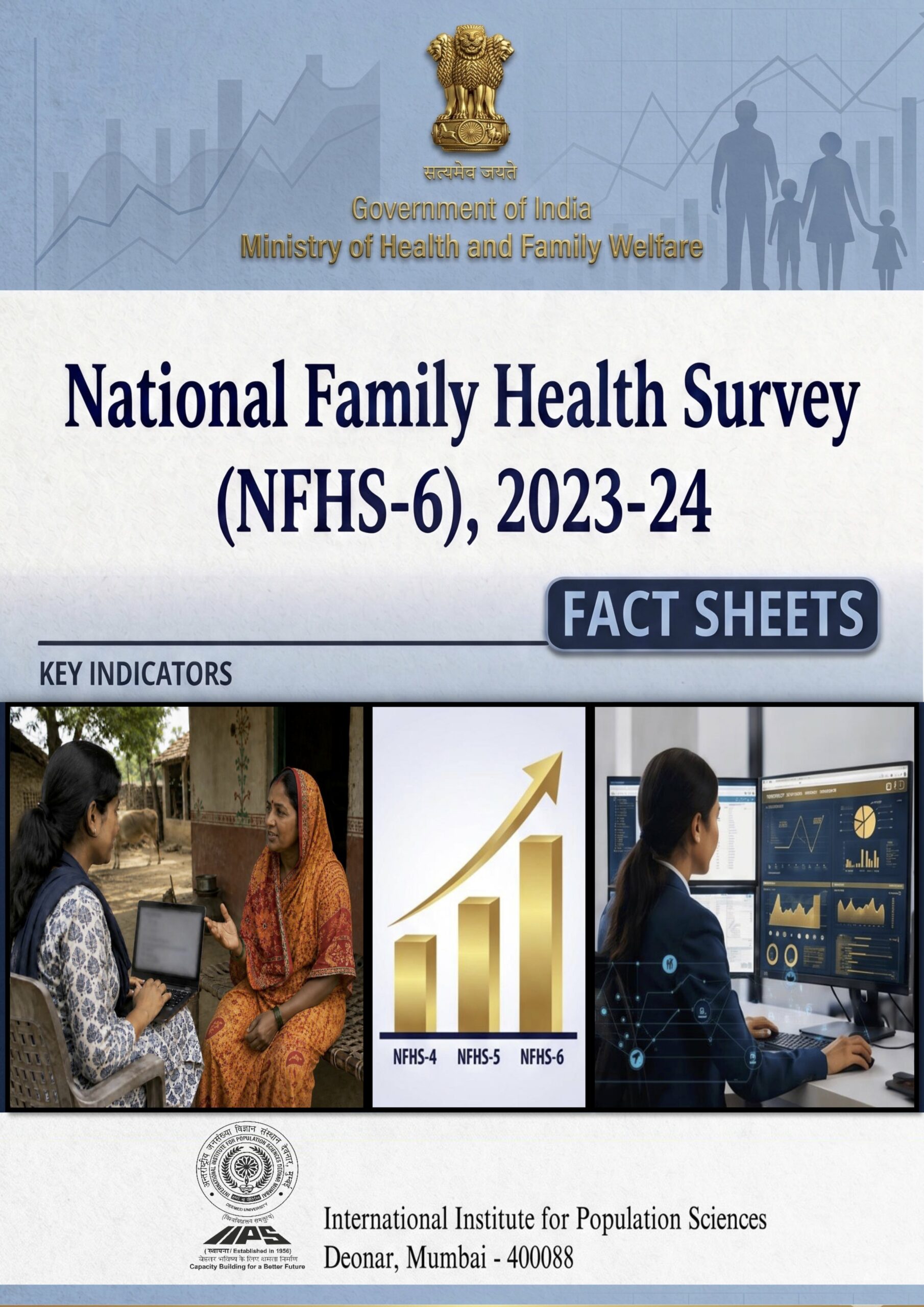
But get this: nowhere in the press release, nor in the report itself, is there so much as a mention of the word defecation. The government acknowledged open defecation in NFHS-5, even if functionaries like Fadnavis had previously prevaricated. But in NFHS-6, the subject itself is dropped. Reading just NFHS-6, you wouldn’t even know open defecation happens in India.
Which is the reason for the latest defecation-related news I want to leave you with. India has begun the immense effort of a census. This involves sending “enumerators” to households across the country to collect data. But get this too: These folks are apparently being asked to revise some of their findings.
One enumerator told The Hindu: “if the house does not have a toilet and occupants are defecating in the open, we are told to check if there is a toilet nearby, even that of a neighbour or a relative, which they may be using occasionally, or even a public urinal. Then the entry can be changed from ‘open defecation’ to having access to a toilet.”
Another hit the nail on the head: “We have been asked not to select options that may show the government in a poor light.”
Now we know why Fadnavis made the announcement he did, all those years ago. He too didn’t want to “show the government in a poor light.” Which leaves me with a question. What really reflects poorly on the government: the reality of open defecation? Or official blindness to the reality?