
by Charles Siegel
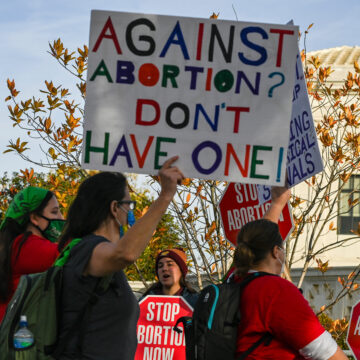
Last week the Supreme Court temporarily restored access to mifepristone, one of two drugs commonly used in combination to terminate pregnancy. The United States Court of Appeals for the Fifth Circuit, the most conservative circuit court of appeals in the country, had halted shipments of mifepristone while weighing a suit by the state of Louisiana. For now, at least, shipments will resume while the case proceeds in the Fifth Circuit, and possibly in the Supreme Court as well.
The case is another in the endless series of battles over abortion access that have played out in the years since Roe v. Wade was overturned by the Supreme Court in Dobbs v. Jackson Women’s Health Org. The point of Dobbs, as Justice Alito so solemnly intoned, was to “return the issue of abortion to the people’s elected representatives.” But that is not what the implacable foes of women’s reproductive rights want at all.
In the four years since Dobbs, they have tried, in every way imaginable, to subvert the will of the people. They have poured billions of dollars worth of lobbying and litigation into this effort, and will never stop.
Take Missouri, for example. Two years after Dobbs, voters approved an amendment to the state constitution, enshrining the right to abortion. Yet Republican legislators immediately sued to invalidate it, and have sought to place a contradictory referendum on the ballot soon too. Similar fights have occurred in Kansas, Arizona and elsewhere.
And they’re not content with trying to undo the actual votes of the people in state after state. They have sought to effectively ban abortion at the national level as well, through tactics such as the lawsuit attacking mifepristone. Such suits are invariably filed in out-of-the-way federal courts in the Fifth Circuit, such as the ones in Amarillo, Texas, and Monroe, Louisiana, to be sure to draw a favorable Trump-appointed judge. It’s the rankest hypocrisy, but what else is new?
It feels like ancient history now, but for a time in the years leading up to Dobbs, I was involved in some abortion cases in Texas, in one small corner of the reproductive rights landscape. Just to recap the legal framework first:
Before Roe, abortion was legal in some states and illegal in others. This didn’t mean, of course, that abortions didn’t happen in the latter group of states. It just meant that women had to travel to a state where abortion was legal, or far more commonly it meant that a woman had to obtain an abortion in the shadows. They were performed in secret, and much less safely. If a woman was lucky she might be helped by a network of volunteers. “The Jane Collective” was one such network in Chicago, remembered in the excellent, gripping documentary “The Janes,” https://www.youtube.com/watch?v=pRbquE2BAkQ, a few years ago.
In 1973, Roe was decided. Jane Roe – a pseudonym for Norma McCorvey – was an alcoholic at 21 in 1969, and pregnant for the third time, having given up her two daughters for adoption. Wade was Henry Wade, the longtime district attorney in Dallas County, who among other things had prosecuted Jack Ruby for the killing of Lee Harvey Oswald. Texas law had banned abortion for over a century. McCorvey sued Wade in federal court to prevent him from enforcing the law, and the case made its way to the Supreme Court, which decided it in 1973 (McCorvey had given birth in the meantime).
Roe made abortion legal in all states, or more precisely it held that state laws absolutely banning abortion were unconstitutional. A “right of personal privacy” that was “founded in the Fourteenth Amendment’s concept of personal liberty and restrictions upon state action…is broad enough to encompass a woman’s decision whether or not to terminate her pregnancy.” This right, however, was not absolute, and was to be balanced against a state’s competing interests in “safeguarding health, in maintaining medical standards, and in protecting potential life,” which “at some point in pregnancy…become sufficiently compelling to sustain regulation of the factors that govern the abortion decision.” The court thus arrived at the following constitutional scheme, quoting the majority opinion by Justice Blackmun:
(a) For … the first trimester, the abortion decision and its effectuation must be left to the medical judgment of the pregnant woman’s attending physician.
(b) [After] the first trimester, the State, in promoting its interest in the health of the mother, may, if it chooses, regulate the abortion procedure in ways that are reasonably related to maternal health.
(c) For the stage subsequent to viability, the State in promoting its interest in the potentiality of human life may, if it chooses, regulate, and even proscribe, abortion except where it is necessary for the preservation of the life or health of the mother.
This tiered regime proved to be very rickety, but for decades it gave women control of their reproductive choices, which in turn gave them much more control over their lives in every respect — physical, emotional, professional, and social. Thus it stood, more or less, until Dobbs ended it all in 2022. For my part, the less said about the opinion in Dobbs, or about the machinations that changed the makeup of the court that produced Dobbs, the better.
So now, in the lofty, theoretical realm in which Justice Alito likes to pretend to dwell, the people of each state decide whether they wish for abortion to be legal, and in what circumstances. That was the mantra of the anti-choice right for decades. Except it was pure crap, because when people do choose to keep abortion legal, the anti-choice right simply doesn’t accept it.
In any event, until Dobbs, abortions could be legally performed in Texas. (I’ll leave aside the grotesque, blatantly unconstitutional “bounty hunter” bill passed in 2021, which effectively ended most abortions in the state; that’s another infuriating story entirely.) Another question, however, was whether the same constitutional rules applied to minors seeking abortions. In a series of decisions, the Supreme Court had held that a state could permissibly pass laws that recognized parents’ traditional interests in controlling the conduct of their children, and thus could require minors to obtain consent of their parents to obtain an abortion. On the other hand, a state could not completely prevent a minor from obtaining an abortion either, even without parental consent.
Texas thus enacted a statute under which a minor could “bypass” the parental-consent requirement, by obtaining a court order authorizing an abortion without obtaining such consent, or even notifying the minor’s parents. The law required that the minor present “clear and convincing evidence” either that “she is mature and sufficiently well-informed to make the decision to have an abortion performed without notification to or consent of a parent, managing conservator or guardian,” or that “notification and attempt to obtain consent would not be in her best interest.” The Texas Supreme Court promulgated rules of procedure under which the applications for such rulings, called “judicial bypass” orders, could be obtained.
The hearings were supposed to be confidential and anonymous. This was often problematic, particularly in small counties. Jane’s Due Process was an organization founded in 2001, by a lawyer who briefly practiced at our firm, to help minors in Texas navigate through this obstacle course. In 2020, I began handling appeals for them.
In a typical judicial bypass case, the minor would contact JDP, either via the group’s website or because someone had given her JDP’s contact information. JDP would connect the young woman with a volunteer lawyer in her area, and that lawyer would assist her through the hearing process. At the conclusion of the hearing, she would be granted a bypass order. If she could then go to a clinic to obtain an abortion, she usually would. But since these were minors, it was often very hard for them even to get to a clinic, especially without their parents’ knowledge. JDP had a group of dedicated volunteer drivers to help.
Once in a while, a judge would refuse to grant a bypass order. There would need to be an appeal, and for a few years I handled these appeals for JDP. (Some of them I handled with Professor Joanna Grossman of SMU Law School, whose knowledge and experience were matched only by the almost supernatural speed at which she seemed to be able to work.) They were almost always successful, not because the appellate judges were pro-choice, but because they understood the purpose and function of the statute. The orders would usually be issued within two or three days, and the minors were able to obtain abortions on a timely basis.
Sometimes, however, even with a favorable order on appeal, it was too late; the minor might have been too far along in pregnancy, and thus would have gone past the point at which abortions were legal in Texas. Or other things might have happened: she might have told a parent anyway, who might (or might not) have relented and given consent. Or fearing the running out of the clock, she might have figured out a way to travel to New Mexico, where parental consent wasn’t required in the first place. Or she might have decided to keep the baby, or might have miscarried.
These cases were always dispiriting to work on, both for the personal stories involved, and for the overriding sense of anger and frustration that some judges in my state were so callously intent on enforcing their own views about abortion instead of applying the statute as written. The reasons that Janes couldn’t, or wouldn’t dare attempt to, obtain parental consent were infinitely varied but always depressing. Her parents would throw her out of the house if they learned she was pregnant. Dad was absent and mom was in prison. She couldn’t tell mom because the father was mom’s boyfriend, or her brother. Mom was dead and dad had been deported. And so on.
As I wrote this column, I went back and looked at the evidence in two of the appeals I handled. In one, the minor testified that she was 15 years old, and actually was 14 when she became pregnant. She attended a small Catholic high school along with her boyfriend, the father. Her parents were very religious, and her father was an administrator of the elementary school that is a feeder to her high school. She had good grades and hoped to go to college. She believed that she would be expelled when her pregnancy became obvious, and her boyfriend would be expelled too. Her parents were entirely against premarital sex and abortion, and would not have allowed her to place the child for adoption.
After hearing this evidence the trial judge stated only that Jane was not “mature and sufficiently well-informed to make the decision to have an abortion. Minor has not demonstrated how it would affect family relatives and that she understands the alternatives and implications.” This ruling, of course, makes no sense. It pointed up the essential paradox at the heart of these cases: if a teen is not mature enough to have an abortion, how on earth is she mature enough to be a mother?
In another case, Jane was 17 years old, and less than six months away from her 18th birthday; if she had gotten pregnant just a few months later she wouldn’t have needed parental consent for an abortion, or a judicial bypass order, at all. Her father was deceased, and her mother had beaten her in the past, and as recently as two years earlier. She believed that if she told her mother about her pregnancy, her mother would disown her and kick her out of the house, and indeed her older sister and younger brother had been kicked out of the house for “not following rules” at ages 19 and 15, respectively. If she were kicked out, Jane testified, she would have nowhere to go; she could not live with her boyfriend, who lived in an apartment with his entire family. She also testified that her mother did not approve of her boyfriend because he was African-American.
Jane’s goal was to graduate from high school, attend a community college for one year and then study forensics at a university; if that plan didn’t work out, she hoped to study cosmetology and eventually open a salon with her mother. Her mother is not a U.S. citizen, and wanted Jane to open a salon with her once Jane turned 18. At the time of the bypass hearing, Jane had an interview scheduled for a job as a bagging clerk at a grocery store.
After hearing all of this evidence, the trial judge announced his ruling in one sentence: Jane was not sufficiently mature. In a written order issued the same day, the judge stated that Jane’s desire for an abortion was “more of a convenience, so she can continue her plans.”
It was always impossible for me to put into words my dismay about orders like this. How could a judge so easily decide that this minor before him — and remember, she was actually just a few months shy of turning 18 — was not mature enough, and was seeking an abortion only as “more of a convenience?” The breezy arrogance of these orders was galling in the extreme.
The only explanation was that these judges simply would never grant a bypass regardless of the evidence, because they were personally opposed to abortion. Never mind that over 20 years earlier, the Texas Supreme Court had held that “it is not the court’s responsibility to superimpose its judgment or its moral convictions on the minor in regard to what course of action she should take with reference to her own body.”
I never met any of the Janes whose appeals I handled; I knew them only from cold appellate records and hearing transcripts. I am glad that most of them obtained abortions, and thus were able to continue on the path they saw for themselves — the futures they imagined. All the people who worked or volunteered at JDP — the people who manned the telephone hotline, the volunteer drivers, the lawyers who handled the trial court hearings, and so on — felt the same way.
As I said, though, that all feels like ancient history now. A minor can’t obtain an abortion in Texas, with or without consent, because no woman can legally have an abortion here at all. As ever, of course, women here still get abortions, but they happen through telemedicine, or travel, or otherwise. And as ever, the anti-choice zealots are working hard — in the legislatures, in the courts, in the press, on social media and everywhere else — to deprive them of control over their own bodies and lives.