
The term was coined by interior designer David Hicks back in the 1960s, but I didn’t know that when I coined the term earlier this year.
I’ve been taking photos of my meals for several years now. Every now and then I’d sit the camera on the table and take a shot. The shot below appears to be my oldest tablescape. It’s from Hoboken’s Malibu Diner back in July of 2029.
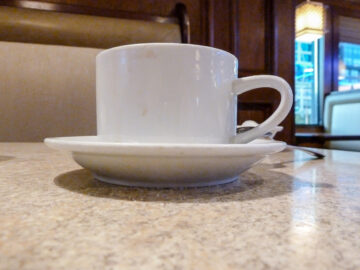
It’s a straightforward shot of a cup of coffee, though obviously the coffee is not visible from this angle. You can see the shadows of the coffee saucer, the cup’s handle, and a spoon cast on the tabletop by the overhead lighting, some light glinting off the cup, and some very faint coffee stains a bit left of center. To the right you can see a booth next to a window and, through the window, some building. Light from the window reflects off the tabletop to the right of the cup. By the nature of the shot, the tabletop itself tends to play a big role in such shots, as does the ground in landscapes.
As for David Hicks, and his meaning for the term, as I said, he’s an interior designer. He coined the term to characterize the selection of objects for, and arrangement on a table in a decorative way. That is, his usage refers to the table and the objects on it. In contrast, my usage refers to a photograph taken from a certain vantage point. The act of coining the term signaled my intention to explore tablescapes in a systematic way.
Given that I am by inclination a street photographer I have little interest in tabletops composed for their visual appeal. I take my tabletops like a find them. In the rough, and in front of me.
This is perhaps the first shot I had in mind when I coined the term. It’s from January of this year. It’s paired with four other food photos in a blog post, but it’s the only tablescape among them. I’m eating breakfast in Turning Point, a breakfast and lunch place in Hoboken, NJ, where I live.
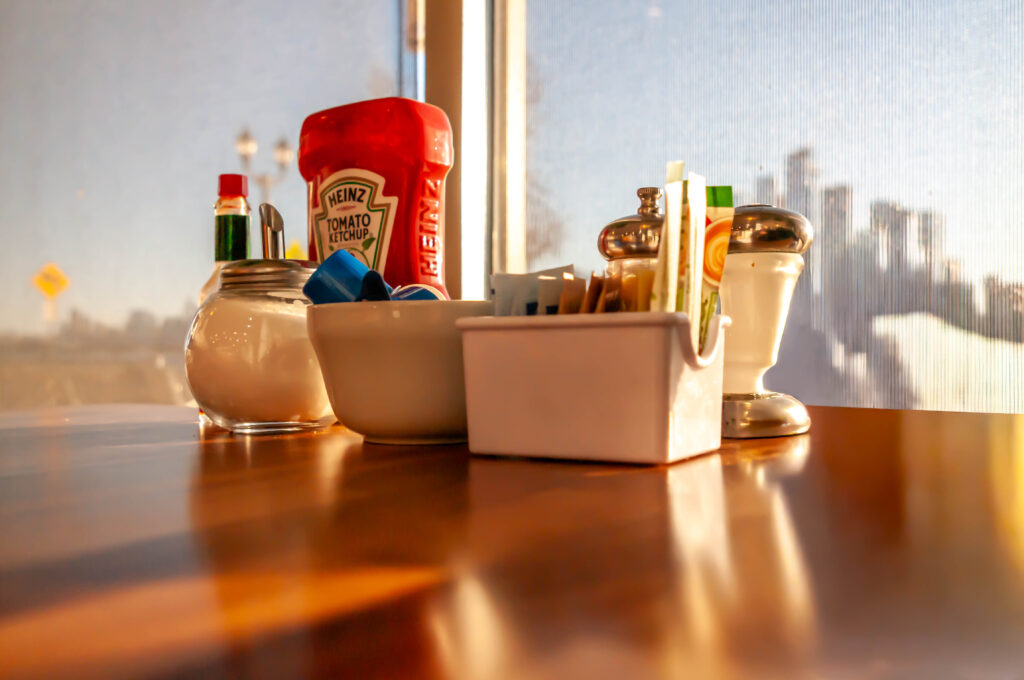
It’s a shot of the condiments on the table. Just left of center we see an upside down squeeze bottle of Heinz ketchup. The buildings you see through the window on the right belong to Hudson Yards, a new development on Midtown Manhattan’s west side, having been constructed over the last decade or so. They weren’t then when I first moved to Hoboken. The blurry yellow traffic sign at the far left is on Sinatra Drive, which runs along the Hudson River on Hoboken’s east side. Given the time of day and the orientation of the table, the sun is relatively low in the sky and is streaming in from the East yielding the play of light, shadow, and reflections across the tabletop.
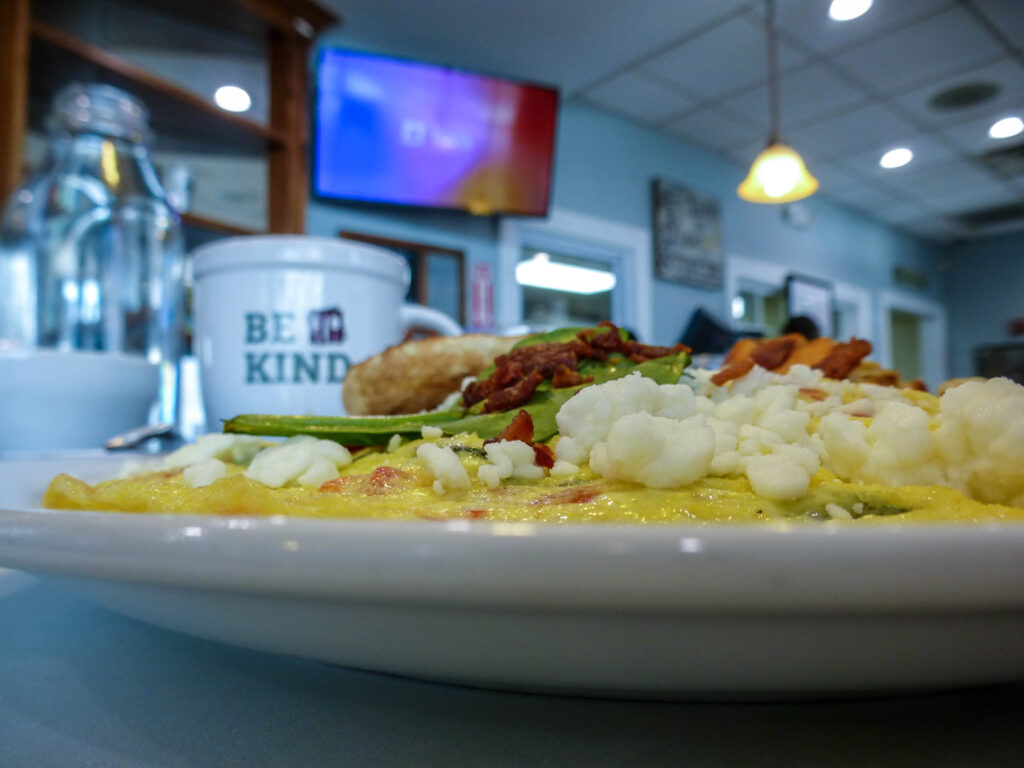
This next one is another Turning Point shot, again from this year (March). It’s angled toward the inside of the building and I’ve positioned the camera so that I catch the edge of my breakfast plate. This is some kind of omelet with feta cheese on top. You can see a coffee cup, out of focus, to the left. “Be Kind” seems to be a corporate slogan.
One of my rules is that I’m not allowed to move things around on the table in order to create a better composition. For the most part I stick to that rule, otherwise, what’s the point?
But of course I’m free to place the camera wherever I wish as long as the bottom is resting on the table. I can adjust the focus as well. However, it is impossible to compose the shot with any accuracy. To do that the camera needs to be at eye level, which is all but impossible in this situation.
Yes, I suppose I could position the camera neat the table’s edge and then kneel on the floor to compose the shot, but I’m not even remotely tempted to try. The fact that I don’t quite know what I’m shooting inheres in the aesthetic of this particular mode. When you’re looking at a true tablescape you’re seeing something that you couldn’t quite see if you were on the scene. That gives these shots an immersive “Alice in Wonderland” vibe.
However, for a “strict” tablescape, the camera has to be resting on the table. In shot below the camera is merely at a low angle with respect to the table.
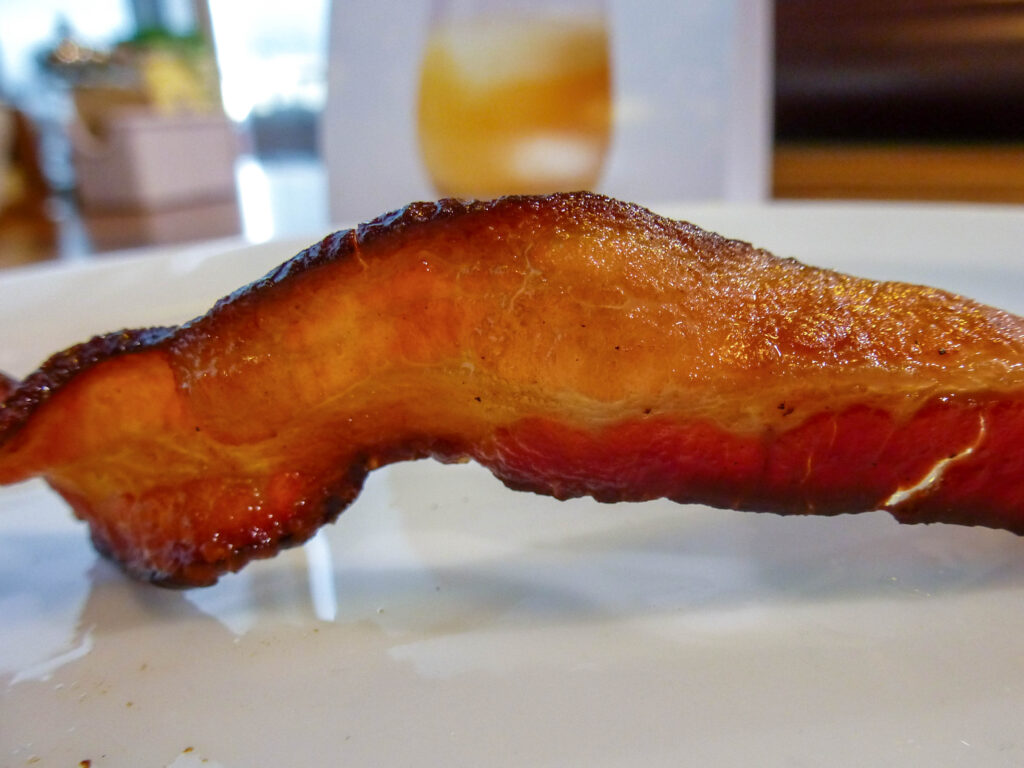
But it’s not actually resting on the table. Hence, no matter how interesting the photo may be – and, let me assure, this photo is VERY interesting for bacon lovers – it’s not a tablescape. Rules is rules, otherwise what’s the point?
(Psst! I may also have posed the strip of bacon.}
I took this shot in my favorite pizza joint, Torna’s (which, incidentally, closed last year). As you can see, it was a bright day. Torna’s faced Southwest, so the sun comes streaming through the windows in the late afternoon on a bright day.
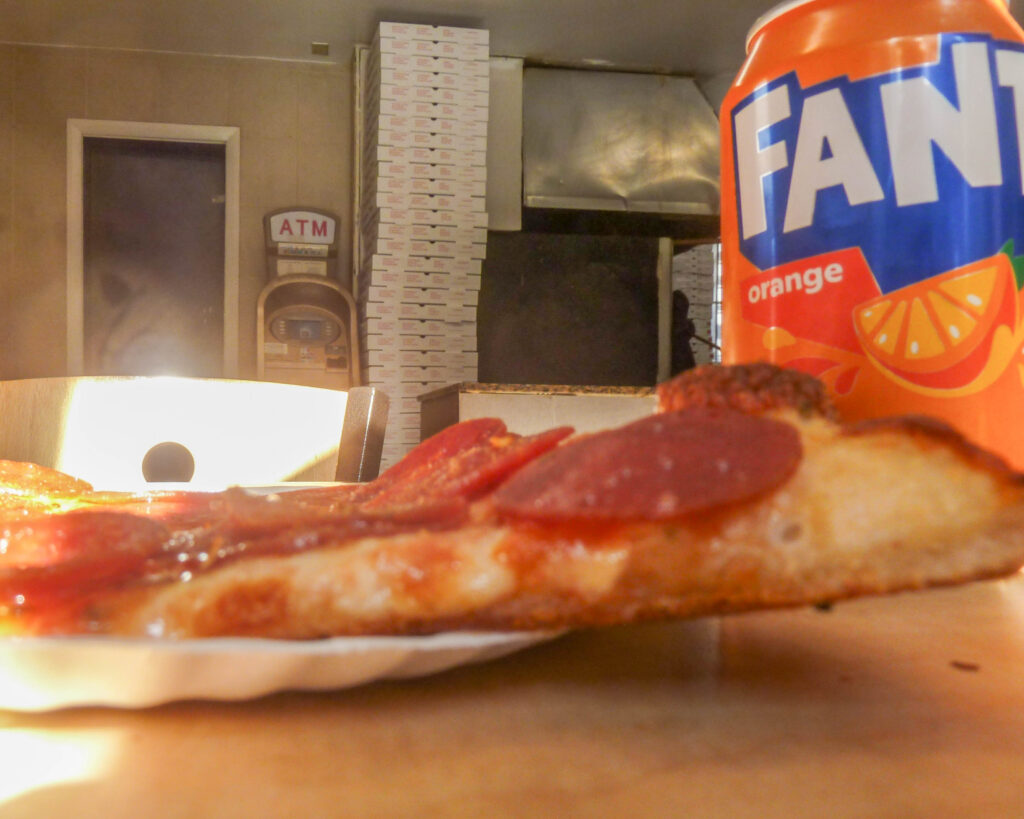
Notice the stack of pizza boxes at the rear and the ATM to left right of the boxes. Those boxes will be gone by the end of the day.
I love this shot. You guessed it, we’re back in Turning Point. It’s a cloudy day so the light isn’t bright. In fact, it’s a bit dim.
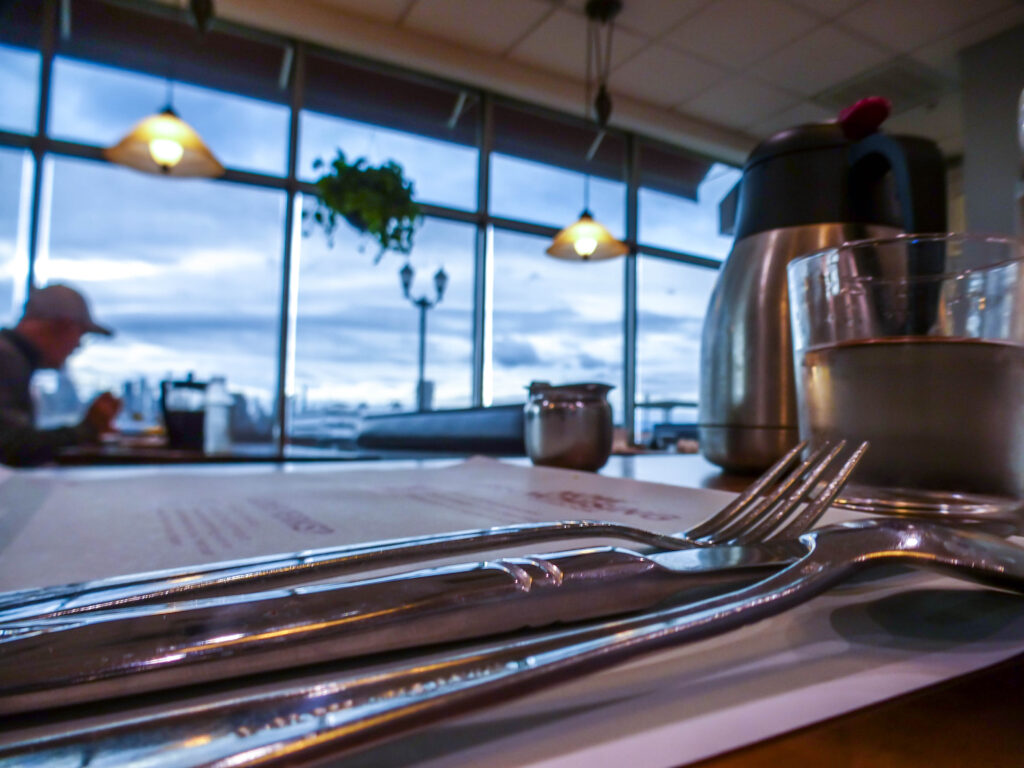
I like the composition, the way the image leads you toward the coffee carafe on the right. We’ve got the light glinting off the flatware in the foreground and the clouds through the window across the upper half. There’s the guy in a cap along the left edge, the two hanging lights above, the two-headed street light between them, and the small pitcher of cream just below the rightmost light. It’s just to the right of the image’s center. Of course, you might not know what it was if you hadn’t been there. It would just be some small object on the table top.
I can’t imagine deliberately posing this shot in a million years. And that too is the point of this discipline. It forces your eye to bump into things, it forces you to look, and thereby to see.
Here’s an utterly pedestrian shot, but I had to include it. Why? Because it’s Mickey D’s. Remember the old commercial, “We Do It All for You.”
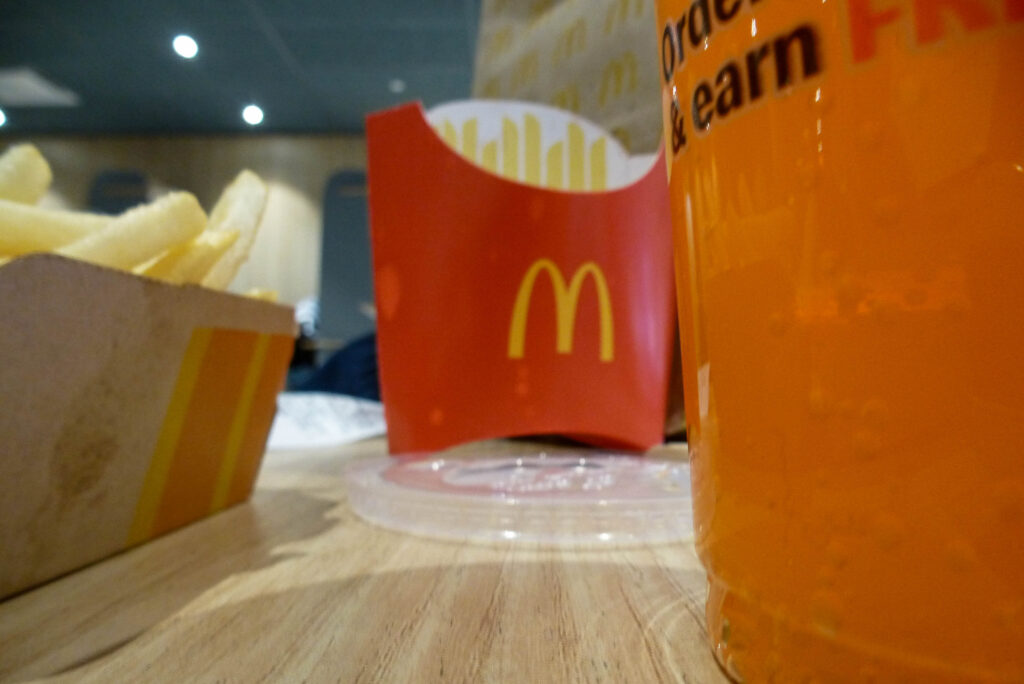
There it is, just for us, those crispy French fries on the left and the iconic golden arches on the red French fries cozy, whatever you call it. Orange Fanta on the right. Notice the reflections on the plastic cup.
Let’s verify. Same table top, but a different angle. Check. The camera’s up off the table, hence the shot isn’t a tablescape even though it’s all about the table and what’s on top of it.
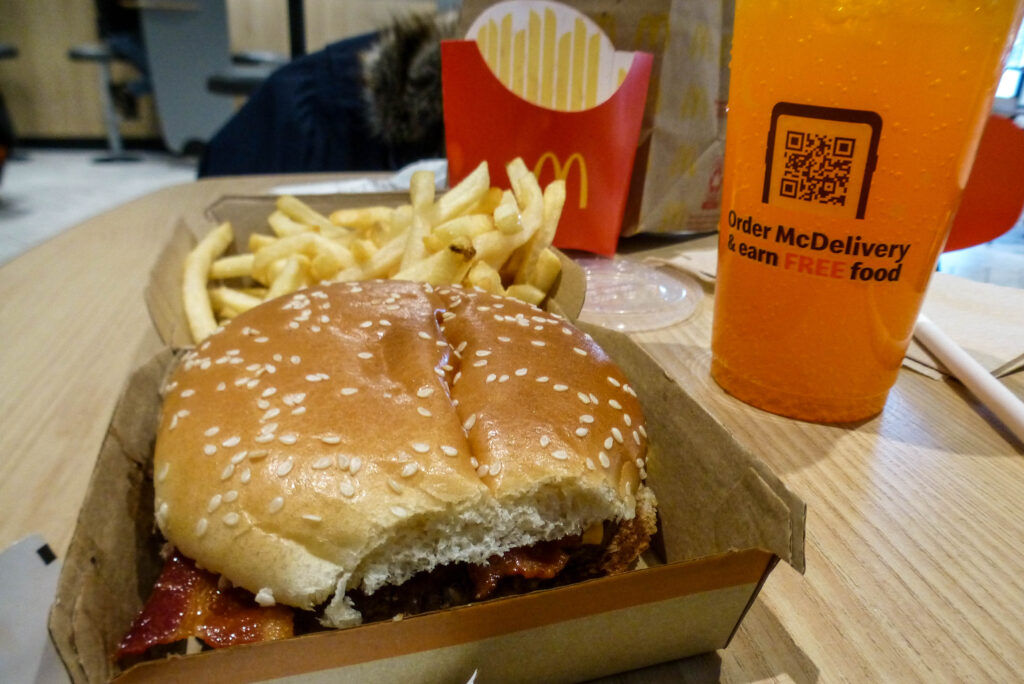
There’s that orange Fanta off to the right (check), the fries (check) – Oh, those fries! – and the fries cozy (check) in the rear. And of course the burger itself is in front. Looks like a quarter-pounder with bacon and cheese.
There’s a world of difference between the two shots. In the first one you’re down in there nestled among the items. In the second one you’re in a helicopter flying over the scene.
Whoa! What’s going on here! Reflections and refractions. I’m dizzy. We’re back at Turning Point, this time at the bar, which has a highly polished stone top.
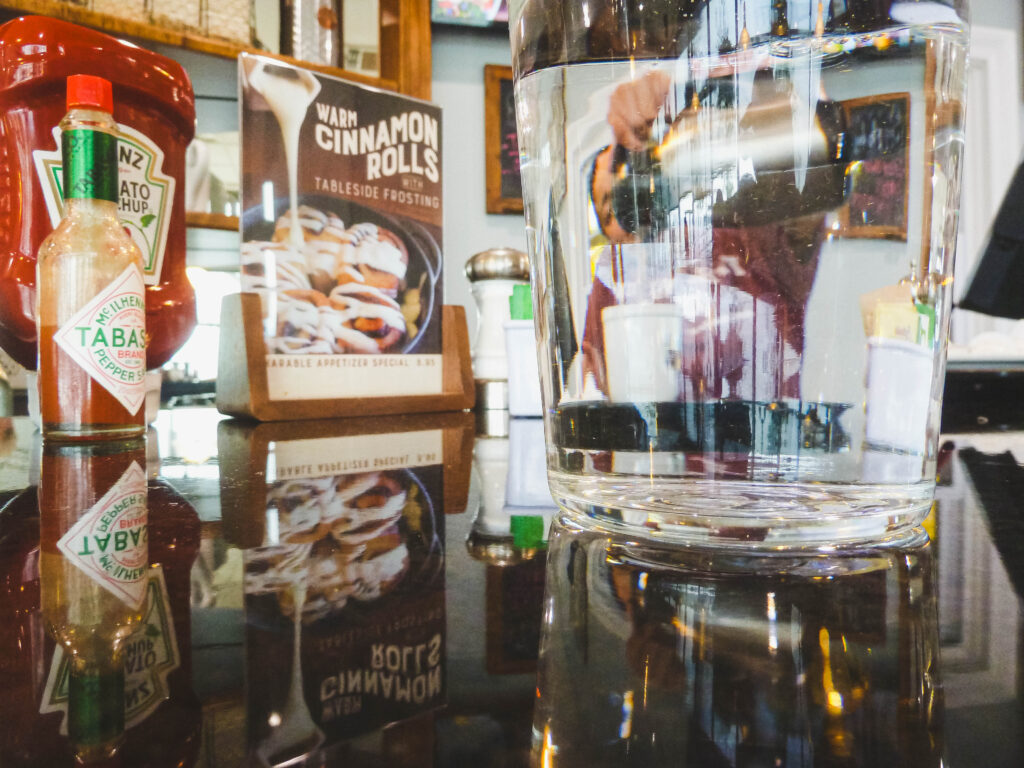
Let’s start at the left. There’s a half-empty bottle of Tabasco sauce in front of that pesky upside-down bottle of Heinze ketchup, both reflected on the bar. Then we’ve got a placard trying to sell us cinnamon rolls, also reflected on the table-top. There’s a salt shaker at the rear. Then a big blur of confusion. It’s a glass tumbler with water in it. If you look a bit below the top you can see a hand pouring coffee into a cop. Is that being reflected from a scene off to our left or coming refracted through the tumbler from behind? If the later I’d expect to see evidence of the waitress either to the right or to the left of the tumbler. I conclude that she’s to our left. But I wouldn’t bet on it.
Finally, a nice legible shot, blueberry pancakes edge-on. Notice the windows reflected on the surface of the plate at the bottom just above the edge. Those blueberries, they’re huge. And that guy to the left, he looks like another blueberry on top of the pancakes.
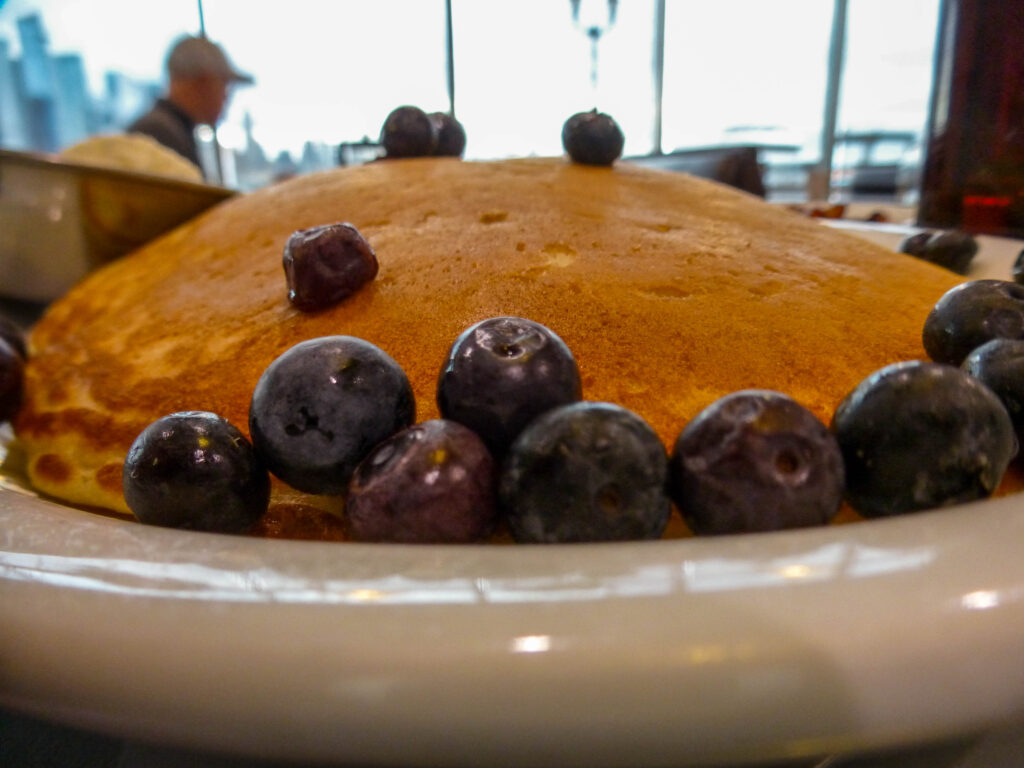
And, you know, when I look at the dates I realize that’s the same guy we saw earlier, in the sixth photo. There were no pancakes in that shot, just the flatware.
* * * * *
Note: Earlier this month I had a long conversation with Google AI about tablescapes and blogged the whole thing: A trip through Alice in Wonderland with Google [tablescapes].
Enjoying the content on 3QD? Help keep us going by donating now.