
by Marie Snyder
“When asked about a ‘major cyberattack’ from China, the president shrugged with indifference. ‘It is what it is.’ … Three days earlier, the president described China’s support for Iran as just ‘one of those things’” —Steve Brown
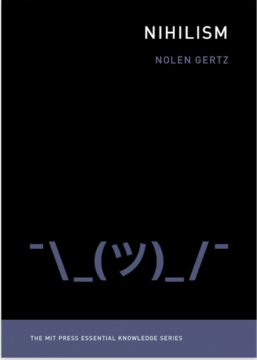
A year after coming out with Nihilism and Technology, Nolen Gertz wrote just plain Nihilism (2019), an “examination of the meaning of meaninglessness: why it matters that nothing matters.” It’s a really short book, but it took a while to wade through it all. Here it all is even more briefly assembled to highlight the salient points.
We typically think of nihilism as very simply meaning, “we believe in nothing” (4), but he takes us through Western philosophy to get to a view that, “Nihilism is about evading reality rather than confronting it, about believing in other worlds rather than accepting this one, and about trying to make ourselves feel powerful rather than admitting our own weaknesses” (73).
THE HISTORY OF NIHILISM
Gertz explains the trajectory along lines similar to the move from pre-modernism to meta-modernism. We once trusted God, then flipped that trust on to science; then we questioned the possibility of knowing anything at all, and now we’re just starting to recognize the need for a few core Truths. Gertz goes back further to Socrates’ provocation to question everything: “From a Socratic perspective, nihilism can be overcome by enlightenment. From a Cartesian perspective, nihilism can be overcome by self-restraint. But from a Humean perspective, nihilism cannot be overcome. It is simply a product of human psychology” (28).
Then he gets to Kant who shifts us from the idea that we can’t know things to the idea that our values are contrary to genuine freedom. Freedom means obeying the self, and, since our desires aren’t within our control (we discover our tastes rather than choose them), our desires aren’t within our freedom but are “forced upon us.” So, true freedom (and morality) can only be understood as obedience to reason.
Then Nietzsche argued that there isn’t one universal morality, but “the end result of a war between rival moralities” (41), and the morality of the Christian church was against life itself. We’ve been conditioned to renounce strength in favour of group safety, but “repressing an instinct is not the same as removing that instinct . . . Since it was ‘immoral’ to be cruel to others, members of society could only maintain their morality by redirecting their cruelty at themselves. This self-cruelty is what became known as ‘guilt’” (46).
What’s all this got to do with nihilism? Suffering through life under the false hope of a better life in the great beyond means that we’ve been imprisoned by “a good and perfect God, a God who created this prison even though its only purpose seems to be to test whether the prisoners can get released for good behaviour” (51). If God is responsible for everything, then we’re responsible for nothing, and our existence has no meaning. And we also have science to take the blame for it all: “science is not the enemy of religion, but is instead a new religion. … The priests of science elevated scientific values like ‘objectivity’ to superhuman heights, leading society to feel ‘enlightened,’ to feel that it had progressed beyond the ‘dark ages’ of Christianity” (55).
So, as far as I understand it all, we started with the idea that if we know universal ideas, then we can have meaning in life through an understanding of the world or of ourselves, but then we gained confidence with our knowledge (first with God, then with science), but lost meaning as we renounced responsibility for our lives by giving all the glory and blame to God and/or science. Meaning in our lives is inextricably tied to responsibility or taking ownership of our lives, and without that, then we’re left with nothing. But that’s just the beginning of the book!
WHAT ISN’T NIHILISM:
Pessimism: Pessimists embrace despair, which is the opposite of nihilism. So, when we maintain hope that things will work out in the end, the hope is without action or effort but looks to some external force to right the wrongs. The same happens when we look to leaders as more than human in order to avoid any responsibility for any situation we encounter. Nihilists just wait to be saved.
Cynicism: Cynics are more about disdain for people, mistrustful of any evidence for anything and refusing to believe in the possibility of altruism, which can look like believing in nothing, but what they believe in is their own self-interest. They seek out ulterior motives for anyone else’s actions. They think of themselves as realists, focusing on what people do rather than any hopes or ambitions, whereas nihilism is closer to idealism, focusing on people’s intentions and aspirations.
Apathy: Apathy means to be without feeling or desire, to not care about anything. It’s a personal feeling rather than a claim about how everyone should feel. Apathetic people reveal nihilists when the apathetic is challenged to try to care, and the nihilist can’t come up with a good reason. The nihilist has strong feelings about nothing. According to Nietzsche, nihilists fall into the morality of pity, which is about elevating oneself by reducing others to their neediness.
FOUR WAYS OF THINKING ABOUT NIHILISM
Nihilism as Denial — Nihilism isn’t a fact about reality but a reaction to reality. For Nietzsche, it’s “discovering life is meaningless and yet going on with our lives anyway. … The meaninglessness of life is due not to the nature of the universe, but to the nature of our culture. … Trying to live the lives that we should want is what makes us nihilistic” (79–80). We’re in denial of, or oblivious to, our own desires.
Nihilism as the Denial of Death — Influenced by Heidegger’s notion of the inauthenticity of life that’s “occupied with pointless activities like chitchat that help us to avoid the anxiety of confronting death,” existentialists living during WWII (Sartre, de Beauvoir, Camus) sought to acknowledge death. “To recognize that we could die at any moment would require that we take every moment of our lives seriously, as seriously as if it were our last” (87). Essentialist narratives around how to be are comforting as they replace absurdity with clarity, but they take us further from reality. “Existentialism reveals that in trying to avoid responsibility, we end up avoiding freedom, and that in trying to avoid death, we end up avoiding life” (87). We need to remove the false sources of meaning (God or DNA) in order to recognize that only we can give ourselves meaning.
Nihilism as the Denial of the Death of Meaning — Postmodernist Lyotard argued that “every field of knowledge operates through specific narratives with their own gamelike rules in order not only to transmit knowledge but even to legitimate its claims as knowledge” (88) called metanarratives. Postmodernism refuses to believe in our stories and values. Tech merely revealed that beneath the fabric of society is nothing. Nihilism came from an evasion of reality “in the form of an evasion of freedom” (96).
Nihilism as the Denial of the Death of the Meaning of Childhood — This is a beautiful, provocative section of the book, inspiring many dog-eared corners, about de Beauvoir’s The Ethics of Ambiguity. Gertz explains, “Inspired by Descartes’s claim that adults are unhappy due to having previously been children, de Beauvoir describes how nihilism is related to the attempt to become a kid again” (96). She compares the type of freedoms we have as a child to those we should aspire to have as adults, and the problem when people bring their childlike expectations of freedom into adulthood, what she calls the spirit of seriousness:
“Serious people evade freedom and responsibility through seeking infantilism and paternalism. Serious people turn themselves into children, wanting nothing more than definitions to learn and rules to obey. They thus require some external authority that can provide such definitions and such rules. . . . [However] no external authority can prevent either children or serious people from having to confront the ambiguity, the volatility, and the inexplicability of life” (98).
This sheds a new perspective on the popularity of influencers who help people make every little decision. But then these serious people, when faced with the suffering of life, further regress into nihilism. She writes, “Conscious of being unable to be anything, man then decides to be nothing. . . . Nihilism is disappointed seriousness turned back against itself. It appears . . . among men who wish to rid themselves of the anxiety of their freedom by denying the world and themselves” (98–9).
When people who avoid personal responsibility through rule-following (in Kierkegaard’s ethical stage) then end up unable to find any proof of meaning in their lives, they end up rejecting meaning altogether, and they take their ball and go home: “For in a world with no external authority the disappointed serious person prefers the annihilation of nihilism to the anxiety of freedom. . . . Nihilism is thus an antidote to the anxiety of freedom because it severs freedom from responsibility and so severs freedom from anxiety. . . . so rather than be anxious, we should just try to relax and be carefree” (100).
For de Beauvoir,
“To be a serious person is to try to escape anxiety by outsourcing the responsibility of freedom to an external authority. To be a nihilist is to try to annihilate anxiety by annihilating freedoms, and to do so by denying the meaningfulness of decision-making. . . . Freedom can also be annihilated — as is described by postmodernism — by thinking of meaning as not worth worrying about” (102).
And then he brings in Hannah Arendt:
“Arendt viewed nihilism as a way of thinking that can look rational but is really an attack on the purpose of rationality. Just as de Beauvoir defined nihilism as seriousness turned against seriousness, Arendt defined nihilism as thinking turned against thinking … ‘the desire to find results that would make further thinking unnecessary’. … Nihilism is ‘dangerous’ not only because it is self-destructive but also because it can be contagious. … Nihilism in an individual is a disorder, but nihilism in a society is a disease. … To the extent that the nihilist succeeds in enjoying life like a child, it is not from finding a new parent as the serious person believes is required, but simply from adopting the uncaring attitude of a child” (105–7).
WHERE DO WE FIND NIHILISM?
We see these attitudes everywhere now. At home, it’s in shows and movies with no characters with a moral compass to guide us. The act of passive viewing “not only is considered to be doing something but is increasingly becoming the only way we know how to do anything” (116). At school, teachers have to compete with screens for attention and a rejection of their authority, not just from rebellious teens, but from their parents as well. Gertz draws on Freire to come to the conclusion that the solution is for students and teachers to regard one another as equals in order to “speak with each other” (122). I had an obsession with Freire for a time, and I practice the ‘speaking with each other’ thing in philosophy classes pretty easily. But sometimes one person really needs to explain how things work. The only way it can work with the teacher as an equal is to bring in a different authority for all to learn from together. Sometimes there really is a need for an authority in the room for any learning to happen, but are teachers necessarily perpetuating nihilism through any type of direct instruction?
Work is largely dehumanizing as we’re living Marx’s alienation of labour. We used to actually create products to sell with our identity firmly embedded in our creations, but now we are all pawns in the machine. Labour shifted “from a source of identity to a source of misery. . . . To become defined by a paycheque is to become defined by what one can consume rather than by what one can create” (128). This lack of meaningful identity leads to emptiness, which provokes us to buy more stuff in a quest to be someone. But the more we accept nihilism, the more we become susceptible to exploitation. Politically, the scope of politics has reduced significantly, rendering participation meaningless. Arendt blames Plato for making the Academy about seeking Truth instead of seeking consensus; he started us down the road of trusting only experts so that we’ve given up thinking for ourselves:
“If debating our judgments about reality with each other is how we become human, then replacing our judgment with the judgment of experts is to replace the political project of becoming human with the scientific project of becoming certain. . . . The distrust of experience that has stretched from Platonic metaphysics to Christian theology to capitalist bureaucracy has left us incapable of judging experience for ourselves, leading us to become much less willing to try to reach consensus with each other, and much more willing (and much more able) to try to destroy each other instead. . . . the loss of trust in judgments from experience has left us with only our prejudices to rely on” (149–53).
We need to come together again to debate and form consensus for the experience of being human, not for the goal of any particular policy. This last bit hits home for me when, as a teacher, I had to navigate an outrageously bureaucratic system in which nobody seems to understand any of the rationale for anything we’re asked to do, and, worse, nobody can figure out who even made any of the rules. It’s a system governed by nobody that works for nobody!
SO, HOW DO WE MOVE FORWARD?
Gertz writes, “From the Nietzschean perspective, then, the question that we need to ask is this: What are the ideals in the present that we must oppose in order to create a future without nihilism?” It seems necessary to look for aspects of life where we can take responsibility (and thereby get a glimpse at adult freedoms). De Beauvoir says, “In America, the individual is nothing. He is made into an abstract object of worship, by persuading him of his individual value, one stifles the awakening of a collective spirit in him” (166). Our obsession with personal happiness has divided us from others, which induces nihilism, “the result of which is that we respond to our suffering with the nihilistic desire to change ourselves rather than with the political demand to change the system” (169).
For Heidegger, “the logic of modern technology is characterized as the logic of ‘setting in order,’ a logic that reduces reality — all reality — to the logic of means and ends, the logic where everything has meaning only insofar as we can use it in order to get something we want” (172). We think instrumentally because we’ve come to identify with our technological tools to the point that we try to align our ends with the ends of our devices. In other words, we have become dehumanized. Even our sense of privacy has changed to the point that “people who still want to live in accordance with a more traditional sense of privacy have come to be seen as antisocial” (177).
Gertz goes on to explain that we’re being reduced to data sets, and it’s all pretty bad. His only way out seems to be “that we could become so nihilistic, that we could become so destructive, that we could destroy even our nihilistic values and the nihilistic systems that sustain them. . . . In other words, if nihilism doesn’t kill us, it might make us stronger” (184).
I hope awareness of the miasma we’re wallowing in can help us to recognize a less destructive path. I draw on Chomsky and Chris Hedges and Timothy Snyder and others for the call to wake up and think about what’s happening in the world and in ourselves. If we turn back to de Beauvoir, we can lift ourselves out of that childlike sense of freedom and embrace an adult freedom that comes with responsibility. If we start there, taking personal responsibility, and then work towards developing a collective, then maybe we could undo societal nihilism from the bottom up. What would have to happen to us to collectively confront reality, accept this world, and admit our own weaknesses? Reading books like this is, at least, a first step.
***
Enjoying the content on 3QD? Help keep us going by donating now.