
by Daniel Gauss
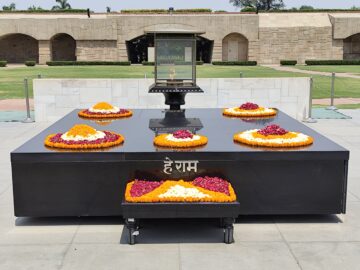
Standing at Raj Ghat, the memorial for Gandhi in New Delhi, near where his corpse was cremated, I began to think about a problem I’ve been grappling with for a long time. With all the good, kind-hearted and sincere people in the world, why is the world not becoming a substantially more humane place?
I am surrounded by incredibly sweet people. I’m often deeply moved, and genuinely amazed, by how generous and compassionate they are, and the lengths they go to in order to be helpful. If you were to judge the world solely by these folks, you would think it to be a gentle, caring place. Comedian Patton Oswalt wrote (after the Boston Marathon bombing), in regard to those causing harm in the world, “The good outnumber you, and we always will.” So, then, why are the good people losing?
It’s pretty clear that the world is not a gentle, caring place. There are at least 50 state-based armed conflicts right now, corruption and duplicity thrive, greed runs unquestioned and unchecked and our climate is deteriorating. In the USA our prisons are full, children struggle to read, income inequality is outrageous and people are barely scraping by paycheck to paycheck. We are in another war. Many of our cities are still racially segregated and class divisions cause unjust treatment and disparate life opportunities and outcomes. Our cities are filled with homeless. The news seems like an unending sequence of cruelty and incompetence.
Standing in silence before the eternal flame at Raj Ghat, reflecting on all that this man did, I felt that his determined effort not only to become more humane, but also to challenge the larger systems that produce suffering, provided the beginning of an answer for me.
After visiting Raj Ghat, and wandering through the nearby Gandhi museum, which traces his life from infancy to death, my big theory now involves what might be called “micro-morality” and “macro-morality.” I think most people shoot for and are largely satisfied with micro-morality…politeness, kindness, volunteering, controlling their temper, forgiving, being nice.
Gandhi demonstrated that micro-morality is essential, but not good enough. We have to be morally good people used to looking inside and judging what we do before we do it, but also people who look seriously at the flawed systems that surround us and think about what we can do to oppose them and possibly change them for the better. My working theory right now is that the world is not becoming more humane because most of us stop at the micro level, whether we realize it or not.
To a great extent Jesus preached micro-morality – forgive others, love your enemy, show mercy, become a new person who responds more humanely to malicious people and situations; act in a morally higher and counter-intuitive way from the easy, unreflective and aggressive way we are normally expected to act. Shoot higher, act beyond the commonplace, rise higher than most aspire to rise by looking inside and recognizing corrosive tendencies we do not need to manifest – we don’t need to hate, to seek revenge, to harm in the name of self-righteousness; we need to love.
Gandhi was greatly influenced by the ethics of Jesus. Reflecting at Raj Ghat, I began to recognize how Gandhi repeatedly translated Jesus’ micro-morality – the ethics of individual transformation and restraint – into macro-morality: collective vision and practices designed to reshape political and social reality.

Jesus’ injunction to “turn the other cheek” (personal non-retaliation) does not remain in Gandhi’s thought as mere private virtue, but becomes satyagraha, or disciplined nonviolent resistance, where entire communities collectively refuse retaliation even in the face of state violence. In movements like the Salt March (1930) and mass civil disobedience campaigns, this principle is developed into a form of coordinated political refusal where millions enact nonviolence as strategic moral pressure.
Similarly, Jesus’ command to “love your enemy” becomes in Gandhi’s hands a reexamination of the oppressor. The British are not conceived of as ontological enemies, but as morally persuadable actors trapped in unjust systems. To see one’s public adversary as capable of conscience, rather than as a fixed embodiment of evil, confers power on the people. This logic underlies Gandhi’s insistence on maintaining dialogue with colonial authorities even during resistance, and his belief that moral transformation of the oppressor is part of the struggle itself.
The Gospel emphasis on inner purity – “first remove the beam from your own eye” – is expanded into Gandhi’s politics of self-purification as public legitimacy. His fasting, vows of celibacy (brahmacharya) and radical simplicity are not merely personal disciplines, they function as political instruments intended to confer moral authority on collective action. For example, during communal tensions, Gandhi’s fasts were explicitly used to convert personal suffering into a public ethical intervention aimed at halting violence.
Jesus’ preferential concern for the poor and marginalized becomes, in Gandhi’s hands, a program for national restructuring. His focus on the Harijan (Dalit) uplift, village self-sufficiency and manual labor (khadi and the spinning wheel) translates compassion into institutional and economic reform. What begins as interpersonal mercy becomes a critique of industrial capitalism, caste hierarchy and colonial extraction.
The Gospel critique of wealth – “you cannot serve God and Mammon” – is reworked into Gandhi’s doctrine of trusteeship, where private wealth is treated as socially obligated capital rather than absolute property. This is a clear example of micro-morality (detachment from greed) becoming macro-morality/structure (a proposed economic model for society).
Jesus’ association of truth with spiritual liberation – “the truth shall set you free” – becomes Gandhi’s principle of satyagraha as political force: truth is not only personal honesty but a collective method of resistance grounded in transparency, public accountability and refusal of deception.
Finally, Jesus’ acceptance of suffering without hatred or desire for retaliation is transformed into Gandhi’s doctrine of redemptive suffering. In this view, voluntary endurance of harm without retaliation is not merely ethical purity but a tactical and symbolic force. It generates political pressure by exposing injustice without reproducing violence, turning the body itself into an instrument of mass persuasion, as seen in imprisonment campaigns and hunger strikes.
It could be argued that the character of Jesus, in the Gospels, posed little concrete economic or institutional threat to the dominant culture of the ancient world comparable to, for example, the Brothers Gracchi, who proposed equitable land redistribution and directly challenged senatorial wealth. Jesus had, after all, no practical blueprint for restructuring taxation, land ownership or class relations. His message was personally moral and symbolic (about “rebirth” or becoming a “new person”).
I would argue that contemporary, major world religions seem oriented much more toward micro‑morality – personal virtue, inner transformation, peacefulness, tranquility, moral discipline and the cultivation of a humane and meaningful interior life where you can respond to evil or harmful behavior with equanimity and even love – you are encouraged to find the emotional wherewithal not to return evil for evil and to display tolerance and compassion in lieu of retribution.
This is one reason Marx’s line about religion being an “opiate of the people” resonates so deeply: if a tradition focuses almost entirely on the inner world, it can leave unjust systems untouched. It is basically saying: “Be a nice person within whatever context you find yourself.” In popular culture you sometimes even hear statements like, “Don’t try to change the world, try to change yourself.” Gandhi seemed to be saying we need to do both, but not in that order.
What is remarkable is that Christianity actually did manage to produce some social change in the ancient world from its micro‑moral foundation (Quo Vadis? is an excellent novel showing the positive moral effects of early Christianity on people in Roman society). Rome became more humane in certain aspects – infanticide declined, gladiatorial games started disappearing, charity expanded, hospitals were built, caring for the poor and vulnerable was increased – yet the truly harmful structural systems like slavery, sexism and class-based poverty were not openly or directly challenged. In fact, poverty was spiritualized and reframed as an opportunity for virtue instead of an injustice to be eliminated. Micro‑morality softened hearts, but it did not restructure the world.
By contrast, the great social revolutionaries (Marx and those who followed him) were almost solely oriented toward macro‑morality, the critique of systems, structures and economic arrangements. But they often lacked the micro‑moral dimension that makes humane revolution possible. This is one of the central insights people get from Animal Farm: the pigs and dogs fail not because their analysis of the system is wrong, but because they are personally corrupt, inwardly under-developed and ethically unrefined. Without micro-morality, macro‑morality seems predisposed to authoritarianism and cruelty.
I remember learning in a Marxist Social Science class in Madison that Marx wanted to remove his social theory from the realm of ethics and plant it firmly in materialism. He wanted a science of history, not a moral judgment. But a revolution without a moral vision can become an exercise in ends justifying means, to catastrophic consequences.
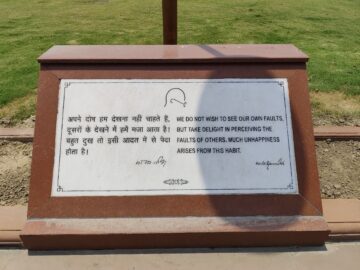
Gandhi is a rare figure who bridges these two worlds. He insisted on micro‑moral transformation, self‑purification, non‑retaliation, truthfulness, mercy, the renunciation of greed but he refused to let these remain private virtues. He elevated them into macro‑moral social action, using them to challenge imperialism, economic exploitation, caste hierarchy and political domination. Gandhi shows that humane macro‑morality can and should grow out of humane micro‑morality: the inner world must be understood and allowed to develop pro-socially to help generate a just social and economic world.
Gandhi refused to let his ethics remain private. He took the vocabulary of micro‑morality and extended it outward, insisting that personal virtue must confront the systems that produce suffering. Once you complete your micro-moral development, you are not simply to take your place in a pre-existing and possibly flawed overall system. You can now give your life further meaning by fighting the good, compassionate fight to ensure justice and equality for others.
Gandhi said, to paraphrase, “Look at the structures around you causing evil for others. You have an obligation as a moral person to also try to change or at least challenge them, but you must challenge them as a moral being, through humanity and non-violence.” Micro‑morality also has the capacity to become a way to feel moral without threatening the arrangements that produce suffering. This is why “good people” may not be making the world better.
I am now going to argue that it is difficult to move beyond the first stage of politeness, kindness, volunteering…the small aspects of personal conduct. Indeed, in our society many people do not even see the need for developing this initial level of maturity and morality and they just act as they feel like acting or speak as they feel like speaking without recognizing or checking any inner motivation toward the morally spiteful or harmful. We are, frankly, an insight averse society. We set behavioral standards for each other, even on a micro-level, that are pitifully low.

Most people who do care about bettering themselves often only think of morality as a private matter: a set of small, interpersonal obligations that govern how one behaves in daily life. Don’t lie, don’t lose your temper, be polite, be charitable, be “a good person.” This is the ethics of character, of self‑management, of not harming the people immediately around you. It is necessary, but it is often politically inert.
A society can be full of individuals who recycle, volunteer, speak kindly, and still be governed by predatory institutions and violent hierarchies. Micro‑morality does not automatically challenge larger evil. It does not confront power. It does not alter the adverse, inequitable conditions under which millions live. It can offer moral comfort without structural consequence.
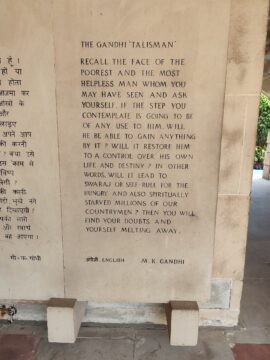
Gandhi’s historical significance begins precisely where micro‑morality ends. He refused to treat virtue as a private hobby. Instead, he extended the vocabulary of personal morality into the realm of political action. Non‑violence, self‑discipline, truthfulness, restraint, these were not merely traits of a good individual, they became instruments of collective resistance, but, even here, we can ask whether he went far enough. Colonial India offered a uniquely clear antagonist: a single, visible, unified system of domination. The British Empire had a name, a flag, a bureaucracy and a moral incongruity that made resistance recognizably necessary.
Did Gandhi stop at the most visible layer of injustice? Removing an imperial oppressor was morally urgent, but it did not require confronting the deeper structural evils that continue to haunt Indian society to this day. Gandhi’s moral extension was possible in part because the target was so obvious. It was like slavery in the United States: once the conflict became regionally defined and morally stark (thank you Harriet Beecher Stowe), it became easier for many Northerners to jump to macro-morality and mobilize against it. Indeed, one of the amazing aspects of Uncle Tom’s Cabin is that Stowe shows “micro-moral” Southerners living comfortably with slavery, some of whom consider themselves moral even while owning slaves.
Gandhi confronted the British Empire with extraordinary moral vision, but can we say the same for his engagement with caste, class and gender? Gandhi did not push as deeply into these internal structures as he did into empire, perhaps (just guessing here) because his method required a visible external oppressor, maybe because he feared fracturing Hindu society and/or maybe because his own social imagination remained, in all candor, a bit conservative.
But Gandhi still created a moral framework that made large-scale action possible, a bridge between inner transformation and structural confrontation. In this respect I think he mirrored the Abolitionist Movement and foreshadowed the Civil Rights Movement (King was, of course, greatly influenced by Gandhi) in the United States: both eliminating overt evils without fully dismantling deeper systems.

So Gandhi’s achievement was not that he solved every structural injustice, but that he demonstrated how micro‑moral discipline could be elevated into macro‑moral action. He showed that personal virtue could become public power. The challenge is that most societies stop at the first victory. They remove the visible oppressor and leave the invisible structures intact. Gandhi pushed farther than most, but even he could not complete the work.
For us in the US, the systems developed in a democratic society produce suffering that is often diffuse, normalized and hidden in plain sight. A criminal justice system that disproportionately harms the poor, an economic order that generates vast income inequality and homelessness, a healthcare system in which people die due to lack of access…these are not foreign occupiers. These are your neighbors, your fellow subway riders.
For every person who stands up and says, “There has to be something wrong with a criminal justice system that prosecutes people who come from impoverished, segregated and crime-ridden neighborhoods; perhaps we need social and economic reform to end crime instead of prisons…” numerous other people will jump up and shout louder: “Everybody is responsible for their own actions! Don’t talk to me about how poverty creates crime! People create crime. No need to change anything economic or social.”
Democracy does not guarantee automatic transparency about the morally problematic aspects of dominant cultural systems and our educational system largely ignores this. Frankly, democracy seems to produce a vast intellectual lumpenproletariat, citizens who have no interest in examining the structures that shape their lives and no desire to think beyond their immediate comfort. They are not oppressed or in danger, they are safe and unreflective. Or, perhaps they are taught in our educational system that they are not important and have no right to articulate what they feel to be wrong about their lives or the lives of others. I think this is true too.
Democracy can create a type of ethical complacency where people stop examining the moral dimensions of their world and instead absorb whatever dominant narratives surround them. It’s about voluntarily surrendering critical thought and moral responsibility without anyone forcing a person to do so.
Because their own lives feel “fine,” they assume the world is fine. This is the real obstacle to macro‑moral change in a democracy: not a dictator or a junta but a mass of free people who cannot or will not see the need for meaningful change of harmful conditions. They have unlimited access to knowledge and wisdom and total freedom of speech, but they support inequitable and unjust systems harming so many.
What they believe is woven into the fabric of everyday life. This is the difficulty of macro‑morality in the modern, democratic world: the structures that need to be changed are the very structures people have been taught to accept as inevitable. If you see something wrong and challenge it, you are resisted by a majority that has not thought as long or as hard as you have. This inhibits many people from thinking or speaking at all. Perhaps our job is more difficult because we are not fighting against an empire with a track record of imperialism and racial cruelty; in our case the “enemy” is hidden beneath excuses and what Antonio Gramsci called “hegemony.”
What should alarm us the most is not simply the existence of unjust systems, but the fact that our educational institutions have left most citizens unable to perceive unjust systems as moral objects at all. We have built an entire structure of schooling that does not help or encourage people to see or question structural harm. This is not truly democratic education.
We might begin to wonder what people are even learning in college as it does not seem to prevent the election of leaders who are unfit for office. In 2020, 43% of college graduates voted for Donald Trump. 48% of these were White, 27% were non-White.
Basically, close to half of the White people in America who went to college voted for Donald Trump in an election. This is just a reminder that higher education alone does not produce macro‑moral awareness. This forces the question of the extent to which higher education has a truly transformative effect on human beings beyond providing them with marketable skills.
We teach children to be polite, to share, to obey rules…the grammar of micro‑ethics, but we do not help young people, at any point, to analyze the justice of the over-riding values, rules and structures themselves. We strive to produce well‑behaved individuals who lack the conceptual tools to interrogate the arrangements that govern their lives.
We do not provide the opportunities or help people to recognize how structural inequality, historical injustice and inherited advantage shape the world they inhabit. This is the result of the passive learning that students encounter throughout their educational lives, K through grad school. This is what Paulo Freire called the “banking system” of education – the student’s brain is the bank and the facts and knowledge of the (biased) curriculum that get poured into it are the currency.
We do not seem to be helping 40 – 50% of the White college graduates in the USA learn that there are other races and ethnicities out there, and economic classes, who are suffering and who need help because of generations of racism and inequality. If a pharmaceutical company ran clinical trials for a pill that claimed to cure a disease, and nearly half the patients who took it still showed symptoms, the treatment would be suspect.
If four years of college cannot reliably produce macro‑moral awareness, cannot reliably teach people to recognize injustice, cannot reliably inoculate citizens against demagoguery, then the institution is not functioning as a beneficial moral or civic force, but more like an empty credentialing service. Higher education, which claims to cultivate critical thinking, civic awareness and moral reasoning, appears to be failing at its most essential task. A society that allows people to remain oblivious to structural harm has abandoned the very possibility of real and meaningful social change.

Raj Ghat, with its austere black marble and nearly empty grounds, is an apt symbol for this distinction between micro and macro-morality. It is not a crowded monument – to be candid, it is out of the way, a bit difficult to get to by public transportation and few people seem to go there. It is a quiet, difficult‑to‑reach space that requires intention and effort.
The walk to it, through heat, pollution and long stretches of emptiness, reflects the intellectual journey from micro‑morality to macro‑morality. The easy path is populated; the hard path is nearly deserted. Most people remain where it is comfortable. Gandhi walked where it was not. He invited us to try this as well.
The lesson of Raj Ghat is that morality becomes meaningful only when it grows beyond the ego. Micro‑morality governs the self; macro‑morality governs the world the self creates and inhabits. Gandhi’s achievement was to defy the separation. He insisted that personal virtue must confront structural injustice, that ethics must become public power. In a world filled with well‑behaved individuals within failing institutions, that insistence remains radical and necessary.
Note: I first employed the distinction of “micro-morality” and “macro-morality” in an essay for Bright Lights Film Journal, arguing that Sam Peckinpah’s films suggest that human beings often preserve micro-moralities – politeness, fairness, reciprocity, loyalty – after abandoning macro-moralities such as justice, compassion or responsibility toward larger systems. This is distinct from the framework of microethics and macroethics that has been used by others in the past.
In The Wild Bunch it is implied that people prefer manageable moral problems over overwhelming ones like war, systemic injustice or institutional corruption. The result is a kind of moral schizophrenia: the ability to feel decent while the world burns around them.
***
Enjoying the content on 3QD? Help keep us going by donating now.