
by David J. Lobina
The role of failure is an underappreciated issue in professional sports – and a brutal reality for most sportspeople in general, in fact, professional or otherwise. I myself play tennis regularly, and I find that I often lose my matches even when I play well. It is rather disheartening, but the fact that I don’t play badly in these losses – and, well, that I typically enjoy playing anyway – makes it worthwhile to continue, though it can take a toll sometimes.
And the situation is all the more dramatic for professional tennis players; indeed, it is hard not to notice that many tennis pros lose more matches than they win, and the toll must be huge (there are expenses to cover, ranking points to covet, and a living to make; this book in particular is an enlightening and fascinating account from a player who did not quite make it, but still play some big matches).
This here is the current ranking of the top 100 male professional players according to their win/loss index. The very top players (2/3) rarely lose; the players below and up to the top 30 win more matches than they lose; the players below the top 30 win a bit more than they lose (but in some cases barely above a 50% success rate); and then from the top 50 downwards the success rate starts at 50% and quickly goes down (the current number 100 has a 6-14 record). And this is only in terms of match win/loss ratios; the vast majority of professional players have not won a tournament this year (this is true of 3 players from the current top 10 right now), and winning tournaments is the most coveted outcome in professional tennis.
But as mentioned, you can play well in a tennis match and still lose, which introduces a different family of failures altogether; in particular, the rate at which players actually lose points in a match. The final match at the 2025 Roland Garros between the top 2 male players at the time is a good example. A total of 385 points were played on the day, with each player winning 50% of points (192 for the winner, 193 for the loser), and this suggests that the match was won (or lost) at very specific junctures – one player managed to win some of the most important points here and there (break point up, set point up, etc.).
In terms of the kinds of shots involved in a tennis match, there are plenty of misses here too. The serve is a central point in tennis, and it does win a player many points, in addition to being the one shot that is under the full control of the serving player. But it is not always as successful as you would expect. At the Roland Garros final, neither player made over 60% of first serves, and in some sets this was closer to 50% and even below it; and when the first serve did go in, neither player won more than 70% of these points, with the percentage of points won on second serves below 60 for both players. Now Roland Garros is a special case, as it is played on a slow clay court surface and this doesn’t benefit the big servers at all, though it is still a dominant shot – in the match I’m highlighting neither player won more than 40% of their receiving points, for instance.
For comparison, across all surfaces and matches, in the last 52 weeks of play 67 players are above 70% in terms of first serve points won, whereas in the case of receiving points won the leader is at mere 32%. There’s a lot more interesting data in tennis, but the general point is clear, I think: winning or losing a match depends on small margins and you have to accept that you are going to miss many shots and lose many points, even if you may win in the end.
Naturally enough, different sports exhibit different patterns of failure. In association football, for instance, pass accuracy is rather high overall (that is, the rate of completed passes, without losing possession), with no team in the UEFA Champions League competition below a 77% rate at present. And so is conversion rate for penalties; this paper lists penalties taken across five Champions League competitions and reports an 80% conversion rate. Other aspects of the game are not so accurate, of course; scoring a goal is the most difficult thing to do in football and there’s not too many of them in any one match, and this is not for lack of trying. In this year’s Champions League, Paris Saint-German leads all teams in both goals scored (34) and attempts at goal (240), and this is a success rate of just 14%.
The Argentinian player Lionel Messi, one of the most successful goal scorers in the last 50 years, is an outlier in many respects, as shown in this study from 2014, but scoring a goal is hard for him too. As you can see in the graphic below, he scores 47% of all attempts within the goal area (darkest blue in the graphic), which is extremely close to the goal, but around 22% within the penalty box and only around 12% outside of the penalty box (the article includes data from Cristiano Ronaldo, another very successful goal scorer from the last 50 years, though his averages are below Messi’s).[i]
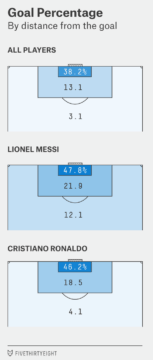
So, in a nutshell, with these numbers, in association football volume (attempts at goals) has to be high for a team to be successful at scoring – and, thus, to have a chance at winning.
High volume is also important in basketball, and has become even more so in recent years. Now scoring a point in a basketball match is not as difficult as scoring a goal in football, and many players score multiple points in any one basketball match. But there is a lot of failure in basketball as well.
Take the NBA, which is very good at keeping stats (though it could be better in some respects, as I shall point out). Putting to one side runaway plays and the like, with players going up to the basket completely unimpeded, and which must approximate a 100% success rate, the free throw must be the most successful kind of shot in basketball (another unimpeded shot, not too far from the basket), and NBA stats seem to confirm this. Of 120 players listed here, 111 have a higher success rate than 70%, which is not low (though some commentators would regard this on the low end for top players).
The very opposite is the case for the three-point shot, the furthest shot from the basket, as the leader in this category is at 49% out of 160 players, with most players below and well below 40% (only 31 players have a 40% success rate, in fact). The NBA also tracks field goal percentage, which tends to be higher than three-point averages, even though it annoyingly includes three-point attempts and makes as well – for most purposes, though, many commentators treat this category as a measure of how good a player is in two-point plays, a category that tends to be led by the tallest players, and so those who play closer to the basket and who shoot fewer three-point attempts (the NBA doesn’t offer a two-point category, though they really should, and other sites do; see here). As a matter of fact, the current top 3 players have a 0% success rate with three-point plays, even though only one of these players has even attempted any this season (and only 4 at that), and they all have an over 60% success rate in the field-goal category.
Interestingly, a success rate of 50% is regarded as very good in this category for a shooting guard (the most mobile players in a basketball court, not the tallest players in the team and thus not players who attempt most of their shots from a short distance), with the combination of 90-50-40 (namely, 90% in free throws, 50 in field goals, and 40 in three pointers) regarded as an exceptional performance for a player to have in any one season (and indeed it has not happened all that often). So, other than in the case of free throws, you can expect to see a top player miss a great many of their two-point and three-point plays, and this makes for an interesting experience for a novice fan of the sport. I grew up watching mostly association football, and from the age of 16 or so I started to be interested in basketball, and in the NBA. It took a while to get used to having to track so many statistics (a curious aspect of most American sports, actually), and to understand their importance, but there is no denying that even in the case of extreme performances, and I usually like to point to Michael Jordan’s 63-point playoff game against the Celtics in 1984 as an example, still a record, if you watch the entire match, you will see Jordan miss a lot of shots – 19 out of 41 of two-pointers, which is almost half of them![ii]
The rate of missed shots in basketball is not in itself the issue; a missed shot gives rise to the possibility of a rebound, and to a new shot – that is, a missed shot allows for another kind of statistic to be gathered (rebounds per game), and a sort of equilibrium is achieved (I won’t discuss baseball, where failure is even more pronounced and there is no obvious balance, at least to me). As in football, the most successful winning strategy these days is increased volume of shots, especially of three pointers. And, hence, the avalanche of three-point plays in modern basketball; there’s some pushback against such tactics, especially from those who favour inside play, but what the hard data show really is undeniable.
So, is the idea to accept failure and get on with it, then? The sentiment has certainly been embraced many times before, including in basketball, and even to the benefit of corporate American to boot. This is clearest in Michael Jordan’s famous Nike commercial about failure.
I’ve missed more than 9000 shots in my career. I’ve lost almost 300 games. 26 times, I’ve been trusted to take the game winning shot and missed. I’ve failed over and over and over again in my life. And that is why I succeed.
Or so we are told in the commercial, a quote that is often attributed to Jordan directly as a source of wisdom – the need to experience failure on one’s journey to success (ah, so capitalist of them) – even if Jordan himself seems to have taken it all a lot more lightly at the time (I remember a press conference where he’s asked about the accuracy of the numbers, and he just replies something along the lines of ‘oh, I’m sure it’s more than that, it’s just a commercial’, but haven’t been able to find it).
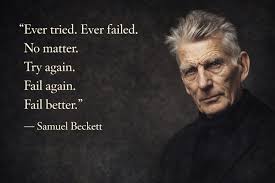
And this goes for tennis too. Stan Wawrinka sports a tattoo of a literary quote that has often been taken to mean much the same thing as Jordan’s commercial – failure as a necessary part of success – namely Samuel Beckett’s ‘fail better’ quote from his Worstward Ho! book:
Ever tried. Ever failed. No matter. Try again. Fail again. Fail better.
Shame that the immediately following words paint a much darker picture of failure:
First the body. No. First the place. No. First both. Now either. Now the other. Sick of the either try the other. Sick of it back sick of the either. So on. Somehow on. Till sick of both. Throw up and go. Where neither. Till sick of there. Throw up and back. The body again. Where none. The place again. Where none. Try again. Fail again. Better again. Or better worse. Fail worse again. Still worse again. Till sick for good. Throw up for good. Go for good. Where neither for good. Good and all
Accepted facts, not self-help, half-baked ideas about “your journey”.
[i] Do note, though, that Messi scores ‘almost as often per shot from outside the penalty area (12.1 percent) as most players do inside it (13.1 percent)’, as the FiveThirtyEight article puts it, an incredible datum in itself. He is also by far the best at goal efficiency given his volume of shots, which is very high indeed, and this is also quite impressive.
[ii] As it happens, I used to have this match on tape, loads of people borrowed it to check out Jordan’s performance for themselves, all of whom had a passing interest in basketball, and they all reported the same impressions: there was a lot of failure and bad shots in there, at least according to my friends. By the way, Jordan did not attempt a single three-pointer on the day (for a mere 2 for the entire Bulls team).
Enjoying the content on 3QD? Help keep us going by donating now.