
Andrew Deming in aeon:
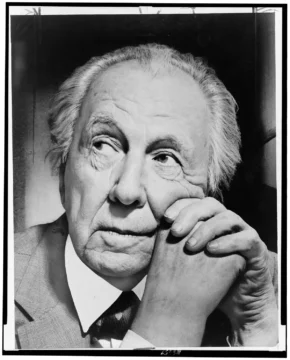 I was 10 when Frank Lloyd Wright first entered my consciousness. I was sitting crosslegged on the beige carpet of my bedroom in a tract house in Melbourne, Florida, watching a Ken Burns documentary about Wright on PBS. Both my parents were schoolteachers, interested in history and travel; for them, the world of architecture belonged to another planet entirely: buildings were background texture. But I noticed the scalloped sink in my parents’ bathroom. I noticed that the façade my house shared with so many on our cul-de-sac looked strangely better in its mirrored version across the street – or perhaps it was only that their landscaping added the faintest sense of intention to a place otherwise void of character. And then there was Wright, whose buildings felt impossibly different from anything I’d seen. His rooms were not rectangles to be filled but worlds unto themselves – shadows, stone, light pouring in sideways. His spaces, at once intimate and vast, were shaped by ideas I had no words for, yet immediately recognised. His work reached backwards and forwards simultaneously: primitive shelter reimagined with an aesthetic that felt both timeless and unmistakably American.
More here.
Enjoying the content on 3QD? Help keep us going by donating now.