
by Scott Samuelson
One of my early memories is lying awake at night, trying to discern through the sounds of the wind the creeping of an Iranian on the roof outside my bedroom window. For a few months, when I’d look both ways to cross the street on my walk to school, I’d scan less for oncoming traffic (my rural town had almost no traffic) than for a stampeding horde of Iranian college students.
I was six years old—just mature enough to pick up on the anxieties of the news. After footage of angry Iranians storming over fences under the banner of a severe bearded old man, Walter Cronkite would sign off each night by numbering how many days the Americans had been held hostage. I must have heard in passing the phrase “American embassy in Tehran,” but it entered my young mind like “city hall in Paducah.” For all I knew, the elementary school of Ainsworth, Iowa was going to fall next. Doesn’t our country have an army supposed to protect us? Why isn’t anyone doing anything? How can we let Iranians snatch up innocent Americans?
The best argument for the United States’ war against Iran (insofar as reason has anything to do with it) hews closely to my six-year-old self’s fears and demands. Don’t we have a mighty military? Why haven’t we done anything for the past five decades? We can’t let Iran have weapons, especially nuclear weapons, because Iran threatens the whole world with impunity.
Setting aside the pile of important procedural and strategic objections to the current war, let’s say—against all odds—that its ostensible goals are realized: the military power of Iran is obliterated, and the vicious ruling regime is eliminated. Obliterate and eliminate—and then what? Many years ago, in a discussion of disarmament talks, E.B. White wrote,
Every ship, every plane could be scrapped, every stockpile destroyed, every soldier mustered out, and if the original reasons for holding arms were still present the world would not have been disarmed. Arms would simply be in a momentary state of suspension, preparatory to new and greater arms.
If that’s true of disarmament talks, how much truer is it when another country has destroyed your stockpiles in an act of aggression?
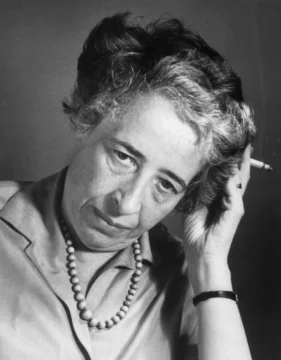
The tenderest hope of the warmongers—a hope I happen to share—is that the Iranian people will find a decent government to replace its current rulers, who, among many other reprehensible things, have killed thousands of Iran’s citizens for protesting the regime’s corruption and repression. Whether that hope for a humane government briefly flutters on the hearts of Iranian dissidents or confidently bangs from the keyboards of the Wall Street Journal, it’s magical thinking to believe that a cleansing violence, especially when inflicted by an aggressive foreign power, is sufficient to make it come true. Does America really think that in humiliating the Iranians and walking away it will make their country more democratic and peaceable? Hannah Arendt once observed, “The practice of violence, like all action, changes the world, but the most probable change is to a more violent world.”
Maybe the war is necessary but not sufficient for positive regime change? Admittedly, examples do exist of a country’s successful one-eighty after being devastated by foreign war, though they’re few and far between. The two that leap to my mind are Germany and Japan in the wake of World War II. Most historians give some degree of credit to the Marshall Plan, which helped the United States’ erstwhile enemies rebuild not only their infrastructure but their dignity. Is my country prepared to offer a Marshall Plan or something like it to Iran? Such a prospect under this America-First administration, which flirts with video-game fantasies of its own theocratic violence, is non-existent.
Or maybe my country is willing to unleash death and destruction only up to the point that it begins to cramp our style at the gas pump? If so, the whole thing screams of the profound unseriousness and shocking inhumanity that we’ve put in charge of our psyches and our politics. The fact that the best-case scenario now looks to me like the TACO offramp—a compound of weak-bully and bored-toddler psychologies—is deeply depressing.
Here’s another memory of mine, from when I was an eighth grader, and my best friend’s dad was an Iranian American. As a young man, he’d fled to the United States, married an American, and raised two kids with her. Over at my friend’s house one day, I was surprised when it dawned on me that my friend’s father must have emigrated well before the Ayatollah had come to power. Wasn’t 1979 the beginning of the Iranian nightmare? My friend’s dad was a gifted artist and a proud citizen—reluctant to talk politics. But, at the prompting of his feisty wife, he opened my teenage eyes to a world more complicated than my naïve vision of American innocence and Iranian villainy.
He and my friend’s mom explained to me how the former prime minister of Iran had nationalized the oil industry with democratic backing; how the CIA and MI6 had teamed up in 1953 to support a coup against him; how the US and the UK compelled the Shah to give them a sweetheart deal for Iranian oil; how they helped the Shah in establishing a secret police to suppress dissent.
We talked about a lot of things that day. The rise of the Ayatollah. The hostage crisis. US support for both sides of the Iran-Iraq War. The recent Iran-Contra hearings. The atrocities of various Iranian regimes. He said that he thought of himself as Persian rather than Iranian.
As we talked, I thought back to when I feared Iranians as a six-year-old. I thought about the quiet, lively, brilliant, naughty-humored, generous man in front of me. I thought about how he’d fled his birth country to mine. I thought about the fear that many Iranian six-year-olds must have felt as the bombs lit up the nights during the coup or over the years of the Iran-Iraq War. I thought about irrational fear compared to all-too-rational fear and where those fears lead people in life. I thought about the fears of people all over the world and how they’re encircled by outward-rippling contexts of violence and politics. I had a sinking feeling that we easily turn into what we fear.
It was a lot to take in. And I didn’t know what I could think of myself as other than American.
***
Scott Samuelson is the author of several books. His most recent, To Taste: On Cooking and the Good Life, comes out this fall.
Enjoying the content on 3QD? Help keep us going by donating now.