
by River Lerner

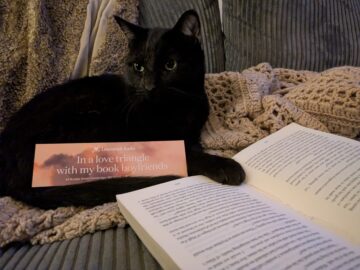
If one strolled into Lovestruck Books, a floor-level shop that tucked itself into Cambridge’s Brattle Street just over a year ago, one would indeed be struck by the cheery, colorful atmosphere, the warm aroma of coffee from the adjacent cafe, and the giggles of gaggles of women (and odd folks such as myself) leafing through endless volumes and kinds of illicit romance. One might earn a free bookmark, as did this writer, that declares: “In a love triangle with my book boyfriends.” Index card placards line the rows of featured texts adorned by gilded covers of dragons and bloody roses. On the homemade placards are endorsements by the staff for this week’s top literary picks.
Book after book, in different handwritten fonts, these voices join in chorus: “If you’re a fan of ACOTAR…”
Everyone at Lovestruck knows ACOTAR: the beloved, worn acronym for A Court of Thorns and Roses book-turned-series by Sarah J. Maas, penned when she was only twenty-three. This 2015 genre gateway book took contemporary romantasy by storm as a respun tale of Beauty and the Beast… with significantly more magic and make-outs. Here I presume my reader is familiar with the first two books, namely ACOTAR and ACOMAF (A Court of Mist and Fury, the sequel.) I also presume my reader is likewise heartwrenched by not the love story we are initially spoon-fed between Feyre and Tamlin, but rather her verboten dynamic with the night-cloaked, jasmined, infuriatingly cocky and transcendently clever dandy known as Rhysand.
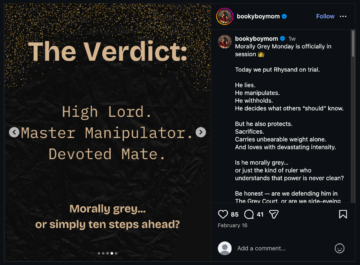
Rhysand is more than, in Feyre’s words, the face of a thousand dreams and nightmares. He is also the subject of many a heated online debate about the morally grey character [1-8]… i.e. what it is (if it exists) and whether Rhys qualifies. The ACOTAR community has polarized views on this matter, with many individuals shifting positions as they receive the revelations offered in ACOMAF. But consider the tense year between their publication dates—May 2015 to May 2016—when the community was left on the cliffhanger of why Rhys takes a special interest in Feyre while he also tortures, torments, and belittles her. Utilizing ACOTAR alone, it takes some real book biopsy and tasseography to get a sense of his true ethical temperature, motivational drivers, and north star.
Moral grey attempts to capture the unflattening of heroes and villains into complex characters who waver, err, and do not always live up to their ideals or our expectations of either pole. I postulate there are three shades to be considered: ambivalent, ambiguous, and neutral. In Rhysand’s case, let us first strike the obvious: this antihero is anything but neutral. Don’t be fooled by his carefully placed yawns and nonchalance, for if you think he is not invested, you are sorely mistaken.
“What do you care?” I barked, and his grip tightened enough on my wrists that I knew my bones would snap with a little more pressure.
“What do I care?” he breathed, wrath twisting his features. Wings—those membranous, glorious wings—flared from his back, crafted from the shadows behind him. “What do I care?” (380)
Thus we are left with ambivalence versus ambiguity. Who really is the man behind the mystery?
The true adventure begins not Feyre’s entrance to Prythian, but with Rhysand’s entrance at Calanmai (ACOTAR 188):
“There you are. I’ve been looking for you.”

Saving us from the boredom of everlasting springtime, Howl Pendragon—wrong story, pardon me—steps into scene and drapes his arm around Sophie—ugh! did it again—and Feyre is instantly protected from three lesser lascivious faeries by the most beautiful man she has ever seen. Everything in her is strung taut between warm, unidentifiable feelings (a hallmark of romantasy) and a primal warning to run far away. Rhysand is temptation incarnate with his violet starry eyes, raven-feather hair, “lover’s purr” voice, and lethal power. We don’t know why we should be afraid of him yet, but Feyre’s instincts caution us so.
Then in Rhysand’s unannounced visit to the Spring Court (234), our intrigue sours as he reveals himself to be a bad dude. He keeps prisoners, he has enemies, and he apparently sent Tamlin a head on a stake. Horrifically, we see him violate Feyre: scraping mental claws against her mind, threatening everything she is, he smugly reads aloud her intimate thoughts about Tamlin as though he is thumbing through a diary. As if that weren’t enough, Rhys forces Tamlin to his knees to grovel for Feyre’s preservation—a lion cowering before his tamer—and despite that degree of humiliation, Rhys does not even promise her safety. At this point, whatever inkling we had about an emergent love triangle is squashed. How could anyone betray Tamlin, glowing golden beast of goodness, for this vulture?

Much later do we learn this is the second major time Rhysand offers Feyre protection in his masterful chess. His show frightens Tamlin into sending her back over the wall and out of Amarantha’s view (and away from further deceptions of Spring.) Of course our Katniss will no longer be sidelined, so she forges her way back over the wall and down Under the Mountain, where she must prove her love for Tamlin against the Witch of the Waste. Yet as we watch Tamlin sit stone-faced and helpless—or at least offering no help—bethroned beside Amarantha, Rhysand shines center stage and delves into the trenches with Feyre. This is where we see his least parsable, most maddening, and retrospectively lifesaving behavior.
Clare Beddor, innocent lamb ratted out by Rhysand-Judas, hangs nailed and mangled high on the cavern wall. However, Feyre lives because of Rhys’ implausible denial that he couldn’t possibly know her name (despite being the most powerful High Lord in history who—just a few chapters before—had skimmed her darkest thoughts as though they were a Cosmo column.) Could it be the case that Rhys wants her to survive this?
The list goes on with the twists and turns of Rhysand’s alignment. Here are just a few examples:
- Rhys aids Amarantha in choosing Feyre’s first deadly test. Of note, he suggests hunting, which is Feyre’s greatest skill.
- In exchange for healing Feyre’s septic, broken body—which, to convince her, requires Rhys to literally twist her arm into agreement—he forces her into a Persephone-Hades weeklong timeshare per month. How cruel! However, this deal presupposes Feyre makes it out of the mountain… a presupposition Rhys flaunts to Amarantha in front of an audience, such that it temporarily defangs the queen’s narrative that Feyre’s death is inevitable. (“For the rest of my life—he said it as if it were going to be a long, long while.” – 349)
- But how about when Rhys kills the Summer Court civilian by squishing his brain until it hemorrhages from his ears? Was that indeed a merciful fate compared to the alternative? The Summer Court and other audience members believe so, offering their gratitude to Rhys as he exits the room, harrowed.
Online arguments most often highlight Rhys’ multiple violations of Feyre’s bodily autonomy that seem antithetical to his broader orientation toward freedom and dignity. To list a few: Feyre’s swirling left arm tattoo and blinking cat’s eye embedded in her palm (note all the lefthand path symbolism), the collarbone-to-toe magic body paint, the forced kiss, and the intoxicating faerie wine. But even before ACOMAF’s tell-all, we read in ACOTAR how these corporeal boundary-crossings save her again and again.
- The creepy feline eye tattooed on Feyre’s hand serves as confidant, protector, connector and lifeline for pages to come. Through The Bond™, Rhys guides Feyre’s actions during both the second and third trial. We learn later in ACOMAF that her swirling Illyrian tattoo grants luck on the battlefield as well.
- The magic paint convinces Feyre that Rhys does not sexually assault her while she’s under the influence of faerie wine (how grand!) It later is manipulated to reaffirm Amarantha’s humans-are-fickle-and-selfish narrative as she assumes Feyre’s promiscuity, distracting away from the paint that was transferred away from Tamlin’s guilty paws onto Rhys’ in the nick of time. (“…[I]f anyone touches you—let’s say a certain High Lord who enjoys springtime—I’ll know.” – 348)
- Likewise, Rhys’ forced kiss saves Feyre from Amarantha noting her and Tamlin’s foolish tryst. Rhys in ACOMAF admits regretting this kiss, taking no pleasure in having copped a feel.
- The faerie wine that Rhys forces Feyre to drink ends up being valuable medicine against memory consolidation/retrieval of her nonconsensual erotic dancing (this one for me is a stretch, but Feyre seems to appreciate it.)
On a first pass of ACOTAR, Rhysand’s behavior is off-color and occasionally contradictory. By the end of the book, we begin to respect its inherent logic, even if we don’t yet understand it. Questions about whether Rhys cares about Feyre as a person or a pawn or whether it really all is for petty revenge over a family feud begin to soften. Rather, we wonder: why does he risk and lose so much by helping her? What is really going on?
On second read of the Under the Mountain sequence, one can catch the glimmers of Rhys’s devastating love for Faye shining through his manicured malevolent persona like daybreak through cloud cover. When Amarantha recites the riddle on love, Feyre notes Rhys not-so-subtly gazing upon her and smiling. What Feyre misinterprets as gloating and patronizing is Rhysand’s glee at her ingenious idea to set a trap for the Middengard. Rhys bets on her to win and is the only one to do so. The music that Tamlin so lovingly lofts into Feyre’s cell—wait, no, that was Rhysand again, foreshadowing the orchestra of Vellaris and Feyre’s future home that he has waiting for her. He cannot help but adore his mate even as she spits at him, glares at him, spurns him for the nemesis who killed his whole family. He returns to her side over and over even as Amarantha punishes him for it.
“Do not think, Feyre, that it did not cost me.” (341-2)
 It slowly dawns on Feyre, and on us, that in all the places Tamlin is cowardly and self-preserving, Rhysand sacrifices all—his reputation, his body, a love he has waited five hundred years for—for the sake of what he believes in, the north star of freedom, and the survival of his contemptuous mate. This is particularly ironic in that while he and Feyre are essentially fated to be together, he (especially in ACOMAF) does everything in his power to preserve her decision-making capacity, as well as her perception that she retains it. Thus despite initially taking Feyre’s bodily autonomy in so many forms, Rhys ultimately proves to care most about Feyre’s consent. This stands in stark contrast to golden boy Tamlin who lies, reneges and kills to seduce and groom Feyre into embodying Wife.
“It took me a while to realize that Rhysand, whether he knew it or not, had effectively kept me from shattering completely.” (369)
Thus the ambivalent grey hypothesis is disproven… after another thousand pages of plot and sexual tension. At the end of ACOMAF, we learn Rhys’ devotion toward Feyre has been constant, not ambivalent; his drivers and values have been opaque to us, not ambiguous to himself. With the degree of self-sacrifice he endures for the sake of his people, his friends, and Feyre, Rhysand launches himself onto #1 Moral High Ground in the Prythian universe, staring down at the rest of us from his moonstone castle as we yearn for him and his otherworldly logic.
The masses tend to agree with me on both the positives and negatives of this. Unlike the heated Team Edward and Team Jacob battles of the early 2010s that plagued middle and high schools nationwide, Rhysand’s glory over Tamlin is largely no contest. However, Rhys’ softens from Book 1’s lusty antihero (how will he shatter us next?!) to Book 2’s man beyond reproach paradoxically flattens him a bit. His behavior comes across as markedly premeditated, consistent and controlled… perhaps too much so. Some of the mystery is gone. One begins to miss his mind games.

Why exactly do inscrutably grey morals, even when mistaken, lead to feral enamor? I have a few guesses. First, the bad boy trope, which the grey character brushes against, is intrinsically attractive, for it signals power, confidence and biological fitness. The sexual chemistry he has with Feyre is off the charts. Second, and relatedly, this bad boy nature evokes the “I can fix him” savior complex and may prove to a reader who feels overlooked that she, like the main female protagonist, is not like other girls and can be picked by someone out of her league. Third, even though he is the highest High Lord in all the land, Feyre somehow feels empowered to banter with and talk back to him, and he rewards her for this. With him, she is finally allowed to be more Lilith than Eve. Fourth, through all the inscrutability, Rhys broadly respects Feyre. Even in moments where he seems to put her in her place, or uses magic or strength to overpower her, Rhys gives plenty of consideration to Feyre’s preferences and explains himself (and the political workings of Prythian) more so than Tamlin ever does to his supposed betrothed. This is catnip for readers who are starved for lewdness that doesn’t sacrifice basic feminism.
Most importantly, Rhysand gives girlfriends and wives everywhere hope: hope that their boyfriends and husbands aren’t just callous or uninvested. Hope that there is a greater purpose, something working in the background not yet able to be understood. Hope that bad boys can be reformed, and by Chapter 54 of life’s next book, an unfathomable, previously unappreciable depth of care will be revealed. By nature of being a mega-ultra-High Lord with a Manus Dei that can crush minds and mist souls, Rhysand deifies this hope, perhaps even challenging the paradox of Epicurus. Even in this wretched world, which sometimes feels Under the Mountain-level inescapable, music may pour through the walls, enchantment and whimsy may apparate into our dark cell, and that which infuriates us most can lovingly keep us alive. What a powerful lesson to be delivered in a fantasy series just a couple pages shy from pure smut.
References
- u/Similar-Focus8400. “Is Rhysand a morally grey character?” Reddit, 18 Aug. 2024.
- @bookyboymom. “Morally Grey Monday is officially in session.” Instagram, 16 Feb. 2026.
- Custom Gifts by Taylor. “Morally grey? More like morally irresistible.” Facebook, 28 Feb. 2025.
- u/dorianhavilliardII. “Rhys as a morally grey character.” Reddit, 17 Mar. 2023.
- Claire. “On Rhysand and the morally gray.” Book Conversion, 3 May 2016.
- u/arabellajezelia. “Rhysand being ‘morally grey’ isn’t a free pass.” Reddit, 26 May 2025.
- @sorry_if_i_piss_you_off. “The oversaturation of this fandom killed it.” TikTok, 13 Feb. 2024.
- @_chronicallybookish. “RHYSAND IS NOT MORALLY GRAY XADEN IS NOT MORALLY GRAY THANK YOU FOR COMING TO MY TED TALK.” Instagram, 16 Dec. 2024.
Enjoying the content on 3QD? Help keep us going by donating now.