
by Rachel Robison-Greene
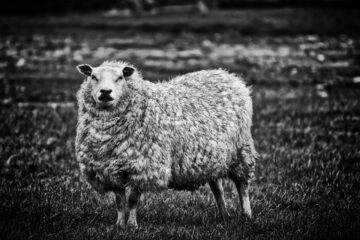
Humans agonize over the inevitability of death. Across a range of philosophical traditions, philosophers advise people to recognize that the present moment is the only time that really exists; the past is over, and the future has not yet come. Meditation on this fact can help us to respond in healthy ways to anxieties about the future and to fear of death in particular. At the same time, we treat non-human animals as if they are less deserving of consideration because we view them as living in a perpetual present. It is common for humans to justify their behavior toward animals by appeal to the claim that animals do not have a sense of past and future. In what follows, I’ll dive into arguments of this type, and I’ll sketch some general responses to them.
We kill non-human animals for all sorts of human purposes: for food, for sport, for research, when they engage in “unacceptable” behaviors or when we view members of their species as inherently “undesirable,” when we want their fur, when we view them to be nuisances, and so on. We kill animals for reasons for which no rational person would ever kill a human being. The evidence provided by our behavior as a species suggests that humans, as a group, do not view the lives of non-human animals as deserving of protection and defense. It is not only that we take non-human animal lives to be lower in comparative worth when compared to the lives of humans; it is also that we tend to treat the lives of many non-human animals as if they are not valuable at all. We feel strongly about our companion animals and grieve them when they die, but don’t extend that concern more broadly. Most people these days readily recognize non-human animals as sentient creatures. They recognize that such creatures can experience pleasure and pain. They may even believe that it is wrong to cause unnecessary suffering to a non-human animal. These same people often stop short of accepting the conclusion that it is wrong or even bad to kill a non-human animal. One potential explanation may be that we think whatever it is that makes death bad for a human being simply does not apply to the death of a non-human animal.
What explains this perception of difference? Anthropocentrism, or human bias, are related explanations. Are there other, more defensible accounts of difference? One proposal is that the lives of non-human animals are less valuable than human lives because non-human animals don’t have the same perception of time that humans do. To live human lives, we must set goals, make plans, and engage in practical reflection on events that will take place in the future as we imagine it to be. We are aware of the fact that if nothing terrible intervenes, we will go on living beyond this moment.
This appeal to differences in perception of time itself requires justification. One way to defend the intuition is by appeal to distinction between persons and non-persons; it may be the case that we have moral obligations to all and only persons. Many argue that for a being to exhibit personhood, they must have a sense of self. On some accounts, this sense involves the recognition of uniqueness and individuality, an ownership of one’s past, and the ability to anticipate the future as one’s own future. Memory views of identity frequently appeal to this psychological continuity to explain how personal identity can persist through time and change. Thwarting a person’s preferences for the future can be a way of doing them harm. If non-human animals do not reflect on their memories of past experiences, they don’t have the persistent sense of identity necessary for their deaths to be bad for them, or so the argument goes.
One of the most fundamental human desires is the desire to go on living. It is what some philosophers call a categorical desire, one on which all of our other desires are contingent. Death puts a stop to all of our future-related plans. Some schools of thought have maintained that we shouldn’t spend time agonizing about that fact. Not only is death not bad for non-human animals, it isn’t bad for persons either! Epicureans argue that the living should not agonize over death because, “when we are, death is not come, and when death is come, we are not.” Death is not bad for the person who dies because they are not around to experience it.
In response, Bernard Williams argues that death can be bad for the person who experiences it because their desires are frustrated. (Williams 1993) Most of the time we view death as a tragedy, especially when the death occurs earlier than we think it should. Part of the tragedy is that the whole suite of that person’s desires and preferences have been frustrated, including those that are most critical to their identity.
The most important point for our purposes is that many who have written on this topic seem to think that being aware that one is an entity with a future that is properly anticipated as one’s own is essential to incurring the kind of harm that Williams describes. I am harmed by being deprived of seeing my son achieve his goals only if I at some point understood that doing so could be part of my future. I am deprived because I lose out on what I wanted to happen to me.
This view has implications for how we view the kinds of harms that it is possible to do to non-human animals. Philosophers may agree that our current practices involved with industrial animal agriculture are wrong, but they disagree about why they are wrong. Through their behavior, non-human animals demonstrate a desire to avoid suffering—they wince and try to escape when pain is inflicted on them. Some argue that a preference to avoid suffering is as far as preferences go for non-human animals given their lack of a conception of their own futures. The claim seems to be that animals cannot have preferences related to their own futures if they are not aware that they have futures. As Peter Singer puts it in Practical Ethics, “beings that cannot see themselves as entities with a future do not have any preferences about their own future existence.” (Singer 2010) The do not have and will never have attitudes about their futures.
The most significant future-oriented event that an animal will encounter is their own death. If writers on this subject are correct in assuming that non-human animals do not have attitudes about their own futures, then they also do not have attitudes about their own deaths. Peter Singer has argued that, at least for some species, not even avoidance behavior is enough to justify our belief that non-human animals have future-oriented preferences to go on living. He says,
This is not to deny that such beings might struggle against a situation in which their lives are in danger, as a fish struggles to get free of the barbed hook in its mouth; but this indicates no more than a preference for the cessation of a state of affairs that causes pain or fear. The behavior of a fish on a hook suggests a reason for not killing fish by that method but does not in itself suggest a preference utilitarian reason against killing fish by a method that brings about death instantly, without first causing pain or distress. Struggles against danger and pain do not suggest that fish are capable of preferring their own future existence to non-existence. (Singer, Practical Ethics 2010).
I think that Peter Singer and others who make such arguments are wrong. Philosophers have seriously neglected discussions of animal minds and doing so is a weightier omission than we might realize. First, the claim that non-human animals can’t have persistent identity through time relies on impoverished accounts of what it means to have memories and other relevant mental states. It’s certainly the case that humans are capable of taking on reflective attitudes toward our own mental states that non-human animals cannot (as far as we know!). That said, it’s far from clear that it is reflective memory of this type that is required for the persistence of identity. Indeed, reflective identity would be a strange place to locate identity in the case of human beings now that we understand how many of our memories are confabulated! Once we’ve divorced ourselves from the importance of reflective memory and we focus on the kind of memory that may be required for training, recognition, habitual behaviors, and reactive responses to familiar stimuli, it seems obvious that non-human animals remember things. This seems sufficient for maintaining identity over time.
Suppose though that, if after one actually managed to convince philosophers that they ought to be more attentive to animal minds, the best arguments still supported the idea that reflective memory is crucial to retaining personal identity through time. Would this entail that, though animal suffering might be bad for an animal, their own death would not be?
Epicurus might be right in which case, since there is no subject to experience the badness and no time at which it can be bad for them, death is not bad for either the human or the non-human animal. Alternatively, the death of a human might be a comparative badness—the world in which they died was worse for them than a world in which they had gone on living. There’s no reason to think that the death of animals couldn’t be bad for the same reason. Another proposal is that death might be bad for a human because it deprives them of satisfying their desires. Whether death is bad for non-human animals for the same reason depends on how we think about desire. If desire is something we must reflectively reaffirm, then perhaps it is true that animals don’t have desires. Again, this strikes me as an absurdly restrictive account of what it is to have a desire. My desire to eat delicious meals is not (except, perhaps, as I write this) a desire I am inclined to perpetually reaffirm. Instead, it’s a disposition to behave. All things being equal, I’ll eat a delicious meal when given the option and I’m inclined to go on doing so. Death would get in the way of that inclination. There is no reason to think the same isn’t also true of non-human animals.
Finally, it’s strange that the sagest advice from the history of philosophy encourages us to live in the moment to avoid anxiety and fear of death. If it is the case that animals live perpetually in the moment, then, at least in that respect they may be psychologically healthier than the rest of us. The fact that they might not share the capacity to reflect on the passage of time doesn’t make their own deaths neutral for them, it just makes them less likely to experience anguish about death in the way that we do.
***
Enjoying the content on 3QD? Help keep us going by donating now.