
by Steve Szilagyi
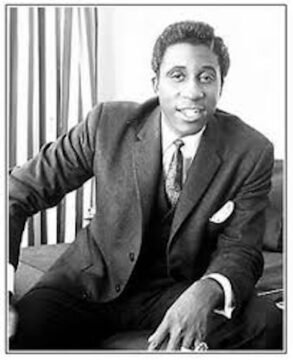
I’m someone who’ll finish a book once I’ve started it, even if I don’t like it very much. Yes, I’m superstitious. If a particular book falls into my hands, I suspect fate may have had some purpose in putting it there. When Steve Bergsman’s I Put a Spell on You: The Bizarre Life of Screamin’ Jay Hawkins popped up in my Amazon recommendations, I hesitated to swipe past it. Who knows but that this book was dropped into the algorithmic stream for the purpose of delivering me into some higher wisdom?
Deliver me it did not—or at least I didn’t give it the chance, setting the book aside halfway through. But Bergsman’s well-researched biography got me thinking about race, performance, and the peculiar moral economy of show business. Best of all, it revived dormant memories of a famous gal named Minnie—and I don’t mean the mouse.
Screamin’ Jay Hawkins was a rhythm-and-blues singer whose song “I Put a Spell on You” became a kind of underground hit in 1956. But what kept him famous was his outrageous stage show. In its heyday, Hawkins would jump out of a closed coffin, dressed in what he called a “cannibal” outfit, complete with loincloth, war paint, and a plastic bone through his nose. He stalked the stage with a skull on a stick, with a cigarette stuck in its mouth.
As an artist, he seemed to have little constituency among his own race but was patronized—first by promoters, and later by white hipsters, who went to his concerts, put him in movies, and declared “I Put a Spell on You” one of “The 500 Songs That Shaped Rock and Roll” (Rolling Stone). Hawkins’ career sat squarely on a discomfiting seam in twentieth-century popular music, where it is hard to separate elevation from exploitation in a business that soils nearly everyone who enters it.
Long ago, I recall reading that Hawkins had a fine baritone voice and that his real dream was to become a crooner like Tony Bennett. When I saw Bergsman’s book, I thought it might be the story of a sensitive, complex figure like Bert Williams, the black Ziegfeld Follies star who won fame and riches performing in minstrel-show makeup—a performer described by W. C. Fields as “the funniest man I ever saw—and the saddest man I ever met.”
I was also hoping the book might clarify my ambivalence about “I Put a Spell on You” itself. I appreciate records and artists from deep in the 1950s R&B catalogue, but find “Spell” hard to listen to all the way through. By all accounts, it was recorded late at night, when the singer and band were falling-down drunk. Hawkins did the vocal lying on his back, howling into the microphone.
Demented, erotic, and banned. The song, written by Hawkins himself, was released in 1956 and had the great good fortune to be banned by some radio stations for sounding “demented,” “cannibalistic,” or “erotic.”
That was enough to make it a must-have for transgression-hungry teenagers and sufficient to win the singer-composer a paycheck for the rest of his life. Hawkins’ voice was a powerful—sometimes alarming—instrument. Unfortunately it came attached to a personality that even sympathetic biographers describe as dissolute, narcissistic, and frequently violent. He is said to have fathered thirty-three children and served jail time for failing to support them.
He was not, like one of his mentors, Tiny Grimes, an underestimated talent. In an age crowded with extraordinary black recording artists, Hawkins barely ranks. If he truly wanted to become the smooth crooner he reportedly aspired to be, he had many opportunities both before and after the fame that came with “Spell.” He recorded songs like “I Love Paris,” “Old Man River,” “People Will Say We’re in Love,” and “Over the Rainbow”—some backed with beautiful orchestration. But the man could not restrain his idiosyncrasies, and time and again the crazy breaks through, either in the vocals or arrangement, turning the standards into novelty numbers.
As Bergsman makes clear, Hawkins was both charming and destructive. He could win friends easily but burned through agents, promoters, and even friends with equal speed. Women were treated little better.
Rapturous white faces. And yet, over the course of his career, he managed to squeeze every drop of fame, money, and juju he could out of “I Put a Spell on You.” In the forty-four years between the release of the song and Hawkins’ death, he appeared on major network television in the United States and Europe, played the Olympia in Paris and other large concert halls worldwide. On YouTube you can see him in 1984, mechanically going through his schtick before a sea of rapturous white faces in a German theater, singing a tedious blues badly—backed by what appears to be a mix of outstanding local musicians and his own sax player.
Twenty-eight years earlier, this outfit got him cut out of the movie Rock Around the Clock—a nobly integrated Alan Freed production mixing black and white stars of early rock ’n’ roll. “The movie people claimed it would be an insult to the black people of the United States,” Hawkins complained. “The NAACP came after me and said, ‘Do you know what you are doing to your own race?’ I said, ‘You take your own race and you know where you can stick ’em. I’m trying to make a living. Will you get outta here and leave me alone?’ Sammy Davis wrote me a letter saying give $500 and join the NAACP. I said show me one thing they’ve done for black people and I will join. I never heard from either one again.”
Although some accounts say Hawkins’ nickname was forced upon him, Bergsman makes it clear that the singer gave himself the moniker early in his career. Fellow wild-man rocker Jerry Lee Lewis toured with Hawkins in the 1950s and considered him a friend, but not a musical competitor. Lewis said Hawkins was “vaudeville”—the very place where, many years earlier, we find W. C. Fields observing the sadness of Bert Williams.
Outstanding musicians. Biographer Bergsman’s interest lies mostly in the wild side of Hawkins’ life rather than the music. But he goes into some detail about the recording session that resulted in “Spell” and notes that Hawkins always worked with outstanding musicians. For instance, the session included drummer “Panama” Francis and saxophonist Sam “The Man” Taylor, who once played for Cab Calloway…
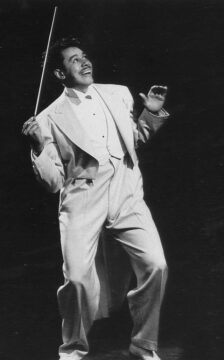
Of course. Cab Calloway. Another singer who had a smash-hit novelty song and always worked with the best musicians. The mere mention of his name was like a wormhole to another, more hopeful universe. What interested me was not simply that both men were linked to novelty songs, but that one used novelty as an opening into a larger artistic life while the other let novelty become a trap.
Setting aside Bergsman’s book on Screamin’ Jay, I went to the library and found Alyn Shipton’s 2010 biography Hi-De-Ho: The Life of Cab Calloway. As Shipton shows, the career of Cabell “Cab” Calloway III (1907–1994) revolved around “Minnie the Moocher” no less than Hawkins’ did around “Spell”. Released in 1930, “Minnie” was the first record by a black artist to sell a million copies. But that big hit never overshadowed Calloway’s greater talents.
Land of paradox. Unlike Hawkins—who grew up amid poverty and dysfunction—Calloway’s parents were college-educated and hoped he would become a lawyer. Instead he followed his sister Blanche, an accomplished singer and bandleader, into show business. Gifted with enormous charisma and chutzpah, Calloway became a bandleader and master of ceremonies, eventually presiding over Harlem’s Cotton Club in the early 1930s.
The Cotton Club was a land of paradox: high society mingling with gangsters, black performers entertaining all-white audiences under the protection of organized crime. In many respects Calloway’s life was as bizarre as Hawkins’. He came up among gangsters, hootch, and vice – and openly celebrated marijuana and cocaine in songs like “Minnie,” “The Viper Song” and “Reefer Man.”
Amazingly, Calloway’s career did not follow the familiar arc of jazz excess—ecstasy followed by collapse—that claimed so many other musicians. Calloway survived and grew artistically. Audiences always demanded “Minnie the Moocher” with its “Hi-De-Ho” call-and-response. But the singers’ extraordinary talent and work ethic made “Minnie” a song that opened doors and welcomed listeners into his world.
Calloway recorded hundreds of songs over the decades, and serious jazz buffs respect his bands and musical chops. His electrifying performances in films like Stormy Weather still leap off the screen. He was a beloved figure in both the black and white communities. Today there is a Cab Calloway School of the Arts in Wilmington, Delaware, and a museum devoted to him at Baltimore’s Coppin State University.
His musical contributions—beginning with his 1930 recording of “St. Louis Blues” (for my money the most frantic hot-jazz side ever waxed)—extended through the big-band era and into the small-combo days of the 1950s. He recorded plenty of good-natured novelty numbers and even turned himself into a zoot-suit caricature in the early 1940s. But musically he continued the American tradition of melding cultures, especially when he broke into cantorial melisma in the midst of one of his exhilarating scat cascades. His version of Harold Arlen’s “Blues in the Night” is definitive and might well have become his signature song, if not for “Minnie.”
His last film appearance was in the 1984 film The Blues Brothers—a comedy “tribute” to great black soul singers. Calloway rises above the confused proceedings with his usual majesty, as you would expect from a man who could sing “Za Zuh Zazz” with dignity and aplomb.
Camp and irony. There is a full-length documentary Screaming Jay, I Put a Spell on Me. He made at least five appearances in major motion pictures, most notably in director and fellow Clevelander Jim Jarmusch’s Mystery Train. Some see him as the precursor of “shock rock” stars like Alice Cooper, Ozzy Osbourne, and even trends like death metal. Similarly, his counterpart Cab Calloway is sometimes honored as a precursor to stars like Michael Jackson and Prince.
Unlike Jackson and Prince, however—and despite his early associations with drugs and gangsters—Calloway did not wind up dead from an overdose. He was a survivor who kept working right up until his final days. In that respect he and Screamin’ Jay were alike: Hawkins died of an aneurysm while on tour in France in 2000.
When I saw Calloway at an intimate concert at New York City’s Town Hall in 1972, he wore an ordinary tan suit and tie. As a fan of his recordings from the 1930s, I was expecting a wild evening. But middle-aged Calloway had other things in mind. Most of the show consisted of standards like “In Other Words (Fly Me to the Moon)”—and Calloway killed it. The man was the great crooner that Hawkins had only dreamed of being. Of course, he finished with “Minnie the Moocher”—almost apologetically, as if to say, “you know I have to do this.”
Enjoying the content on 3QD? Help keep us going by donating now.