
by Jeroen Bouterse
 In his Confessions, Augustine remembers his state after the death of a beloved childhood friend. He writes: “Everywhere I looked I saw death. […] My eyes sought him everywhere, and did not see him. I hated all places because he was not in them.” An unfailingly moving passage, and a testament to Augustine’s power as a thinker – for profound as his account of his loss is, we are already being led along for a much bigger point. Almost immediately, Augustine moves on to chastise his former self: “fool that I was then, enduring with so much rebellion the lot of every man”. A soul that tethers itself to mortal things, rather than lifting itself up to God, will naturally be bloodied when it inevitably loses them.
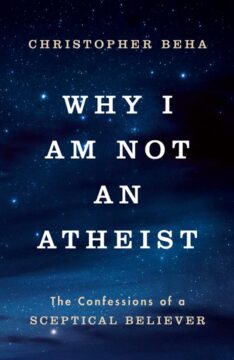
I was brought back to these passages by the parallels with Christopher Beha’s account in Why I am not an atheist (2026). Beha is modest enough to suggest less exalted models, but of course he is aware of the echo of Augustine. It’s not just that this is another account of an intellectual who returns to the Catholic faith. Beha also shares with the Church father the admirable skill of rendering now-abandoned perspectives with a language that makes their original pull understandable. Here he looks back on his thoughts after nearly losing a friend:
“I still had so much to lose, and I would eventually lose all of it. Everyone I loved would be taken from me, unless I was taken from them first.”
Like Augustine, Beha finds powerful and honest words for a state of mind he used to inhabit, but makes sure these words contain the seeds of self-criticism too. At this point in the narrative, Beha’s meditations on suffering and death push him away from religion; after a book-long journey through godless alternatives, however, he will find a less self-absorbed form of love, one presumably more resilient to the thoughts that dislodged him from his faith.
Scientific materialism
We spend most of the book conversing with two versions of an atheist worldview. The first is a materialist one, which tends to see atheism as the commonsense secular beliefs and attitudes that remain when religious nonsense and superstition are eradicated by the emancipating power of science. This is the atheism of Bertrand Russell’s Why I am not a Christian, the book that triggered Beha to stop taking Communion in the first place. Beha takes us through the philosophical traditions of Lockean empiricism and Humean skepticism to arrive at the nineteenth-century freethinkers that would inform Russell’s intellectual and moral critique of religion.
Tracing the history of this worldview shows that it is “one worldview among many”, not an inevitable or natural remainder. This remains a point worth making; and to his credit, Beha does not leave it there either – “showing a worldview to be a worldview is not itself an argument against it”. Beha examines its limitations. The ‘hard problem’ that sticks for him, is that of consciousness. While materialists such as Daniel Dennett see Darwinism as a universal acid that eats through every attempt to contain it, Beha agues that it fails to penetrate the notion of mind, founded in the indubitable existence of subjective experiences. Mind turns out to be “its own kind of ‘universal acid’”. If there can be no physicalist explanation of subjective mental experiences, then the project of physicalism falls apart. “If we acknowledge that reality surpasses our comprehension […] then we are back to mystery”.
I think Beha overplays his hand here. This is not the place to settle the entire argument – if I had a paragraph-long solution to the hard problem of consciousness, I would not be hiding it in a book review – but I do want to point out that Beha’s version ties materialism rather strongly to scientific epistemologies, which in their insistence on publicly available sense perception tend to discard introspection and suppress the reality of mental experience. Historically, materialism pre-dates such norms; for instance, most Hellenistic philosophers taught that everything is somehow configured from stuff, without making an exception for the human soul (or even for the divine).[1] How its operations were accompanied by experiences was not a live philosophical issue. This does not prove any metaphysical point, but it does falsify the suggestion that the experience of being a subject will naturally be central to your metaphysical project unless you are an overexcited positivist.
Even post-Descartes, not every science-beholden worldview allows the same purchase to the hard problem of consciousness. Thomas Henry Huxley, whom Beha briefly mentions as the first self-styled agnostic, was about as optimistic as one could be about the project of reducing mental activity to brain processes; but even he saw no reason to commit to a definite answer to the question of “how many x” – how many kinds of substances – there were in the world.[2] That doesn’t need to be the last word; but it should lead us to wonder whether there is a single place where ‘the scientific-materialist edifice’ cracks. Or whether there is even an edifice to crack; I sometimes got the sense of someone bringing a wedge to a forest. Beha himself has ably guided us through a rich tradition of empiricists and freethinkers, no two of which entertained the same metaphysical position, and all of whom would respond differently to the question of consciousness.
Life in the antithesis
In any case, this is where Beha’s argument leads us next. ‘The’ materialist form of atheism is untenable to anyone who takes themselves seriously as a subject; “we are left to choose between materialism and freedom”. The second half of Beha’s book examines freedom, engaging with the non-materialist, romantic idealist atheist tradition. He traces its roots in Spinoza’s Ethics, Rousseau and then in different responses to Kant. Especially in his discussion of Schopenhauer, the central tension of Beha’s book really comes together: Schopenhauer draws attention to the self – as subject – as not something that knows the world, but that wills things. It leads to a bifurcated picture of the world, and both sides look bleak. “Seen as will, the world is a kind of thoughtless, meaningless pulsing. Seen as representation, meanwhile, it is an endless parade of suffering.” The only way out of this is through renunciation.
Still looking for a way to live as an atheist at this point in the narrative, Beha finds that Schopenhauer’s pessimism resonates much more strongly with him than the scientific materialist, Bertrand Russell-version of atheism. “Everything about Schopenhauer’s work seems designed to appeal to an artistically inclined depressive”. In a personal interlude, he has already sketched the kind of life he is living around the time he reads the idealists, having thrown himself into a hubristic attempt to defy death by creating the perfect novel. “I was living near my family surrounded by people who loved me, but their love felt like a trap meant to distract me from this work.” Again, Beha has the Augustinian gift of painting his past life with a brush that highlights both its attraction – seen on its own, romantic terms – and its self-destructiveness.
Following the threads further from Schopenhauer, Beha covers Nietzsche’s life-affirming rather than life-negating version of a non-materialist atheist world-view. From Nietzsche, we learn the meta-point that even if our whole life is in some sense a work of art, or an experiment, we need to inhabit the worldviews we are ‘testing’ seriously – “your evidence will be of no weight”, he quotes Nietzsche, “until you have lived for years on end without Christianity, with an honest, fervent zeal to endure life in the antithesis of Christianity: until you have wandered far, far away from it.”
Nietzsche functions as a wake-up call to the scientific materialists, who think they can just subtract God from the world and otherwise carry on as normal. Though Beha is too kind to say it out loud, theirs is painted as the ‘unexamined life’-version of atheism; the one that looks away from the abyss. The real atheistic experiment is that of Schopenhauer and Nietzsche.
Its problem is that it makes you very, very lonely. All the work that the scientific materialist tradition outsourced to objective reality now remains to be done by the saintly, heroic, or artistic individual – “truth must be ‘proved’ through action”; and at the same time, that individual needs to operate in the understanding that their own creations will never be more than that. Beha has experienced the magnitude of that task, and has come to despair of it. “Most of us, it seems, don’t just want values; we want our values to be ‘real.’” Constructing your own worldview is “incredibly isolating”. Look around you, Beha says; we live in a world where this kind of self-creation is what is being asked of all of us – it is what social media are all about. And how are we doing? We are anxious, we are miserable, we are failing.
Against the dark
We are, in short, ready to be saved; in need of infinite help. In the dialectic of the book: we have tried find an anchor in the world (in the objective truths of scientific materialism), we have tried to carry the load ourselves (in the ideal of authenticity developed by romantic idealism); and the lesson is that neither is enough. “For meaning we need someone else.” We need to start neither from truth, nor from will, but from love.
This is not exactly a synthesis of the first two; just like Augustine, Beha’s intellectual search does not lead to a satisfying conclusion merely by its own internal logic. In the last chapter, he is still stuck drinking too much and reading Romanian existentialists while living with two younger roommates; “one of those transitional phases that don’t transition into anything, eventually just becoming your life”. Yes, it is starting to dawn on him that it can’t go on like this, and he makes half-hearted attempts to change that inevitably fail – the equivalent of Augustine’s “chastity but not yet”.
The crucial intervention is not another reading assignment, but being introduced to someone who becomes his life partner. She opens Beha’s eyes to the possibility of happiness. His return to Christian church services, and later to Communion, follows almost as a matter of course. He starts reading Christian mystics, and realizes that God is love and that rather than asking too many questions, he should try to serve. In brief, he becomes a Roman Catholic.
We have spent more than twenty chapters outside of the Church; Beha converts back only at the very end of the book, leaving me with many questions. Fair enough: his book is not called ‘Why I am a Catholic’ but ‘Why I am not an atheist’. It is not a work of apologetics but of self-reflection. Even in the little space he devotes to it, Beha anticipates several of the main objections an outsider might throw at him; they are the same ones he has lived with for decades, and he is happy to tell us how he feels about them now. He has not suddenly forgotten what it was like to be that person.
My primary responses reading Beha’s book were of sympathy with his struggles, admiration for the breadth and depth of his reading and his eloquence, and respect for his honesty about himself and his charitable reading of thinkers he disagrees with. His book does not lose these virtues just because he takes a few turns at the end that I can’t make sense of. Nevertheless, the quick connection Beha draws between love and God is both problematic and ill-prepared. Beha’s narrative contains some hints as to what a secular synthesis might have looked like, but he does not pursue them. For one, we have seen Schopenhauer say that a true understanding of the suffering of life will lead to sympathy towards all sufferers. This is at the same time the high point of Beha’s discussion of the romantic tradition, and a curious loose end in his search for an atheistic life.
The task Schopenhauer put on the saintly individual is one that we could at least try to shoulder together with others. Let me quote a passage from Richard Rorty:
“To accept the contingency of starting-points is to accept our inheritance from, and our conversation with, our fellow-humans as our only source of guidance. To attempt to evade this contingency is to hope to become a properly-programmed machine. […] If we give up this hope, we shall lose what Nietzsche called ‘metaphysical comfort’, but we may gain a renewed sense of community. Our identification with our community – our society, our political tradition, our intellectual heritage – is heightened when we see this community as ours rather than as nature’s, shaped rather than found, one among many which men have made. In the end, the pragmatists tell us, wat matters is our loyalty to other human beings clinging together against the dark, not our hope of getting things right.”[3]
Loyalty to other human beings clinging together against the dark is one of the strongest images of the proper attitude to the human predicament for me, and I wonder how Beha would relate to it. When he asks himself a similar question – “why not just stick with love?” (without the rest of his religion) – he claims that he tried that, and that it didn’t work for him. But over a good twenty chapters, we have not in fact seen him try this; by his own account, he was far too busy locking himself up in his room, reading romantics and producing artful writing.
What a good world needs
In spite of his thorough reading, I still believe Beha has discarded the enlightened tradition too easily, reading it mainly for its epistemology and its rational, objectifying view of the natural world, and not for its profound ethical innovations. What I see when I read enlightened ethicists is not cold reductionism, but secular agape. Sometimes the source material is almost screaming this out: when Mill says that the happiness anyone should strive for is not “the agent’s own happiness, but that of all concerned”,[4] Beha notices (as does Mill himself) that this resembles “the impossible mandate that Jesus laid upon his followers”.
He could have followed that thread further. The ethicist Derek Parfit dedicated his life, not to the creation of a perfect work of art, but quite literally to the question of What Matters. I feel connected to Parfit when on an otherwise cheerful and vibrant day, I find myself weeping over lives I don’t know destroyed in current or past wars.[5] Peter Singer and other secular philosophers have made the argument for extending our compassion to non-human animals. Based on their arguments and examples, I strive to live my life demonstrating that we do not have to kill or harm sentient beings to thrive. The Effective Altruism movement, for its flaws, has at its core the belief that charity is not about the person giving it but about the person receiving it. It is the opposite of romantic, clear-eyed about the reality of other people.
These too are attempts to live lives; to shape worldviews and prove their truth through action. They don’t require atheism and I don’t mean to claim their virtues solely on its behalf – their cultural histories are intertwined with religious concepts, too. However, they are secular, and they gain more urgency in a world with no hope for outside redemption. They are everything but solipsistic. This is my biggest frustration with Beha’s search: did he consider this? Weren’t worldviews like these worth at least trying to inhabit? Did it have to be either the aesthetic project of the post-moral Nietzschean superman or back to “the virgin birth, and the Resurrection of the body, and the transubstantiation of the Eucharist, and the existence of hell”?
In that enumeration – Beha’s own, somewhat bashful enumeration – hell should stand out. It is not just a silly superstition, but an evil idea – a moral acid that disfigures whatever edifice purports to require it. Bertrand Russell said understatedly but correctly that Jesus’ reported tendency to threaten hell to his opponents indicated a very serious defect in his moral character. There is an almost deceptive simplicity to Russell’s ethical rejection of Christianity, and to the alternative morality he holds up against it; “a good world needs knowledge, kindliness, and courage.” It moved me when re-reading it, and for myself, it reinforced that this is the kind of community I aspire to. Especially if it is one worldview among many.
***
[1] Peter Brown, Augustine of Hippo: a biography (1967) ch8 ‘Ambrose’.
[2] Cyril Bibby, Scientist extraordinary: the life and scientific work of Thomas Henry Huxley, 1825-1895 (1972) 108.
[3] Richard Rorty, ‘Pragmatism, relativism, and irrationalism’ (1979).
[4] John Stuart Mill, Utilitarianism (1861) ch2.
[5] David Edmonds, Parfit (2023) ch21.