
From Jonathan Bate’s Literary Remains:
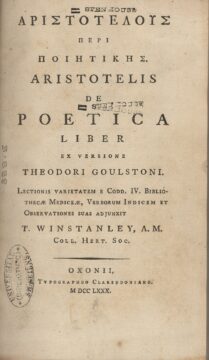 One of the most consequential misunderstandings in the history of literary criticism turns on a single Greek word. In Aristotle’s Poetics, that word is hamartia. It is usually rendered, in classrooms and handbooks, as “tragic flaw,” and on that translation an entire tradition of reading tragedy has been erected. Yet if we return to Aristotle’s Greek and trace the word’s history with some philological care, it becomes clear that this familiar formula rests on a slow but decisive mistranslation—less an error at a single moment than a long cultural drift in which a term meaning “mistake” gradually hardened into a doctrine of moral defect.
In classical Greek, hamartia belongs to the language of action rather than character. Its root sense is concrete and kinetic: to miss one’s mark, as an archer misses the target. By extension, it denotes an error, a misjudgment, a false step—often one made in ignorance of some crucial fact. Aristotle uses the term this way throughout his works, ethical and otherwise.
More here.
Enjoying the content on 3QD? Help keep us going by donating now.