
by Charles Siegel
Last week, on Presidents’ Day, President Trump lost in court. This is hardly news. The administration has already lost hundreds of cases in just a little over a year. And this isn’t the first time it has lost on a day when courts aren’t even open.
The ruling came in a case officially entitled City of Philadelphia v. Burgum. Of the many, many cases the administration has lost, this is not remotely the most important. The day before I submitted this column, for example, the Supreme Court ruled against Trump in the tariffs case. (Trump, naturally, immediately called the justices who ruled against him — including three of the six conservatives on the court, two of whom he had appointed and all of whom had given him wide and unprecedented immunity — “fools and lapdogs” and an “embarrassment to their families.”) And just the day before that, a federal judge in West Virginia granted a habeas corpus petition filed by an ICE detainee. He began his opinion as follows:
Antiseptic judicial rhetoric cannot do justice to what is happening. Across the interior of the United States, agents of the federal government—masked, anonymous, armed with military weapons, operating from unmarked vehicles, acting without warrants of any kind—are seizing persons for civil immigration violations and imprisoning them without any semblance of due process. The systematic character of this practice and its deliberate elimination of every structural feature that distinguishes constitutional authority from raw force place it beyond the reach of ordinary legal description. It is an assault on the constitutional order. It is what the Fourth Amendment was written to prevent. It is what the Due Process Clause of the Fifth Amendment forbids.
In our constitutional republic, governmental force derives its authority from the Constitution. But that authority is not unlimited. The Government’s power is legitimate only because it is derived from the People and exercised through law by identifiable public officers answerable to the public and to the courts. The structure of the Constitution guarantees visibility. Both the officer and the force he employs are traceable to authority delegated by the People and subject to the limits imposed by law. When the Government uses force against the public, the citizen can recognize the officer as a lawful representative. The public can evaluate the act. The judiciary can later review it. Every stop, arrest, detention, and use of force can be tested against the Constitution’s protections. Not so here.
For these reasons and the reasons that follow, Petitioner’s Amended Verified Petition for Writ of Habeas Corpus is GRANTED. The court FINDS that both his Fourth Amendment right to be free from unreasonable searches and seizures as well as his Fifth Amendment right to due process have been violated. Immediate release is the only relief sufficient to remedy Petitioner’s unlawful detention.
This judicial fury is increasingly common.
The administration loses seemingly every day in court now. But the Presidents’ Day ruling, while not as immediately consequential as rulings in other cases, does nicely encapsulate a lot of things: the viciousness, and at the same time the smallness, of Trump’s actions; the continuing pitched resistance to them; and the resilience and indignation of the judiciary, including that of many conservative federal judges appointed by Republican presidents.
City of Philadelphia v. Burgum concerns the President’s House, which as the court described it is “a component of Independence National Historic Park that commemorates the site of the first official presidential residence and the people who lived there, including people enslaved by President George Washington.” The Park was established “for the purpose of preserving for the benefit of the American people as a national historic park certain historical structures and properties of outstanding national significance located in Philadelphia…associated with the American Revolution and the founding and growth of the United States.” It includes such well-known sites as the Liberty Bell Center and Independence Hall.
The President’s House site is at Sixth and Market Streets. In the 1790s, before construction of the White House was completed, Presidents Washington and Adams lived there. The court described recent historical research as follows:
At the turn of this century, historians identified the location of the first official residence of the President of the United States, where Presidents Washington and Adams lived during their terms. This historical research also identified information about nine enslaved Africans whom President Washington owned, brought to the official presidential residence, and rotated in and out of Pennsylvania, a practice which prevented enslaved individuals from petitioning for their freedom under Pennsylvania law. Etched into a wall within the President’s House exhibit are the names of those nine enslaved individuals: Oney Judge, Austin, Christopher Sheels, Giles, Hercules Posey, Joe Richardson, Moll, Paris, and Richmond. Of those nine, Oney Judge escaped the house in 1796, eventually making her way to New Hampshire. Hercules also eventually escaped his enslavement after he was brought to Mount Vernon.
This research led the House of Representatives, in 2003, to urge the National Park Service to “appropriately commemorate the concerns raised regarding the recognition of the existence of the [residence] and the slaves who worked in it during the first years of our democracy.” It is worth noting that Republicans controlled the House (and the Senate and the presidency) in 2003.
In the same year, a new pavilion for the Liberty Bell exhibits opened adjacent to the eventual site of the President’s House. This juxtaposition motivated the City, which jointly administers the President’s House with the National Park Service, to “collaborate with the Service to tell a ‘fuller story’ because ‘it was finally time to tell an honest story about American history and the founding of this country and the role that slavery and enslaved Africans had…as well as the free [African American] Philadelphians.’”
The court went on to describe the planning and budgeting process that took the next several years. Finally, in 2017, while Trump was president, the Park Service issued a “Foundation Document” for Independence National Historical Park, setting out “basic guidance for the Park,” including “its purpose, its reason for inclusion in the national park system, its significance, and its fundamental values and resources….” The document noted “ the paradox of the Washingtons bringing their enslaved people to work and live there,” and described this paradox as “crucially significant” to the Park as a whole. It further detailed “interpretive themes” for the park, including “Liberty: The Promises and Paradoxes,” explaining this paradox as follows: “not only are they ideals to strive for but they are unfulfilled promises for people who struggle to be fully included as citizens of our nation.”
Donald Trump is an incredibly busy man. In his second term, he has, so he says, ended eight wars. He has reduced prices by “300, 400, even 500%,” which is especially impressive since nothing can be reduced by more than 100%. He has renamed and then closed the Kennedy Center, destroyed a big chunk of the White House, and imposed tariffs on most of the countries on earth (even on the Heard and McDonald Islands, whose only inhabitants are penguins, who must be celebrating Friday’s Supreme Court ruling).
Somehow, though, in the midst of all this, he found time to issue Executive Order 14253, on March 27, 2025. The order states that “over the past decade, Americans have witnessed a concerted and widespread effort to rewrite our Nation’s history, replacing objective facts with a distorted narrative driven by ideology rather than truth. This revisionist movement seeks to undermine the remarkable achievements of the United States by casting its founding principles and historical milestones in a negative light.” It goes on to declare “the policy of my Administration to restore Federal sites dedicated to history, including parks and museums, to solemn and uplifting public monuments that remind Americans of our extraordinary heritage, consistent progress toward becoming a more perfect Union, and unmatched record of advancing liberty, prosperity, and human flourishing. Museums in our Nation’s capital should be places where individuals go to learn—not to be subjected to ideological indoctrination or divisive narratives that distort our shared history.” Accordingly, the Secretary of the Interior is to ensure that “all public monuments, memorials, statues, markers, or similar properties within the Department of the Interior’s jurisdiction do not contain descriptions, depictions, or other content that inappropriately disparage Americans past or living (including persons living in colonial times), and instead focus on the greatness of the achievements and progress of the American people or, with respect to natural features, the beauty, abundance, and grandeur of the American landscape.”
What does this mean? What can it possibly mean that a monument should not “inappropriately disparage Americans past or living”? What would Trump accept as appropriate disparagement?
In the immediate aftermath of the order, most attention focused on major, longstanding institutions such as the Smithsonian Museum, and on historical displays in national parks. Then in January, the Park Service “removed 34 educational panels from the President’s House that referenced slavery, and further, deactivated video presentations that accompany these educational panels.” The city filed suit the next day, seeking an injunction requiring the government to restore the exhibits in their entirety.
Up until this point I have been referring to “the court.” But “the court” is actually Judge Cynthia Rufe, a 77-year old senior judge in the Eastern District of Pennsylvania. She was nominated to the federal bench by George W. Bush. This nomination came after she was recommended by the state’s two Republican senators at the time, Arlen Specter and Rick Santorum. Yes, the Rick Santorum who advocated teaching “intelligent design” in science class and said “radical feminism” had made it “socially affirming to work outside the home.” Any judge acceptable to Rick Santorum is hardly a liberal squish. Judge Rufe was a state court judge for eight years, and has been on the federal bench for 24 years now.
Judge Rufe granted the City’s request for a temporary injunction. Her 40-page opinion is a meticulous rejection of the government’s various technical arguments about standing and jurisdiction. And her ultimate conclusion – that a temporary injunction is warranted because the City is likely to succeed on the merits of its claims — is itself based on technical rulings. These include a holding that the Park Service’s actions were “arbitrary and capricious” and “ultra vires,” or unauthorized by any law. But in a few extraordinary passages, Judge Rufe excoriated the government for its attempt to whitewash history. These are worth quoting at some length:
The government shrugs off NPS’s action as within its power and discretion, but that action violates the expressed intention of the same EO the government claims motivated it. EO 14253 seeks to prevent revisionist attempts to “replace[ ] objective facts with a distorted narrative.” NPS’s action did the opposite, by dismantling objective historical truths.
It is not disputed that President Washington owned slaves…. Some escaped to freedom, including Oney Judge. The President’s House displays recognized Oney Judge and focused on how her struggle for freedom represented this country’s progress away from the horrors of slavery and into an era where the founding ideals of “Life, Liberty and the pursuit of Happiness” could be embodied for every American.
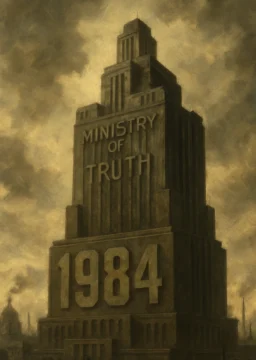
And yet, in its argument, the government claims it alone has the power to erase, alter, remove and hide historical accounts on taxpayer and local government-funded monuments within its control. Its claims in this regard echo Big Brother’s domain in Orwell’s 1984, where:
The largest section of the [government’s] Records Department … consisted simply of persons whose duty it was to track down and collect all copies of books, newspapers, and other documents which had been superseded and were due for destruction. A number of the Times [a newspaper] which might, because of changes in political alignment, or mistaken prophesies uttered by Big Brother, have been rewritten a dozen times still stood on the files bearing its original date, and no other copy existed to contradict it. Books, also, were recalled and rewritten again and again, and were invariably reissued without any admission that any alteration had been made.
The government here likewise asserts truth is no longer self-evident, but rather the property of the elected chief magistrate and his appointees and delegees, at his whim to be scraped clean, hidden, or overwritten. And why? Solely because, as Defendants state, it has the power.
An agency, whether the Department of the Interior, NPS, or any other agency, cannot arbitrarily decide what is true, based on its own whims or the whims of the new leadership, regardless of the evidence before it. Accordingly, the City is likely to prevail on its claims that the removal was arbitrary and capricious….
The City argues that it will incur various forms of irreparable harm if the displays are not restored and safeguarded. Among the harms the City alleges are a loss of access to historical truth, an undermining of the public trust, and an inability to recount its own story in preparation for the semiquincentennial.
The harm at issue in this case must account for the significance of the slavery-related displays that NPS removed. As the federal government itself recognized, “the President’s House and its history is important and meaningful to many people for many reasons.” The President’s House has resulted from years of advocacy, engagement by the public, and cooperation between the City and the government. As the City argues, the removal of interpretive displays and exhibits “constitutes erasure, undermines public trust, and compromises the integrity of public memory.”…
The removed displays were not mere decorations to be taken down and redisplayed; rather, they were a memorial to “men, women, and children of African descent who lived, worked, and died as enslaved people in the United States of America,” a tribute to their struggle for freedom, and an enduring reminder of the inherent contradictions emanating from this country’s founding. Each person who visits the President’s House and does not learn of the realities of founding-era slavery receives a false account of this country’s history.
It is greatly reassuring when judges, especially conservative ones, speak plainly and forcefully like this. Judge Rufe actually began her opinion with another quote from 1984: “All history was a palimpsest, scraped clean and reinscribed exactly as often as was necessary. In no case would it have been possible, once the deed was done, to prove that any falsification had taken place.” She then stated the issue before her, and her decision: “As if the Ministry of Truth in George Orwell’s 1984 now existed, with its motto ‘Ignorance is Strength,’ this Court is now asked to determine whether the federal government has the power it claims — to dissemble and disassemble historical truths, when it has some domain over historical facts. It does not.”
The day after Judge Rufe issued her ruling, the Ministry of Truth appealed.